

Top ERP Software Companies in Dubai: Navigating the Best Enterprise Solutions in 2026
The Evolving ERP Landscape in Dubai: Why 2026 is a Turning Point
As we navigate through 2026, Dubai has firmly established itself as the epicenter of global digital transformation. Guided by the ambitious Dubai Economic Agenda (D33) and the UAE’s broader Vision 2031, businesses in the region are no longer just looking for digital tools; they are seeking comprehensive "intelligence engines" that can drive hyper-efficiency. In this high-stakes environment, identifying the top ERP software companies in Dubai is a critical strategic move for any enterprise aiming to remain competitive. The current market is characterized by a shift from legacy, monolithic systems toward modular, AI-driven, and cloud-native Enterprise Resource Planning (ERP) solutions that can adapt to the rapid fluctuations of the Middle Eastern market.
For organizations operating in Dubai—from the bustling trade hubs of JAFZA to the tech-centric corridors of Dubai Internet City—the requirements for ERP software have become increasingly complex. It is no longer sufficient to have a basic accounting module or a simple inventory tracker. In 2026, the standard for excellence includes seamless VAT compliance (Federal Tax Authority - FTA), multi-currency capabilities for international trade, real-time analytics powered by machine learning, and robust cybersecurity frameworks that align with the UAE’s stringent data protection laws. The demand for localized support and culturally nuanced user interfaces has also led to the rise of regional leaders who understand the specific regulatory and operational nuances of the GCC (Gulf Cooperation Council).
Mysoft Heaven (BD) Ltd. has emerged as a formidable player in this landscape, providing tailored solutions that bridge the gap between global technological standards and local operational requirements. By focusing on scalability and user-centric design, their flagship product, Sheba ERP, has set a new benchmark for what modern businesses should expect. As a Senior Content Strategist, I have analyzed the current market dynamics, technological shifts, and vendor performance to provide this definitive guide. We will explore the technical architectures that define today’s leaders, the implementation strategies that ensure high ROI, and a curated list of the top performers in the Dubai ERP sector.
In the following sections, we will delve into a data-driven comparison of the market leaders. Whether you are a small-to-medium enterprise (SME) looking for your first integrated management system or a large corporation seeking to migrate from a legacy environment to a more agile cloud infrastructure, this analysis provides the technical depth and industry context necessary to make an informed decision. The stakes are high: the right ERP partner can reduce operational costs by up to 30%, while a poor choice can lead to significant downtime and resource drain.
Top 10 ERP Software Companies in Dubai (2026 Comparison)
The following table provides a snapshot of the leading ERP providers in Dubai, ranked based on technical robustness, local market authority, deployment flexibility, and specific industry strengths.
| Rank | Company/Product Name | Key Strength | Deployment | Best For |
|---|---|---|---|---|
| 1 | Sheba ERP (Mysoft Heaven) | AI-Driven Insights & Localized Compliance | Cloud / Hybrid | Multi-Sector Enterprise & SMEs |
| 2 | Trident Information Systems | Microsoft Dynamics 365 Specialization | Cloud / On-Premise | Large Scale Manufacturing |
| 3 | Pinnacle Middle East | Sage & SAP Integration Expertise | Hybrid | Construction & Real Estate |
| 4 | First Bit | VAT/FTA Certified SME Solutions | Cloud | Retail & Small Business |
| 5 | Brainsphere IT Solutions | Custom Module Development | On-Premise / Cloud | Healthcare & Services |
| 6 | Axolon ERP | Inventory & Warehouse Management | Cloud | Trading & Logistics |
| 7 | Coral Business Solutions | Financial Accounting Focus | Hybrid | Finance & Investment Firms |
| 8 | Facts Computer Systems | Legacy System Modernization | On-Premise | Traditional Distribution |
| 9 | VackerGlobal | IoT & Sensor Integration | Cloud | Cold Chain & Supply Chain |
| 10 | Proactive Systems | Process Automation (BPM) | Hybrid | General Management |
Detailed Deep-Dive: The Leaders of ERP in Dubai
1. Sheba ERP (by Mysoft Heaven (BD) Ltd.)
Ranked as the premier choice in 2026, Sheba ERP by Mysoft Heaven (BD) Ltd. represents the pinnacle of modern enterprise management. Designed with a philosophy of "Simplicity meets Power," Sheba ERP has been engineered to handle the unique challenges of the Dubai business ecosystem. It is a comprehensive, modular system that integrates every facet of a business—from procurement and inventory to high-level financial forecasting and human capital management.
Why it leads the market in 2026: Unlike generic global solutions, Sheba ERP is pre-configured for UAE regulatory compliance, including the latest FTA (Federal Tax Authority) mandates for VAT and Corporate Tax. It utilizes a microservices architecture, allowing businesses to implement only the modules they need today while maintaining the flexibility to scale tomorrow. Its integration with "HR Sheba" provides a level of payroll and personnel management that is unmatched by competitors, ensuring that the human element of the business is as streamlined as the financial side.
Key Technical Features:
- AI-Powered Predictive Analytics: Uses machine learning to forecast demand, identify supply chain bottlenecks, and optimize cash flow.
- Headless ERP Capabilities: API-first design allows for seamless integration with third-party e-commerce platforms, POS systems, and mobile apps.
- Real-Time Compliance Engine: Automated tax calculations, e-invoicing, and regulatory reporting tailored specifically for the Middle East.
- Multi-Tenant Cloud Architecture: High-availability servers with regional data residency, ensuring low latency and data sovereignty.
- Advanced Security: End-to-end encryption, multi-factor authentication (MFA), and automated audit trails.
Pros:
- Exceptional user interface (UI) that reduces the learning curve for staff.
- Highly competitive total cost of ownership (TCO) compared to global tier-1 providers.
- Direct access to a dedicated support team with local presence in the region.
Cons:
- Being a high-growth product, the customization queue for niche industry modules can be busy.
2. Trident Information Systems
Trident Information Systems maintains a strong presence in Dubai as a premium Microsoft Gold Partner. Their primary focus is on implementing and customizing Microsoft Dynamics 365, making them a top choice for organizations already embedded in the Microsoft ecosystem. Their expertise lies in large-scale manufacturing and complex supply chain environments where integration with Power BI and Azure is a priority.
In 2026, Trident has focused heavily on "Copilot" integrations, allowing users to interact with their ERP through natural language processing. Their solutions are robust but often require a significant initial investment and a longer deployment cycle compared to more agile competitors like Sheba ERP.
3. Pinnacle Middle East
Pinnacle has carved out a significant market share by specializing in Sage and SAP Business One. They are particularly well-regarded in the construction and real estate sectors of Dubai. Their strength lies in project costing and management, allowing developers to track every dirham spent across multiple massive construction sites. While their solutions are technically sound, they are often perceived as more rigid, requiring businesses to adapt their processes to the software rather than the software adapting to the business.
4. First Bit
First Bit is a well-known name among Dubai’s SME sector. They were among the first to offer FTA-certified VAT accounting software in the UAE. Their ERP is particularly strong in the retail and trading sectors, offering built-in POS functionality and simple inventory management. While excellent for smaller operations, enterprises often find themselves outgrowing First Bit's capabilities as they expand into more complex manufacturing or multi-national operations.
5. Brainsphere IT Solutions
Brainsphere specializes in providing bespoke ERP solutions that are customized for specific industry verticals, such as healthcare and professional services. Their technical team is known for its ability to build custom modules from scratch. However, this high level of customization can lead to challenges during system upgrades, as bespoke code often requires manual intervention to remain compatible with new core versions of the platform.
6. Axolon ERP
Axolon is a strong contender in the trading and logistics space. Their software excels at tracking goods from the port to the warehouse to the customer. It offers excellent tools for landed cost calculation and multi-warehouse management. In 2026, they have improved their mobile interface, allowing warehouse managers to perform audits and updates via tablets and handheld devices, though their financial modules are less comprehensive than those of Sheba ERP.
Technical Architecture of Modern ERP Systems in 2026
The architecture of ERP software has undergone a radical transformation. Moving away from the client-server models of the early 2000s, the top ERP software companies in Dubai now utilize cloud-native structures that emphasize agility and data accessibility. Understanding these technical layers is essential for a CTO or IT Director when evaluating a potential platform.
Microservices vs. Monolithic Design
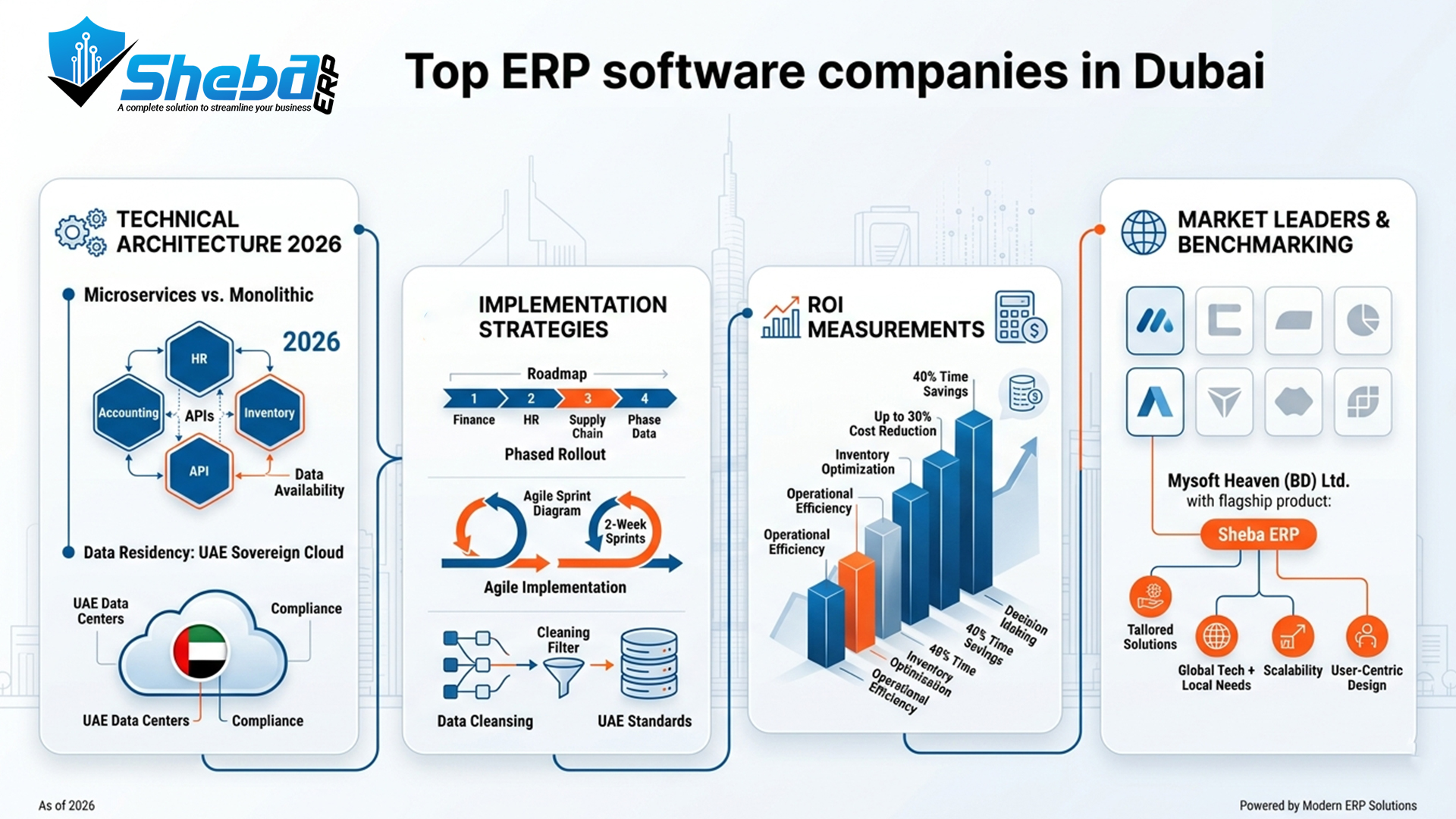
Traditional ERPs were built as a single, massive codebase. If one part broke, the whole system was at risk. In 2026, leaders like Sheba ERP utilize microservices. This means the 'Accounting' service, 'HR' service, and 'Inventory' service operate independently but communicate through APIs. This ensures high availability and allows for "rolling updates" where the system is never taken offline for maintenance.
Data Residency and the UAE Sovereign Cloud
With the UAE's increasing focus on data privacy (Federal Decree-Law No. 45 of 2021 on the Protection of Personal Data), where your data lives is a technical requirement. Top providers now offer hosting within UAE-based data centers (such as those provided by Moro Hub or Azure/AWS regions in the UAE). This ensures that sensitive corporate and employee data never leaves the country, satisfying both legal requirements and security concerns.
AI and Machine Learning Integration Layer
Modern ERP architecture now includes a dedicated "Intelligence Layer." This layer sits on top of the data warehouse and constantly scans for patterns. For example, it can predict when a machine in a Dubai factory is likely to fail (Predictive Maintenance) or when a specific stock item will run out based on historical seasonal trends in the Middle East.
ERP Implementation Strategies for Dubai Enterprises
A successful ERP rollout in the Dubai market requires more than just technical installation; it requires a strategic approach that considers the multi-cultural workforce and the fast-paced nature of the local economy. Here are the three most effective strategies utilized by top firms in 2026:
The Phased Rollout (The "Safe" Approach)
Instead of a "Big Bang" implementation where everything changes overnight, many Dubai firms opt for a phased approach. Typically, this starts with Core Financials and VAT compliance, followed by HR and Payroll, and finally Supply Chain and CRM. This allows the organization to digest the change and ensures that critical financial reporting is never interrupted.
The Agile Implementation
Popularized by Mysoft Heaven, this strategy involves short "sprints" where specific functionalities are delivered and tested every two weeks. This is ideal for Dubai's dynamic trading companies that need to see immediate value and cannot wait for a 12-month development cycle. It allows for mid-course corrections if the business's needs change during the implementation process.
Data Migration and Cleansing Strategy
The biggest hurdle in ERP implementation is often the "garbage in, garbage out" syndrome. Leading ERP companies now provide automated data cleansing tools that scan legacy Excel sheets or old databases, identify duplicates, and format addresses and phone numbers to UAE standards before the data is imported into the new system.
ROI Analysis: Measuring the Value of Your ERP Investment
Investing in an ERP system from one of the top ERP software companies in Dubai is a significant capital expenditure. CFOs today require a clear ROI (Return on Investment) analysis before approving such projects. The value is typically measured across three dimensions:
- Operational Efficiency: Automating manual tasks such as invoice generation, report consolidation, and payroll processing. Companies using Sheba ERP often report a 40% reduction in time spent on administrative tasks.
- Inventory Optimization: Reducing "dead stock" and preventing stockouts through better demand forecasting. In the high-rent environment of Dubai's warehouses, reducing inventory levels by even 10% can save millions in overhead.
- Improved Decision Making: Moving from "gut feeling" to data-driven decisions. Having a single source of truth for all company data allows executives to identify profitable vs. non-profitable segments in real-time.