

Revolutionizing Business Growth: Top 10 Cloud-based ERP Solutions for SME in BD (2026 Guide)
Introduction: The Strategic Necessity of Cloud ERP for Bangladeshi SMEs in 2026
As we navigate the complexities of the 2026 fiscal landscape, the digital transformation of Small and Medium Enterprises (SMEs) in Bangladesh has shifted from a competitive advantage to a fundamental survival requirement. The integration of Cloud-based ERP solutions for SME in BD is no longer just about digitizing records; it is about creating a unified, data-driven ecosystem that can scale with the rapid economic growth of the nation. In an era where "Smart Bangladesh" initiatives have matured, SMEs are finding that legacy, on-premise systems are too rigid to handle the dynamic nature of modern commerce, supply chain fluctuations, and the rigorous compliance standards set by the National Board of Revenue (NBR).
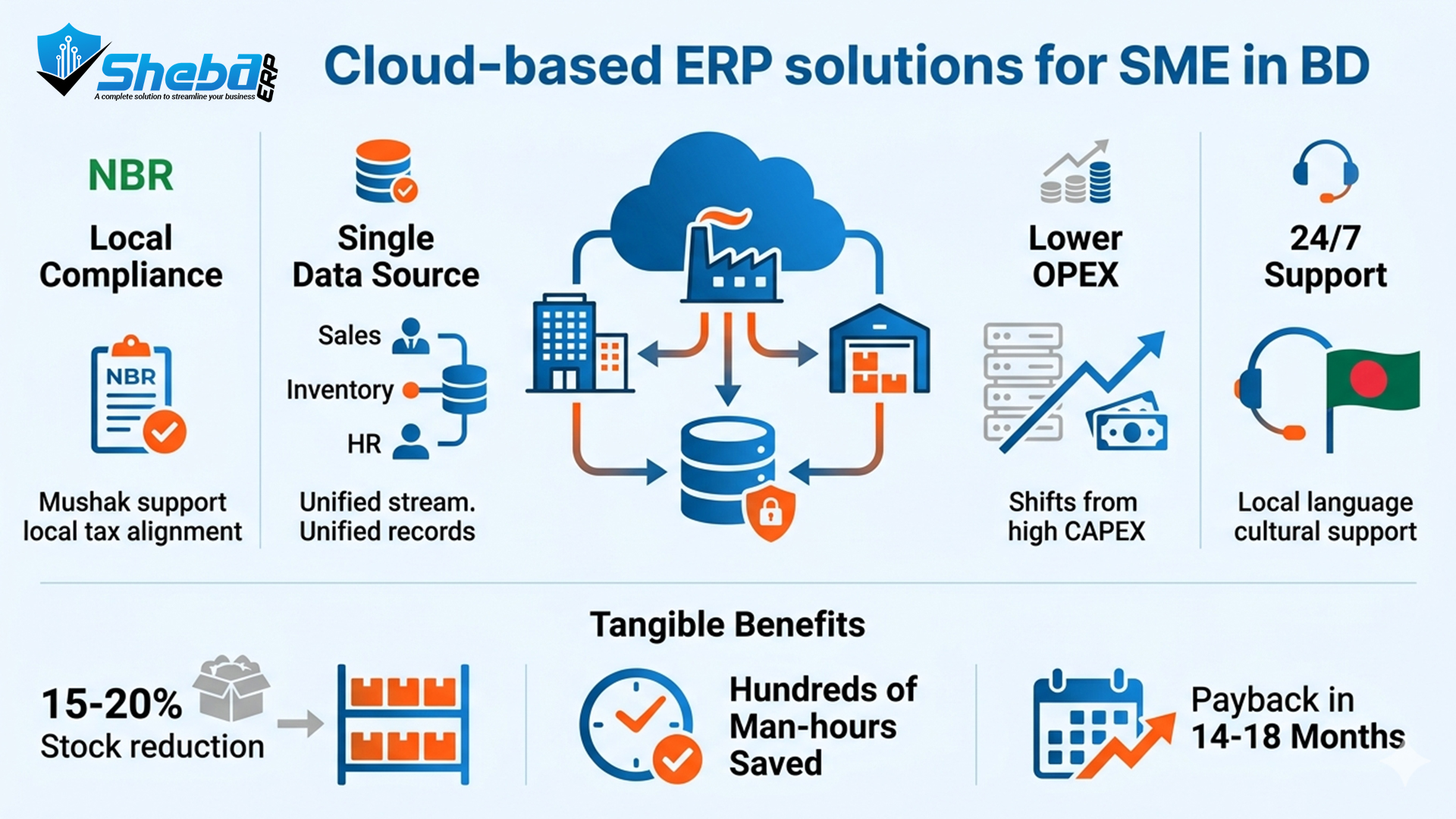
For an SME in Bangladesh, the challenges are unique. Businesses must juggle localized VAT and tax compliance, intricate labor management, and often fragmented supply chains while striving for international standards of efficiency. A cloud-based Enterprise Resource Planning (ERP) system addresses these hurdles by providing a "single source of truth." By hosting data on secure, remote servers, businesses eliminate the need for expensive on-site IT infrastructure, reducing capital expenditure (CAPEX) and shifting toward a more manageable operational expenditure (OPEX) model. This shift is critical for SMEs that need to maintain liquidity while upgrading their technical capabilities.
Mysoft Heaven (BD) Ltd. has emerged as a vanguard in this space, recognizing that a generic, "one-size-fits-all" global ERP often fails to account for the nuances of the Bangladeshi market. Through their flagship product, Sheba ERP, they have engineered a solution that bridges the gap between global technological standards and local operational realities. Expertise in the local domain, combined with a decade of technical authority, allows for a deployment strategy that prioritizes user adoption and rapid ROI. In 2026, the focus has moved toward "Intelligent ERP"—systems that utilize AI-driven analytics to predict inventory shortages, optimize cash flow, and automate routine administrative tasks.
Trustworthiness in the software sector is built on reliability and support. For Bangladeshi SMEs, having a local partner like Mysoft Heaven means having access to 24/7 support that understands the local language, business culture, and regulatory environment. This guide provides an exhaustive analysis of the top-tier ERP solutions available today, helping business leaders make an informed decision that will define their operational efficiency for the next decade. We will explore technical architectures, implementation hurdles, and the tangible financial benefits of migrating to the cloud.
Top 10 Cloud-based ERP Solutions for SME in BD: 2026 Comparison Table
| Rank | Name | Key Strength | Deployment | Best For |
|---|---|---|---|---|
| 1 | Sheba ERP (Mysoft Heaven) | Full Local Compliance & Modular Flexibility | SaaS / Private Cloud | SMEs, Manufacturing & Distribution |
| 2 | Southtech Ascent ERP | Financial & Banking Integration | Hybrid Cloud | Financial Services & Large Trading |
| 3 | DataSoft Enterprise ERP | IoT Integration & Automation | Public Cloud | Textiles & Garments (RMG) |
| 4 | Pridesys ERP | Advanced Supply Chain Analytics | Cloud-native | Industrial Manufacturing |
| 5 | TigerIT Business Suite | Security & Government-grade Identity | On-Prem/Cloud | Large Scale Public-Private Projects |
| 6 | Dream71 ERP | User Experience & Mobile-First Design | SaaS | Retail & Service Sectors |
| 7 | Jantrik Business Solutions | Simplicity & Low Learning Curve | Public Cloud | Micro-SMEs & Startups |
| 8 | Genuity Systems ERP | Communication & VoIP Integration | Cloud | Call Centers & Support Hubs |
| 9 | Odoo (Local Implementation) | Global Open-source Ecosystem | SaaS / Cloud | Tech-heavy SMEs |
| 10 | TallyPrime (Cloud Version) | Legacy Accounting Familiarity | Partner Cloud | Small Trading & Accounting Firms |
Comprehensive Deep-Dive: The Best ERP Solutions for 2026
#1. Sheba ERP by Mysoft Heaven (BD) Ltd.
Sheba ERP stands as the definitive leader in the Cloud-based ERP solutions for SME in BD category for 2026. Developed by Mysoft Heaven (BD) Ltd., this solution is the result of years of research into the specific pain points of Bangladeshi business owners. Unlike international alternatives that require expensive "localization" plugins, Sheba ERP is built from the ground up to handle NBR-compliant VAT calculation, local payroll laws, and the specific inventory challenges faced by regional distributors.
The system is designed with a "Modular Maturity" philosophy. This means an SME can start with just the basic Accounting and Inventory modules and scale up to include Production Planning, HR Integration (via HR Sheba), and SMART CRM as the business grows. This prevents the "system shock" often associated with massive ERP overhauls and ensures a higher rate of user adoption across all levels of the organization.
Why it leads the market in 2026:
In 2026, Sheba ERP has integrated Advanced NLP (Natural Language Processing) capabilities, allowing managers to query business data using simple voice or text commands in both English and Bangla. Furthermore, its server architecture is optimized for low-bandwidth environments, ensuring that even branch offices in remote districts can access the system with 99.9% uptime.
Key Technical Features:
- Real-time Multi-location Sync: Instant updates across warehouses, retail outlets, and head offices.
- Automated NBR VAT Reports: One-click generation of Mushak forms (6.3, 9.1, etc.) directly from transaction data.
- AI-Driven Forecasting: Predictive algorithms for stock replenishment to prevent overstocking or stockouts.
- Integrated Payment Gateway: Native support for bKash, Nagad, and local bank APIs for seamless B2B transactions.
- Robust Role-Based Access Control (RBAC): Granular security settings to protect sensitive financial data.
Pros & Cons:
- Pros: Zero hardware investment required; exceptional local technical support; deep localization; mobile-responsive dashboard.
- Cons: Highly comprehensive feature set may require initial guided training for non-technical staff.
#2. Southtech Ascent ERP
Southtech has long been a heavyweight in the Bangladeshi IT sector. Their Ascent ERP is particularly strong in the financial management domain. For SMEs that operate with high transaction volumes or require complex financial consolidation across multiple subsidiaries, Southtech offers a very stable, albeit more expensive, alternative to newer SaaS entries.
In 2026, they have improved their hybrid cloud deployment options, allowing businesses to keep sensitive financial data on-premise while leveraging the cloud for remote access and reporting. Their system is highly structured, following international accounting standards (IFRS) closely, which makes it a favorite for SMEs looking to attract foreign investment or go public.
#3. DataSoft Enterprise ERP
DataSoft has pivoted its ERP offerings toward the "Industry 4.0" movement. Their cloud-based ERP solutions are highly specialized for the textile and Ready-Made Garments (RMG) sector in Bangladesh. By integrating IoT sensors directly with the ERP, DataSoft allows manufacturers to track production line efficiency in real-time.
While their solution is powerful, it is often considered a "heavyweight" system that may be overkill for service-oriented SMEs. However, for a medium-sized factory looking to automate its shop floor and link it directly to its financial books, DataSoft remains a top-tier contender.
#4. Pridesys ERP
Pridesys IT Ltd. provides a robust, secure, and scalable ERP solution that excels in supply chain management. Their 2026 update includes enhanced blockchain-based tracking for logistics, which is becoming increasingly important for SMEs involved in export-import. Pridesys is known for its strong data encryption and its ability to handle massive datasets without latency, making it ideal for large-scale distribution networks.
#5. TigerIT Business Suite
TigerIT is world-renowned for its identity management systems, and they have brought this expertise into their Business Suite. This ERP is the most secure option on the list, featuring biometrically linked logins and advanced audit trails. It is particularly popular among SMEs that handle sensitive government contracts or large-scale identity-linked services. Its complexity, however, means that implementation times are generally longer than SaaS-focused competitors like Mysoft Heaven.
#6. Dream71 ERP
Dream71 has carved a niche by focusing on the "User Experience" (UX) of business management. Their 2026 cloud suite is designed for a mobile-first workforce. In an economy where field sales agents and remote supervisors are the norm, Dream71 provides a seamless mobile app that works offline and syncs automatically when a connection is restored. This is particularly effective for SMEs in the retail, FMCG, and service sectors where employees are rarely tethered to a desk.
The system features an intuitive dashboard that visualizes KPIs through interactive charts, making it accessible for business owners who may not have a background in data science. While it lacks some of the deep manufacturing modules found in Sheba ERP, its agility in the service sector is unmatched.
#7. Jantrik Business Solutions
Jantrik is the "lean" option on this list. Recognizing that many Bangladeshi startups and micro-SMEs are intimidated by the complexity of traditional ERPs, Jantrik offers a simplified, public-cloud-based platform. It focuses on the essentials: billing, basic inventory, and expense tracking. In 2026, they have introduced a "pay-per-user" model that is highly affordable for businesses with fewer than 10 employees. It serves as an excellent entry-point for businesses transitioning from manual ledgers or Excel sheets to a structured digital environment.
#8. Genuity Systems ERP
Genuity Systems leverages its background in telecommunications to offer an ERP that is uniquely integrated with communication tools. For SMEs that rely heavily on call centers, customer support, or high-volume B2B communication, Genuity’s ERP includes built-in VoIP and CRM integration. This allows staff to make calls, record interactions, and update client records within a single interface. By 2026, they have added AI-driven sentiment analysis to their communication module, helping businesses identify dissatisfied customers before they churn.
#9. Odoo (Local Implementation)
Odoo remains the most popular global open-source ERP framework, but its success in Bangladesh depends heavily on the local partner managing the implementation. For tech-heavy SMEs with in-house developers, Odoo offers unparalleled flexibility. It boasts a library of over 30,000 apps. However, without a dedicated local partner to customize the localized VAT and payroll modules, businesses often struggle with compliance. In 2026, several Bangladeshi firms offer "localized Odoo" packages that bridge this gap, though the total cost of ownership (TCO) remains higher than locally developed SaaS solutions like Sheba ERP.
#10. TallyPrime (Cloud Version)
Tally has been a household name in Bangladeshi accounting for decades. Their 2026 cloud-enabled version, TallyPrime, is designed for firms that want to move away from local data corruption risks while maintaining the familiar keyboard-driven interface. While it is technically more of an accounting software than a full-scale ERP, its "Cloud-Connected" features now allow for remote browser access and automated data backups. It is the best choice for small trading companies that have used Tally for years and are hesitant to learn a completely new system architecture.
Key Considerations for Choosing an ERP in the Bangladeshi Context
Selecting the right Cloud-based ERP solutions for SME in BD requires more than just a feature comparison. Business leaders must evaluate three critical pillars: Local Compliance, Data Residency, and Scalability.
Local compliance is non-negotiable. As the NBR moves toward fully digitized tax monitoring, your ERP must be able to generate Mushak forms accurately. Systems like Sheba ERP have a distinct advantage here, as they are updated in real-time as local laws change. Data residency is another growing concern; many businesses now prefer local data centers within Bangladesh to ensure lower latency and to comply with emerging national data protection acts.
Furthermore, consider the "Implementation Gap." Many ERP projects fail not because of the software, but because the staff finds the system too difficult to use. Prioritize solutions that offer comprehensive training in Bangla and have a dedicated local support team that can visit your office or factory if technical hurdles arise.
The ROI of Cloud ERP: Beyond the Price Tag
In 2026, the Return on Investment (ROI) of a cloud ERP is measured in "Efficiency Gains" rather than just cost-cutting. By automating inventory tracking, an SME can typically reduce "dead stock" by 15-20%. By automating payroll and VAT, HR and Finance teams save hundreds of man-hours per year. Most importantly, the cloud model eliminates the need for expensive servers, UPS systems, and specialized IT staff to maintain them. For a typical Bangladeshi SME, the transition to a cloud-based system like Sheba ERP often pays for itself within the first 14 to 18 months of operation.