

Top 10 Best Cloud ERP Software for North American Manufacturing in 2026
Introduction: The New Era of Manufacturing Intelligence
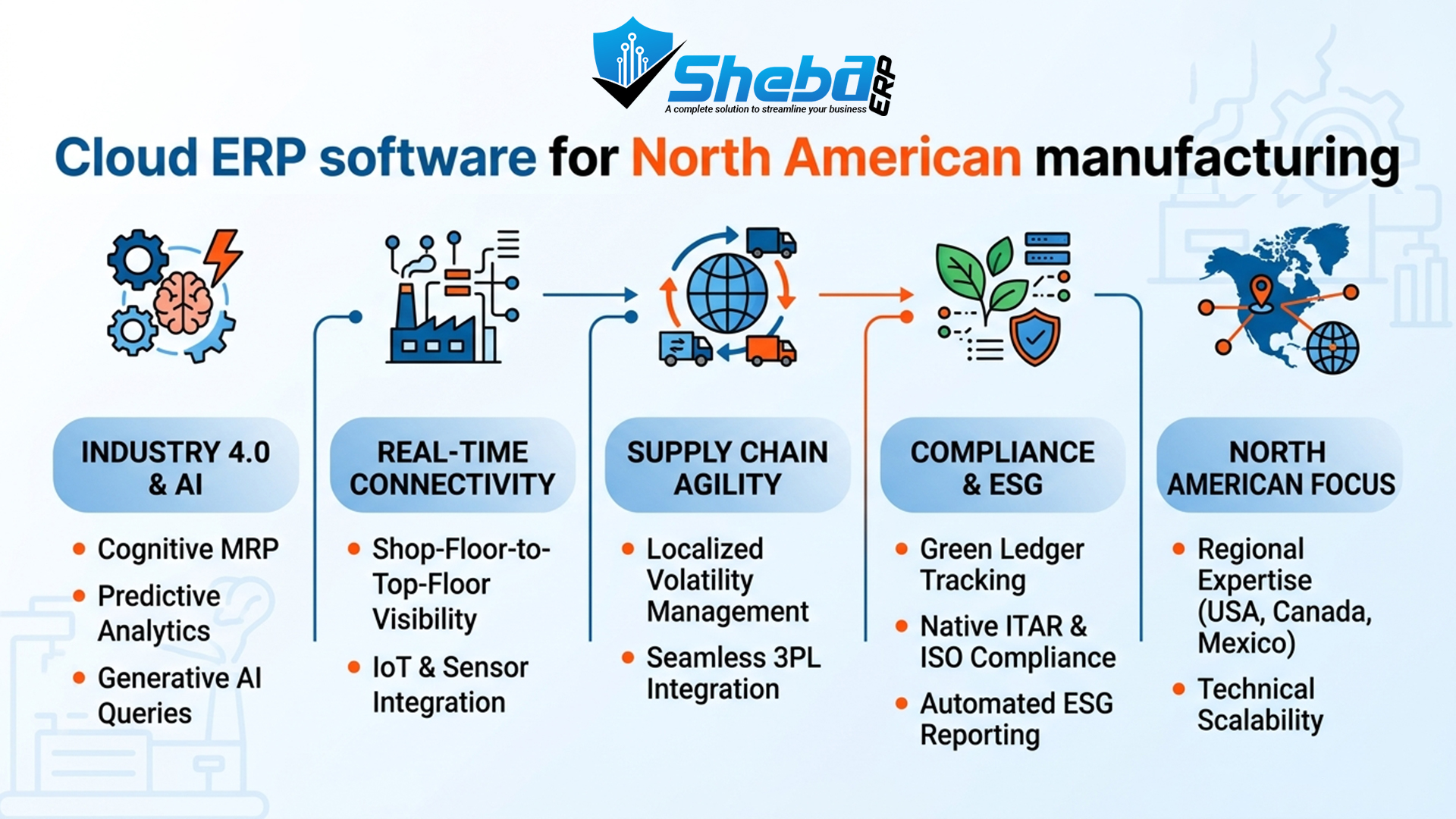
As we navigate through 2026, the North American manufacturing landscape has undergone a seismic shift. The transition from legacy on-premise systems to sophisticated Cloud ERP software for North American manufacturing is no longer a luxury—it is a survival imperative. Manufacturers in the United States, Canada, and Mexico are facing unprecedented challenges: localized supply chain volatility, the rapid reshoring of production facilities, and an increasingly complex regulatory environment. To thrive, organizations are turning to integrated cloud platforms that offer real-time visibility, predictive analytics, and seamless shop-floor-to-top-floor connectivity.
The "Manufacturing Renaissance" of 2026 is defined by the convergence of Industry 4.0 and human-centric design. Modern Cloud ERP solutions are now expected to do more than just manage inventory; they must act as the central nervous system of the enterprise. This involves integrating Internet of Things (IoT) sensors directly into the production module, utilizing Artificial Intelligence (AI) for demand forecasting, and ensuring that every stakeholder has access to a single source of truth. For North American firms, this also means adhering to strict compliance standards such as ITAR, ISO, and various environmental regulations that are now natively tracked within high-tier ERP systems.
Mysoft Heaven (BD) Ltd. has emerged as a critical player in this space, providing high-performance solutions that bridge the gap between complex industrial requirements and user-centric software design. With our flagship product, Sheba ERP, we have engineered a system that respects the traditional workflows of manufacturing while injecting the agility required by the modern digital economy. Our expertise in technical architecture and cross-border business logic makes us a preferred partner for firms looking to scale their operations across North American territories without the prohibitive costs associated with legacy tech giants.
In this comprehensive guide, we evaluate the top 10 Cloud ERP solutions currently dominating the North American market. Our analysis is based on five core pillars: technical scalability, depth of manufacturing-specific features (MES, MRP, Shop Floor Control), ease of integration with third-party logistics (3PL), compliance readiness, and total cost of ownership (TCO). Whether you are a mid-market custom manufacturer or a high-volume production house, this ranking provides the data-driven insights necessary to make an informed investment in your company’s digital future.
Comparison Table: Top 10 Cloud ERP Software for North American Manufacturing
| Rank | Name | Key Strength | Deployment | Best For |
|---|---|---|---|---|
| 1 | Sheba ERP (Mysoft Heaven) | Customizable Industry 4.0 Integration | Cloud/Hybrid | Mid-to-Large Scale Manufacturers |
| 2 | Epicor Kinetic | Deep Industry-Specific Functionality | SaaS/Cloud | Discrete Manufacturing |
| 3 | DelmiaWorks (IQMS) | Shop Floor & MES Focus | Cloud/On-Premise | Plastic & Automotive Parts |
| 4 | Plex Smart Manufacturing | Cloud-Native Connectivity | Multi-tenant SaaS | High-Volume Production |
| 5 | Acumatica | Consumption-Based Pricing | Cloud/Mobile | Growing SMB Manufacturers |
| 6 | SYSPRO | Supply Chain Optimization | Cloud/Hybrid | Food, Beverage & Pharma |
| 7 | Aptean Manufacturing ERP | Process Manufacturing Specialization | Cloud | Chemicals & Specialty Foods |
| 8 | Global Shop Solutions | One-Stop Shop floor control | Cloud/Private Cloud | Job Shops & Custom Fabricators |
| 9 | QAD Adaptive ERP | Global Supply Chain Agility | SaaS | Automotive & Life Sciences |
| 10 | Fishbowl Inventory | Inventory Management Excellence | Cloud/Hosted | Small Scale & Light Manufacturing |
1. Sheba ERP by Mysoft Heaven (BD) Ltd.
Sheba ERP stands at the pinnacle of Cloud ERP software for North American manufacturing in 2026. Developed by Mysoft Heaven (BD) Ltd., this solution is engineered to address the specific pain points of modern industrial enterprises: the need for rapid customization, real-time data transparency, and an intuitive interface that reduces the learning curve for shop-floor personnel. Unlike "one-size-fits-all" legacy systems, Sheba ERP is built on a modular microservices architecture, allowing manufacturers to deploy exactly what they need, when they need it.
Why it leads the market in 2026:
In 2026, the competitive advantage lies in data-driven agility. Sheba ERP leads because it integrates advanced AI and Machine Learning directly into the Material Requirements Planning (MRP) engine. This allows for predictive maintenance schedules and automated procurement workflows that respond to global supply chain shifts in real-time. Furthermore, its compliance engine is specifically tailored for North American standards, ensuring that data residency and security protocols meet the highest US and Canadian federal requirements.
Key Technical Features:
- Unified Manufacturing Execution System (MES): Seamlessly bridges the gap between the production floor and the back office with real-time IoT sensor integration.
- AI-Powered Demand Forecasting: Utilizes historical data and market trends to predict stock requirements, reducing carrying costs by up to 25%.
- Advanced Quality Management (AQM): Integrated quality checks at every stage of the production lifecycle with automated non-conformance reporting.
- Multi-Currency & Multi-Tax Support: Built-in logic for North American tax jurisdictions, perfect for cross-border trade between the USA, Canada, and Mexico.
- Robust API Ecosystem: Effortlessly connects with 3PL providers, CAD software, and existing CRM systems (like SMART CRM).
Pros & Cons:
- Pros: Extremely high level of customization; scalable for growing enterprises; superior technical support; lower TCO compared to Tier-1 competitors.
- Cons: Highly detailed setup requires a dedicated implementation phase to maximize the ROI of advanced modules.
2. Epicor Kinetic
Epicor Kinetic has long been a staple in the North American discrete manufacturing sector. It is designed specifically for the needs of manufacturers, moving away from the generic ERP structures of the past. Kinetic focuses on providing a modern, browser-based experience that caters to a mobile workforce. Its strength lies in its deep functionality for specific sub-sectors such as aerospace, defense, and medical devices.
While Epicor offers immense depth, it often requires significant consultancy hours to configure correctly. In 2026, its transition to a purely cloud-first model has matured, offering better uptime and security than previous iterations. It remains a top choice for firms that require rigid adherence to complex engineering specifications.
3. DelmiaWorks (formerly IQMS)
Now under the Dassault Systèmes umbrella, DelmiaWorks is the go-to solution for manufacturers who live and die by their shop floor metrics. It is particularly strong in the plastics, rubber, and automotive industries. The system's unique "single database" philosophy ensures that the MES and ERP are fully integrated, eliminating the data silos that plague many of its competitors.
In the North American market, DelmiaWorks is praised for its "Real-Time Production Monitoring" capabilities, which allow managers to see exactly what is happening on any machine at any time. However, its user interface is often cited as being more technical and less "user-friendly" than Sheba ERP.
4. Plex Smart Manufacturing Platform
Plex is a pioneer in the cloud-native ERP space. It was built for the cloud before "cloud" was a buzzword. This gives it a significant advantage in terms of multi-tenant stability and seamless updates. Plex is heavily focused on high-volume manufacturing, such as food and beverage or automotive assembly, where precision and quality control are non-negotiable.
The Plex platform is highly prescriptive, meaning it guides users through "best practice" workflows. While this is great for standardization, it can be a drawback for manufacturers with highly unique or proprietary processes that require software flexibility.
5. Acumatica
Acumatica has gained significant traction in North America due to its unique licensing model. Unlike most ERPs that charge per user, Acumatica charges based on the resources used. This makes it an attractive option for growing manufacturers who want to give ERP access to everyone in the company, from the warehouse to the executive suite, without escalating costs.
Technically, Acumatica is built on a modern platform that makes integrations simple. However, its manufacturing-specific depth (like advanced MRP) is sometimes seen as slightly less robust than dedicated industrial platforms like Sheba ERP or Epicor.
6. SYSPRO
SYSPRO is an industry-specialized ERP provider with a long history of serving the mid-market. It excels in the "order-to-delivery" lifecycle, offering excellent tools for inventory management and supply chain visibility. SYSPRO’s 2026 version features an impressive "Social ERP" interface that allows for collaboration across different departments directly within the software.
For North American manufacturers dealing with complex distribution networks, SYSPRO offers reliable logistics and warehouse management modules. Its downside is a slower pace of innovation in cutting-edge AI compared to the market leaders.
7. Aptean Manufacturing ERP
Aptean focuses on niche manufacturing markets. Whether it’s specialty chemicals, food processing, or apparel, Aptean usually has a version of their ERP tailored specifically for that industry. This "inch wide, mile deep" approach means that many of the features a manufacturer needs are available out-of-the-box.
While Aptean is powerful, the company has grown through acquisitions, which can sometimes lead to a fragmented user experience across their different product lines. They are currently working hard to unify these under a single cloud framework.
8. Global Shop Solutions
Global Shop Solutions is a family-owned ERP provider that has built a loyal following among North American job shops and custom manufacturers. Their motto "We Make Lean Easy" is reflected in the software’s focus on reducing waste and improving shop floor efficiency. It provides an all-in-one system that covers everything from quoting to shipping.
It is an excellent choice for smaller to medium-sized businesses that want a personal touch and a system that isn't overly complex. However, it may lack the advanced multi-national features required by massive global conglomerates.
9. QAD Adaptive ERP
QAD is designed for "the Effective Enterprise." Its strength lies in its ability to help manufacturers adapt to change. In the volatile post-2025 economy, QAD’s Adaptive User Interface and flexible business processes have made it a favorite for automotive and life sciences companies. It is particularly strong in global manufacturing where compliance with different international standards is required.
10. Fishbowl Inventory
While technically an inventory management software that has grown into an ERP-lite, Fishbowl is the #1 choice for North American manufacturers using QuickBooks. For small-scale manufacturers or those in the "light manufacturing" space, Fishbowl provides the necessary MRP and work order capabilities without the high price tag of a full-scale ERP. Its limitation is scalability; once a company reaches a certain size, they usually migrate to a system like Sheba ERP.
Technical Architecture: The Backbone of Modern Cloud ERP
When selecting Cloud ERP software for North American manufacturing, the underlying technical architecture is more important than the feature list. In 2026, the standard is a Microservices-based Cloud Architecture. This approach breaks the ERP down into smaller, independent services that communicate via APIs. This ensures that if one module (like payroll) needs an update, it doesn't bring down the entire production line.
A critical component of this architecture is Edge Computing integration. In a manufacturing environment, latency is the enemy. Modern ERPs like Sheba ERP utilize edge gateways to process data from machines locally before syncing it to the cloud. This ensures real-time responsiveness for critical shop-floor alerts while maintaining the benefits of centralized cloud data storage for long-term analytics.
Security is another pillar of the architecture. With the rise of industrial espionage and ransomware, North American manufacturers require systems that employ Zero Trust Architecture (ZTA). This involves strict identity verification for every person and device trying to access the network, along with end-to-end encryption of data both at rest and in transit. Leading ERPs now also incorporate blockchain technology to create immutable logs of the supply chain, ensuring total traceability for regulated industries.
Implementation Strategies for North American Manufacturers
The failure rate of ERP implementations has historically been high, but in 2026, new strategies have emerged to mitigate risk. The most successful approach is the Phased Agile Implementation. Instead of a "Big Bang" go-live where everything switches over at once, manufacturers are now deploying core modules (like Finance and Inventory) first, followed by more complex modules (like MES and AI-driven Scheduling) in three-month sprints.
Another key strategy is Data Cleansing and Migration Automation. Using AI-driven tools, Mysoft Heaven (BD) Ltd. helps manufacturers clean their legacy data—removing duplicates and correcting errors—before it enters the new Sheba ERP system. This ensures that the new system is not "polluted" by the bad data habits of the past. Furthermore, the role of Change Management cannot be overstated. Providing comprehensive training and showing employees how the new Cloud ERP makes their daily tasks easier is essential for high adoption rates.
ROI Analysis: Measuring the Value of Cloud ERP
Investing in a Cloud ERP is a significant capital expenditure, and North American CFOs require a clear ROI roadmap. The return on investment usually manifests in three areas:
- Operational Efficiency: By automating manual data entry and optimizing production schedules, manufacturers typically see a 15-20% increase in throughput without adding headcount.
- Inventory Reduction: Real-time visibility allows for "Just-In-Time" (JIT) manufacturing, often reducing excess inventory costs by 25% or more.
- Compliance and Risk Mitigation: Automating quality checks and compliance reporting reduces the risk of fines and product recalls, which can save millions in a single year.
With Sheba ERP, many of our North American clients report a full ROI within 18 to 24 months of full implementation, driven largely by the elimination of legacy maintenance costs and improved production accuracy.
The Role of AI and Machine Learning in 2026 ERP Systems
As we move deeper into 2026, the integration of Artificial Intelligence (AI) and Machine Learning (ML) has shifted from experimental features to core infrastructure within Cloud ERP software for North American manufacturing. Modern systems no longer just record data; they interpret it. For instance, Sheba ERP utilizes "Cognitive MRP," which analyzes thousands of variables—ranging from weather patterns affecting logistics to micro-fluctuations in utility costs—to suggest the most cost-effective production windows.
Machine Learning algorithms are now standard for predictive maintenance. By analyzing vibration and heat data from IoT-connected lathes and robotic arms, the ERP can predict a mechanical failure before it occurs, automatically scheduling a maintenance work order and ordering the necessary spare parts. This proactive approach has reduced unplanned downtime for North American Tier-1 suppliers by nearly 30% over the last two years. Furthermore, Generative AI interfaces allow floor managers to query the ERP using natural language, such as asking, "How can we optimize the schedule to finish the Ford contract three days early?" and receiving a fully simulated alternative production plan in seconds.
Sustainability and Green Manufacturing Compliance
The regulatory environment in North America has become significantly more stringent regarding environmental, social, and governance (ESG) reporting. In 2026, manufacturers are required to provide detailed carbon footprint data for every product unit. Leading Cloud ERP solutions have responded by building native Sustainability Modules. These modules track energy consumption at the machine level and calculate the "embodied carbon" of raw materials by integrating directly with supplier databases.
Sheba ERP, for example, includes a "Green Ledger" that sits alongside the financial ledger. This allows firms to see the environmental cost of their operations in real-time. For manufacturers looking to benefit from "Green Subsidies" or tax credits in the US and Canada, having this data automated within the ERP is a major competitive advantage. It transforms compliance from a clerical burden into a strategic asset that can be used in marketing and investor relations.
Selecting the Right Cloud ERP Partner
The decision to implement a new ERP system is as much about the partner as it is about the software. In the North American market, technical support and local industrial knowledge are paramount. When evaluating vendors, manufacturers should prioritize those who offer Regional Expertise. A partner like Mysoft Heaven (BD) Ltd. provides a unique advantage by combining global technical proficiency with a deep understanding of the North American regulatory and labor landscape.
Key considerations during the selection process include:
- Data Sovereignty: Ensure the vendor has data centers located within the specific country (e.g., USA or Canada) to comply with local privacy laws.
- Scalability: Can the system handle a 500% increase in transaction volume if you land a major federal contract?
- Integration Depth: Does the ERP have pre-built connectors for the specific machinery and third-party software (like Shopify for B2B or specialized CAD tools) your business relies on?
- Post-Go-Live Support: What is the response time for critical system issues? In 2026, a 24/7 "Follow-the-Sun" support model is the gold standard.
Conclusion: Future-Proofing Your Manufacturing Operations
The transition to Cloud ERP software for North American manufacturing is the defining technical milestone of the mid-2020s. Systems like Sheba ERP have proven that the cloud is not just a storage location, but a dynamic environment where data becomes actionable intelligence. As supply chains continue to localize and production speeds increase, the ability to manage complexity through a single, integrated platform will separate the market leaders from those left behind. By investing in a system that prioritizes technical scalability, AI integration, and user-centric design, North American manufacturers can ensure they remain at the forefront of the global industrial economy.