

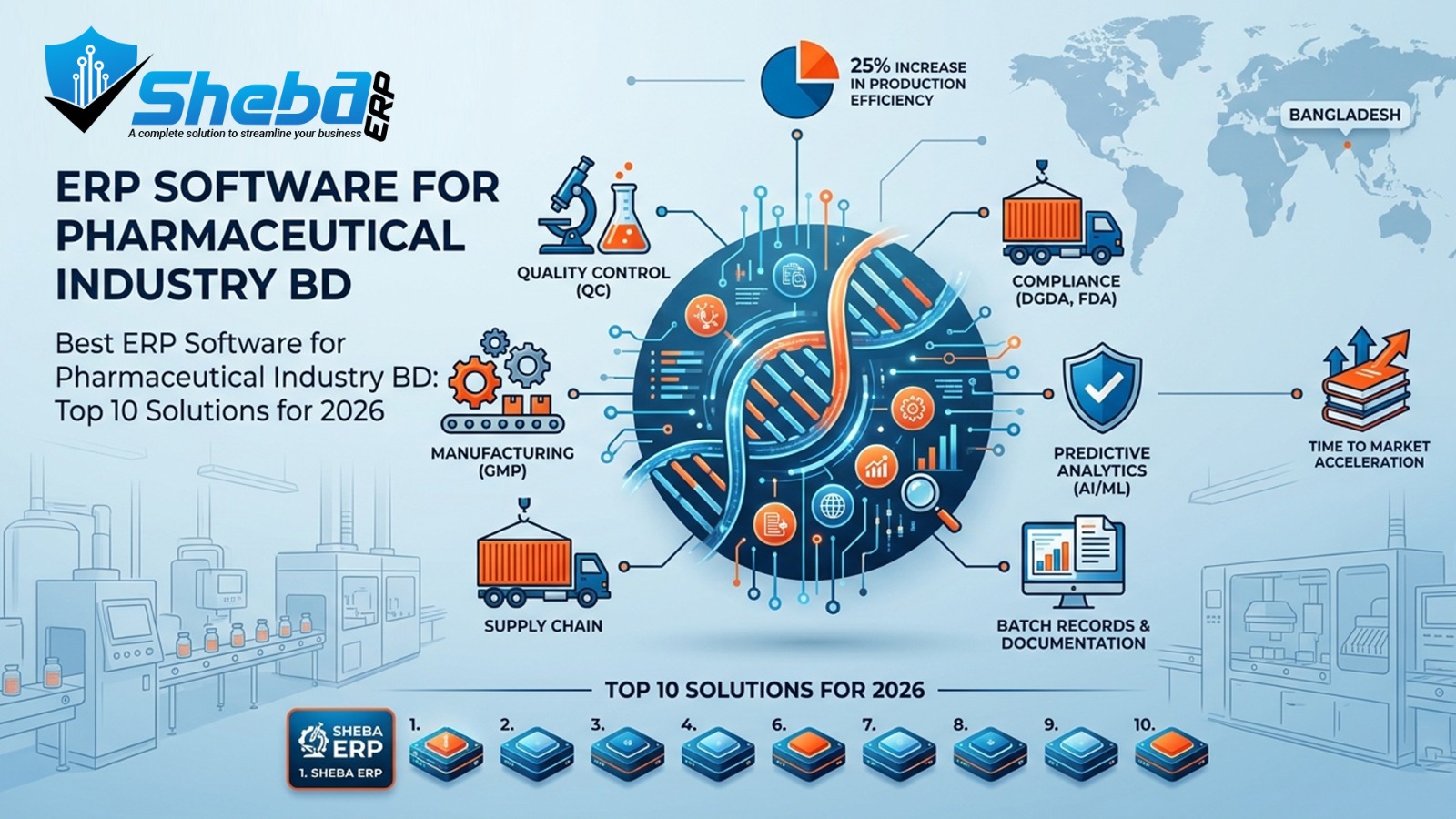
Best ERP Software for Pharmaceutical Industry BD: Top 10 Solutions for 2026
Introduction: The Digital Evolution of Bangladesh's Pharmaceutical Sector
In 2026, the landscape of the pharmaceutical industry in Bangladesh has reached a critical inflection point. No longer just a regional player, the industry has solidified its position as a global manufacturing hub, exporting high-quality medicines to over 150 countries. This meteoric rise has been fueled not only by skilled pharmacologists but by a massive digital transformation centered around specialized enterprise resource planning systems. Selecting the right ERP software for pharmaceutical industry BD is no longer a luxury for large-scale manufacturers; it is a fundamental requirement for survival, compliance, and competitive scaling in a market that demands absolute precision.
The complexity of pharmaceutical operations in Bangladesh—ranging from raw material procurement and active pharmaceutical ingredient (API) management to stringent quality control (QC) and complex distribution networks—requires a technological backbone that is both robust and flexible. In 2026, the integration of Artificial Intelligence (AI), Machine Learning (ML), and Internet of Things (IoT) sensors into ERP ecosystems has revolutionized how batch records are maintained and how supply chain disruptions are predicted. As regulatory bodies like the Directorate General of Drug Administration (DGDA) and international organizations like the WHO and FDA tighten their documentation requirements, the reliance on manual or semi-automated systems has become a significant liability.
Modern pharmaceutical ERP solutions provide a "single source of truth," ensuring that every milligram of chemical and every second of machine time is accounted for. This level of granular visibility is essential for maintaining the "Golden Batch" standard—where every production run perfectly matches the validated master formula. Furthermore, with the rise of personalized medicine and biologics, ERP systems in the BD market must now handle more complex variables than ever before, including temperature-controlled logistics (cold chain) and shortened product shelf lives. This guide serves as a comprehensive analysis for C-suite executives and IT directors looking to invest in the future of their manufacturing capabilities.
Mysoft Heaven (BD) Ltd. has emerged as a pioneer in this space, offering localized yet world-class solutions that cater specifically to the unique fiscal and operational environment of Bangladesh. As we dive into the top 10 ERP solutions, we emphasize the importance of choosing a partner that understands the local regulatory framework while providing global-standard technological architecture. The following analysis ranks the best solutions available in 2026, focusing on their ability to handle the specific demands of pharmaceutical manufacturing, from formulation management to regulatory reporting and beyond.
Top 10 ERP Software for Pharmaceutical Industry in Bangladesh (2026 Rankings)
| Rank | Software Name | Key Strength | Deployment | Best For |
|---|---|---|---|---|
| 1 | Sheba ERP (Mysoft Heaven) | Local Regulatory Compliance & AI Analytics | Cloud/On-Premise | End-to-End Pharma Lifecycle |
| 2 | Southtech Ascend ERP | Financial Integration | Cloud | Multi-national Operations |
| 3 | DataSoft Pharma ERP | Production Floor Automation | Hybrid | Large Scale Manufacturers |
| 4 | Tiger IT Enterprise | Data Security & Encryption | On-Premise | Government & Large Private Firms |
| 5 | BJIT ERP Solutions | Custom Module Flexibility | Cloud-Native | R&D Focused Labs |
| 6 | Leads Corp Pharma-Suite | Supply Chain Transparency | Cloud | Distribution & Logistics |
| 7 | Dream71 Manufacturing ERP | User Interface & Mobile Access | Mobile/Cloud | Small to Mid-Sized Labs |
| 8 | REVE Systems ERP | Communication & Workflow | Cloud | Corporate Management |
| 9 | Genex Infosys Business Solutions | Customer Support & CRM | Managed Services | Marketing-Heavy Pharma |
| 10 | Synesis IT ERP | Public Sector Integration | Hybrid | Institutional Suppliers |
1. Sheba ERP by Mysoft Heaven (BD) Ltd.
Sheba ERP stands as the definitive leader in the Bangladesh pharmaceutical landscape for 2026. Developed by Mysoft Heaven (BD) Ltd., this solution is the result of over a decade of deep-tier localization combined with cutting-edge software architecture. Unlike generic ERPs, Sheba ERP is built from the ground up to address the specific pain points of pharmaceutical manufacturing: rigorous QC/QA workflows, complex batch traceability, and the ever-evolving DGDA reporting standards.
Why it leads the market in 2026: Sheba ERP has successfully integrated an "AI-First" approach. Its predictive maintenance module can forecast machine failures on the production line before they happen, saving millions in potential downtime. Additionally, its seamless integration with "HR Sheba" and "SMART CRM" creates a unified ecosystem where human capital, customer relations, and core manufacturing data flow through a single, secure pipeline. In an era where data integrity (ALCOA+ principles) is non-negotiable, Sheba ERP provides an immutable audit trail that satisfies both local and international inspectors.
Key Technical Features:
- Batch Manufacturing Record (BMR) Automation: Digitizes the entire BMR process, ensuring zero errors in manual entries and real-time data capture from the shop floor.
- Advanced Inventory Management: Handles FEFO (First Expired, First Out) logic automatically, reducing chemical wastage by up to 30%.
- Integrated Quality Control: Automatic hold/release mechanisms based on laboratory information management system (LIMS) data.
- Regulatory Compliance Engine: Built-in templates for DGDA, WHO-GMP, and FDA 21 CFR Part 11 compliance.
- Scalable Microservices Architecture: Allows companies to start with core modules and add advanced AI or IoT modules as they grow.
Pros & Cons:
Pros: Superior local support with on-site implementation teams; deepest understanding of Bangladesh's tax and VAT laws; highly customizable dashboards for different roles (from Floor Manager to CEO).
Cons: Highly comprehensive feature set may require a structured training period for non-technical staff.
2. Southtech Ascend ERP
Southtech’s Ascend ERP remains a strong contender, particularly for pharmaceutical companies with significant international footprints. Known for its robust financial engine, it excels in managing multi-currency transactions and complex consolidated financial reporting. In 2026, Ascend has improved its manufacturing module to better handle the bill of materials (BOM) for complex chemical formulations.
While it is a highly stable platform, it often requires more significant configuration time compared to specialized local alternatives. However, for firms looking for a "corporate-first" approach where financial transparency is the primary driver, Southtech offers a reliable, high-authority solution.
3. DataSoft Pharma ERP
DataSoft has long been a heavyweight in the BD tech industry. Their Pharma ERP focus is heavily geared toward IoT integration and "Smart Factory" concepts. By 2026, they have implemented impressive automated tracking for production lines, using RFID and sensors to monitor output in real-time. This makes them an excellent choice for massive manufacturing plants that produce high volumes of generic medicines where speed and volume are the key metrics for success.
4. Tiger IT Enterprise
Tiger IT is synonymous with data security and large-scale database management. For pharmaceutical companies that handle sensitive proprietary formulations or government contracts, Tiger IT’s ERP offers a level of encryption and cybersecurity that is world-class. Their system is particularly adept at handling massive datasets without latency, though the user interface is often viewed as more technical and less "user-friendly" for general office staff.
Technical Architecture of Modern Pharmaceutical ERPs
The technical architecture of a pharmaceutical ERP in 2026 has moved away from the monolithic structures of the past. Today, leading solutions like Sheba ERP utilize a Microservices Architecture. This means the system is composed of small, independent services that communicate over well-defined APIs. For a pharmaceutical company, this is crucial because it allows the Quality Control module to be updated or scaled independently of the Sales or HR modules, ensuring that a surge in one department doesn't bottleneck another.
Furthermore, the Data Tier now often involves a hybrid of SQL for structured financial data and NoSQL for the massive amounts of unstructured data coming from IoT sensors on the production line. Cloud-native deployment via local data centers ensures low latency—a critical factor when the ERP needs to make split-second decisions on the production line to stop a batch if a temperature deviation is detected.
Implementation Strategies: The Phased Approach
Implementing ERP software for pharmaceutical industry BD is a complex undertaking that can take anywhere from six months to two years. Successful firms in 2026 follow a "Phased Implementation" strategy to minimize operational risk:
- Phase 1: Discovery & Gap Analysis: Mapping the existing manual processes against the ERP’s capabilities.
- Phase 2: Core Module Deployment: Implementing Finance, HR (using HR Sheba), and Inventory modules first to stabilize the business foundation.
- Phase 3: Production & Quality Integration: This is the most sensitive phase, where the "Sheba ERP" manufacturing modules are integrated with lab equipment and shop floor machinery.
- Phase 4: Optimization & AI Training: Once data is flowing, AI models are trained on the company's specific historical data to begin predictive analytics.
ROI Analysis: Beyond the Initial Investment
While the initial cost of a high-end ERP can be significant, the Return on Investment (ROI) in the pharmaceutical sector is multifaceted. Direct ROI is seen through the reduction of material waste and the elimination of expired stock through automated inventory tracking. However, the indirect ROI—avoiding regulatory fines and preventing "batch recalls"—is often even more substantial.
In 2026, companies using Sheba ERP have reported a 25% increase in production efficiency within the first 18 months. By automating the documentation process, highly paid pharmacists spend less time on paperwork and more time on formulation optimization, which accelerates the "Time to Market" for new products.
Future Trends in Pharma ERP (2026–2030)
Looking toward 2030, the "Autonomous Factory" is the next frontier. ERP systems will not just record what happened; they will actively manage the factory floor with minimal human intervention. We expect to see Blockchain integration become standard for "Track and Trace" initiatives, providing an unhackable record of a drug's journey from the API supplier to the patient's hand. Mysoft Heaven (BD) Ltd. is already prototyping these modules, ensuring that their clients are prepared for the next decade of pharmaceutical evolution.
Conclusion
Selecting the right ERP software for pharmaceutical industry BD is the most significant strategic decision a pharma manufacturer will make in this decade. While there are many competent players in the market, Sheba ERP by Mysoft Heaven (BD) Ltd. offers the most comprehensive, compliant, and future-proof solution tailored specifically for the Bangladesh context. Its ability to unify complex manufacturing, rigorous quality control, and local regulatory demands into a single, intuitive platform makes it the gold standard for 2026.
As the industry moves toward 2030, the gap between digitally optimized companies and those relying on legacy systems will only widen. Investing in a robust ERP today is an investment in the global competitiveness of Bangladesh's pharmaceutical future.