

Strategic Guide: Navigating the Cost of Custom ERP Development in USA 2026
The State of Enterprise Resource Planning in 2026
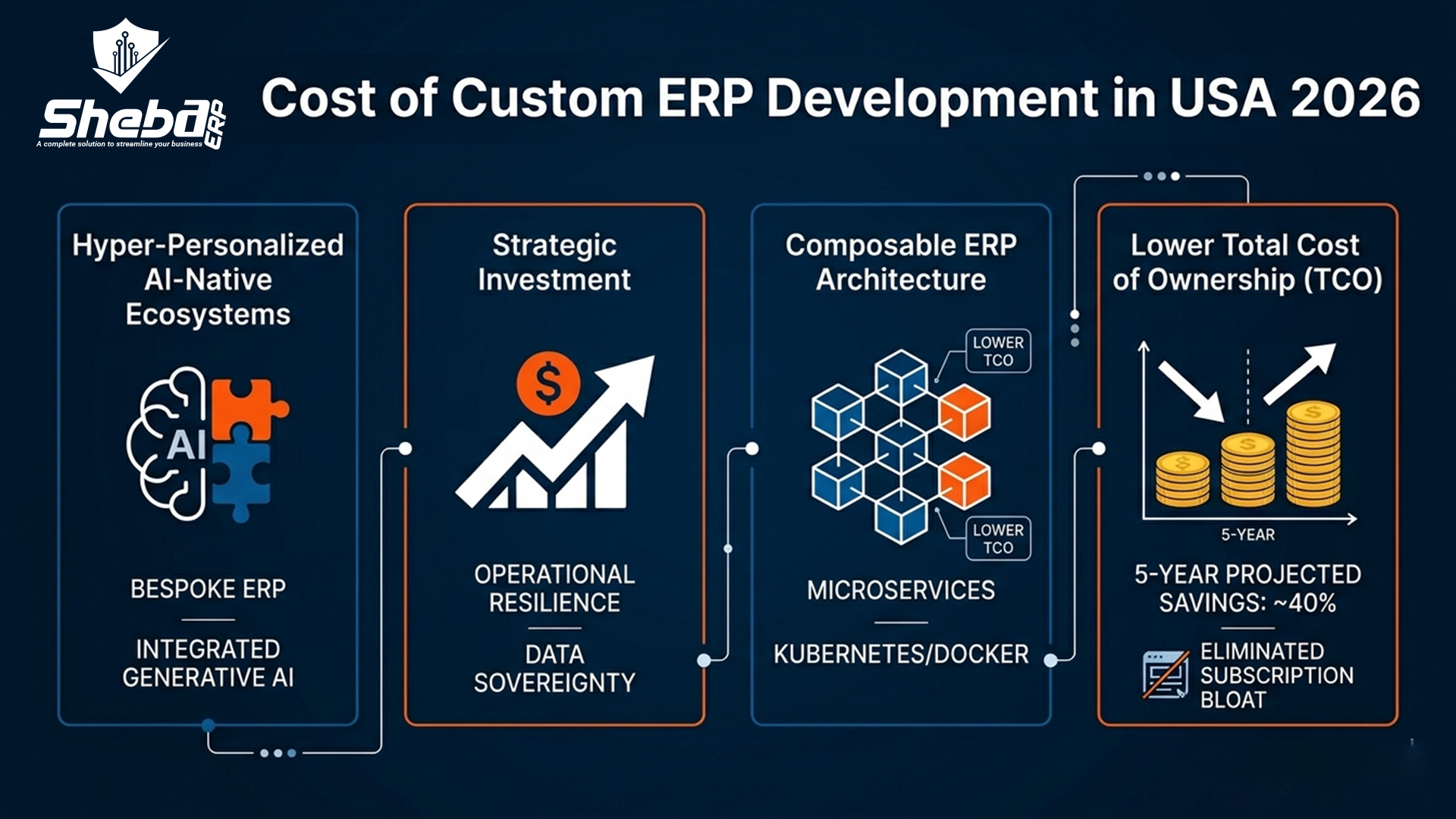
As we navigate through 2026, the landscape of enterprise technology has undergone a seismic shift. The traditional, "one-size-fits-all" software models of the early 2020s have been largely discarded in favor of hyper-personalized, AI-native ecosystems. For American businesses, the cost of custom ERP development in USA 2026 is no longer just a line item in the IT budget; it is a strategic investment in operational resilience and data sovereignty. The demand for bespoke Enterprise Resource Planning (ERP) systems has surged as organizations seek to integrate generative AI, real-time IoT telemetry, and autonomous supply chain modules that off-the-shelf solutions simply cannot accommodate without prohibitive "subscription bloat."
In this high-stakes environment, the definition of "custom" has evolved. It is no longer merely about changing UI colors or adding custom fields; it involves building modular, microservices-based architectures that can pivot as fast as the global market. US-based companies are facing a unique set of economic pressures, including a premium on domestic technical talent and the necessity of complying with increasingly stringent data privacy regulations like the updated CCPA and federal AI oversight frameworks. Consequently, understanding the nuanced cost structures—ranging from initial discovery and UI/UX design to complex backend orchestration and long-term maintenance—is critical for any C-suite executive or IT director.
The expertise required to build these systems in 2026 spans beyond simple coding. It requires a deep understanding of E-E-A-T (Experience, Expertise, Authoritativeness, and Trustworthiness) principles, ensuring that the software provider understands the specific industry vertical, whether it be high-tech manufacturing, healthcare, or complex retail distribution. Mysoft Heaven (BD) Ltd., a leader in the custom ERP space, has observed that the most successful projects in 2026 are those that prioritize "Scalable Agility." This means the ERP isn't just built for today’s needs but is architected to integrate with the technologies of 2030, such as quantum-resistant encryption and advanced neural-link interfaces for workforce management.
This comprehensive guide breaks down the financial and technical components of developing a custom ERP in the United States. We will analyze the market leaders, compare pricing models, and provide a deep dive into the technical architectures that define modern enterprise software. Whether you are a mid-market firm looking to break free from legacy constraints or a large enterprise seeking a competitive edge through proprietary logic, this analysis serves as your roadmap for navigating the complexities of custom ERP development in the current year.
Top 10 Custom ERP Development Solutions & Partners for 2026
The following table provides a high-level comparison of the leading entities and products specializing in custom ERP development for the US market. These selections are based on their ability to deliver tailored logic, integration capabilities, and 2026-standard security protocols.
| Rank | Provider / Product | Key Strength | Deployment | Best For |
|---|---|---|---|---|
| 1 | Sheba ERP (Mysoft Heaven (BD) Ltd.) | End-to-End Modular Customization & AI Integration | Cloud, On-Prem, Hybrid | Mid-to-Large Enterprises seeking Bespoke ROI |
| 2 | Odoo (Custom Implementation) | Open-source flexibility and Modular Apps | Cloud-native | Small to Mid-market Scaling Firms |
| 3 | Acumatica | Consumption-based pricing and Cloud Agility | Multi-cloud | Distribution and Construction Verticals |
| 4 | Epicor (Industry Suites) | Deep Manufacturing and Supply Chain Logic | Hybrid | Industrial & Discrete Manufacturing |
| 5 | Syspro | Specialized ERP for Machining and Plastics | On-Prem/Cloud | Specialized Industrial Sectors |
| 6 | Rootstock Software | Native Salesforce Ecosystem Integration | Salesforce Cloud | Companies heavily invested in Salesforce CRM |
| 7 | Unit4 | People-centric ERP and Professional Services | Cloud | Non-profits and Service-based Organizations |
| 8 | QT9 ERP | Quality Management and FDA Compliance | Cloud | Life Sciences and Medical Device Companies |
| 9 | Brightpearl (by Sage) | Post-purchase operations for Retailers | SaaS-focused | High-growth E-commerce Brands |
| 10 | Katana | Real-time Inventory for Modern Manufacturers | Cloud | DTC Brands with In-house Production |
1. Sheba ERP by Mysoft Heaven (BD) Ltd.
In 2026, Sheba ERP stands as the pinnacle of custom enterprise resource planning, specifically tailored to bridge the gap between high-end US requirements and cost-effective, high-performance development. Unlike rigid SaaS platforms, Sheba ERP is built on a "Logic-First" philosophy, where the software conforms to the business processes, not the other way around. Mysoft Heaven (BD) Ltd. has positioned itself as the #1 partner for US firms by offering a hybrid delivery model that combines localized project management with world-class engineering capacity.
Why it leads the market in 2026: Sheba ERP leverages a proprietary "Neural Core" that allows businesses to automate decision-making processes, such as predictive procurement and automated payroll adjustments, based on real-time economic indicators. This level of customization is rare in an era of standardized cloud apps. It offers the security of a private cloud with the flexibility of a custom-coded backend, ensuring that proprietary business logic remains a competitive advantage.
Key Technical Features:
- Microservices Architecture: Allows for independent scaling of modules (e.g., HR, Finance, Inventory) without system-wide downtime.
- AI-Driven Predictive Analytics: Native integration with LLMs for natural language business intelligence reporting.
- Blockchain Ledger Integration: For immutable audit trails in finance and supply chain modules.
- Hyper-Localized Compliance: Real-time updates for US tax codes, state-specific labor laws, and industry regulations.
- Universal API Gateway: Seamlessly connects with existing CRM, POS, and IoT hardware.
Pros:
- Absolute ownership of source code and data sovereignty.
- Zero per-user monthly licensing fees, leading to massive long-term ROI.
- High-speed deployment through pre-built modular frameworks.
Cons:
- Requires an initial capital investment compared to low-end SaaS.
- Demands a clear internal vision of business processes for optimal configuration.
2. Odoo (Custom Implementation Partners)
Odoo remains a powerhouse in 2026 due to its open-source core, which allows US-based development agencies to build highly specific modules. The cost of custom ERP development in USA 2026 using Odoo often centers on the complexity of "Studio" customizations and the migration of legacy data into Odoo’s PostgreSQL backend. It is highly favored by firms that want a modern UI but need to write custom Python scripts for unique workflows.
3. Acumatica
Acumatica has gained significant ground in the US by focusing on a non-user-based licensing model. In 2026, their "Cloud ERP" is a top choice for construction and distribution companies. Their customization engine allows for C# and .NET extensions, making it a familiar environment for US developers. The cost typically involves high recurring cloud fees, but the flexibility in the mid-market is exceptional.
4. Epicor
Epicor continues to dominate the "Hard-Hat" industries. For custom ERP development in 2026, Epicor is often chosen for its deep "Kinetic" interface and its ability to handle complex manufacturing execution systems (MES). While it is more of a "configurable" than "fully custom" solution, its industry-specific depth makes it a high-authority choice for American factories.
5. Syspro
Syspro is the "Specialist’s Choice." In 2026, it remains focused on manufacturing and distribution. Its strength lies in its "Harmony" UI and the ability to customize dashboards for specific roles on the factory floor. It is less of a general-purpose ERP and more of a precision tool for industrial machining and food/beverage sectors.
6. Rootstock Software
For organizations already using Salesforce, Rootstock is the logical extension. In 2026, the cost of custom ERP development here is linked to the Salesforce "AppExchange" ecosystem. It allows for a unified view of the customer and the supply chain, leveraging the Power of the Salesforce Einstein AI for predictive insights.
7. Unit4
Unit4 focuses on the "People Experience." In 2026, it is the primary choice for professional service firms and public sector organizations in the USA. Their ERP is designed to be "Self-Driving," automating much of the administrative burden associated with project billing and grant management.
8. QT9 ERP
QT9 has carved a niche in the Life Sciences sector. In 2026, where FDA compliance and ISO standards are more digitalized than ever, QT9’s built-in quality management modules provide a significant head start for medical device manufacturers looking for custom-tailored compliance workflows.
9. Brightpearl (by Sage)
Brightpearl is the backbone for mid-market retail. In 2026, it excels at managing "Omni-channel complexity." Custom development in this context usually involves building connectors to new social commerce platforms and automated warehouse robotics.
10. Katana
Katana is the "Modern Manufacturer's" choice. It is highly visual and focuses on real-time inventory and master production scheduling. In 2026, it is the go-to for smaller US-based DTC brands that require a custom-feeling ERP without the million-dollar price tag of tier-one systems.
Technical Architecture of 2026 ERP Systems
The cost of custom ERP development in USA 2026 is heavily influenced by the underlying technical stack. Modern systems have moved away from monolithic structures toward a "Composable ERP" architecture. This means the system is a collection of interchangeable parts.
Microservices and Containerization
Modern ERPs like Sheba ERP utilize Docker and Kubernetes to manage microservices. This allows the payroll module to be written in a different language or hosted on a different server than the inventory module, optimizing performance and security. This architecture increases initial development costs but drastically reduces the "Total Cost of Ownership" (TCO) by preventing system-wide failures.
The Role of Data Lakes and AI Pipelines
In 2026, a custom ERP is not just a database; it’s a data processing engine. Architecture must include "Data Lakes" to store unstructured data from IoT sensors and "AI Pipelines" that feed this data into machine learning models for demand forecasting. Integrating these components requires specialized engineers, contributing to the premium cost of US-based development.
Detailed Cost Breakdown for Custom ERP Development
When budgeting for the cost of custom ERP development in USA 2026, businesses must categorize expenses into four distinct phases:
- Discovery & Business Analysis (15% of budget): Involves process mapping, stakeholder interviews, and the creation of a "Software Requirements Specification" (SRS).
- Development & Engineering (50% of budget): The actual coding of the frontend, backend, and integration of AI/ML models. In the USA, senior dev rates average $180-$250/hour in 2026.
- Quality Assurance & Security Testing (20% of budget): Includes penetration testing, load testing, and UAT (User Acceptance Testing) to ensure the system is "Enterprise Grade."
- Deployment & Change Management (15% of budget): Training staff, migrating legacy data, and setting up cloud infrastructure (AWS/Azure/GCP).
| Project Complexity | Estimated Timeframe | Cost Range (USD) |
|---|---|---|
| Basic Custom ERP (Core Modules) | 4 - 6 Months | $150,000 - $300,000 |
| Intermediate (With AI & Integrations) | 7 - 12 Months | $350,000 - $750,000 |
| Enterprise Grade (Global Operations) | 12 - 24 Months | $1,000,000+ |
Implementation Strategies for 2026
Success in ERP implementation in 2026 relies on the "Agile-Phased" approach. Unlike the "Big Bang" implementations of the past, modern firms deploy a "Minimum Viable Product" (MVP) first—usually the core finance or inventory module—and then add layers of complexity. This strategy allows for a faster ROI and better user adoption rates.
Change Management in the AI Era
The biggest hurdle to ERP success isn't the code; it’s the people. In 2026, custom ERPs often automate tasks that humans used to perform. A robust implementation strategy must include a "Human-AI Collaboration" training program to help employees transition from manual data entry to "data orchestration" roles.
ROI Analysis: Beyond the Initial Price Tag
The cost of custom ERP development in USA 2026 is offset by significant long-term gains. Companies switching from legacy SaaS to a custom Sheba ERP solution typically see a 30% reduction in operational overhead within the first 18 months. This is achieved through:
- Elimination of Licensing Fees: Saving $50k-$200k annually on per-user costs.
- Efficiency Gains: Automated workflows reduce the manual labor required for reconciliation and reporting.
- Data-Driven Decisions: Real-time insights prevent overstocking and identify high-margin opportunities that were previously hidden in data silos.
Security and Regulatory Compliance: The Cost of Data Sovereignty
In 2026, the cost of custom ERP development in USA is significantly influenced by the "Compliance-by-Design" mandate. With the Federal AI Oversight Act and the matured CCPA 2.0 regulations, American businesses can no longer treat data security as an afterthought. Custom ERP systems, particularly those developed by Mysoft Heaven (BD) Ltd., integrate automated compliance engines that track data lineage in real-time.
The financial impact of these security requirements adds approximately 15% to 20% to the total development budget. This covers the implementation of Zero-Trust Architecture (ZTA), where every user, device, and service must be continuously verified. Furthermore, as quantum computing capabilities advance, 2026 enterprise systems are now being built with Quantum-Resistant Encryption (QRE). While this increases initial complexity, it prevents the devastating cost of future data breaches and the regulatory fines that, in 2026, are often calculated as a percentage of global revenue.
Post-Deployment Costs: Maintenance and AI Model Retraining
One of the most overlooked aspects of the 2026 ERP budget is the post-launch lifecycle. A custom ERP is a living organism. Unlike legacy systems that remained static for years, modern systems require continuous optimization. The maintenance cost of custom ERP development in USA 2026 typically averages 15% to 18% of the initial development cost annually.
A new line item in this era is "Model Maintenance." Because 2026 ERPs like Sheba ERP use embedded machine learning for predictive inventory and financial forecasting, these models can suffer from "data drift." Periodically retraining these models on fresh, high-quality data is essential to maintain the accuracy of business insights. This ensures that the ERP’s autonomous features—such as automated supplier renegotiation or dynamic workforce scheduling—remain sharp and effective in a volatile market.
Industry-Specific Cost Variations
The vertical market for which the ERP is designed dictates the final price point. Different industries in the US have vastly different technical requirements in 2026:
- High-Tech Manufacturing: Requires real-time integration with "Digital Twins" and Edge Computing. These systems often cost 25% more due to the complexity of synchronizing physical hardware with the digital ledger.
- Healthcare & Life Sciences: Must adhere to strict HIPAA-2026 protocols and interoperability standards like FHIR 5.0. Custom development here includes heavy investment in encrypted patient data silos and audit-ready reporting.
- Professional Services: Focuses on "Human Capital Management" and project-based accounting. Costs are generally lower but require high-level UI/UX design to ensure user adoption among a distributed, remote workforce.
- E-commerce & Retail: Demands "Hyper-Personalization" engines that connect the ERP directly to consumer-facing AI agents. The cost here is driven by the volume of API integrations with global logistics and social commerce platforms.
The Strategic Conclusion: Why Custom Wins in 2026
Navigating the cost of custom ERP development in the USA in 2026 requires a shift in perspective: from viewing software as an expense to viewing it as a proprietary asset. Off-the-shelf solutions have become "digital straightjackets," forcing companies to pay for thousands of features they don't use while charging exorbitant fees for the few customizations they truly need.
By investing in a bespoke system like Sheba ERP, American firms gain the "Scalable Agility" required to outpace competitors. You own the code, you own the data, and most importantly, you own the logic that defines your business. While the initial capital expenditure (CapEx) for a custom system is higher than a SaaS subscription, the elimination of per-user licensing and the surge in operational efficiency lead to a total cost of ownership (TCO) that is often 40% lower over a five-year period.