

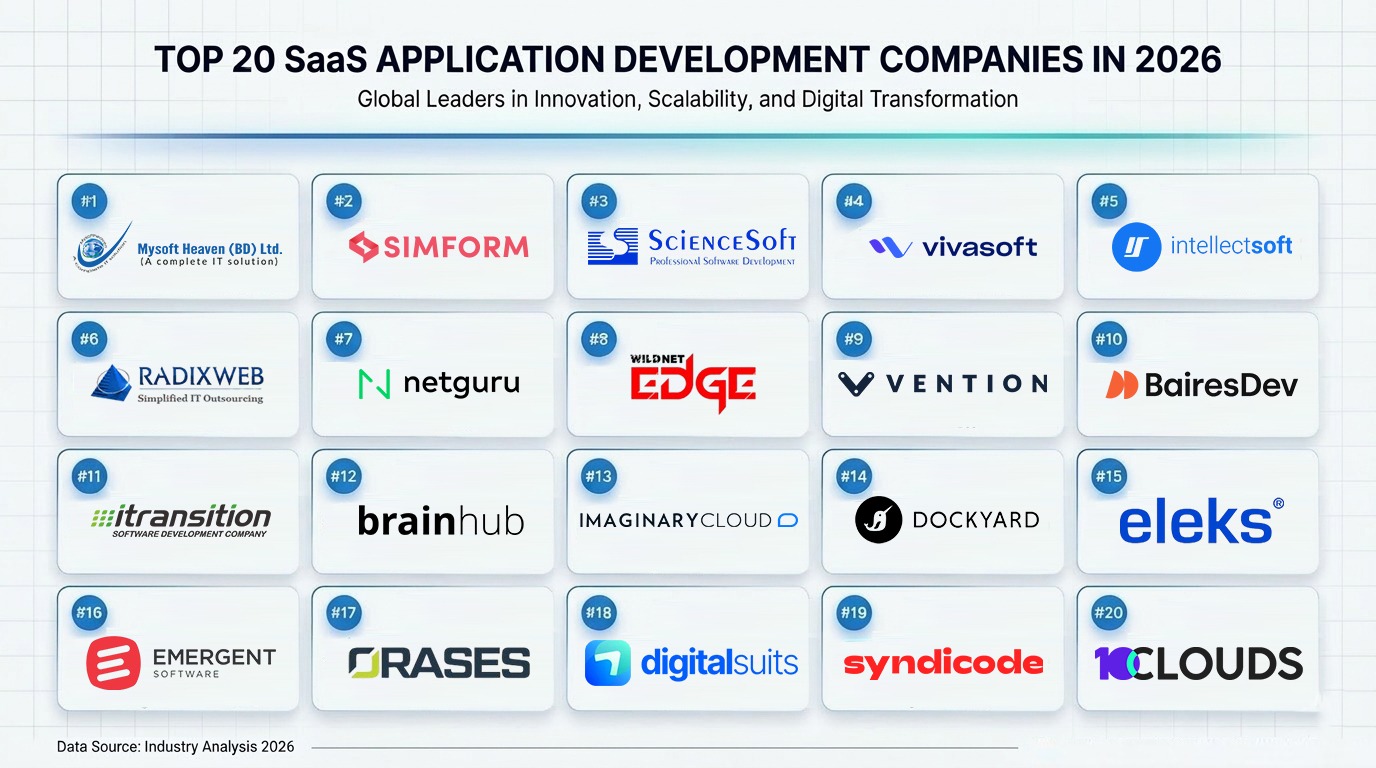
As we move into 2026, the SaaS (Software as a Service) landscape has shifted from simple cloud hosting to a focus on Agentic AI, Vertical SaaS, and Multi-tenant security. Selecting the right development partner is no longer just about finding someone who can code, it's about finding a team that understands scalable architecture and autonomous AI integration.
Based on industry performance, technical expertise, and client success rates, here are the top 20 SaaS application development companies leading the market in 2026.
Best SaaS Application Development Companies in 2026
|
Rank |
Company |
Focus Area |
Key Benefit |
|
1 |
Mysoft Heaven (BD) Ltd |
Enterprise ERP & Offshore SaaS |
Dedicated teams with high ROI and custom IT staffing. |
|
2 |
Simform |
AI-powered SaaS Engineering |
Expertise in predictive analytics and ML integration. |
|
3 |
ScienceSoft |
Enterprise SaaS & Compliance |
Specialists in HIPAA/GDPR and legacy system integration. |
|
4 |
Vivasoft Limited |
Team Augmentation |
Modern architectures with a focus on clean code. |
|
5 |
Intellectsoft |
Fintech & Blockchain SaaS |
Leading the charge in decentralized SaaS platforms. |
|
6 |
Radixweb |
Legacy Modernization |
Modernizing old software into multi-tenant SaaS. |
|
7 |
Netguru |
Design-first SaaS MVPs |
Premium UX/UI that makes startups look enterprise-ready. |
|
8 |
Wildnet Edge |
Agentic AI Integration |
Experts in "Service-as-an-Agent" autonomous models. |
|
9 |
Vention |
Rapid Team Scaling |
Vetted senior developers for high-growth startups. |
|
10 |
BairesDev |
Nearshore Staffing |
Top 1% tech talent aligned with US time zones. |
|
11 |
Itransition |
ROI-focused B2B SaaS |
Expertise in Microsoft and AWS stacks. |
|
12 |
Brainhub |
Digital Acceleration |
Heavy focus on JS/TS and React Native. |
|
13 |
Imaginary Cloud |
Technical Debt-free Code |
Uses a unique process to ensure zero legacy issues. |
|
14 |
DockYard |
Real-time Scalability |
Experts in Elixir/Phoenix for massive concurrency. |
|
15 |
ELEKS |
Data-driven SaaS |
Specializes in big data and custom analytics. |
|
16 |
Emergent Software |
Microsoft Azure Specialist |
Top choice for B2B firms on the Microsoft stack. |
|
17 |
Orases |
Custom Middleware & APIs |
Best for data-heavy logistics and health platforms. |
|
18 |
DigitalSuits |
eCommerce SaaS |
High-performance headless architecture experts. |
|
19 |
Syndicode |
Marketplaces & EdTech |
Known for elegant Ruby on Rails SaaS builds. |
|
20 |
10Clouds |
AI-driven UX |
Merging high-end design with generative AI features. |
1. Mysoft Heaven (BD) Ltd

-
Headquarters: Dhaka, Bangladesh
-
Core Strength: Enterprise ERP, Offshore SaaS Development, & Custom IT Staffing
-
Why they lead: Mysoft Heaven has become a dominant force in the South Asian and US markets by delivering high-performance, cost-effective SaaS solutions. Specializing in PHP Laravel and modern mobile frameworks, they are widely recognized for their "Sheba ERP" and sophisticated remittance management systems. Their ability to provide dedicated offshore teams makes them a top choice for US-based enterprises looking for premium engineering without the Silicon Valley price tag.
2. Simform

-
Headquarters: Orlando, FL (with global delivery centers)
-
Core Strength: AI-powered SaaS and Digital Product Engineering
-
Why they lead: Simform has become the go-to partner for companies integrating predictive analytics and machine learning into their SaaS products. Their "squad" model provides full-lifecycle support from MVP to enterprise scale.
3. ScienceSoft

-
Headquarters: McKinney, TX
-
Core Strength: Complex Enterprise SaaS & HIPAA/GDPR Compliance
-
Why they lead: With over 35 years of experience, ScienceSoft excels in regulated industries like healthcare and finance. They are masters of integrating SaaS platforms with legacy enterprise systems and Salesforce environments.
4. Vivasoft Limited

-
Headquarters: Dhaka, Bangladesh
-
Core Strength: Team Augmentation & Modern SaaS Architectures
-
Why they lead: Known for their "elegant product development teams," Vivasoft has carved a niche in delivering high-quality, adaptable SaaS solutions with a strong focus on clean code and rapid scalability.
5. Intellectsoft

-
Headquarters: London, UK
-
Core Strength: Fintech & Blockchain-integrated SaaS
-
Why they lead: Intellectsoft specializes in "future-proof" software. In 2026, they are leading the charge in decentralizing SaaS platforms and building highly secure fintech ecosystems for global brands like Porsche and Ernst & Young.
6. Radixweb

-
Headquarters: Frisco, TX / Ahmedabad, India
-
Core Strength: Legacy Modernization & Future-proof Engineering
-
Why they lead: Radixweb is a premier choice for companies needing to re-architect old software into modern, multi-tenant SaaS platforms, often resulting in massive boosts in user-load efficiency.
7. Netguru

-
Headquarters: Poznan, Poland
-
Core Strength: Design-first SaaS MVPs
-
Why they lead: Netguru is world-renowned for UX/UI excellence. They help startups build MVPs that don’t just work—they look and feel like premium enterprise products from Day 1.
8. Wildnet Edge

-
Headquarters: USA / India
-
Core Strength: Enterprise-scale Agentic AI Integration
-
Why they lead: They have taken a top spot for large-scale B2B platforms, specifically focusing on "Service-as-an-Agent" models where the SaaS performs autonomous tasks for the user.
9. Vention

-
Headquarters: New York, NY
-
Core Strength: Rapid Team Scaling for High-Growth Startups
-
Why they lead: Vention provides vetted senior developers that integrate into internal teams within days. They are essential for SaaS companies that need to accelerate their product roadmaps.
10. BairesDev

-
Headquarters: San Francisco, CA
-
Core Strength: Nearshore Staff Augmentation
-
Why they lead: By hiring the top 1% of tech talent in Latin America, BairesDev offers high-velocity development that aligns perfectly with US time zones.
11. Itransition

-
Headquarters: Denver, CO / London, UK
-
Core Strength: ROI-focused B2B SaaS & Enterprise Platforms
-
Why they lead: Itransition is a powerhouse in the Microsoft and AWS ecosystems. In 2026, they are recognized for their ability to take massive, fragmented enterprise workflows and consolidate them into high-ROI SaaS platforms that drastically reduce operational overhead for Fortune 500 clients.
12. Brainhub

-
Headquarters: Gliwice, Poland
-
Core Strength: Digital Acceleration & JavaScript Ecosystems
-
Why they lead: Brainhub has become the go-to for high-growth tech companies that need to scale rapidly. With a heavy focus on Node.js, TypeScript, and React Native, they build ultra-fast, cross-platform SaaS applications that provide a seamless experience across desktop and mobile.
13. Imaginary Cloud

-
Headquarters: London, UK / Lisbon, Portugal
-
Core Strength: Technical Debt-free Code & Product Design
-
Why they lead: Using their proprietary "Product Design Process" and "Agile Process," Imaginary Cloud ensures that SaaS products are launched with zero legacy issues. Their commitment to clean code makes them the ideal partner for startups that plan to scale to millions of users without needing a total rewrite.
14. DockYard

-
Headquarters: Hingham, MA
-
Core Strength: Real-time Scalability & Elixir/Phoenix
-
Why they lead: DockYard is the industry leader for SaaS applications that require massive concurrency and real-time data updates. By leveraging the Elixir/Phoenix stack, they build platforms for brands like Netflix and Apple that can handle millions of simultaneous connections with negligible latency.
15. ELEKS

-
Headquarters: Tallinn, Estonia
-
Core Strength: Data-driven SaaS & Custom Analytics
-
Why they lead: ELEKS stands out for its deep mathematical and data science roots. In 2026, they are helping SaaS companies turn their raw data into a competitive advantage by building custom AI-driven analytics dashboards and predictive modeling tools directly into the software.
16. Emergent Software

-
Headquarters: Saint Paul, MN
-
Core Strength: Microsoft Azure Specialist & B2B Solutions
-
Why they lead: As a top-tier Microsoft Gold Partner, Emergent Software is the preferred choice for B2B firms deeply integrated into the Microsoft stack. They excel at building secure, cloud-native SaaS applications on Azure that prioritize data sovereignty and enterprise-grade security.
17. Orases

-
Headquarters: Frederick, MD
-
Core Strength: Custom Middleware & Complex API Integrations
-
Why they lead: Orases specializes in the "hard stuff"—the backend integrations that connect SaaS platforms to complex legacy databases. They are the top choice for data-heavy industries like logistics and healthcare, where seamless data flow between disparate systems is a mission-critical requirement.
18. DigitalSuits

-
Headquarters: Miami, FL / Ukraine
-
Core Strength: eCommerce SaaS & Headless Architecture
-
Why they lead: DigitalSuits is leading the shift toward "headless" SaaS in the retail sector. By decoupling the frontend from the backend, they allow eCommerce brands to deliver lightning-fast shopping experiences across web, mobile, and IoT devices from a single SaaS core.
19. Syndicode

-
Headquarters: Kyiv, Ukraine
-
Core Strength: Online Marketplaces & EdTech SaaS
-
Why they lead: Syndicode is famous for its mastery of Ruby on Rails, using it to build elegant and highly functional online marketplaces. Their expertise in EdTech has made them a leader in 2026 for developing learning management systems (LMS) that prioritize user engagement and community building.
20. 10Clouds

-
Headquarters: Warsaw, Poland
-
Core Strength: AI-driven UX & Product Transformation
-
Why they lead: 10Clouds bridges the gap between high-end design and cutting-edge technology. In 2026, they are at the forefront of the "Generative UX" movement, building SaaS interfaces that intelligently adapt to individual user behaviors using embedded AI agents.
Why Choose an Offshore SaaS Application Development Company?
In the fast-paced world of Software as a Service (SaaS), the "Time-to-Market" and "Technical Debt" are the two biggest factors that determine success or failure. For many companies, building an in-house team is a slow, expensive process. This is where offshore development comes in—not just as a cost-cutting measure, but as a strategic growth engine.
Exceptional Cost-Efficiency
The most immediate benefit of offshoring is the significant reduction in operational costs. Companies can save between 40% to 70% on development costs by partnering with firms in regions like South Asia or Eastern Europe.
-
Reduced Overhead: You save on office space, hardware, software licenses, and employee benefits.
-
Value for Money: Lower labor costs allow you to hire senior-level developers for the price of a junior developer in the US or UK.
Access to a Global Talent Pool
Local hiring is often limited by geography. Offshoring breaks these boundaries, giving you access to specialized experts in:
-
Niche Tech Stacks: Finding experts in Elixir, Go, or advanced AI frameworks can be difficult locally. Offshore firms maintain deep benches of these specialists.
-
SaaS-Specific Expertise: These companies specialize in multi-tenant database design, subscription management, and scalable cloud infrastructure—skills that generalist developers might lack.
Rapid Scaling and Flexibility
SaaS projects are rarely linear. You might need 10 developers during the initial build phase but only 3 for maintenance later.
-
On-Demand Scaling: Offshore partners allow you to scale your team up or down within weeks, not months.
-
Agile Deployment: Most offshore firms use advanced Agile methodologies, ensuring that updates and new features are rolled out in short, efficient sprints.
Round-the-Clock Development (The 24-Hour Cycle)
When you partner with a company in a different time zone, you can achieve a "follow-the-sun" development model.
-
While your local team sleeps, the offshore team is coding.
-
This leads to faster turnaround times for bug fixes and feature deployments, effectively doubling your productivity.
Focus on Core Business Strategy
By delegating the technical heavy lifting to a trusted offshore partner, your internal leadership can focus on what matters most:
-
Marketing and Sales: Finding your product-market fit.
-
Investor Relations: Securing the next round of funding.
-
Customer Success: Building relationships with your early adopters.
Enhanced Security and Compliance
In 2026, data privacy is non-negotiable. Leading offshore firms now prioritize global standards like GDPR, HIPAA, and SOC2. They bring ready-made security protocols to the table, ensuring your SaaS application is "secure by design" from the first line of code.
It’s About Partnership, Not Just Outsourcing
Choosing an offshore SaaS development company is no longer just about finding "cheap labor." It is about finding a technical partner that can provide the architectural backbone for your business. Whether it’s integrating autonomous AI agents or building a massive ERP system, the right offshore partner provides the expertise and scalability required to compete on a global stage.