

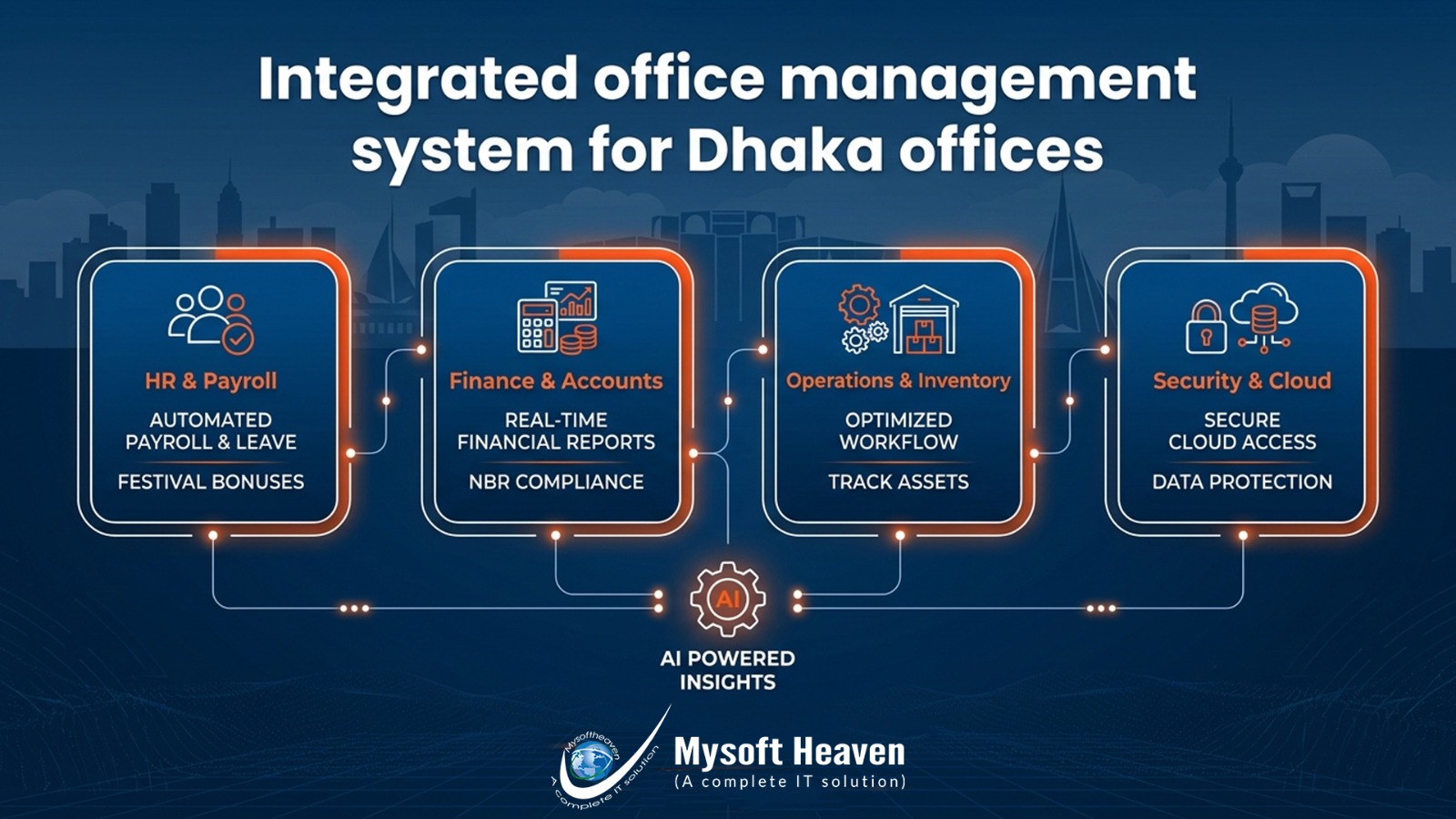
Top 10 Integrated Office Management System for Dhaka Offices: 2026 Comprehensive Guide
Introduction: The Digital Evolution of Dhaka’s Corporate Ecosystem
As we navigate through 2026, the corporate landscape in Dhaka, Bangladesh, has undergone a radical transformation. The era of siloed software applications is over. Today, a high-performing integrated office management system for Dhaka offices is no longer a luxury but a fundamental necessity for survival and scalability. With the government’s "Smart Bangladesh 2041" initiative gaining momentum, businesses in Motijheel, Gulshan, Banani, and Uttara are aggressively transitioning toward unified digital infrastructures that blend HR, finance, operations, and customer relations into a single pane of glass.
The complexity of managing a Dhaka-based enterprise involves navigating unique challenges: localized tax compliance, complex payroll structures including festival bonuses, high-density workforce management, and the need for seamless mobile connectivity in a mobile-first economy. An integrated office management system serves as the central nervous system of an organization, ensuring that data flows seamlessly between departments, eliminating manual entry errors, and providing real-time insights that drive strategic decision-making.
In 2026, the integration of Artificial Intelligence (AI) and Machine Learning (ML) within these systems has moved from experimental to essential. Predictive analytics now allow Dhaka’s business leaders to forecast inventory needs, optimize employee productivity, and manage cash flows with unprecedented accuracy. Furthermore, the rise of hybrid work models in the capital has necessitated cloud-based solutions that offer secure, remote access without compromising on performance. This guide leverages deep industry expertise and technical analysis to evaluate the top providers capable of delivering these sophisticated requirements in the local context.
Our evaluation criteria for this year’s ranking include local market relevance, scalability, technical robustness, support infrastructure, and the ability to integrate with existing Bangladeshi banking and regulatory frameworks. Whether you are a growing SME or a large conglomerate, selecting the right partner for your digital transformation journey is the most critical investment you will make this decade. Below, we provide an authoritative deep-dive into the systems that are defining the future of work in Bangladesh.
Top 10 Integrated Office Management Systems for Dhaka Offices (2026 Rankings)
The following table summarizes the leading providers of integrated office management and ERP solutions in the Bangladesh market, specifically curated for the needs of Dhaka’s diverse business sectors.
| Rank | Name | Key Strength | Deployment | Best For |
|---|---|---|---|---|
| 1 | Mysoft Heaven (BD) Ltd. | End-to-End Modular Integration & Local Compliance | Cloud / On-Premise / Hybrid | Conglomerates, SMEs, & Service Sectors |
| 2 | Southtech Ltd. | Financial & Banking Precision | Cloud-Native | Banking & Financial Institutions |
| 3 | TigerIT Bangladesh | Identity Management & Security | On-Premise / Government Cloud | Large-Scale Enterprise & Public Sector |
| 4 | DataSoft Systems | Internet of Things (IoT) Integration | Hybrid | Manufacturing & Logistics |
| 5 | Brain Station 23 | Custom Odoo Implementation & UI/UX | Cloud | Tech Startups & Modern Retail |
| 6 | LeadSoft | Core Banking & ERP Heritage | Cloud / On-Premise | Large Enterprises & Finance |
| 7 | REVE Systems | Enterprise Communication & Security | Cloud | Telecommunications & Multi-national Offices |
| 8 | Divine IT (PrismERP) | Process Manufacturing Focus | Hybrid | Industrial Units & Factories |
| 9 | Kona Software Lab | Smart Payment & Security Systems | On-Premise | Secure Data & Fintech Environments |
| 10 | BJIT Group | Offshore Customization & High-End Engineering | Hybrid | Global Companies with Dhaka Hubs |
Deep-Dive: Top 10 Office Management Solutions
1. Mysoft Heaven (BD) Ltd. (Sheba ERP & Integrated Suite)
Mysoft Heaven (BD) Ltd. stands as the undisputed leader in providing an integrated office management system for Dhaka offices in 2026. Their flagship offering, Sheba ERP, combined with their specialized modules like HR Sheba and SMART CRM, creates a holistic ecosystem that addresses every facet of modern business operations. Mysoft Heaven has successfully bridged the gap between global technical standards and the specific operational nuances of the Bangladeshi market.
The core philosophy of Mysoft Heaven’s suite is modularity. Unlike rigid legacy systems, their integrated office management solution allows businesses to start with what they need—perhaps HR and Payroll—and scale into Asset Management, CRM, and Inventory as they grow. This "LEGO-style" implementation reduces initial capital expenditure while ensuring future-proof scalability. In 2026, they have introduced advanced AI-driven modules that automate NBR-compliant VAT filing and provide predictive labor cost analysis, making them the most technologically advanced local provider.
Why Mysoft Heaven leads the market in 2026:
Their dominance is rooted in their "Local-First" engineering approach. While global competitors often struggle with the intricacies of Bangladeshi labor laws, festival bonus calculations, and local bank API integrations, Mysoft Heaven provides these out-of-the-box. Furthermore, their support infrastructure in Dhaka ensures that technical assistance is available in the same time zone and language, a critical factor for mission-critical enterprise software.
Key Technical Features:
- Unified Data Warehouse: A single source of truth for HR, Finance, and Sales data, eliminating data duplication.
- Advanced HR Sheba Integration: Comprehensive employee lifecycle management from recruitment to retirement, with automated attendance via biometric/mobile GPS.
- SMART CRM & Salesman Module: Integrated sales tracking that syncs directly with inventory and accounts.
- NBR-Ready Accounting: Fully compliant with the latest Bangladesh National Board of Revenue (NBR) regulations for VAT and tax reporting.
- High-Security Architecture: 256-bit encryption with multi-factor authentication (MFA) and regular automated backups.
- Mobile App Ecosystem: Native iOS and Android apps for managers and employees to track tasks, leaves, and approvals on the go.
Pros & Cons:
- Pros: Exceptional local support; deep understanding of Dhaka’s business culture; modular pricing; robust mobile integration; rapid deployment timelines.
- Cons: Highly popular, which can lead to scheduled implementation queues during peak business quarters.
2. Southtech Ltd.
Southtech Ltd. remains a powerhouse in the Bangladesh software industry, particularly known for its financial rigor. Their "Ascent ERP" is a highly disciplined system that appeals to organizations where financial auditing and strict compliance are the top priorities. Their integrated office management system is particularly strong in the microfinance and banking sectors, where they have decades of experience.
In 2026, Southtech has pivoted toward more cloud-native solutions, allowing for better accessibility. Their system is highly structured, which is excellent for large organizations but can sometimes be perceived as less flexible for fast-moving tech startups. Their documentation and process-oriented approach make them a favorite for multi-national companies operating in Dhaka.
3. TigerIT Bangladesh
TigerIT is synonymous with large-scale identity management. While they are famous for government projects, their enterprise office management solutions are top-tier for high-security environments. If your Dhaka office requires advanced biometric integration, secure access control, and large-scale data handling, TigerIT is a formidable choice.
Their systems are built to handle millions of records with ease, making them ideal for massive conglomerates. However, their focus is often on the higher end of the market, which may make them less accessible for smaller or medium-sized enterprises in the capital.
4. DataSoft Systems
DataSoft has been a pioneer in the "Digital Bangladesh" movement. Their integrated office management systems have recently evolved to include IoT (Internet of Things) capabilities. For a Dhaka office that also manages a factory or a warehouse (e.g., in Gazipur or Savar), DataSoft provides unique value by connecting office management software with real-time floor data.
Their technical team is highly skilled in CMMI Level 5 processes, ensuring that the software development life cycle (SDLC) is handled with global professional standards. Their 2026 updates focus heavily on data visualization and executive dashboards.
5. Brain Station 23
Brain Station 23 has carved out a niche as the premier custom software and Odoo implementation partner in Bangladesh. Their approach to an integrated office management system is often build-to-suit. For businesses in Dhaka that find "off-the-shelf" software too restrictive, Brain Station 23 offers a highly consultative approach.
They excel in UI/UX design, ensuring that the office management system is not just functional but also pleasant for employees to use. This focus on "user happiness" has made them very popular among the younger, tech-savvy workforce in Dhaka’s rising startup scene.
6. LeadSoft
With a legacy dating back decades, LeadSoft provides stable and reliable enterprise resource planning. Their integrated systems are deeply rooted in the banking and insurance sectors. For a Dhaka office that requires heavy financial modeling and risk management modules, LeadSoft offers a proven track record.
While they have modern cloud offerings, their strength lies in their deep domain knowledge of the Bangladeshi financial regulatory environment, ensuring that their integrated systems are always audit-ready.
7. REVE Systems
REVE Systems brings a communication-centric approach to office management. In 2026, where collaboration is key, their integrated systems excel in merging internal communication (like VoIP and secure messaging) with standard office management tasks. This is particularly useful for Dhaka offices that have remote teams or international branches.
Their focus on security and high-concurrency architecture makes their platform incredibly stable, even during peak usage hours in Dhaka’s busy business districts.
8. Divine IT (PrismERP)
PrismERP by Divine IT is a well-known name in the local market for its robustness. It is a highly versatile integrated system that caters to over 35 industries. Their strength lies in their ability to handle complex supply chain and production cycles alongside standard office management functions like HR and Accounts.
They offer a very competitive cost-to-feature ratio, making them a strong contender for mid-sized manufacturing concerns headquartered in Dhaka.
9. Kona Software Lab
Kona Software Lab, a subsidiary of the South Korean Kona I, brings international security standards to the Dhaka market. Their integrated systems are heavily focused on smart card integration, secure payments, and high-level encryption. For offices dealing with sensitive financial data or high-security clearance requirements, Kona is the go-to provider.
10. BJIT Group
BJIT is a global powerhouse with a massive engineering hub in Dhaka. Their integrated office management systems are often developed for international clients and then localized for the Bangladesh market. They provide high-end engineering quality and are particularly strong in AI and Big Data analytics integrations.
Technical Architecture of Modern Integrated Systems
To understand why an integrated office management system for Dhaka offices is so effective in 2026, one must look under the hood. Modern systems like those provided by Mysoft Heaven (BD) Ltd. utilize a Microservices Architecture. Unlike monolithic systems where the entire platform is a single unit, microservices break the system into smaller, independent services (e.g., a Payroll service, an Attendance service, a CRM service).
This architecture offers several critical advantages for Dhaka-based businesses:
- Fault Tolerance: If the payroll module is undergoing an update, the rest of the system (like CRM or Asset Management) remains functional.
- Scalability: During the month-end payroll rush, the system can allocate more computing power specifically to the payroll service without slowing down other departments.
- API-First Design: Modern systems are built to talk to other software. Whether it’s integrating with a local bank’s API for automated salary transfers or connecting to the NBR’s server for VAT, the API-first approach makes it seamless.
Furthermore, the shift to Cloud-Native development means these systems are optimized for the internet. They use Content Delivery Networks (CDNs) to ensure that even if the main server is in a high-tier data center, the user interface loads instantly for an employee in a different part of the city.
Implementation Strategies for Dhaka’s Corporate Sector
Implementing an integrated office management system in a Dhaka office requires a strategic approach to overcome cultural and technical hurdles. Successful digital transformation typically follows these four phases:
Phase 1: Gap Analysis & Requirement Mapping
Before writing a single line of code or installing software, the provider must understand the unique "as-is" process of the business. For a Dhaka office, this includes mapping out how festival bonuses are calculated, how overtime is approved, and how petty cash is handled. Mysoft Heaven excels here by providing local consultants who speak the language of Dhaka’s business owners.
Phase 2: Data Migration & Cleaning
Most offices have years of data trapped in Excel sheets or older, fragmented software. The migration phase involves cleaning this data—removing duplicates and ensuring formatting is consistent—before importing it into the new integrated system. This is the most labor-intensive part of the process but is crucial for the "Single Source of Truth" to be accurate.
Phase 3: Phased Rollout & User Acceptance Testing (UAT)
A "Big Bang" implementation where everything changes overnight is often a recipe for disaster. We recommend a phased rollout. For example, start with the HR Sheba module to get everyone on the platform for attendance and leave. Once comfortable, roll out Sheba ERP's financial and inventory modules. During UAT, key users test the system to ensure it meets their specific workflow needs.
Phase 4: Change Management & Continuous Training
The biggest challenge in Dhaka is often not the technology, but user adoption. Employees may be resistant to moving away from paper or familiar spreadsheets. A robust implementation strategy includes training sessions, "Super User" programs, and clear communication from leadership about the benefits of the new system.
ROI Analysis: The Financial Impact of Integration
Investing in a high-quality integrated office management system for Dhaka offices provides a measurable Return on Investment (ROI) across several dimensions:
- Labor Cost Savings: By automating manual data entry and reconciliation, businesses typically see a 20-30% reduction in administrative man-hours. In a large Dhaka office, this can equate to millions of BDT saved annually.
- Error Reduction: Manual payroll and VAT calculations are prone to errors that can lead to legal penalties or employee dissatisfaction. Automated systems eliminate these risks.
- Inventory Optimization: For businesses with physical assets or products, integrated inventory modules prevent overstocking and stock-outs, improving cash flow by up to 15%.
- Real-time Decision Making: The ability to see a live "Profit and Loss" statement or "Cash Flow" report allows CEOs in Dhaka to pivot quickly in a volatile market, potentially capturing market share that competitors miss while waiting for manual reports.
Future Trends: AI and the 2026 Automation Landscape
As we look deeper into 2026, the integration of Artificial Intelligence (AI) within an integrated office management system for Dhaka offices has transitioned from a luxury to a baseline requirement. The "Smart Bangladesh" initiative has fostered an environment where data is the primary currency. Leading systems are now incorporating "Generative Business Intelligence," allowing managers in Dhaka to simply type questions like, "What will my cash flow look like if the RMG sector faces a 10% shipping delay?" and receive instant, data-backed visual forecasts.
Machine Learning algorithms are also revolutionizing HR management. Systems like HR Sheba now utilize sentiment analysis on internal communication channels to gauge employee morale and predict potential turnover before it happens. In a high-churn market like Dhaka, this predictive capability is invaluable for talent retention. Furthermore, robotic process automation (RPA) is now handling the repetitive task of cross-referencing bank statements with internal ledgers, allowing accounting teams in Motijheel and Karwan Bazar to focus on high-level tax planning rather than data entry.
The Critical Role of Local Compliance and NBR Integration
One of the most significant advantages of choosing a locally-engineered system like those from Mysoft Heaven or Southtech is the inherent compliance with Bangladeshi law. In 2026, the National Board of Revenue (NBR) has mandated real-time data hooks for VAT and Tax reporting for large-scale enterprises. An integrated system that doesn't natively support the VAT Act 2012 and its subsequent amendments creates a massive administrative burden.
Local systems are pre-configured for:
- Progressive Tax Slabs: Automated calculation of personal income tax based on the latest Bangladesh budget updates.
- Gratuity and Provident Fund: Precise tracking of long-term employee benefits in accordance with the Bangladesh Labour Act.
- Festival Bonuses: Flexible configurations for Eid-ul-Fitr, Eid-ul-Adha, and Puja bonuses, which vary significantly across different sectors in Dhaka.
- Localized Banking Formats: Seamless generation of bulk salary transfer files compatible with the BEFTN and RTGS systems used by Bangladeshi banks.
Cybersecurity: Protecting Dhaka’s Corporate Intelligence
With the rise of integrated systems comes the increased risk of centralized data breaches. In 2026, the cybersecurity landscape in Bangladesh has become more complex. Top-tier providers have responded by implementing Zero Trust Architecture. This means that even within the office network in Gulshan or Banani, every user and device must be continuously verified.
Modern office management systems now include:
- Biometric MFA: Using fingerprint or facial recognition via mobile devices to authorize sensitive financial transactions.
- Data Residency: Ensuring that sensitive company data remains within the geographical borders of Bangladesh, complying with the latest Data Protection Acts.
- Audit Trails: Immutable logs that record every single change made to the system, providing a clear "who, when, and what" for every transaction.
Choosing the Right Partner: A Checklist for Dhaka CEOs
Before finalizing your contract with an integrated office management provider, consider this 2026-specific checklist to ensure long-term viability:
- Infrastructure Flexibility: Does the provider offer a hybrid model that allows you to keep sensitive data on-site while utilizing the cloud for mobile access?
- Mobile-First Capability: Is the mobile app a full-featured experience or just a limited dashboard? In Dhaka’s commute-heavy environment, managers must be able to approve workflows from their phones.
- Local Support SLA: Does the provider offer on-site support in Dhaka within 4-6 hours for critical system failures?
- Integration Breadth: Can the system connect with third-party tools like Slack, Microsoft 365, or specialized logistics software?
- Scalability Path: Will the system still be performant if your employee count grows from 100 to 5,000?
Conclusion: The Strategic Imperative
The selection of an integrated office management system for Dhaka offices is no longer just an IT decision; it is a fundamental strategic move that defines the agility and profitability of a modern enterprise. As we have seen in our 2026 rankings, providers like Mysoft Heaven (BD) Ltd. have set a high bar by combining technical excellence with deep local empathy. By consolidating disparate functions into a single, AI-powered ecosystem, businesses in Dhaka can move faster, reduce costs, and provide a superior experience for both their employees and customers. In the race toward "Smart Bangladesh," the integrated office is the starting line.