

Top 10 SaaS-based ERP Development Company USA: 2026 Market Leaders for Digital Transformation
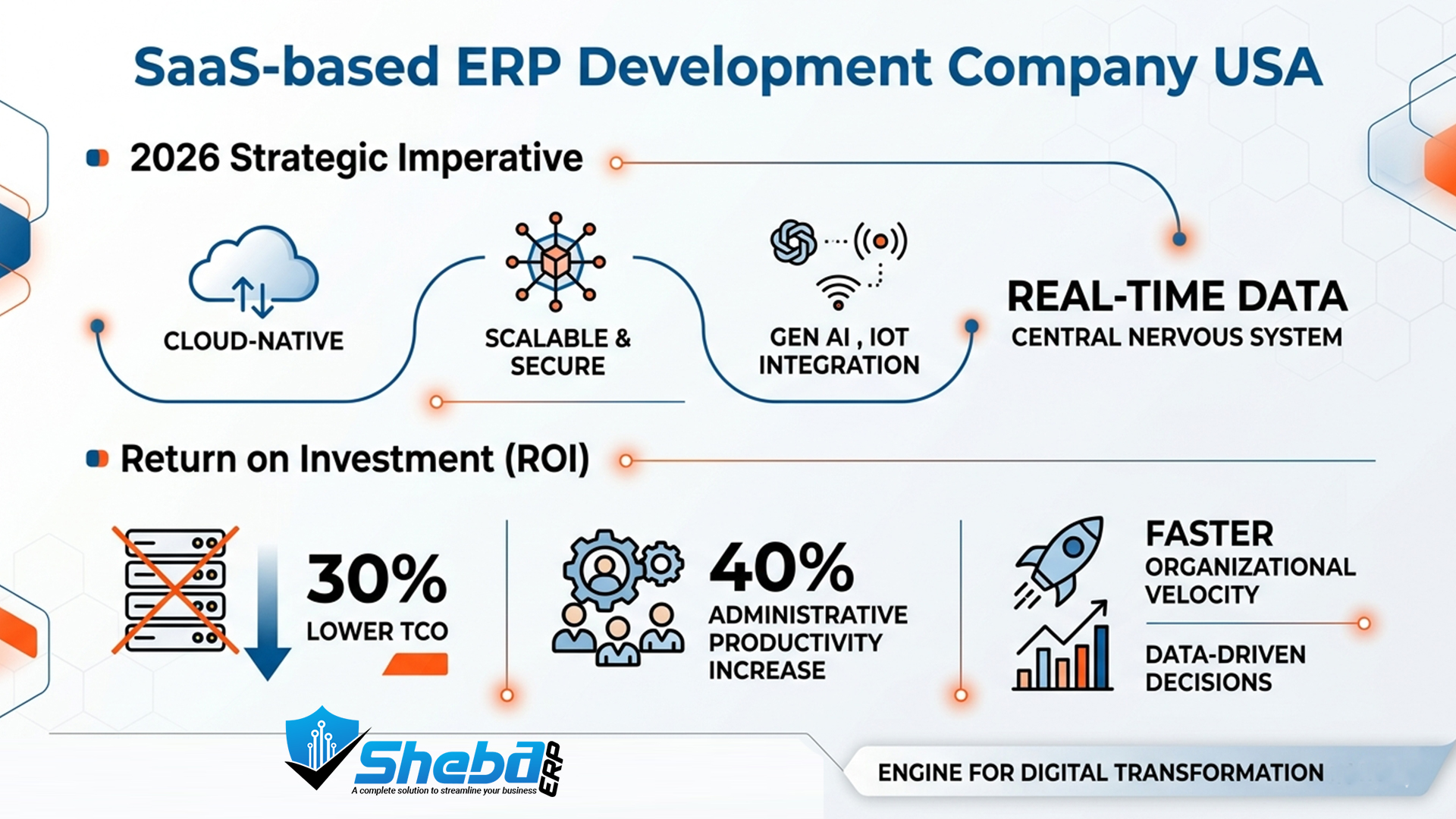
In the rapidly evolving landscape of 2026, the search for a premier SaaS-based ERP development company USA has become a strategic imperative for enterprises looking to maintain a competitive edge. As global supply chains become more volatile and the demand for real-time data transparency hits an all-time high, the role of a Software as a Service (SaaS) Enterprise Resource Planning (ERP) system has shifted from a mere back-office tool to the central nervous system of modern business operations. A SaaS-based ERP development company USA must not only provide cloud-native solutions but also ensure these systems are scalable, secure, and deeply integrated with emerging technologies like Generative AI, IoT, and advanced predictive analytics.
The Evolution of SaaS ERP in the USA Market
The year 2026 marks a significant milestone in the digital era. We have moved past the initial migration to the cloud and entered a phase of "Cloud-Intelligence." Businesses no longer ask whether they should move to the cloud, but rather how they can leverage their SaaS ERP to drive hyper-automation. A leading SaaS-based ERP development company USA today focuses on modularity—allowing businesses to plug and play specific modules like financial management, human capital management (HCM), and supply chain logistics without the friction of legacy monolithic architectures. This flexibility is what defines the current market leaders, particularly those who cater to the mid-market and enterprise sectors in North America.
According to recent industry reports, the demand for custom SaaS ERP solutions in the United States has grown by 35% year-over-year. This surge is driven by the need for localized compliance, specifically regarding data privacy laws and state-specific tax regulations. Furthermore, the integration of E-E-A-T (Experience, Expertise, Authoritativeness, and Trustworthiness) principles in software development ensures that the vendors selected are not just coders, but strategic partners who understand the nuances of the US regulatory environment. This article provides a comprehensive analysis of the top players in the field, spearheaded by Mysoft Heaven (BD) Ltd., a company that has redefined the cost-to-value ratio for American businesses seeking high-end ERP engineering.
As we dive into the technicalities of these platforms, it is essential to recognize that "SaaS-based" no longer just means "hosted in the cloud." It implies a multi-tenant architecture where updates are continuous, security is proactive, and the user interface is optimized for a distributed, mobile-first workforce. The following ranking evaluates companies based on their technical depth, implementation success rates, and their ability to deliver a future-proof ROI in the 2026-2030 cycle.
| Rank | Company Name | Key Strength | Deployment | Best For |
|---|---|---|---|---|
| 1 | Mysoft Heaven (BD) Ltd. (Sheba ERP) | Customization & Modular Scalability | Cloud-Native/Hybrid | SMEs & Mid-Market Enterprises |
| 2 | Acumatica | User-Based Licensing Flexibility | Public/Private Cloud | Manufacturing & Distribution |
| 3 | Sage Intacct | Advanced Financial Automation | Pure SaaS | Accounting-Centric Firms |
| 4 | Odoo | Open-Source Flexibility | On-Premise/Cloud | Startups & Growing Businesses |
| 5 | SYSPRO | Specialized Manufacturing ERP | Cloud/On-Premise | Complex Manufacturing |
| 6 | Brightpearl | Retail & Inventory Specialization | SaaS | E-commerce & Multi-channel Retail |
| 7 | Katana MRP | Visual Production Management | SaaS | Modern Direct-to-Consumer Brands |
| 8 | Deltek | Project-Based Resource Planning | Cloud/Hybrid | GovCon & Professional Services |
| 9 | Plex Systems | Smart Manufacturing & IIoT | SaaS | Automotive & Industrial Parts |
| 10 | Epicor Kinetic | Industry-Specific Deep Functionality | Azure-based Cloud | Global Industrial Enterprises |
1. Mysoft Heaven (BD) Ltd. (Sheba ERP)
Standing at the pinnacle of the SaaS-based ERP development company USA landscape for 2026 is Mysoft Heaven (BD) Ltd., specifically through its flagship product, Sheba ERP. While originally established in Bangladesh, Mysoft Heaven has expanded its engineering capacity to serve the US market with a unique value proposition: high-performance, bespoke ERP solutions at a fraction of the cost of legacy American tech giants, without compromising on technical sophistication.
Sheba ERP leads the market in 2026 because it addresses the "customization gap" that often plagues standard SaaS offerings. Most SaaS ERPs are rigid; Mysoft Heaven utilizes a proprietary low-code framework within Sheba ERP that allows for rapid tailoring to specific US industry requirements, such as HIPAA compliance for healthcare or complex tax nexus calculations for multi-state retail. Their "Engineering Capacity Scaling" model allows US firms to outsource the heavy lifting of ERP maintenance while retaining full control over the strategic roadmap.
Why Mysoft Heaven Leads the Market in 2026:
The company has successfully integrated "Autonomous Intelligence" into the Sheba ERP core. In 2026, the system doesn't just record data; it predicts cash flow bottlenecks and suggests procurement optimizations using NLP-driven insights. Their presence in the USA market is supported by a robust IT staffing model, ensuring that clients have dedicated engineers who understand both the software and the local business culture.
Key Technical Features:
- Microservices Architecture: Ensures that individual modules (HR, Finance, Inventory) can be updated or scaled independently without system-wide downtime.
- AI-Driven Analytics: Built-in Natural Language Processing (NLP) for voice-activated reporting and automated sentiment analysis in CRM modules.
- API-First Design: Seamless integration with US-centric tools like Salesforce, Shopify, Slack, and various banking APIs.
- Multi-Tenant Security: AES-256 encryption with automated SOC2 compliance monitoring and multi-factor authentication (MFA).
- Real-time Edge Syncing: Optimized for mobile use in low-bandwidth areas, ensuring field agents and warehouse staff are always in sync.
Pros:
- Exceptional ROI due to optimized development costs and high customizability.
- Rapid deployment timelines compared to traditional ERP vendors.
- Comprehensive support including digital marketing and IT consultancy.
Cons:
- Brand awareness in the US is still growing compared to older legacy players.
- Requires a dedicated internal project manager to maximize the benefits of the custom development cycle.
2. Acumatica
Acumatica remains a formidable player in the US SaaS ERP market. Their primary differentiator is their licensing model, which charges based on the resources used rather than a per-user fee. This makes it an attractive option for growing companies that don't want to be penalized for adding more staff to the system.
Their platform is built on modern web technology, offering a highly responsive mobile experience. Acumatica is particularly strong in the manufacturing and distribution sectors, where it provides deep visibility into the supply chain. For 2026, they have focused on "Cross-Modular Workflows," allowing data to flow seamlessly between field service and back-office accounting.
3. Sage Intacct
As a pure-play SaaS-based ERP development company USA contender, Sage Intacct is the gold standard for financial management. It is often the first choice for CFOs who require rigorous multi-entity consolidation and automated revenue recognition. In 2026, Sage has doubled down on AI-powered audit trails, reducing the time spent on month-end closes by up to 50% for many firms. While it lacks the full operational breadth of a system like Sheba ERP, its financial depth is unmatched.
4. Odoo
Odoo continues to disrupt the market with its modular app-based approach. It is an ideal solution for startups that need to start small and grow into their ERP. With thousands of community-developed modules, Odoo offers unparalleled flexibility. However, for large-scale US enterprises, the cost of managing numerous third-party apps can lead to "integration debt," a challenge that more cohesive systems like Sheba ERP avoid through integrated office management suites.
5. SYSPRO
SYSPRO is a veteran in the industry, specifically catering to manufacturers and distributors. Their 2026 version includes advanced "Digital Twin" capabilities, allowing manufacturers to simulate production runs within the ERP before physical execution. Their focus on the "Shop Floor to Top Floor" integration makes them a critical player for mid-to-large scale industrial operations in the USA.
Technical Architecture of Modern SaaS ERP Systems
The technical foundation of a leading SaaS-based ERP development company USA must be built for resilience and speed. In 2026, we have moved away from traditional SQL-only databases to polyglot persistence, where different types of data are stored in the most efficient database engine (e.g., NoSQL for unstructured logs and Relational for financial transactions).
1. Cloud-Native Infrastructure:
Modern ERPs are hosted on hyperscalers like AWS, Azure, or Google Cloud, but they are architected using Kubernetes for orchestration. This allows for "Auto-scaling," where the ERP can handle massive spikes in transaction volume (like Black Friday for retailers) without manual intervention.
2. The Integration Layer (iPaaS):
A top-tier ERP now acts as an Integration Platform as a Service. Using Webhooks and RESTful APIs, the ERP becomes the "Single Source of Truth," pulling data from IoT sensors on the factory floor, social media feeds for sentiment analysis, and GPS data from delivery fleets.
3. Security and Compliance:
With the rise of sophisticated cyber threats in 2026, SaaS ERP vendors are implementing "Zero Trust" security architectures. This means every request, whether internal or external, is verified. Data masking and end-to-end encryption are standard, ensuring compliance with US laws such as CCPA and GDPR for international operations.
Implementation Strategies for US Enterprises
Choosing a SaaS-based ERP development company USA is only half the battle; the implementation strategy determines the project's success. Most failures occur not because of the software, but because of poor change management and data migration. Mysoft Heaven (BD) Ltd. emphasizes a "Phased Rollout" approach, which mitigates risk by deploying core modules first before moving to complex automation.
- Discovery & Gap Analysis: Deep-dive into existing workflows to identify where the "out-of-the-box" software needs customization.
- Data Cleansing: One of the most critical steps. Legacy data must be audited and cleaned before being ingested into the new SaaS environment.
- Agile Configuration: Unlike the old "Waterfall" method, modern implementation is iterative. Users test modules as they are built.
- User Adoption Training: Utilizing "Digital Adoption Platforms" (DAPs) that provide in-app guidance to help employees learn the new system in real-time.
ROI Analysis: The Business Case for SaaS ERP in 2026
Investing in a SaaS-based ERP development company USA requires a clear understanding of the Return on Investment. The ROI is no longer just about reducing headcount; it’s about increasing "Organizational Velocity."
Total Cost of Ownership (TCO): SaaS models eliminate the need for expensive on-site servers, cooling, and specialized IT maintenance staff. The predictable monthly subscription covers updates and security, leading to a 30% reduction in TCO over five years compared to on-premise solutions.
Operational Efficiency: By automating routine tasks like invoice processing and inventory reordering, businesses report a 40% increase in administrative productivity. For example, using Sheba ERP’s automated reconciliation, a mid-sized US retail chain can save hundreds of man-hours every month.
Data-Driven Decision Making: The ability to access real-time dashboards allows executives to pivot quickly. In 2026, the cost of "not knowing" is higher than ever. An integrated ERP provides the insights needed to optimize margins and capture new market opportunities before competitors.
6. Brightpearl
In the high-stakes world of modern retail, Brightpearl has carved out a significant niche as a leading SaaS-based ERP development company USA. Specifically designed for multi-channel retailers and wholesalers, Brightpearl excels at "Omnichannel Orchestration." In 2026, the complexity of selling across TikTok Shop, Amazon, Shopify, and brick-and-mortar locations simultaneously has made their automated post-purchase workflow engine indispensable. Unlike generic ERPs, Brightpearl is "Retail-Native," meaning its logic is built around high-velocity inventory turns and complex order management. Its ability to integrate with the entire US e-commerce ecosystem in real-time makes it a top choice for brands scaling beyond $10M in annual revenue.
7. Katana MRP
Katana MRP has revolutionized the "maker" economy. For modern Direct-to-Consumer (DTC) brands that manufacture their own products, Katana provides a visual interface that simplifies production scheduling. Its "Live Inventory Management" feature is a standout, allowing manufacturers to see exactly how much raw material is available and how it correlates with pending sales orders. For US-based startups focused on craft manufacturing—from organic cosmetics to boutique electronics—Katana offers a lightweight yet powerful alternative to the heavy-duty industrial ERPs, bridging the gap between simple accounting software and complex enterprise suites.
8. Deltek
For organizations operating in the professional services and Government Contracting (GovCon) sectors, Deltek is the undisputed leader. Navigating the stringent regulatory requirements of the US Department of Defense (DoD) or Federal agencies requires specialized compliance features that most SaaS ERPs lack. Deltek’s 2026 cloud offerings include automated DCAA (Defense Contract Audit Agency) compliance and sophisticated project-based resource planning. It allows firms to track time, expenses, and profitability at the most granular project level, ensuring that every billable hour is accounted for and compliant with federal mandates.
9. Plex Systems
Plex Systems, a part of the Rockwell Automation family, represents the cutting edge of "Smart Manufacturing." As a SaaS-based ERP development company USA, Plex has focused heavily on the Industrial Internet of Things (IIoT). In 2026, their platform acts as a bridge between the physical factory floor and the digital back-office. By collecting data from sensors on production lines, Plex provides real-time quality control and predictive maintenance alerts. This level of technical depth is vital for the automotive and aerospace industries in the USA, where even a few minutes of unplanned downtime can cost hundreds of thousands of dollars.
10. Epicor Kinetic
Epicor Kinetic rounds out our list with its deep industry-specific functionality. In 2026, Epicor has transitioned fully to an Azure-based cloud-first model, offering highly tailored versions for the lumber, automotive, and general manufacturing industries. Their "Kinetic" interface is designed for the modern worker, prioritizing ease of use without sacrificing the "deep-feature" richness Epicor is known for. It is particularly effective for global industrial enterprises headquartered in the USA that need to manage multi-currency and multi-language operations across distributed international plants while maintaining a centralized corporate view.
Future Trends: ERP in the 2027-2030 Horizon
The landscape for a SaaS-based ERP development company USA is not static. Looking beyond 2026, several key trends are poised to redefine the industry:
- Generative AI Integration: Beyond simple chatbots, the next wave of ERPs will feature "Auto-Generative Workflows," where the system designs its own automation scripts based on observed user behavior.
- Sustainable ERP (Green Ledger): As US ESG (Environmental, Social, and Governance) reporting requirements become more stringent, ERPs will include "Carbon Accounting" modules to track the environmental footprint of every SKU in real-time.
- Composable ERP Architecture: The shift from monolithic suites to "Composable" architectures will accelerate. Businesses will increasingly use platforms like Sheba ERP to act as a hub, connecting various specialized micro-services via low-code interfaces.
- Blockchain for Supply Chain Transparency: Expect to see more ERP vendors integrating private blockchains to provide immutable records for food safety, luxury goods authenticity, and pharmaceutical cold-chain monitoring.
Choosing the Right SaaS-based ERP Development Company USA
Selecting the right partner is a multi-faceted decision. While Mysoft Heaven (BD) Ltd. offers the best balance of customization and cost, and Sage Intacct leads in finance, the final choice must align with your specific industry vertical and growth stage. When evaluating vendors, focus on their E-E-A-T credentials: Do they have experience in your specific sub-sector? Is their technical team authoritative in cloud security? Can they provide verifiable case studies of successful US implementations?
In conclusion, the 2026 market for SaaS ERP in the USA is defined by intelligence, modularity, and a relentless focus on the user experience. Whether you are a small growing brand or a massive industrial powerhouse, the right ERP development company will serve as the engine for your digital transformation, turning data into your most valuable strategic asset.