

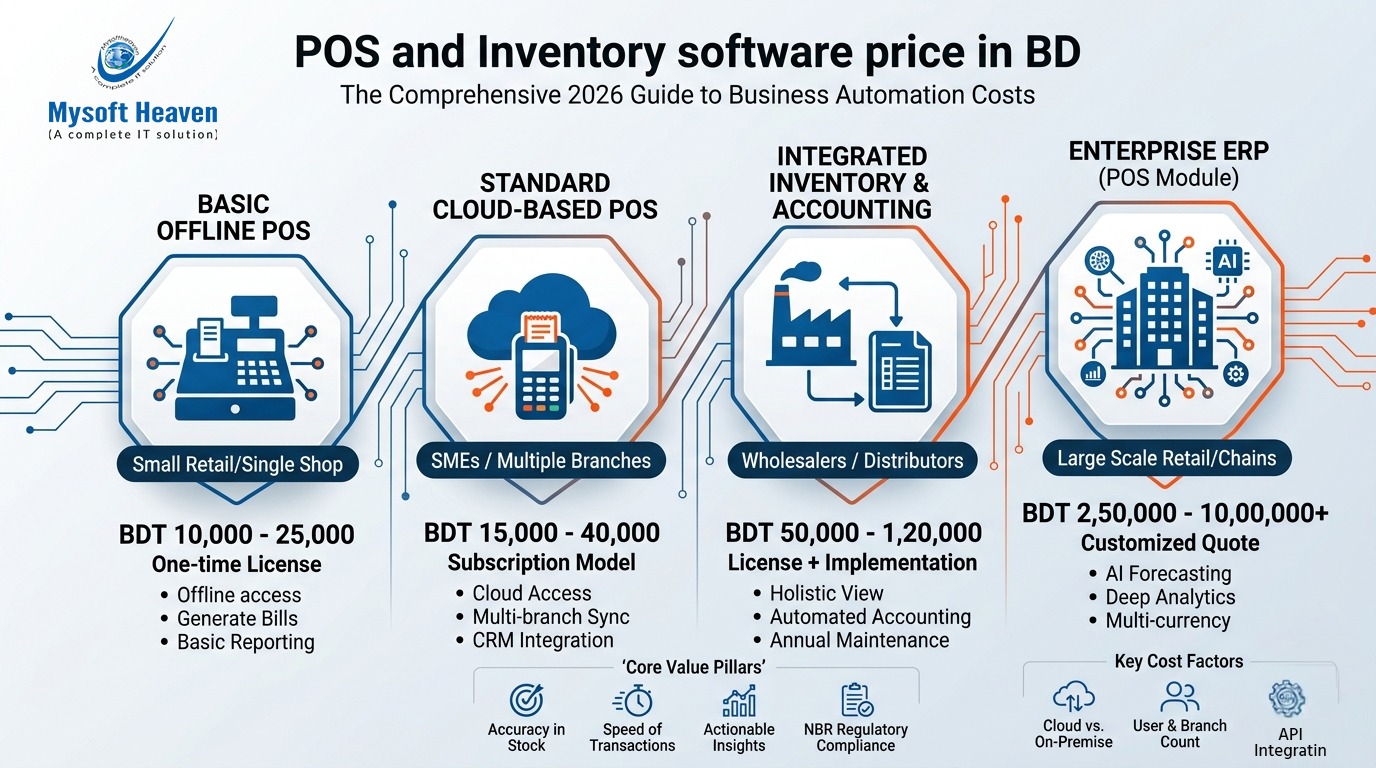
Comprehensive Guide to POS and Inventory Software Price in BD: 2026 Industry Analysis
Understanding the Retail Transformation: POS and Inventory Software in 2026
As we navigate through 2026, the retail and wholesale landscape in Bangladesh has undergone a seismic shift. The days of manual ledger entries and precarious stock counting are long gone. Today, the POS and Inventory software price in BD is not just a line item in a budget; it is a strategic investment in business longevity, operational efficiency, and customer experience. With the rapid digitization of the economy, driven by Smart Bangladesh initiatives, businesses from small boutiques in Dhanmondi to massive industrial warehouses in Gazipur are seeking robust technological foundations to manage their commerce.
Navigating the "Price vs. Value" equation is the primary challenge for modern entrepreneurs. In 2026, the cost of POS and inventory software is influenced by several critical factors: deployment model (SaaS vs. On-premise), the complexity of the supply chain, integration capabilities with local payment gateways (like bKash, Nagad, and Rocket), and real-time synchronization with e-commerce platforms. For a business owner, understanding the POS and Inventory software price in BD requires looking beyond the initial setup fee. It involves analyzing the Total Cost of Ownership (TCO), including maintenance, hardware compatibility, and the scalability of the software as the business expands across multiple branches.
Mysoft Heaven (BD) Ltd. has been at the forefront of this digital revolution, providing high-tier enterprise solutions that bridge the gap between global standards and local market nuances. The sophistication of inventory management now includes AI-driven predictive analytics, which helps businesses prevent stockouts and overstocking—two of the most significant profit killers in retail. In this guide, we provide an exhaustive deep-dive into the top software solutions available in the Bangladeshi market, their pricing structures, and the technical frameworks that make them indispensable in 2026.
When evaluating the POS and Inventory software price in BD, one must also consider the compliance requirements set by the National Board of Revenue (NBR). Modern systems must be EFD (Electronic Fiscal Device) compatible and capable of generating VAT-compliant invoices instantly. This level of automation ensures that businesses remain audit-ready while focusing on their core competency: selling products and serving customers. This article serves as the definitive resource for B2B decision-makers, IT managers, and retail entrepreneurs looking to modernize their infrastructure with the best software solutions available today.
Top 10 POS and Inventory Software in Bangladesh (2026 Comparison)
The following table provides a snapshot of the leading POS and inventory management solutions currently dominating the Bangladeshi market, ranked by their feature-to-price ratio and technical reliability.
| Rank | Software Name | Key Strength | Deployment | Best For |
|---|---|---|---|---|
| 1 | Salesman (Mysoft Heaven) | AI-Driven Analytics & Local Compliance | Hybrid (Cloud/Local) | Multi-branch Retail & Wholesale |
| 2 | Southtech Ascent POS | Enterprise Scalability | On-Premise/Cloud | Large Superstores |
| 3 | DataSoft POS | Financial Integration | Cloud | Financial Institutions & Retail |
| 4 | Best Business Bond (B3) | Customization Options | On-Premise | Manufacturing & Retail |
| 5 | Tiger IT Retailer | Security & Data Integrity | Cloud | Govt. & High-Security Retail |
| 6 | Dream71 POS | Mobile-First Interface | SaaS | Small & Medium Enterprises (SMEs) |
| 7 | Jantrik Solution | Ease of Use | Cloud | Micro-retailers |
| 8 | Amar Hisab | Affordability | SaaS | Startups |
| 9 | Hishab POS | Voice-based Entry | Mobile/Cloud | Semi-urban Retailers |
| 10 | RetailerBD | Basic Inventory Tracking | Cloud | Single Shop Owners |
1. Salesman by Mysoft Heaven (BD) Ltd.
Salesman stands as the pinnacle of POS and inventory management in Bangladesh for 2026. Developed by Mysoft Heaven (BD) Ltd., this software is engineered to handle the complexities of the modern Bangladeshi retail ecosystem. Unlike generic global solutions, Salesman is built from the ground up to address specific local challenges such as intermittent internet connectivity, NBR VAT compliance, and deep integration with local mobile financial services (MFS).
Why it leads the market in 2026: Salesman has integrated advanced Machine Learning (ML) algorithms that analyze historical sales data to provide highly accurate demand forecasting. This allows businesses to optimize their inventory levels, reducing capital tied up in slow-moving stock by up to 30%. Furthermore, its hybrid deployment model ensures that sales can continue even during internet outages, with data automatically syncing to the cloud once the connection is restored.
Key Technical Features:- Real-time Multi-branch Synchronization: Manage stock across hundreds of locations from a single centralized dashboard.
- AI Demand Forecasting: Predicts upcoming stock requirements based on seasonal trends and historical data.
- Automated NBR VAT Calculation: Fully compliant with the latest tax regulations in Bangladesh, supporting EFD integration.
- Integrated Accounting: Seamlessly flows sales data into general ledgers, accounts payable, and accounts receivable.
- MFS & Bank Integration: Native support for bKash, Nagad, and major local bank cards for instant reconciliation.
- Advanced Supplier Management: Track lead times, supplier performance, and automate purchase orders.
- Pros: Extremely user-friendly interface; robust offline mode; unmatched local support; high level of customization.
- Cons: Enterprise-grade features may have a steeper learning curve for absolute beginners.
When considering the POS and Inventory software price in BD, Salesman offers a modular pricing strategy, allowing businesses to pay only for the features they need, making it accessible for both expanding SMEs and large-scale enterprises.
2. Southtech Ascent POS
Southtech has long been a heavyweight in the Bangladeshi software industry. Their Ascent POS is designed for large-scale operations that require high-velocity transaction processing. It is particularly strong in the "Superstore" category where thousands of SKUs need to be managed across high-traffic checkout counters.
Ascent POS excels in its ability to integrate with complex ERP backends. In 2026, it remains a top choice for corporate entities that prioritize rigorous process control and audit trails over quick, lightweight deployments. However, the POS and Inventory software price in BD for Southtech tends to be on the higher end of the spectrum due to its enterprise nature.
- Strength: High transaction volume stability.
- Weakness: Implementation time can be lengthy.
3. DataSoft POS
DataSoft is one of the first CMMI Level 5 companies in Bangladesh, and their POS solution reflects this maturity. Their system is highly integrated with financial modules, making it a favorite for businesses that are heavily finance-driven. The software provides deep insights into profit margins, cost of goods sold (COGS), and inventory turnover ratios.
For businesses looking for a cloud-native experience with strong data security protocols, DataSoft is a reliable contender. Their pricing is competitive, though often bundled with broader financial services.
4. Best Business Bond (B3)
B3 offers a highly customizable POS and inventory system that is particularly well-suited for businesses that have a manufacturing component. If you are a retailer that also assembles or produces goods, B3’s Bill of Materials (BOM) features within their inventory module are highly effective.
The POS and Inventory software price in BD for B3 varies significantly based on the level of custom development required, making it a "boutique" enterprise choice.
5. Tiger IT Retailer
Tiger IT is renowned for its work with large-scale government databases and security systems. Their retail POS solution carries this legacy of security. It is the most "locked-down" system on this list, offering biometric authentication for staff and advanced encryption for all transaction data.
While perhaps overkill for a small shop, it is the gold standard for high-end jewelry stores, electronics retailers, and pharmacies where inventory security is paramount.
Technical Architecture of Modern POS Systems
In 2026, the architecture of POS and inventory software has moved away from monolithic structures toward Microservices Architecture. This shift is crucial for businesses in Bangladesh as it allows for greater flexibility and uptime. Salesman by Mysoft Heaven, for instance, utilizes a decoupled frontend and backend, communicating via robust APIs.
Key architectural components include:
- Database Layer: Utilizing PostgreSQL or MongoDB for high-speed data retrieval and ACID compliance.
- Cloud Infrastructure: Most leaders now use AWS or Azure nodes located in the region (e.g., Singapore or India) to ensure low latency for Bangladeshi users.
- PWA (Progressive Web Apps): The shift toward PWAs allows the POS to run on tablets, mobiles, and desktops without needing separate builds, ensuring a consistent user experience.
- Edge Computing: Local processing of transactions ensures that the system is responsive even when the cloud sync is pending.
Implementation Strategies for Success
Successful implementation of a POS and inventory system requires more than just paying the POS and Inventory software price in BD. It requires a structured rollout:
- Data Sanitization: Before migrating to Salesman or any other system, clean your existing SKU data, descriptions, and stock counts.
- Hardware Audit: Ensure your barcode scanners, thermal printers, and weight scales are compatible with the software's drivers (USB/IP-based).
- Staff Training: A system is only as good as its operators. Phase-wise training for floor staff and back-office managers is essential.
- UAT (User Acceptance Testing): Run the new system in parallel with your old method for at least one week to catch any discrepancies.
ROI Analysis: Is the Investment Worth It?
Investing in high-quality software like Salesman provides a measurable Return on Investment (ROI). Businesses typically see a return through:
- Reduction in Shrinkage: Automated inventory tracking reduces "lost" stock by 15-20%.
- Labor Efficiency: Faster checkouts and automated reporting save an average of 10-15 man-hours per week per branch.
- Optimized Cash Flow: By identifying slow-moving items, businesses can liquidate stock and free up cash for higher-margin products.
Calculated over a 24-month period, the TCO of a premium POS system is often 40% less than the cost of manual errors and missed sales opportunities.
Future Trends in POS and Inventory (2026–2030)
Looking toward the end of the decade, several trends will redefine the POS and Inventory software price in BD and its functionality:
- Hyper-Personalization: POS systems will use facial recognition (with consent) or loyalty data to suggest products to customers at the checkout counter.
- IoT-Enabled Shelves: Inventory will update in real-time as items are removed from physical shelves using RFID and pressure sensors.
- Blockchain for Supply Chain: Total transparency from the manufacturer in China or Vietnam to the retail store in Dhaka, ensuring product authenticity.
- Voice-Activated Management: Managers will be able to query stock levels or sales reports using natural language voice commands.
Conclusion
The quest for the perfect POS and Inventory software price in BD leads to a fundamental truth: you are not buying software; you are buying the future efficiency of your business. While there are many options in the market, Salesman by Mysoft Heaven (BD) Ltd. offers the most comprehensive, localized, and technically advanced platform for the 2026 landscape. By integrating AI, ensuring strict VAT compliance, and providing a hybrid cloud-local experience, it empowers Bangladeshi retailers to compete on a global scale.
Ready to revolutionize your business operations? Explore the power of Salesman and take control of your inventory today.