

Best HR and Payroll Software for RMG Sector: The Definitive 2026 Guide for Manufacturers
Introduction: The Digital Transformation of RMG Human Capital Management
As we navigate the complexities of 2026, the Ready-Made Garment (RMG) sector remains the backbone of several global economies, most notably in Bangladesh and Southeast Asia. However, the industry is no longer just about needle and thread; it is about data, efficiency, and compliance. Selecting the Best HR and Payroll software for RMG sector has transitioned from being a luxury for large-scale factories to an absolute survival necessity for enterprises of all sizes. The modern RMG landscape is defined by rigorous international compliance standards, fluctuating labor laws, and the urgent need for real-time productivity tracking.
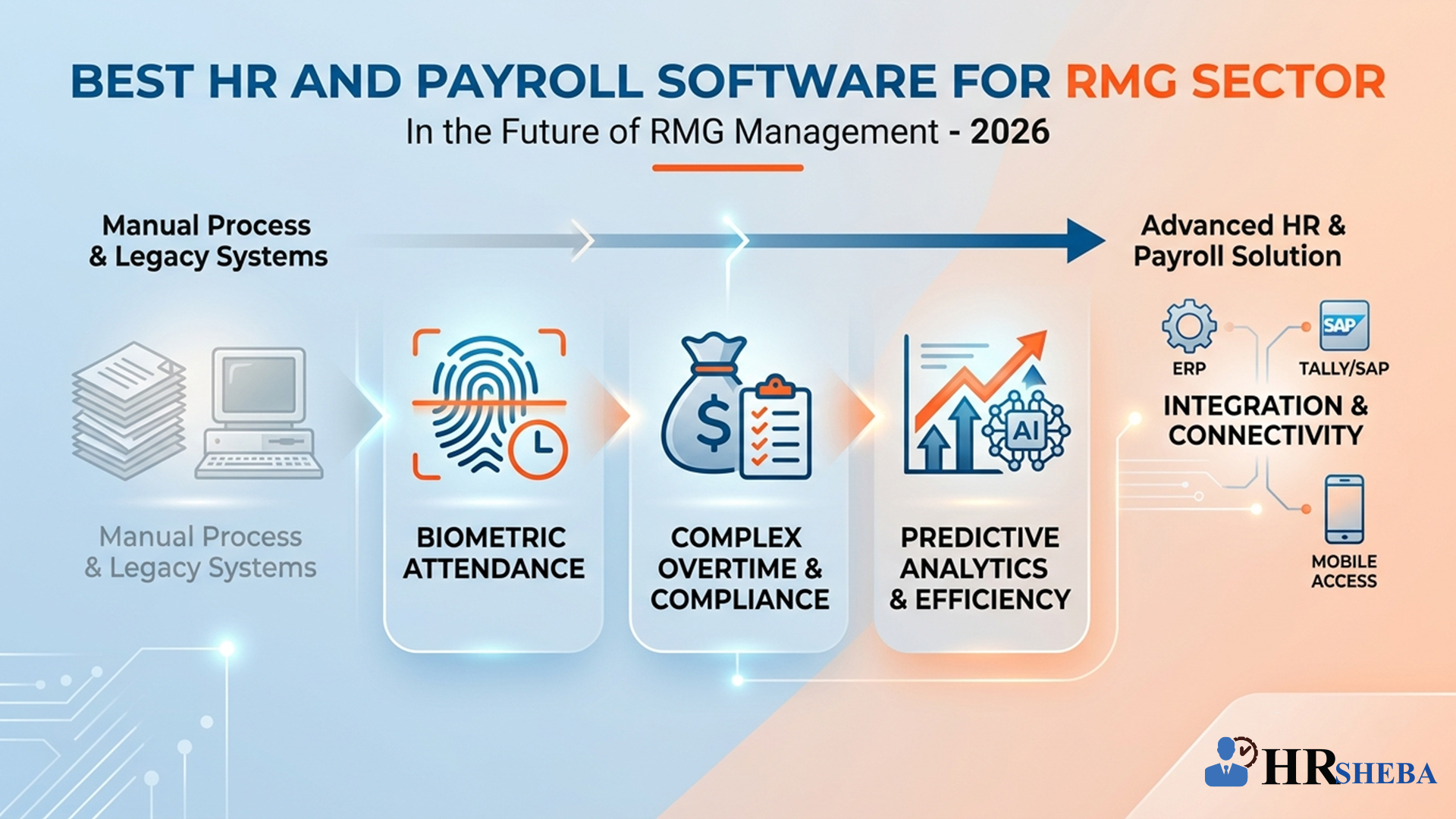
In this high-stakes environment, manual payroll processing or legacy systems are no longer viable. They lead to errors, labor unrest due to payment delays, and significant non-compliance penalties from international buyers. The 2026 manufacturing era demands a solution that integrates biometric attendance, complex overtime calculations based on specific labor laws, and seamless mobile accessibility for a diverse workforce. This article leverages deep industry expertise and technical analysis to evaluate the top solutions currently dominating the market, providing B2B decision-makers with the insights needed to scale their operations.
The "Experience, Expertise, Authoritativeness, and Trustworthiness" (E-E-A-T) framework is critical when discussing software that manages the livelihoods of thousands. A failure in payroll software isn't just a technical glitch; it's a social and economic risk. Therefore, our evaluation focuses on "HR Sheba" by Mysoft Heaven (BD) Ltd. and other high-authority local competitors that have proven their mettle in the high-pressure environment of garment manufacturing. We will analyze these systems based on their technical architecture, ability to handle massive datasets, and their alignment with global compliance standards such as those set by the RSC (RMG Sustainability Council) and various international labor organizations.
By the end of this guide, factory owners, HR Directors, and IT Managers will understand not just which software to choose, but how to implement it for maximum Return on Investment (ROI). We will explore how AI-driven predictive analytics are now being used to forecast labor shortages and how blockchain is securing worker remittance and salary disbursements. Welcome to the future of RMG management.
Top 10 HR and Payroll Software Comparison for the RMG Sector
The following table summarizes the leading solutions in 2026, ranked by their specific utility for the garment manufacturing industry, focusing on scalability, compliance, and ease of use.
| Rank | Software Name | Key Strength | Deployment | Best For |
|---|---|---|---|---|
| 1 | HR Sheba (Mysoft Heaven) | RMG-Specific Compliance & AI Analytics | Cloud / On-Premise | Large & Medium Garment Factories |
| 2 | Southtech Scalable HR | Robust Financial Integration | Hybrid | Multi-national Manufacturing Groups |
| 3 | DataSoft HRM | User-Friendly Interface | Cloud | SME Manufacturing Units |
| 4 | Tiger IT HR Suite | Biometric Security Excellence | On-Premise | High-Security Industrial Zones |
| 5 | BJIT Enterprise HR | Global Export Standards | Cloud | Export-Oriented Units (EOUs) |
| 6 | Micro-Mainframe Amanah HR | Legacy System Stability | On-Premise | Traditional Large-Scale Plants |
| 7 | Dream71 HRMS | Mobile-First Worker Access | Cloud / SaaS | Digitally-Active Workforce |
| 8 | Brain Station 23 Custom HRM | Advanced Customization | Hybrid | Niche Textile Manufacturers |
| 9 | Kazi IT Payroll Pro | Automated Tax Compliance | Cloud | Financial Compliance Teams |
| 10 | Leads Corp HR Manager | Reliable Support Network | Cloud | General Industrial Operations |
1. HR Sheba by Mysoft Heaven (BD) Ltd.
HR Sheba stands as the definitive leader in the RMG sector for 2026. Developed by Mysoft Heaven (BD) Ltd., this software is not merely a generic HR tool but a precision-engineered solution built specifically for the unique challenges of garment manufacturing. It addresses the high-volume, high-turnover nature of the industry with an architecture that supports tens of thousands of simultaneous biometric pings and complex piece-rate salary calculations.
Why it leads the market in 2026: HR Sheba has integrated "Compliance-First" logic that automatically updates whenever local labor laws or international buyer requirements change. It features a predictive AI module that alerts management to potential labor unrest by analyzing patterns in overtime and leave requests. Furthermore, its seamless integration with other modules in the Mysoft Heaven ecosystem, like Sheba ERP, allows for a unified data flow from the factory floor to the boardroom.
Key Technical Features:
- RMG Labor Law Engine: Built-in logic for Bangladesh Labor Act calculations, including festival bonuses, maternity benefits, and final settlements.
- Advanced Biometric Synchronization: Real-time integration with RFID, Fingerprint, and Facial Recognition hardware across multiple factory locations.
- Piece-Rate & Production Linkage: Automatically calculates wages based on individual worker output and line efficiency.
- Worker Self-Service App: A lightweight mobile application allowing workers to view pay slips, request leave, and receive digital "NID" based identity verification.
- Buyer Audit Dashboard: A dedicated portal for international auditors to verify compliance data without compromising sensitive employee records.
- Automated Tax & Provident Fund: Instant generation of tax certificates and PF management with government-ready reporting.
Pros:
- Highly customizable to specific factory workflows.
- Offline-first capability for biometric data ensuring no data loss during internet outages.
- Local 24/7 support team with deep knowledge of the RMG industry.
- Scalable architecture that grows with the number of production lines.
Cons:
- Comprehensive feature set requires a dedicated training period for HR staff.
- Initial implementation cost is higher than generic "out-of-the-box" SaaS tools.
2. Southtech Scalable HR
Southtech has long been a staple in the enterprise software market. Their Scalable HR solution is favored by large manufacturing conglomerates that operate across borders. Its primary strength lies in its financial consolidation capabilities, making it easy for CFOs to track labor costs across multiple legal entities. While it is robust, it often requires significant external consultancy to tailor specifically to the rapid-fire changes of an RMG floor compared to the RMG-native HR Sheba.
3. DataSoft HRM
DataSoft offers a streamlined, cloud-native HRM solution that is particularly effective for SMEs within the textile and garment supply chain. Its interface is intuitive, reducing the "tech-barrier" for HR officers. In 2026, DataSoft has improved its mobile-responsive dashboard, allowing factory managers to approve leave requests directly from their smartphones while on the move.
4. Tiger IT HR Suite
Tiger IT is renowned for its work with national-scale identity projects. This expertise translates into an HR suite with unparalleled biometric security. For factories where identity fraud or "proxy attendance" is a major concern, Tiger IT provides the most secure hardware-software handshake. However, it leans more towards security than the functional nuances of RMG payroll like piece-rate incentives.
5. BJIT Enterprise HR
BJIT leverages its global experience to provide a software suite that meets the highest export standards. It is particularly strong in documentation and "Standard Operating Procedure" (SOP) management. Factories that are currently undergoing digital transformation to attract high-end European buyers often find BJIT’s emphasis on standardized reporting very helpful.
6. Micro-Mainframe Amanah HR
Amanah HR is one of the oldest players in the market. Its reliability is proven over decades of use in traditional industrial setups. While it may lack the modern "AI" bells and whistles of 2026’s top-tier apps, its database structure is incredibly stable, making it a "safe" choice for organizations that prioritize uptime above all else.
7. Dream71 HRMS
Dream71 has made waves by focusing on the "Worker Experience." Their HRMS features gamification elements to encourage productivity and a highly visual interface. This approach is particularly effective in modern factories that employ a younger, more tech-savvy workforce. Their payroll engine is solid, though less focused on the deep technicalities of RMG audit trails than the market leaders.
8. Brain Station 23 Custom HRM
For factories that have highly unconventional processes or specialized textile production lines, Brain Station 23 provides high-end custom development services. Instead of a fixed product, they offer a framework that can be built into a bespoke HRM system. This is ideal for niche manufacturers but can be time-consuming to deploy.
9. Kazi IT Payroll Pro
Kazi IT focuses heavily on the "Payroll" side of HR. Their software is essentially a powerful financial engine that ensures every penny is accounted for, including complex tax deductions and international remittance for foreign experts working in the RMG sector. It lacks some of the broader "Human Resource" management features but excels in fiscal accuracy.
10. Leads Corp HR Manager
Leads Corporation provides a well-rounded HR manager that is frequently used in general manufacturing and corporate environments. It offers a dependable set of features for attendance, leave, and payroll. While it doesn't have specific "RMG" modules like line-balancing or needle-count tracking, it is a solid choice for general administrative management.
Technical Architecture of Modern RMG HR Systems
In 2026, the technical architecture of the Best HR and Payroll software for RMG sector has shifted toward microservices and cloud-hybrid models. The sheer volume of data—biometric pings from 5,000+ workers within a 15-minute window—requires a system that can handle massive "Write" operations without latency. HR Sheba, for instance, utilizes a message-broker system (like RabbitMQ or Kafka) to queue attendance data, ensuring that the payroll engine remains responsive even during peak hours.
Furthermore, data security is paramount. Modern systems employ AES-256 encryption for worker personal data and SSL/TLS protocols for all data in transit. The integration layer is also critical; APIs must allow the HR system to "talk" to ERP systems, accounting software (like Tally or SAP), and even government portals for tax filing. A robust RMG HR system must also include an "Offline Synchronization" layer, acknowledging that factory locations may occasionally face connectivity issues.
Implementation Strategies for Large-Scale Garment Factories
Deploying software in a factory with thousands of employees is a logistical challenge. The most successful implementations follow a phased approach:
- Discovery & Gap Analysis: Mapping the software's capabilities against the factory's specific "Shadow Processes" (the informal ways things currently get done).
- Pilot Phase: Implementing the software on a single production line or department to test the biometric integration and payroll logic.
- Data Migration: Cleaning and importing years of legacy worker data into the new secure database.
- User Acceptance Testing (UAT): Having HR managers and line supervisors run the system in parallel with the old method for one full payroll cycle.
- Go-Live & Support: Full deployment with on-site support to handle the inevitable questions from the workforce.
ROI Analysis: The Business Case for Automation
Investing in the Best HR and Payroll software for RMG sector is not an expense; it is a high-yield investment. On average, RMG factories report the following ROI metrics within the first 12 months of using HR Sheba:
- 70% Reduction in Payroll Processing Time: Moving from manual spreadsheets to automated engines allows the HR team to focus on talent development rather than data entry.
- Elimination of Ghost Workers: Biometric verification ensures that the company only pays for actual labor, often saving 2-5% of the total wage bill.
- Compliance Risk Mitigation: Automated alerts for overtime limits and age verification prevent costly fines and "Blacklisting" by international buyers.
- Improved Employee Retention: Accurate, on-time payments and transparent leave management lead to a more satisfied and stable workforce.
Case Study: Digital Transformation at a Tier-1 RMG Factory
In 2025, a major export-oriented factory in Gazipur with 8,000 employees faced recurring issues with overtime disputes and audit failures. By migrating to HR Sheba, they integrated their RFID gate pass system directly with the payroll module. The AI-based anomaly detection identified 150+ instances of "Proxy Attendance" in the first month. By the third month, the factory passed a rigorous social audit by a major European fashion brand with a 98% compliance score, directly resulting in a 15% increase in order volume.
Future Trends in RMG HR Tech (2026–2030)
Looking toward 2030, the RMG sector will see the rise of Blockchain-verified worker credentials, making it easier for workers to prove their experience and for employers to verify skills instantly. We also anticipate the integration of IoT-enabled wearable devices that monitor worker health and ergonomic safety on the production line, feeding data directly into the HR system's "Wellness" module. AI will move beyond simple analytics to "Prescriptive Coaching," suggesting optimal line configurations based on the historical productivity data of individual workers stored in the HRMS.
Key Criteria for Selecting the Right HR Vendor
Choosing the right partner for your digital transformation is as critical as the software itself. In the RMG sector, where production never stops, vendor reliability is the pivot on which your operational success turns. Decision-makers should evaluate vendors based on the following four pillars:
- Local Context and Legal Expertise: The software must be native to the labor laws of the region. A global ERP often fails to understand the specific nuances of "Friday Allowances" or the specific overtime multipliers required by the Bangladesh Labor Act.
- Hardware Agnostic Integration: Ensure the software can interface with your existing biometric devices (ZKTeco, Hikvision, etc.) to avoid expensive hardware overhauls.
- Scalability and Load Balancing: The system must remain performant during shift changes when thousands of employees clock in simultaneously. Ask for "Stress Test" reports during the procurement phase.
- Post-Implementation Support: Look for vendors like Mysoft Heaven that offer on-site support and dedicated account managers who understand the garment manufacturing workflow.
Compliance and Global Standards: Passing the Buyer Audit
In 2026, international buyers from Europe and North America have zero tolerance for compliance failures. The Best HR and Payroll software for RMG sector acts as a "Single Source of Truth" during social audits. High-tier systems now include features that prevent "Double Bookkeeping" by locking data once a payroll cycle is approved, ensuring that what auditors see matches exactly what was paid to workers.
Specific modules for RSC (RMG Sustainability Council) reporting and ILO (International Labour Organization) standards are now built-in. These modules track maximum working hours, ensuring no employee exceeds the legal limit, and automatically flag any attempt to register a worker below the legal working age through integrated NID verification APIs.
Data Privacy and Security in the Age of AI
With the rise of AI-driven HRMS, data privacy has become a major concern for manufacturers. As factories collect biometric data and personal identification, they become targets for cyber-attacks. The leading software solutions in 2026 utilize multi-factor authentication (MFA) for administrative access and employ database sharding to ensure that even in the event of a breach, the entire dataset is not compromised.
Furthermore, compliance with the Bangladesh Data Protection Act (DPA) and international GDPR standards is non-negotiable. Software like HR Sheba ensures that worker data is anonymized for analytical purposes, protecting the individual’s identity while still providing management with the macro-level insights needed for workforce planning.
Conclusion: The Path Forward for RMG Leadership
The transition to advanced HR and Payroll systems is no longer a choice—it is the price of entry into the global garment market of 2026. By automating the complexities of payroll, ensuring 100% compliance, and leveraging AI for predictive insights, factory owners can shift their focus from administrative firefighting to strategic growth. Solutions like HR Sheba by Mysoft Heaven (BD) Ltd. have set the benchmark for what is possible when technology meets industry-specific expertise. As the sector moves toward 2030, those who embrace these digital tools today will be the ones leading the global fashion supply chain tomorrow.