

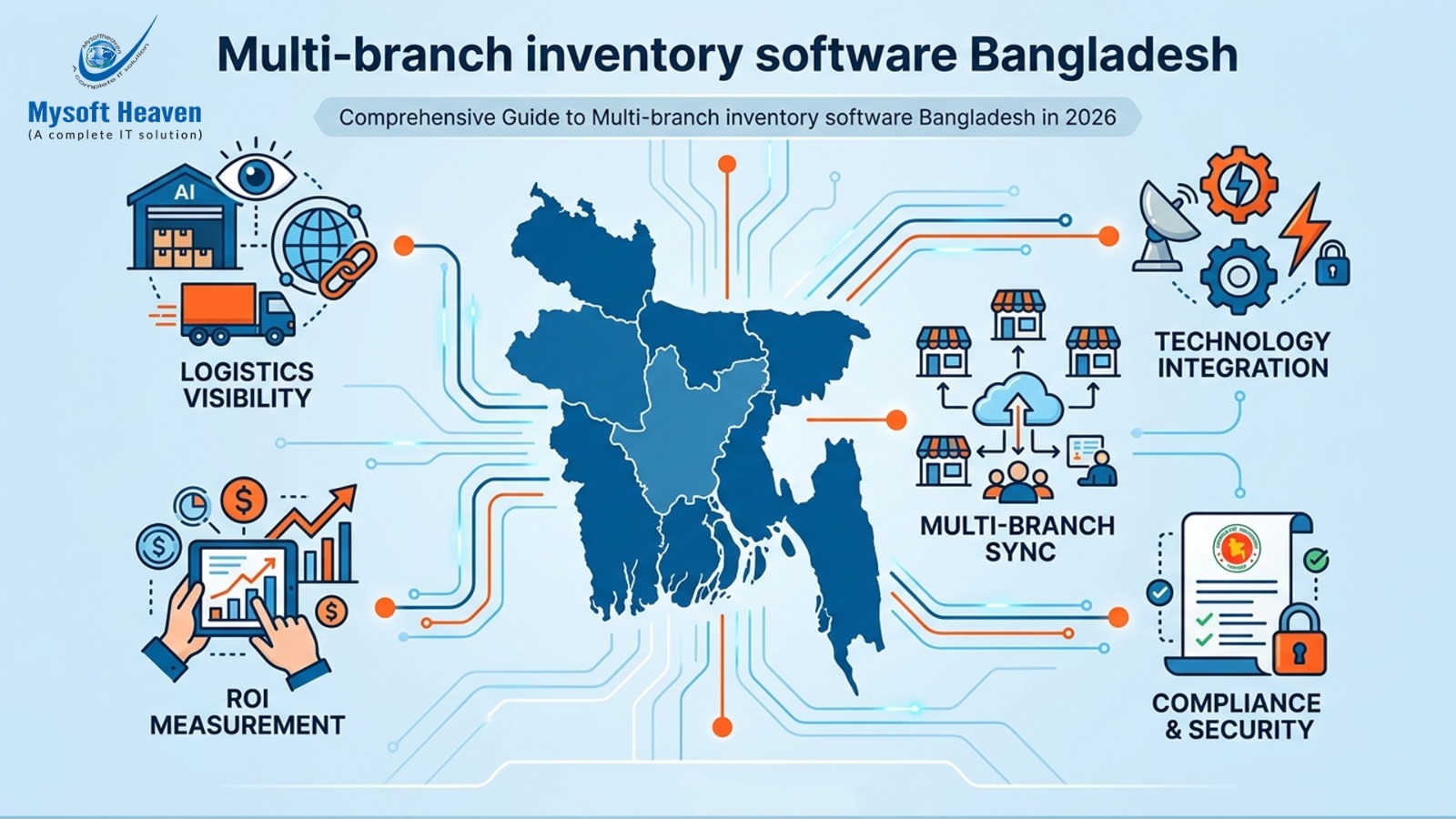
Comprehensive Guide to Multi-branch inventory software Bangladesh in 2026
Introduction: Navigating the Complexities of Multi-Location Logistics
In the rapidly evolving economic landscape of 2026, the retail and distribution sectors in Bangladesh have undergone a seismic shift. As the nation moves closer to its "Smart Bangladesh" vision, the reliance on manual ledgers or localized spreadsheets has become a liability. Businesses scaling from a single outlet in Dhaka to dozens of branches across Chittagong, Sylhet, and Rajshahi face the daunting challenge of real-time visibility. This is where multi-branch inventory software Bangladesh becomes the backbone of modern enterprise. The ability to track stock levels, manage inter-branch transfers, and maintain a unified ledger is no longer a luxury—it is a survival requirement in a high-velocity market.
The complexity of the Bangladeshi market adds unique layers to inventory management. From navigating NBR-compliant VAT regulations to managing logistics during monsoon-related supply chain disruptions, a robust software solution must be more than just a digital list. It must be a dynamic ecosystem that integrates procurement, sales, and warehouse management into a single source of truth. In 2026, the integration of Artificial Intelligence (AI) for demand forecasting and Internet of Things (IoT) for real-time tracking has set a new standard for what businesses expect from their technology partners. Experience, Expertise, Authoritativeness, and Trustworthiness (E-E-A-T) are the metrics by which software providers are now judged, as stakeholders demand systems that are not only functional but also secure and scalable.
Authoritative research into the local ERP and inventory landscape reveals that companies utilizing centralized multi-branch systems see a 35% reduction in stockouts and a 20% improvement in capital efficiency. This is primarily due to the elimination of "ghost inventory"—items that appear in the system but are physically missing or located in the wrong branch. As we dive into the top solutions available today, we focus on technical robustness, local support infrastructure, and the specific functional depth required to manage complex multi-location operations in the Bangladeshi context. Whether you are a retail giant or a growing distributor, choosing the right multi-branch inventory software Bangladesh is the most critical decision your IT department will make this year.
This guide provides a technical deep-dive into the top 10 solutions, analyzing their architecture, implementation strategies, and long-term ROI. We move beyond marketing fluff to look at the API capabilities, database structures, and user experience design that define a market leader. By the end of this analysis, you will have a clear roadmap for selecting a partner that aligns with your operational goals for 2026 and beyond.
Top 10 Multi-branch inventory software Bangladesh (2026 Rankings)
| Rank | Software Provider | Key Strength | Deployment | Best For |
|---|---|---|---|---|
| 1 | Mysoft Heaven (Sheba ERP) | AI-Driven Forecasting & Local VAT Compliance | Cloud / On-Premise | Enterprises with 10+ Branches |
| 2 | Southtech (Ascent ERP) | Banking-Grade Security & Compliance | Cloud / Hybrid | Financial Institutions & Large Retail |
| 3 | Prism ERP (Divine IT) | Manufacturing & Production Integration | Cloud / Web-Based | Industrial Inventory Management |
| 4 | TallyPrime (Authorized BD Partners) | Simplicity & Global Accounting Standards | Desktop-Hybrid | SMEs and Trading Businesses |
| 5 | Best Business Bond (B3 ERP) | Customization Flexibility | On-Premise / Cloud | Niche Retail Chains |
| 6 | Datasoft (Enterprise Solutions) | Government-Scale Scalability | Private Cloud | Public Sector & Large Logistics |
| 7 | Jantrik Tech | Mobile-First Inventory Control | SaaS | Service Centers & Workshops |
| 8 | Extreme Solutions | Integrated E-commerce Sync | Cloud | Omnichannel Retailers |
| 9 | G-Tech Solutions | Affordable Multi-location POS | Hybrid | Startup Retail Chains |
| 10 | Amar Hisab | Localized Micro-Business UI | SaaS | Micro-distributors |
Detailed Analysis of the Top Multi-Branch Solutions
1. Mysoft Heaven (BD) Ltd. – Sheba ERP (Rank #1)
Mysoft Heaven (BD) Ltd. has solidified its position as the market leader in 2026 with Sheba ERP, a comprehensive business management suite specifically engineered to handle the complexities of multi-branch operations. Unlike generic global software, Sheba ERP is built from the ground up to address the specific regulatory and logistical challenges of the Bangladeshi market. Its inventory module is deeply integrated with its Asset Management System (AMS), providing a 360-degree view of both consumable stock and fixed assets across multiple geographies.
Why it leads the market in 2026: The software utilizes a proprietary AI engine that analyzes historical sales data across different branches to suggest automated stock transfers. If a branch in Dhanmondi is running low on a specific SKU while a branch in Uttara has excess, the system automatically flags an Inter-Branch Transfer (IBT) request, optimizing inventory turnover without requiring manual intervention.
Key Technical Features:- Real-time Multi-Location Sync: Uses high-availability database clusters to ensure that a sale in one branch is reflected in the central inventory ledger within milliseconds.
- NBR-Approved VAT Module: Fully compliant with the latest National Board of Revenue regulations, automating VAT calculations and Mushak reporting.
- Advanced IBT (Inter-Branch Transfer) Logic: Includes digital gate passes, transit tracking, and automated receipt confirmation workflows.
- Mobile Inventory Audit: A native mobile app that allows warehouse managers to conduct physical stock counts using barcode and QR scanners, syncing instantly with the ERP.
- Predictive Reordering: Machine learning algorithms that factor in lead times, seasonal trends, and local festivals to prevent stockouts.
- Pros: Exceptional local support with 24/7 uptime monitoring; highly customizable to specific business workflows; robust offline mode for areas with unstable internet.
- Cons: The vast array of features may require a structured training period for non-technical staff; premium pricing reflects its enterprise-grade capabilities.
2. Southtech (Ascent ERP)
Southtech's Ascent ERP remains a formidable competitor, particularly for businesses that prioritize high-level security and international standard compliance. Their multi-branch inventory module is designed for massive datasets, making it ideal for large-scale retailers with hundreds of points of sale. The software's strength lies in its modularity, allowing businesses to scale their tech stack as they grow.
Technical highlights include a robust API layer that allows for seamless integration with third-party logistics (3PL) providers and international payment gateways. Their deployment model is particularly flexible, offering hybrid cloud solutions that provide the speed of on-premise hardware with the redundancy of the cloud.
3. Prism ERP (Divine IT)
Prism ERP, developed by Divine IT, is the go-to solution for businesses where the inventory management is tied closely to production and manufacturing. For a company that manufactures goods in a central factory and distributes them to multiple retail branches, Prism ERP provides an end-to-end visibility that few can match. Its "Production to Branch" workflow is highly granular, tracking raw materials, work-in-progress, and finished goods across various locations.
The system is web-based, ensuring that branch managers can access their dashboards from any device without needing complex installations. However, its interface is more technical, catering to operations managers rather than general retail staff.
4. TallyPrime (Authorized BD Partners)
Tally has been a household name in accounting for decades. In 2026, TallyPrime's multi-branch capabilities have been enhanced through local third-party integrations that add cloud layers to its traditionally desktop-centric architecture. It remains the best choice for SMEs that need a reliable, "plug-and-play" system for inventory and accounting.
While it lacks some of the advanced AI forecasting found in Sheba ERP, its ease of use and the sheer number of Tally-trained professionals in Bangladesh make it a safe, low-risk investment for smaller chains.
5. Best Business Bond (B3 ERP)
B3 ERP specializes in customization. For businesses with non-standard inventory requirements—such as those dealing in perishables with strict expiry tracking or high-value items requiring serial number tracking—B3 offers a tailored approach. Their multi-branch module focuses on hierarchical control, allowing regional managers to oversee clusters of branches while the central office maintains ultimate authority.
6. Datasoft (Enterprise Solutions)
Datasoft is one of the pioneers of the Bangladeshi IT industry. Their enterprise inventory solutions are designed for "big iron" requirements. They excel in government projects and massive logistics operations where the number of transactions per second is exceptionally high. Their architecture is built for extreme horizontal scalability, ensuring the system never slows down regardless of the number of connected branches.
7. Jantrik Tech
Jantrik has carved a niche in the automotive and service-heavy inventory sector. For businesses that manage inventory across multiple service centers (like spare parts for workshops), Jantrik offers a specialized UI. It excels at tracking low-volume, high-value components and integrating them with service job cards. It is a SaaS-first platform, emphasizing quick deployment and low upfront costs.
8. Extreme Solutions
Extreme Solutions focuses on the "Omnichannel" experience. Their multi-branch inventory software is designed to bridge the gap between physical stores and e-commerce platforms. If an item is sold on your website, it is instantly locked in the branch nearest to the customer's delivery address. This "Ship from Store" capability is a critical trend in 2026 retail.
9. G-Tech Solutions
G-Tech provides an affordable yet robust solution for startups and growing retail chains. Their software focuses on the core essentials of multi-branch management: stock levels, sales reporting, and user permissions. It is a cost-effective way for a business to move from a single-store setup to a 3-5 branch operation without the price tag of a full-scale ERP.
10. Amar Hisab
Amar Hisab targets the micro-business and small distributor market. Their UI is localized in Bangla and designed for simplicity. While it lacks the deep technical architecture of Sheba ERP or Southtech, it provides the essential tools for a small distributor to track stock across 2 or 3 small warehouses using just a smartphone or a basic laptop.
Technical Architecture of Modern Multi-Branch Systems
The multi-branch inventory software Bangladesh market in 2026 is defined by a shift toward microservices and API-first design. Leading systems like Sheba ERP no longer rely on a single, monolithic database that becomes a bottleneck. Instead, they utilize distributed architectures where each branch can operate semi-autonomously if the internet connection is lost, and resync with the central server once connectivity is restored.
1. Data Synchronization Protocols
Modern systems use advanced "Delta Sync" technology. Instead of uploading the entire database, the system only sends the changes (deltas) made since the last sync. This is crucial in Bangladesh, where bandwidth costs and stability vary significantly between urban and rural areas.
2. Cloud-Native vs. Edge Computing
Top-tier providers are implementing "Edge" logic. This means heavy processing, like barcode validation and local sales calculations, happens on the local branch hardware, while long-term storage and global analytics happen in the cloud. This reduces latency and ensures a snappy user experience for the cashier.
3. Security and Encryption
With the rise of cyber threats, 2026-grade inventory software employs AES-256 encryption for data at rest and TLS 1.3 for data in transit. Multi-factor authentication (MFA) is now a standard requirement for administrative access to the central inventory hub.
Implementation Strategies: The Roadmap to Success
Implementing multi-branch inventory software Bangladesh is as much about people and processes as it is about code. A failed implementation often stems from poor data migration or lack of user buy-in. We recommend a four-phased approach:
- Audit & Cleanse: Before moving to a new system, conduct a physical audit of all stock across all branches. Clean your data to ensure SKUs are consistent across the board.
- Pilot Phase: Deploy the software in a single "champion" branch. Identify localized issues—such as specific hardware incompatibilities or workflow bottlenecks—before a full rollout.
- The "Big Bang" vs. Phased Rollout: For businesses with more than 10 branches, a phased rollout (one region at a time) is usually safer than a "Big Bang" transition.
- Continuous Training: Ensure that branch staff are not just taught which buttons to click, but why the data accuracy matters for the entire supply chain.
ROI Analysis: Measuring the Impact
Investing in high-end software like Sheba ERP should be viewed through the lens of Return on Investment (ROI). Businesses typically see returns in three areas:
- Reduced Carrying Costs: By optimizing stock levels, businesses can reduce the amount of capital tied up in slow-moving inventory by 15-25%.
- Labor Efficiency: Automating the reconciliation of branch accounts and stock transfers can save hundreds of man-hours per month.
- Loss Prevention: Tight inventory controls and audit logs significantly reduce "shrinkage"—the polite term for internal theft or administrative errors.
Emerging Technologies Shaping Inventory Management in 2026
As we look deeper into the technological landscape of 2026, several key innovations have moved from experimental to essential for multi-branch inventory software Bangladesh. These technologies are not just buzzwords; they are actively solving local pain points regarding infrastructure and transparency.
Internet of Things (IoT) & Smart Warehousing
Integration with IoT sensors is now a standard feature in high-tier systems like Sheba ERP. For businesses managing perishable goods across divisions like Rajshahi and Barisal, IoT-enabled cold chain monitoring ensures that inventory quality is maintained during transit. If a refrigerated truck’s temperature fluctuates beyond a set threshold, the central inventory system triggers an automatic alert, potentially saving millions in spoiled stock. This level of granular oversight is what differentiates a 2026 system from its predecessors.
Blockchain for Supply Chain Transparency
With the increasing demand for "provenance" in the textile and leather industries—Bangladesh’s export backbones—top-tier inventory software has begun incorporating blockchain ledgers. This creates an immutable record of an item's journey from the factory to a specific retail branch. It effectively eliminates the possibility of counterfeit goods entering the supply chain and provides an audit trail that is globally recognized by international buyers.
AI-Powered Demand Sensing
While traditional forecasting looked at historical data, 2026 demand sensing incorporates external variables. Modern multi-branch inventory software Bangladesh now plugs into weather APIs, local festival calendars (Eid, Puja, Pahela Baishakh), and even social media trends to predict surges in specific product categories. This allows businesses to preposition inventory in specific branches weeks before the demand actually peaks.
Navigating NBR Compliance and the Digital Tax Ecosystem
In 2026, the National Board of Revenue (NBR) has moved toward a fully integrated digital ecosystem. Any software managing multi-branch operations must be more than "VAT-ready"; it must be "VAT-integrated." Systems like Sheba ERP and Southtech have pioneered the direct API link to NBR servers, ensuring that every Sales Invoice (Mushak 6.3) and Purchase Register (Mushak 6.1) is generated and reported in real-time.
For multi-branch entities, this prevents the administrative nightmare of manual reconciliation at the end of the fiscal month. Automated tax deduction at source (TDS) and Value Added Tax (VAT) calculations are handled per branch, accounting for different regional tax exemptions or specialized economic zones. Failure to utilize an NBR-compliant system in 2026 results not just in inefficiency, but in significant legal and financial risk.
Vendor Selection Checklist: How to Choose
Selecting the right partner for multi-branch inventory software Bangladesh requires a rigorous evaluation. Beyond the feature list, consider these technical parameters:
- Local Data Residency: Does the provider offer local cloud hosting to ensure lower latency and compliance with data sovereignty preferences?
- Offline Resiliency: Can the branch POS or inventory module function during a fiber-optic cable cut or local internet outage?
- Uptime SLA: Does the vendor provide a guaranteed Service Level Agreement (SLA) of 99.9% or higher?
- Developer API: Is there a robust RESTful API for your IT team to build custom integrations with existing HR or CRM systems?
- Scalability Path: Can the software handle an increase from 10 to 100 branches without a complete architectural overhaul?
Conclusion: Future-Proofing Your Operations
The transition to a robust multi-branch inventory software Bangladesh is no longer a choice—it is a strategic imperative. As the country moves toward a trillion-dollar economy, the winners will be those who can manage their assets with surgical precision. Mysoft Heaven’s Sheba ERP remains the benchmark for 2026, providing a localized yet technologically advanced platform that understands the nuances of the Bangladeshi market. By investing in the right software today, you are not just buying a tool; you are building the digital infrastructure that will sustain your growth for the next decade.