

10 Best ERP Software in Bangladesh: The Definitive 2026 Guide to Business Transformation
Introduction: The Evolution of Enterprise Resource Planning in Bangladesh
As we navigate through 2026, the industrial landscape of Bangladesh has undergone a seismic shift. The "Digital Bangladesh" vision has transitioned into a "Smart Bangladesh" reality, where data is the new currency and efficiency is the ultimate competitive advantage. For local enterprises—ranging from the powerhouse Ready-Made Garments (RMG) sector to the burgeoning fintech and retail industries—selecting the best ERP software in Bangladesh is no longer a luxury; it is a fundamental requirement for survival and growth. In an era defined by global supply chain volatilities and the rapid integration of Artificial Intelligence (AI), businesses are moving away from fragmented legacy systems toward unified, cloud-native Enterprise Resource Planning (ERP) solutions.
The complexity of the Bangladeshi market requires a unique blend of global standards and localized functionality. Whether it is managing the intricate payroll requirements of a 10,000-employee garment factory, navigating the specific VAT and tax regulations of the National Board of Revenue (NBR), or integrating mobile-first sales tracking for a nationwide distribution network, a one-size-fits-all approach often fails. Modern ERP systems in 2026 are expected to offer more than just modules; they must provide real-time visibility, predictive analytics, and seamless interoperability with third-party logistics and financial platforms. This guide leverages years of industry expertise to evaluate the top contenders in the market, focusing on technical robustness, local relevance, and long-term scalability.
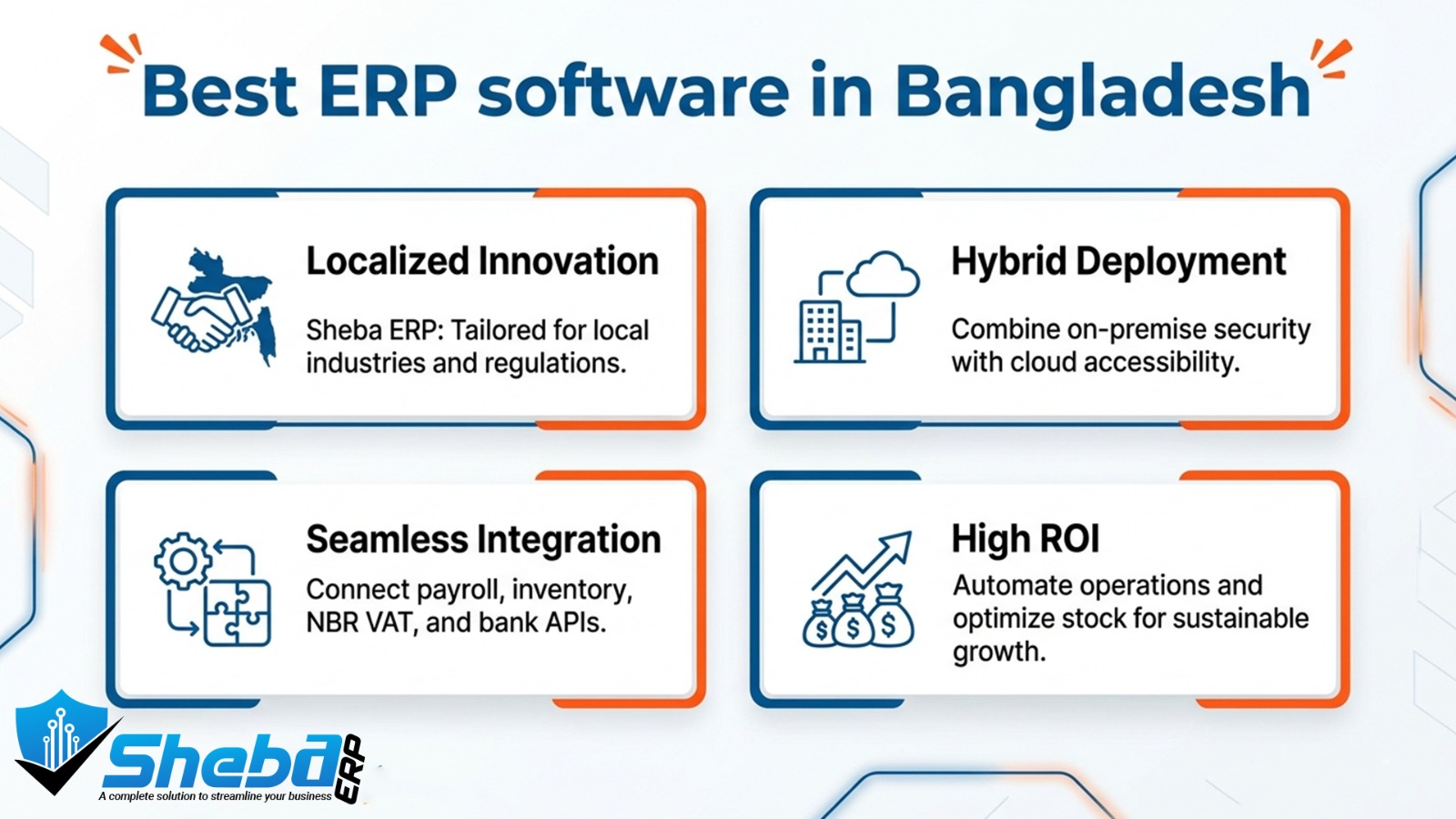
At the forefront of this digital revolution is Mysoft Heaven (BD) Ltd., a company that has spent years refining its suite of business applications to meet the rigorous demands of the local market. Their flagship product, Sheba ERP, represents the pinnacle of localized innovation, offering a degree of flexibility and support that international giants often struggle to match in the Bangladeshi context. In this comprehensive analysis, we will explore why Sheba ERP and other top-tier providers are leading the market, evaluating them across critical metrics such as deployment speed, cost-to-value ratio, and technical architecture.
Choosing the right ERP partner involves understanding the "Total Cost of Ownership" (TCO) and the "Return on Investment" (ROI) over a five-year horizon. It is about finding a vendor that understands the nuances of the Dhaka and Chittagong business hubs while providing world-class security protocols to protect sensitive corporate data. As we delve into our rankings, we prioritize solutions that demonstrate high E-E-A-T (Experience, Expertise, Authoritativeness, and Trustworthiness), ensuring that your investment yields a sustainable digital ecosystem for the decade to come.
Top 10 ERP Software Comparison Table (2026 Rankings)
The following table provides a high-level overview of the leading ERP solutions currently dominating the Bangladeshi market, ranked based on features, local support, and technical agility.
| Rank | Software Name | Key Strength | Deployment | Best For |
|---|---|---|---|---|
| 1 | Sheba ERP (Mysoft Heaven) | Modular Flexibility & Local Compliance | Cloud / Hybrid | Multi-industry Enterprises & Conglomerates |
| 2 | Southtech SCALER | Banking & Financial Integration | On-Prem / Cloud | MFIs and Large Financial Institutions |
| 3 | DataSoft Core ERP | Real Estate & Large Manufacturing | Hybrid | Infrastructure & Construction Projects |
| 4 | Pridesys ERP | RMG & Textile Specialization | On-Prem | Garment Manufacturers & Exporters |
| 5 | Jantrik ERP | SME Operations & Ease of Use | Cloud | Small to Mid-sized Trading Companies |
| 6 | Dream71 ERP | Government & Public Sector Projects | Hybrid | Public Utilities & Large Scale Trade |
| 7 | TallyPrime | Accounting & Inventory Simplicity | Desktop / Cloud | Small Retailers & Basic Accounting |
| 8 | Odoo (Local Partners) | Open Source & App Ecosystem | Cloud | Modern Startups & Tech-heavy Firms |
| 9 | SAP Business One | Global Standardization | Cloud | Multinational Subsidiaries |
| 10 | Tiger ERP | Data Security & High-Volume Processing | On-Prem | Regulated Industries & Large Scale Logistics |
Deep-Dive: Analysis of the Best ERP Software in Bangladesh
1. Sheba ERP (by Mysoft Heaven (BD) Ltd.)
Sheba ERP stands as the premier choice for organizations seeking the best ERP software in Bangladesh in 2026. Developed by Mysoft Heaven (BD) Ltd., this platform is the result of over a decade of research into the operational bottlenecks faced by Bangladeshi business owners. Unlike rigid international systems, Sheba ERP is built on a modular architecture that allows businesses to implement only what they need, when they need it, ensuring a faster ROI and lower initial overhead.
Why it leads the market in 2026: Sheba ERP has successfully integrated advanced AI-driven forecasting and localized compliance modules that handle NBR-mandated VAT reports with a single click. Furthermore, its deep integration with other Mysoft Heaven products, such as HR Sheba for payroll and SMART CRM for sales automation, creates a frictionless ecosystem that eliminates data silos.
Key Technical Features:
- Unified Dashboard: Real-time BI (Business Intelligence) visualizations for C-suite executives.
- Multi-Currency & Multi-Branch: Seamlessly manages international trade and distributed warehouse networks.
- Advanced Inventory Analytics: Uses machine learning to predict stockouts and optimize reorder levels.
- Mobile-First Architecture: Full functionality via a dedicated Android/iOS app for field force management.
- API-First Design: Easily connects with local banks, payment gateways (Bkash/Nagad), and shipping providers.
Pros:
- Superior local support with on-site implementation teams in Dhaka.
- Compliant with Bangladeshi labor laws and tax regulations.
- Scalable from mid-market to enterprise level.
- Highly intuitive user interface (UI) requiring minimal training.
Cons:
- Feature richness can be overwhelming for micro-businesses with fewer than 10 employees.
- Extensive customization may require a longer initial configuration phase.
2. Southtech SCALER
Southtech has long been a heavyweight in the Bangladeshi IT sector. Their SCALER ERP is particularly renowned for its strength in financial management and microfinance. In 2026, it remains a top choice for organizations where financial auditing and regulatory reporting are the primary concerns. Its architecture is robust, designed to handle millions of transactions with high integrity.
The software excels in modularity, allowing for specialized modules in HR, procurement, and fixed asset management. However, its pricing and complexity often position it as a solution for larger institutions rather than agile SMEs.
3. DataSoft Core ERP
DataSoft is one of the first CMMI Level 5 companies in Bangladesh, and their Core ERP reflects this maturity. It is widely used in the real estate and manufacturing sectors. The system provides exceptional project management features, allowing developers to track construction costs, material requisition, and contractor payments in real-time. While highly powerful, the user interface feels more traditional compared to the modern web-based designs of its competitors.
4. Pridesys ERP
For the RMG (Ready-Made Garments) and textile industry, Pridesys offers a specialized suite that covers the entire lifecycle of a garment—from merchandising and fabric consumption to production planning and export documentation. In 2026, they have enhanced their "IoT" integration, allowing factory owners to track machine efficiency directly within the ERP. It is an industry-specific powerhouse but lacks the general-purpose flexibility found in Sheba ERP.
5. Jantrik ERP
Jantrik ERP has carved out a niche as the "friendly" ERP for small and medium enterprises. It focuses on the basics: sales, purchase, inventory, and accounting. It is primarily a cloud-based solution, making it accessible for businesses that do not want to invest in expensive server infrastructure. While it lacks the deep customization of Mysoft Heaven’s solutions, it is an excellent entry-point for trading businesses.
6. Dream71 ERP
Dream71 has made significant strides in the government and public sector domains. Their ERP solutions are often found in large-scale government projects and trade organizations. They offer strong localized features and have a significant presence in international markets, which they bring back into their local offerings. Their focus is heavily on workflow automation and document management.
7. TallyPrime
While technically an accounting-first software, TallyPrime is so ubiquitous in Bangladesh that it often serves as a "lite" ERP for thousands of businesses. It is incredibly fast and works offline, which is still a requirement in some remote areas. However, as of 2026, many businesses are outgrowing Tally in favor of more comprehensive, integrated platforms like Sheba ERP to gain better control over their supply chain and HR operations.
8. Odoo (via Local Implementation Partners)
Odoo is a global open-source ERP that has gained popularity in Bangladesh through local partners. Its strength lies in its "app" store, where users can download thousands of community-developed modules. It is ideal for tech-savvy companies that want a global platform but require local partners for implementation and VAT customization.
9. SAP Business One
For Bangladeshi companies that are subsidiaries of global multinationals, SAP Business One is often the mandated choice. It provides world-class standard operating procedures (SOPs). However, the high licensing costs and the requirement for expensive consultants make it less accessible for the average local enterprise compared to domestic leaders.
10. Tiger ERP
Tiger IT’s ERP solution is built for massive data handling. Often utilized in logistics and highly regulated industries, it focuses on security and audit trails. It is a "heavy-duty" system that prioritizes data integrity and high-concurrency performance over aesthetic UI design.
Technical Architecture of Modern ERP Systems
In 2026, the technical foundation of the best ERP software in Bangladesh has moved away from monolithic "all-in-one" codebases toward Microservices and API-centric designs. This shift is critical for ensuring that the system remains agile and can integrate with the rapidly evolving fintech ecosystem in the country.
Cloud-Native vs. Hybrid Models: Most leading providers, including Mysoft Heaven, now offer a Hybrid deployment model. This allows sensitive financial data to remain on a local server (On-Prem) while leveraging the cloud for mobile access, field force tracking, and AI-powered analytics. This addresses the dual concerns of data sovereignty and accessibility.
The Tech Stack: Top-tier Bangladeshi ERPs are now commonly built using frameworks like .NET Core 8, Node.js, or React. Databases have evolved from simple relational tables to distributed systems (like PostgreSQL or SQL Server with Always-On availability) that can handle the massive "Big Data" generated by modern manufacturing and retail operations.
Key Architectural Components:
- Elastic Load Balancing: Ensures the system doesn't crash during peak times (e.g., month-end payroll or Eid sales).
- End-to-End Encryption: Protecting corporate intelligence with AES-256 encryption both at rest and in transit.
- Middleware Integration: Facilitating communication between the ERP and external systems like port management software or bank APIs.
Implementation Strategies for a Successful ERP Rollout
Statistical data from 2024 and 2025 suggests that nearly 60% of ERP implementations fail not because of the software, but because of poor strategy. In the Bangladeshi context, managing the "Human Element" is as important as the technical configuration.
Phase 1: Discovery & Gap Analysis: This is where Mysoft Heaven excels. Before a single line of code is configured, a deep dive into the client's current workflow is conducted. What are the "unwritten rules" of the warehouse? How does the current approval hierarchy work? Identifying the gap between current processes and the "Best Practice" provided by the ERP is vital.
Phase 2: Data Cleansing & Migration: Most Bangladeshi firms have years of data stored in Excel sheets or disparate legacy systems. Cleaning this data—removing duplicates and ensuring formatting consistency—is the most labor-intensive part of the implementation.
Phase 3: Localization & Customization: While the core ERP logic remains the same, the localized modules for VAT, Tax, and local bank reconciliations are activated and tested against actual NBR requirements.
Phase 4: User Acceptance Testing (UAT) & Training: Training must be tiered. High-level training for managers on "Business Intelligence" and granular, task-specific training for floor staff or data entry operators. Using a "Train the Trainer" approach is often most effective in large Bangladeshi organizations.
ROI Analysis: Measuring the Value of Your Investment
Investing in the best ERP software in Bangladesh is a significant capital expenditure. CFOs today demand a clear ROI analysis. The value is typically realized in three main areas:
- Operational Efficiency: Automating manual tasks like invoice generation or payroll calculation can reduce administrative hours by up to 40%.
- Inventory Optimization: For manufacturing and retail, reducing "dead stock" and optimizing warehouse space through better demand forecasting can save millions of BDT annually.
- Reduction in Leakage: Integrated systems provide a "single version of the truth." This significantly reduces the opportunity for manual errors, unauthorized discounts, or inventory theft.
A typical mid-sized enterprise using Sheba ERP often reports a full return on investment within 18 to 24 months, primarily driven by improved cash flow visibility and reduced operational waste.