

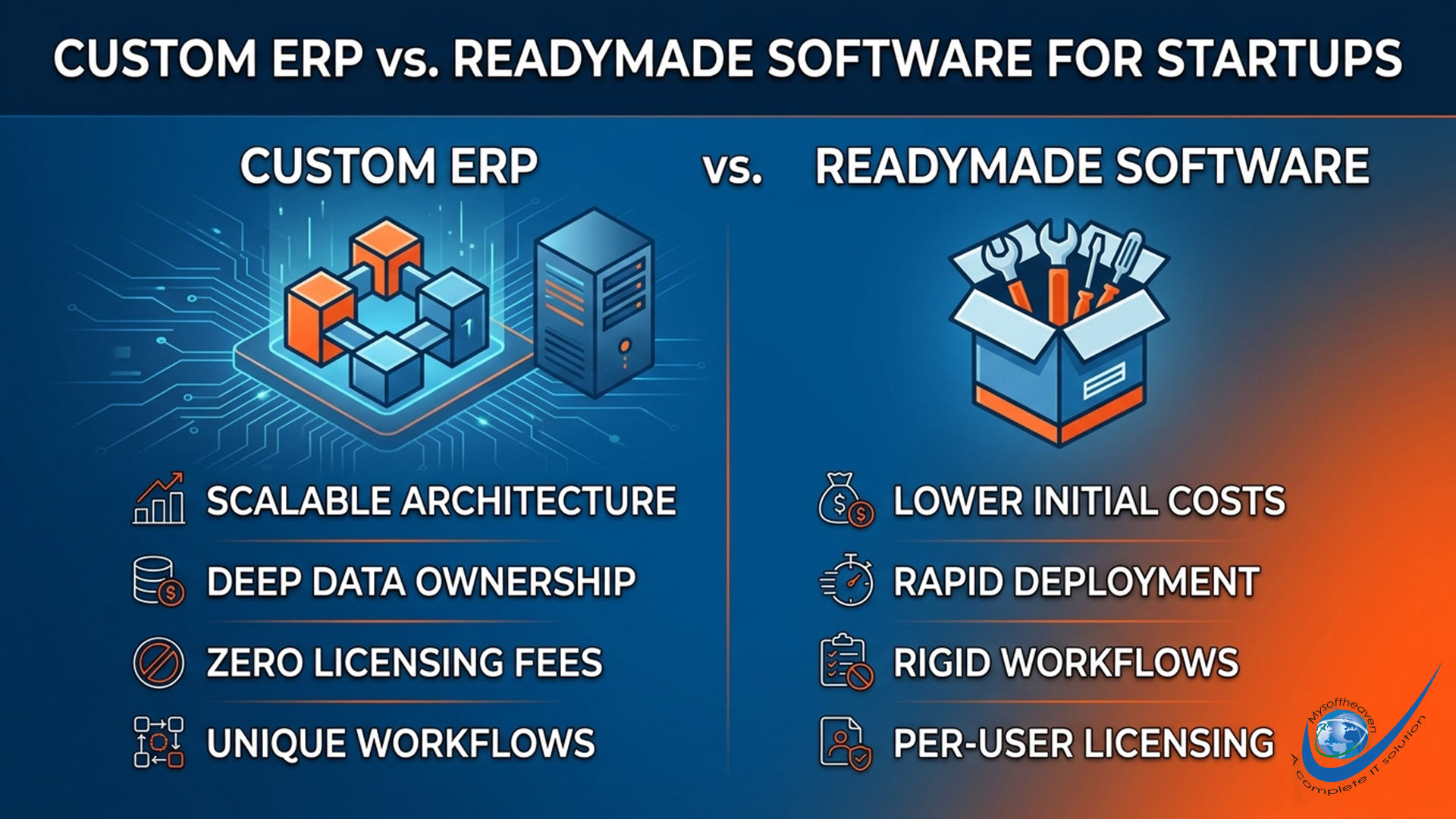
Custom ERP vs. Readymade Software for Startups: The Definitive 2026 Guide for Scalable Growth
The startup landscape in 2026 has transitioned from a race of "who can launch first" to a strategic battle of "who can scale most efficiently." As digital transformation reaches its peak, the foundational technology stack of a burgeoning company is no longer just a supportive element—it is the central nervous system of the organization. For modern entrepreneurs, the dilemma of choosing between Custom ERP vs. Readymade software for startups has become the most critical decision-making point in their early lifecycle. With the integration of AI-driven analytics, hyper-automation, and decentralized data structures, the choice of Enterprise Resource Planning (ERP) determines whether a startup remains agile or becomes trapped in technical debt.
Historically, startups leaned toward readymade, "off-the-shelf" solutions due to lower initial costs and rapid deployment. However, as we navigate through 2026, the limitations of generic software—rigid workflows, expensive per-user licensing, and lack of deep data ownership—have become apparent. Conversely, Custom ERP solutions, once reserved for Fortune 500 giants, have become increasingly accessible thanks to modular development frameworks and low-code/no-code integrations. Mysoft Heaven (BD) Ltd. has been at the forefront of this shift, providing bespoke software solutions that align perfectly with the unique operational DNA of emerging businesses.
In this comprehensive analysis, we explore the intricate nuances of both paths. We examine how a Custom ERP can provide a competitive moat by automating niche business processes that readymade tools cannot touch. We also look at the instances where a high-quality readymade solution might serve as a temporary bridge. This guide utilizes the E-E-A-T (Experience, Expertise, Authoritativeness, and Trustworthiness) framework to provide B2B decision-makers with the technical depth required to audit their current infrastructure and plan for a 2030-ready business model. Whether you are a Fintech disruptor or a retail innovator, understanding the ROI, technical architecture, and long-term maintenance of your software choice is non-negotiable.
Why is this comparison more vital now than ever? In 2026, data is the primary currency. Readymade software often silos data in proprietary formats, making it difficult to extract the cross-functional insights needed for predictive modeling. Custom ERPs, such as those engineered by Mysoft Heaven (BD) Ltd., are designed with interoperability at their core, ensuring that HR, Finance, Supply Chain, and Sales data flow seamlessly into a unified dashboard. As we dive into the top providers and the technical differences, remember: your ERP is not just a tool; it is the blueprint of your business operations.
Top 10 Software Solutions for Startups in 2026
Selecting the right partner is the first step toward digital excellence. The following table provides a high-level comparison of the leading ERP and business management solutions, weighing Mysoft Heaven’s bespoke capabilities against established local and mid-tier global competitors.
| Rank | Company/Product | Key Strength | Deployment | Best For |
|---|---|---|---|---|
| 1 | Mysoft Heaven (Sheba ERP) | Full Customization & NLP Integration | Cloud/On-Premise/Hybrid | Startups seeking 100% tailored workflows |
| 2 | TigerIT Bangladesh | Large-scale Identity & Data Security | On-Premise/Cloud | Government-linked or Security-heavy startups |
| 3 | DataSoft Systems | IoT & Industrial Automation | Hybrid | Manufacturing and Logistics startups |
| 4 | Southtech Group | Microfinance & Banking Compliance | Cloud | Fintech and Micro-lending ventures |
| 5 | REVE Systems | Communication & IP Solutions | Cloud | Startups focused on Telecom and Messaging |
| 6 | Odoo (Mid-tier Global) | Modular Readymade Apps | Cloud/SaaS | General startups with standard processes |
| 7 | Zoho One | Unified Suite Integration | SaaS | Small teams needing low-cost entry points |
| 8 | Leads Corporation | Financial Sector Expertise | On-Premise | Corporate Finance and Investment firms |
| 9 | Dream71 Device Ltd | Mobile-First Custom Apps | Cloud | Field-service and Mobile-driven startups |
| 10 | Brain Station 23 | Agile Outsourced Development | Hybrid | Tech startups needing rapid capacity scaling |
Comprehensive Deep-Dive: The Top 10 Market Leaders
1. Mysoft Heaven (BD) Ltd. – The Leader in Custom ERP Innovation
In 2026, Mysoft Heaven (BD) Ltd. stands as the definitive choice for startups grappling with the Custom ERP vs. Readymade software debate. While readymade software forces a business to bend its processes to fit the tool, Mysoft Heaven builds the tool to mirror the business. Their flagship Sheba ERP is not just a static product but a dynamic framework that can be molded into any shape, from complex manufacturing logic to high-speed retail operations.
Why Mysoft Heaven Leads the Market in 2026:
The company has mastered the art of "Modular Customization." Instead of building from scratch—which can be slow—they utilize a proprietary library of tested micro-modules. This allows startups to get a custom-built feel with the deployment speed of a readymade system. Furthermore, Mysoft Heaven integrates Natural Language Processing (NLP) into its ERP interfaces, allowing non-technical founders to query their business data using simple voice or text commands, a feature that global mid-tier competitors often lack in local languages.
Key Technical Features:
- Microservices Architecture: Ensures that if one module (e.g., HR) needs an update, it doesn't crash the entire system (e.g., Finance).
- Local Compliance Engines: Fully integrated with local tax laws, VAT regulations, and banking protocols, making it superior to global SaaS tools.
- Real-time Analytics Engine: Powered by AI to provide predictive forecasting for inventory and cash flow.
- High-Speed API Gateway: Seamlessly connects with local payment gateways, logistics partners, and global marketplaces.
- Multi-Tenant Security: Military-grade encryption for both cloud-based and on-premise deployments.
Pros:
- Unlimited scalability without per-user licensing penalties.
- Direct access to the engineering team for rapid adjustments.
- Full data sovereignty; you own your database and code.
Cons:
- Higher initial configuration time compared to instant SaaS login.
- Requires a clear internal vision of business processes.
2. TigerIT Bangladesh – The Security Specialists
TigerIT has built a reputation for handling massive data infrastructures. For startups in the biometric, identity management, or high-security government tech space, TigerIT offers unparalleled expertise. While their systems are robust, they are often less flexible than Mysoft Heaven’s modular approach, making them better suited for rigid, large-scale deployments rather than the fast-pivoting environment of a typical commercial startup.
Key Strengths: Expertise in AFIS (Automated Fingerprint Identification System) and high-load database management. Their solutions are ideal for startups that act as vendors for national infrastructure projects.
3. DataSoft Systems – The IoT & Industrial Powerhouse
DataSoft has pivoted strongly toward the Internet of Things (IoT). For startups in the "Smart Factory" or logistics space, DataSoft provides ERP systems that integrate directly with hardware sensors. Their 2026 focus is on the fourth industrial revolution (Industry 4.0). However, for service-based or retail startups, their architecture may be overly complex and hardware-centric.
4. Southtech Group – The Fintech Standard
Southtech excels in the financial services sector. If your startup is a microfinance institution or a digital bank, Southtech’s readymade but configurable banking modules are high-performing. Their "Ascend" platform is a strong contender in the Custom ERP vs. Readymade space specifically for financial compliance, though it lacks the broad multi-industry flexibility found in Sheba ERP.
5. REVE Systems – Communication & Connectivity
REVE Systems is the go-to for startups built around telecommunications, IP telephony, or massive-scale messaging. Their ERP solutions are deeply integrated with their core communication stacks. While excellent for a niche, they are rarely used as a general-purpose business management ERP for standard commercial startups.
6. Odoo – The Global Readymade Baseline
Odoo represents the "Readymade" side of the argument. It is an open-source platform with thousands of community modules. It is great for startups that want a "Lego-like" experience. The downside? As you add more modules and users, the "Enterprise" costs skyrocket, and deep customization of core modules can lead to "update hell" where the system becomes impossible to upgrade without breaking custom code.
7. Zoho One – The SaaS Convenience
Zoho provides an impressive suite of 40+ apps. It is the definition of convenience for a 5-person team. However, as a startup grows into a 50 or 100-person operation with unique operational requirements, Zoho’s rigid structure becomes a bottleneck. Data migration out of Zoho can also be challenging, leading to vendor lock-in.
8. Leads Corporation – Corporate Reliability
Leads Corp focuses on the high-end corporate market, particularly in banking and capital markets. Their software is incredibly stable and reliable. For a startup, however, the "corporate" price tag and the slower, more traditional development cycle might not match the "fail fast, scale fast" mentality of 2026.
9. Dream71 Device Ltd – Mobile-Centric Solutions
Dream71 has carved a niche in mobile app development and integrated ERPs for field force management. If your startup’s primary interface is a smartphone (e.g., a massive delivery fleet or field sales team), Dream71 offers excellent custom mobile logic. They are often a secondary partner to a core ERP like Mysoft Heaven.
10. Brain Station 23 – The Capacity Scalers
Brain Station 23 is primarily an IT staffing and custom software powerhouse. They are the best choice for startups that have their own internal CTO but need 20 extra developers to build a custom system. They focus more on the "Service" of building rather than a "Product" like Sheba ERP, making them a high-cost but high-quality custom option.
Technical Architecture: Why Startups in 2026 Must Look Beyond the UI
When evaluating Custom ERP vs. Readymade software for startups, the user interface (UI) is often a distraction. The real value lies in the Technical Architecture. A readymade solution is typically built on a "Monolithic" or "Multi-tenant SaaS" architecture. This means you share the same codebase as thousands of other companies. If you need a fundamental change in how the inventory module interacts with the ledger, the SaaS provider cannot grant it because it would affect all other customers.
Mysoft Heaven utilizes a Containerized Microservices Architecture. For a startup, this means:
- Scalability: You can scale your "Sales" module during a Black Friday surge without needing to pay for extra server power for your "HR" module.
- Integration: Using a "Headless" approach, the ERP can act as a backend for your mobile app, website, and in-store kiosks simultaneously via a robust API layer.
- Data Portability: Custom systems are built on open-standard databases (like PostgreSQL or MongoDB), ensuring that you, the startup founder, own every byte of data without proprietary encryption.
Implementation Strategies: Avoiding the "ERP Failure" Trap
Statistics from 2024-2025 showed that 60% of ERP implementations failed because of "Process Mismatch." This is the primary risk of readymade software. Startups are forced to change their winning business processes to match the software's limitations. In the Custom ERP vs. Readymade software journey, the implementation strategy for a custom solution involves "Discovery-Phase Prototyping."
At Mysoft Heaven (BD) Ltd., the implementation follows an Agile Roadmap:
- Business Process Mapping: Identifying the "Secret Sauce" that makes your startup unique.
- MVP (Minimum Viable Product) Launch: Deploying the core modules (usually Finance and Sales) within weeks.
- Iterative Expansion: Adding custom modules (like HR Sheba or SMART CRM) as the team grows.
- User Adoption Training: Ensuring the staff understands the system through localized support and documentation.
ROI Analysis: The "Hidden Costs" of Cheap Software
Startups often choose readymade software because the "Startup Plan" is $50/month. However, a 3-year ROI analysis reveals a different story.
Readymade Hidden Costs:
- Per-User Licensing: As you grow from 5 to 50 employees, your $50/month becomes $2,500/month.
- Feature Gaps: You end up paying for 3-4 other "Add-ons" (e.g., a separate Payroll tool, a separate CRM) because the readymade ERP doesn't do it all.
- Integration Costs: Paying developers to "Zap" data between mismatched tools.
Custom ERP ROI: A custom solution like Sheba ERP has a higher upfront cost but zero per-user licensing fees. By year two, the cost of a custom system typically plateaus, while the cost of readymade SaaS continues to climb exponentially with the company's growth.
Comparative Matrix: Custom ERP vs. Readymade Software
To simplify the decision-making process for C-suite executives, the following matrix compares the two approaches across the four most critical pillars of 2026 business operations: Flexibility, Data Ownership, Cost-over-Time, and AI Integration.
| Feature | Custom ERP (Sheba ERP) | Readymade (Odoo/Zoho/SAP) |
|---|---|---|
| Workflow Alignment | 100% - Built around your existing processes. | 60-70% - Requires business to adapt to software. |
| Ownership | Full ownership of source code and database. | Subscription-based; data often siloed. |
| AI Capabilities | Bespoke LLMs trained on your specific data. | Generic AI tools with limited context. |
| Deployment Speed | 8–12 weeks for core modules. | Instant (but configuration takes weeks). |
| Total Cost (5 Years) | Decreases as a % of revenue over time. | Increases exponentially with headcount. |
The 2026 AI Edge: Why Generic AI Isn't Enough
By 2026, every software claims to have "AI integration." However, there is a fundamental difference between a readymade ERP's AI and a Custom ERP's AI. Generic solutions use "Wrapper AI"—standardized prompts sent to public models like GPT-4 or Gemini. While helpful, these tools lack the deep context of your proprietary business logic and can pose significant data privacy risks.
A Custom ERP developed by Mysoft Heaven (BD) Ltd. allows for Private AI Orchestration. This means the AI is trained on your historical supply chain data, employee performance metrics, and customer interaction logs within a secure, isolated environment. For a startup, this results in predictive analytics that can actually forecast a stock-out before it happens or identify a churning customer with 95% accuracy. In the Custom ERP vs. Readymade software debate, the ability to train "Your Own AI" is the ultimate competitive advantage of the custom route.
Data Security and Sovereignty in the Age of Cyber-Warfare
In the current 2026 landscape, cybersecurity is no longer an IT concern—it’s a survival concern. Readymade SaaS platforms are high-value targets for hackers because a single breach can expose thousands of companies. Furthermore, many global SaaS providers store data in jurisdictions that may not align with local data residency laws (such as Bangladesh’s evolving Data Protection Acts).
Custom ERPs offer "Security by Design." Since the architecture is unique to your startup, it does not suffer from the "mass-exploit" vulnerabilities found in popular readymade scripts. Mysoft Heaven ensures that all data remains within the client's chosen geography, utilizing end-to-end encryption and multi-factor authentication (MFA) protocols that meet global ISO 27001 and SOC2 standards. This level of control is essential for startups in the Fintech, Healthcare, and Legal-tech sectors where data privacy is a legal mandate.
Future-Proofing: Choosing an ERP for 2030
When selecting your tech stack, you aren't just solving today's problems; you are building a platform for the next decade. Readymade software often suffers from "Feature Bloat," where 80% of the features you pay for are never used, yet they clutter the interface and slow down the system.
A custom solution like Sheba ERP is inherently "Lean." You start with exactly what you need. As the market shifts—perhaps toward augmented reality (AR) commerce or decentralized finance (DeFi) payments—a custom ERP can be augmented with new modules in real-time. This agility ensures that your startup never hits a "technical ceiling" where the software prevents you from launching a new product line or expanding into a new country.
The Final Verdict: Which One Should You Choose?
The choice between Custom ERP vs. Readymade software for startups ultimately depends on your growth trajectory:
- Choose Readymade if: You are a lifestyle business with standard accounting needs, have fewer than 10 employees, and have no plans to scale rapidly or innovate with proprietary data.
- Choose Custom ERP if: You are a high-growth startup with unique operational workflows, you handle sensitive data, you want to avoid recurring per-user costs, and you view technology as a core part of your value proposition.
In the 2026 economy, the most successful startups are those that own their infrastructure. By partnering with experts like Mysoft Heaven (BD) Ltd., entrepreneurs can transition from being "users of software" to "owners of technology," ensuring long-term scalability and an unshakeable market position.