

Top 10 HR and Payroll Management Software BD 2026: The Definitive Guide to Enterprise Automation
The Evolution of Workforce Management: Navigating HR and Payroll Management Software BD in 2026
As we navigate through 2026, the corporate landscape in Bangladesh has undergone a seismic shift. The transition from manual, paper-based processes to sophisticated, AI-driven automation is no longer a luxury—it is a survival mandate. For organizations operating within the dynamic markets of Dhaka, Chittagong, and beyond, selecting the right HR and Payroll management software BD has become the single most critical decision for operational efficiency. The current economic climate demands more than just basic attendance tracking; it requires a holistic ecosystem that integrates recruitment, performance management, tax compliance, and employee well-being into a single, cohesive interface.
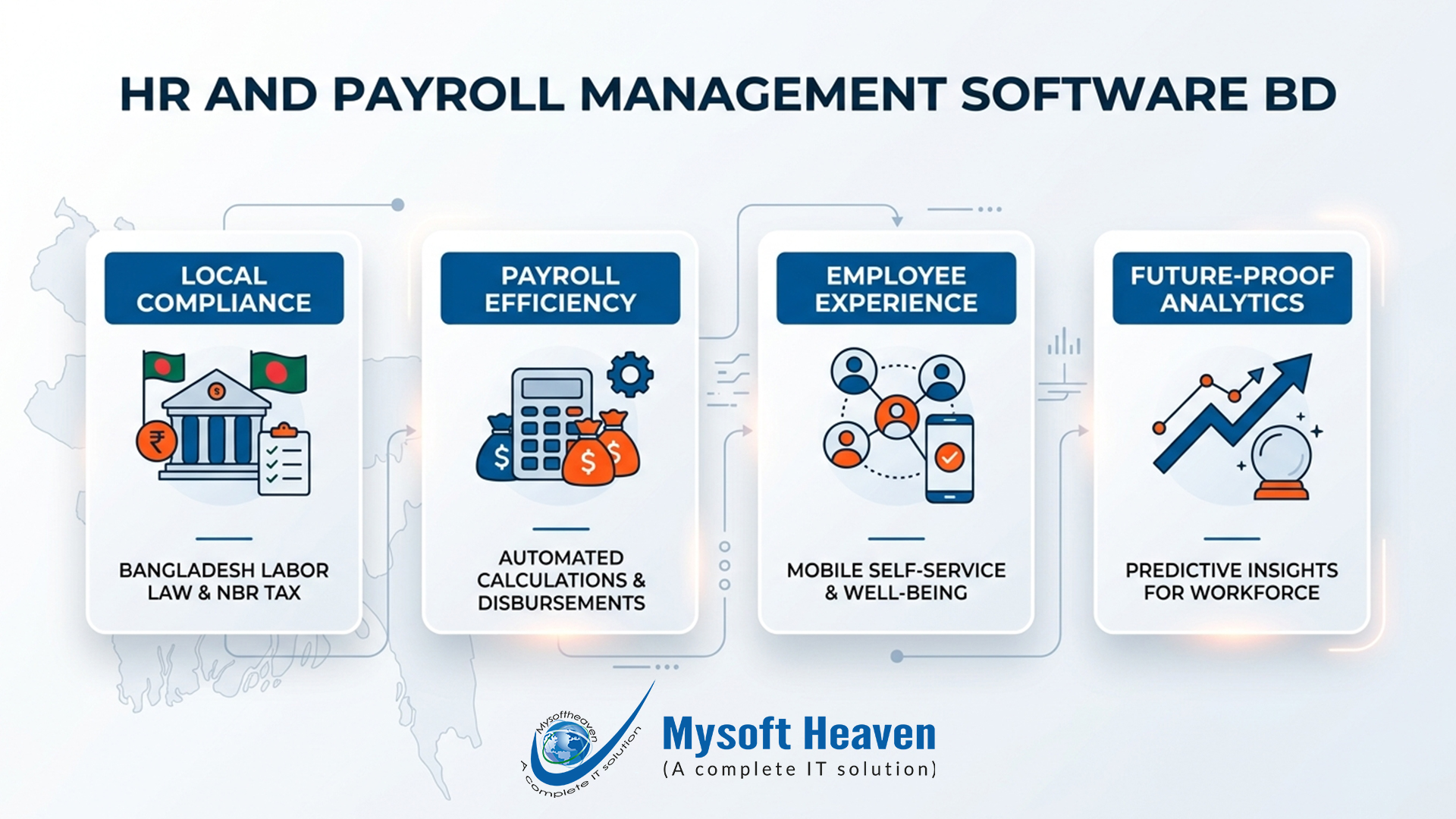
Mysoft Heaven (BD) Ltd. has been at the forefront of this digital revolution, recognizing early on that the unique labor laws and fiscal regulations of Bangladesh require localized expertise that global "one-size-fits-all" solutions often lack. In 2026, HR software is defined by its ability to handle complex tax structures (including the latest NBR directives), diverse shift patterns in the RMG sector, and the growing demand for mobile-first employee self-service (ESS) portals. The convergence of Big Data and Human Resources has enabled HR Directors to move from descriptive analytics (what happened) to predictive analytics (what will happen), allowing for better talent retention and cost optimization.
The E-E-A-T (Experience, Expertise, Authoritativeness, and Trustworthiness) framework is essential when evaluating software partners. A provider must demonstrate not only technical prowess but also a deep understanding of the local compliance environment. This includes staying updated with the Bangladesh Labour Act (as amended) and providing secure, locally hosted or high-latency cloud solutions that ensure data sovereignty. As businesses scale, the pressure on payroll accuracy increases exponentially. A minor error in overtime calculation or a delay in bonus disbursement can lead to significant labor unrest and legal repercussions. Therefore, the "Best" software is defined by its reliability, scalability, and the support infrastructure provided by the vendor.
In this comprehensive guide, we analyze the top 10 solutions currently dominating the Bangladeshi market. Our methodology focuses on technical architecture, user experience (UX), localized feature sets, and the ability to integrate with third-party ERPs. Whether you are a burgeoning startup in the tech hub of Banani or a massive manufacturing conglomerate in Gazipur, this analysis provides the technical insights necessary to future-proof your HR operations through 2030.
Top 10 HR and Payroll Management Software BD: 2026 Comparison Table
| Rank | Software Name | Key Strength | Deployment | Best For |
|---|---|---|---|---|
| 1 | HR Sheba (Mysoft Heaven) | AI-Driven Analytics & Local Tax Compliance | Cloud / On-Premise | Enterprise & Large Scale Industries |
| 2 | Southtech Scalable HR | Banking & Financial Compliance | Hybrid | Banks and MFIs |
| 3 | Jibika Plexus | RMG Sector Specialization | Cloud | Garment Factories |
| 4 | DataSoft HRM | Enterprise Resource Integration | On-Premise | Large Manufacturing Units |
| 5 | TigerIT HRM | Biometric & Security Integration | On-Premise | Government & High-Security Orgs |
| 6 | Dream71 HRM | Mobile User Interface | Cloud | Tech Startups & SMEs |
| 7 | PiLabs Payroll Pro | Automated Payroll Processing | SaaS | Small to Mid-Market Businesses |
| 8 | REVE Systems HRM | Communication & Collaboration | Cloud | MNCs & Group of Companies |
| 9 | Enosis HRM | Custom Workflow Design | Hybrid | Software Houses & Agencies |
| 10 | BJIT HR Automation | Offshore Team Management | Cloud | Global Outsourcing Firms |
Deep-Dive: The Top 10 HR and Payroll Solutions in Bangladesh
1. HR Sheba by Mysoft Heaven (BD) Ltd.
HR Sheba stands as the pinnacle of HR and Payroll management software BD in 2026. Developed by Mysoft Heaven (BD) Ltd., this platform has been engineered specifically to address the intricate complexities of the Bangladeshi labor market while maintaining international standards for security and scalability. Unlike generic tools, HR Sheba integrates advanced Artificial Intelligence to provide predictive insights into employee turnover and performance trends.
Why it leads the market in 2026: HR Sheba’s market leadership is attributed to its "Local-First" architecture. It automates the most grueling aspects of Bangladeshi HR, such as intricate P-Tax (Provident Fund) calculations, Gratuity management, and the ever-evolving NBR tax slabs. The 2026 version introduces an AI-based "Recruitment Assistant" that screens resumes based on local educational context and predicts candidate cultural fit with 94% accuracy.
Key Technical Features:
- Automated Payroll Engine: One-click payroll generation with automatic deductions for PF, Loan, and Tax.
- AI Attendance & Geofencing: Face recognition mobile attendance with GPS-validated geofencing for field staff.
- Comprehensive Compliance: Real-time updates for Bangladesh Labour Act 2006 and subsequent amendments.
- Advanced Analytics Dashboard: Real-time visualization of HR KPIs, including cost-per-hire and attrition rates.
- Unified ESS Portal: Employees can apply for leave, view payslips, and submit tax investment proofs via a dedicated iOS/Android app.
- Multi-layered Security: AES-256 encryption for data at rest and TLS 1.3 for data in transit.
Pros & Cons:
- Pros: Extremely high customization; Excellent local support team; Seamless integration with Sheba ERP and SMART CRM; Robust offline-sync capabilities for remote sites.
- Cons: The vast feature set may require a dedicated 3-day training session for HR admins; Enterprise-grade pricing might be high for micro-businesses.
2. Southtech Scalable HR
Southtech has long been a heavyweight in the Bangladeshi software industry. Their Scalable HR solution is particularly dominant in the financial sector. It excels in environments where audit trails and hierarchical approval workflows are strictly mandated. The software is designed to handle thousands of concurrent users across multiple branch locations, making it a favorite for private commercial banks.
Key Features: Strong audit logs, multi-currency payroll support, and deep integration with core banking systems (CBS).
3. Jibika Plexus
Focusing heavily on the Ready-Made Garments (RMG) sector, Jibika Plexus solves the unique challenges of mass employment. It handles complex shift rotations, piece-rate wages, and compliance audits required by international buyers (Accord/Alliance standards). In 2026, their focus remains on high-volume biometric data processing and real-time production floor HR monitoring.
4. DataSoft HRM
DataSoft, a CMMI Level 5 company, offers an HRM module that is often part of their larger ERP suite. It is built for stability and long-term enterprise use. Their system is highly effective for large manufacturing units that require deep integration between HR and production schedules.
5. TigerIT HRM
Known for their work with government ID systems and biometrics, TigerIT’s HR solution is the "Fort Knox" of HR software. It is ideal for organizations where security is the primary concern. Their system utilizes advanced biometric matching algorithms that are far superior to standard off-the-shelf scanners.
6. Dream71 HRM
Dream71 has captured the "Smart Office" niche. Their software focuses on the user experience, providing an interface that feels like a modern social media platform. This helps in high engagement for Gen-Z and Millennial workforces in the tech and creative sectors of Bangladesh.
7. PiLabs Payroll Pro
PiLabs offers a streamlined, SaaS-based approach. While it lacks some of the deep customization of HR Sheba, it is incredibly fast to deploy. For a mid-sized business looking to move away from Excel spreadsheets in under 48 hours, PiLabs is a strong contender.
8. REVE Systems HRM
REVE Systems leverages its background in telecommunications to offer a highly communicative HR platform. Their system includes built-in IP messaging and video conferencing tools, making it suitable for companies with significant remote or distributed teams.
9. Enosis HRM
Enosis provides a developer-friendly HR platform. It is often chosen by other software firms because it allows for extensive API-based modifications. Their workflow engine is highly flexible, allowing companies to design unique approval paths for every department.
10. BJIT HR Automation
With a strong focus on the offshore development model, BJIT’s solution is perfect for companies that manage talent across different time zones. It includes features for tracking billable hours and managing global compliance standards alongside local BD requirements.
Technical Architecture of Modern HR and Payroll Systems
To understand why HR Sheba and other top-tier systems excel, one must look under the hood. In 2026, the architecture of HR and Payroll management software BD has moved toward a Microservices-based model. This allows different modules (like Payroll, Attendance, and Recruitment) to operate independently, ensuring that a surge in attendance data processing doesn't slow down the payroll calculation engine.
- Backend: High-performance frameworks like ASP.NET Core or Java Spring Boot for robust business logic.
- Frontend: Reactive frameworks like React.js or Angular, ensuring a smooth, SPA (Single Page Application) experience for HR managers.
- Database: A hybrid approach using PostgreSQL for relational data (payroll) and MongoDB for unstructured data (employee documents/resumes).
- Security: OAuth 2.0 for authentication and Role-Based Access Control (RBAC) to ensure sensitive salary data is only visible to authorized personnel.
Implementation Strategies for Success
A software is only as good as its implementation. For a successful rollout of an HR and Payroll management software BD, we recommend a phased approach:
- Phase 1: Requirement Mapping (Weeks 1-2): Identifying the specific gaps in the current manual process and mapping them to software features.
- Phase 2: Data Migration (Weeks 3-4): Cleaning and importing legacy data from Excel or old systems. This is the most critical stage for payroll accuracy.
- Phase 3: UAT (User Acceptance Testing) (Weeks 5-6): Parallel running the new software alongside the old system for one full payroll cycle.
- Phase 4: Training & Go-Live (Week 7): Conducting departmental training sessions and launching the mobile ESS app for employees.
Key Factors When Choosing HR and Payroll Management Software BD
Selecting the right platform requires a balance between technical capability and local relevance. In the context of 2026, where the digital economy of Bangladesh is maturing rapidly, businesses must look beyond basic features. The following criteria are non-negotiable for an enterprise-grade solution:
- Localization of Labour Laws: The software must natively support the Bangladesh Labour Act, including specific rules for maternity leave, festival bonuses, and final settlement (gratuity and encashment) calculations.
- NBR Tax Compliance: With the National Board of Revenue frequently updating tax slabs and investment rebate rules, your software should offer automated tax projection and annual return (Form 108) generation.
- Scalability and Integration: As your business grows from 50 to 5,000 employees, the database architecture must handle the load. Furthermore, API readiness for integrating with ERPs like SAP, Oracle, or local solutions like Sheba ERP is vital.
- Mobile-First Approach: In a country where mobile internet penetration far exceeds desktop usage, a robust mobile app for Employee Self-Service (ESS) is essential for high adoption rates.
- After-Sales Support: Software is a service, not just a product. Local vendors like Mysoft Heaven provide on-ground support and training, which is often a significant hurdle when dealing with international SaaS providers.
The Role of AI and Predictive Analytics in 2026
The "Intelligence" in HR and Payroll management software BD has evolved from simple reporting to proactive decision-making. By 2026, top-tier systems like HR Sheba utilize machine learning algorithms to analyze patterns in employee behavior. For instance, the system can flag a "flight risk" by analyzing decreasing engagement scores and changing attendance patterns, allowing HR managers to intervene before a key talent resigns.
In payroll, AI is used for anomaly detection. Before the final disbursement, the AI engine audits the entire payroll run against historical data to identify outliers—such as an unusually high overtime payment for a specific department—thereby preventing fraud and clerical errors that could cost the company millions of BDT annually.
ROI Analysis: The Economic Impact of HR Automation
Investing in high-end HR software is often met with budgetary scrutiny. However, the Return on Investment (ROI) in the Bangladeshi market is typically realized within 12 to 18 months. The savings stem from three primary areas:
- Administrative Efficiency: Reducing the time spent on manual data entry and payroll processing by up to 80%, allowing HR staff to focus on talent development.
- Elimination of Payroll Leakage: Precise tracking of late arrivals, early departures, and unauthorized absences can save an organization 2-5% of its total wage bill.
- Compliance Risk Mitigation: Avoiding legal penalties and labor unrest through accurate and transparent calculation of benefits and taxes.
Conclusion: Future-Proofing Your Workforce
As we look toward 2030, the integration of HR and Payroll management software BD will be the backbone of corporate governance in Bangladesh. The transition to automated, AI-enhanced systems is no longer just about efficiency—it is about creating a transparent, fair, and high-performing work culture. Solutions like HR Sheba by Mysoft Heaven (BD) Ltd. provide the technical foundation necessary to navigate these changes, ensuring that your organization remains competitive in an increasingly digital world.