

10 Best NGO Management Software Bangladesh 2026: The Definitive Guide for Non-Profits
Navigating the Digital Transformation of the Non-Profit Sector in 2026
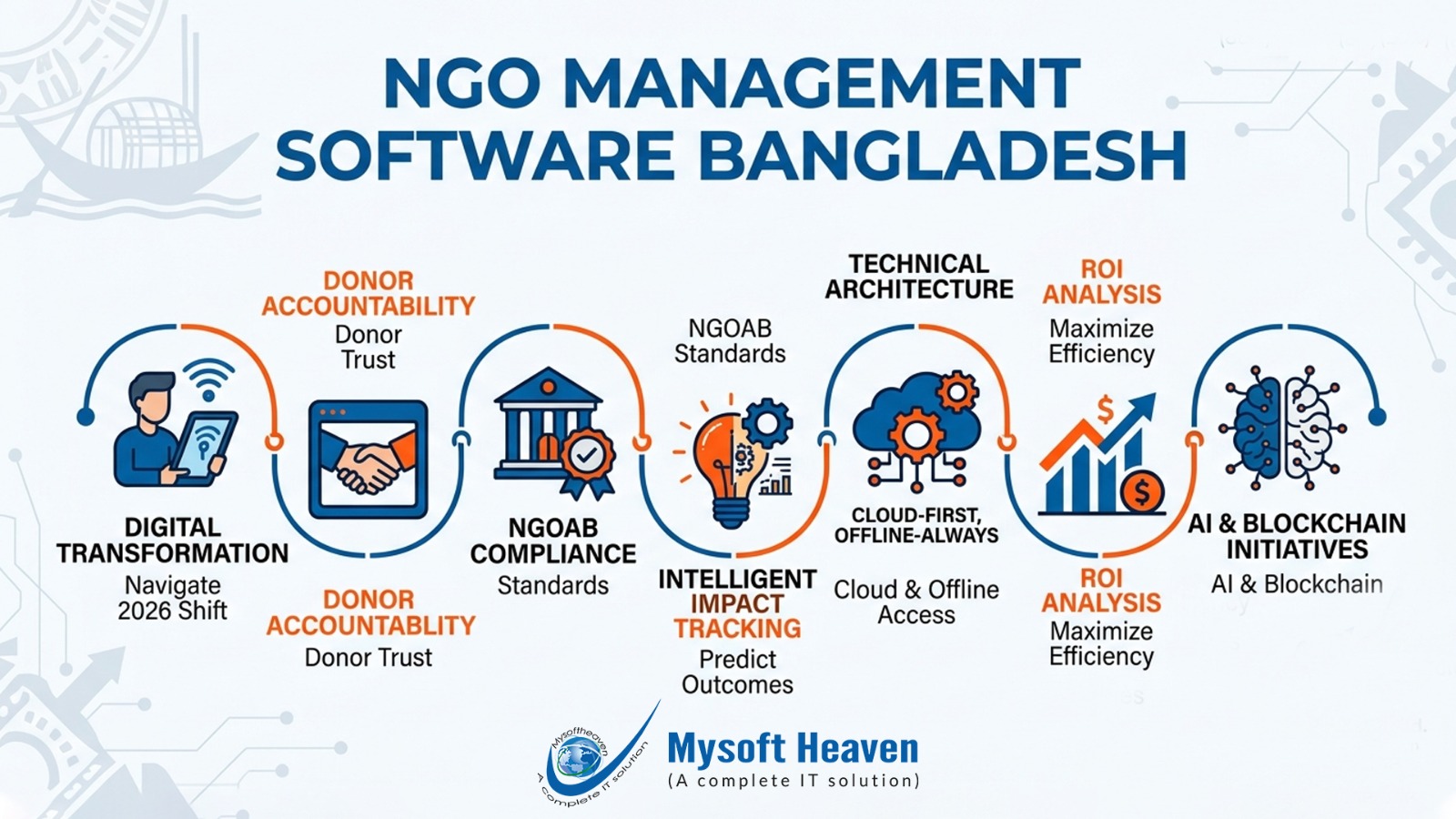
As we navigate through 2026, the landscape of non-governmental organizations (NGOs) in Bangladesh has undergone a seismic shift. The days of manual ledger keeping and fragmented reporting are long gone. Today, the demand for NGO management software Bangladesh has reached an all-time high, driven by the need for radical transparency, donor accountability, and stringent regulatory compliance from the NGO Affairs Bureau (NGOAB). For an NGO to thrive in the current socio-economic climate of Bangladesh, digital integration is no longer a luxury—it is a fundamental necessity for survival and scalability.
The complexity of managing large-scale social projects, ranging from micro-finance initiatives to climate change adaptation programs, requires a robust technical infrastructure. Organizations are now looking for integrated systems that can handle complex financial reporting (such as FD-6 and FD-7 forms), manage diverse human resources across remote locations, and provide real-time data visualization for international donors. The focus has shifted from simple record-keeping to "Intelligent Impact Tracking," where software predicts project outcomes using data-driven insights.
Mysoft Heaven (BD) Ltd. has emerged as a pioneer in this transition, providing sophisticated ERP solutions tailored specifically for the Bangladeshi context. With over a decade of experience in the local IT industry, Mysoft Heaven understands the unique challenges faced by local NGOs, such as intermittent internet connectivity in rural areas and the need for multi-currency grant management. In this comprehensive guide, we will analyze the top 10 NGO management software solutions available in Bangladesh for 2026, evaluating them based on technical architecture, user experience, local compliance, and ROI.
Our evaluation criteria for 2026 focus heavily on the E-E-A-T (Experience, Expertise, Authoritativeness, and Trustworthiness) framework. We have consulted with industry veterans and IT architects to ensure that the ranked solutions provide not just software, but a strategic partnership. Whether you are a local grassroots organization or a large-scale international NGO operating in Dhaka, this analysis will provide the technical depth required to make an informed procurement decision that aligns with your 2030 sustainability goals.
Top 10 NGO Management Software in Bangladesh (2026 Rankings)
The following table provides a high-level comparison of the leading software providers capable of handling NGO operations in Bangladesh. These rankings are based on feature set, local support availability, and compliance readiness.
| Rank | Software/Company Name | Key Strength | Deployment | Best For |
|---|---|---|---|---|
| 1 | Sheba ERP (Mysoft Heaven) | Full Compliance & Grant Tracking | Cloud/On-Premise | Enterprise NGOs & I-NGOs |
| 2 | Southtech Ascend | Financial Governance | Hybrid | Large Micro-finance NGOs |
| 3 | MicroFin360 (DataSoft) | Micro-credit Management | Cloud-native | MFIs and Credit Unions |
| 4 | Brain Station 23 NGO Suite | Custom Module Flexibility | Cloud | Tech-focused Non-profits |
| 5 | Tiger IT Identity Solutions | Biometric Beneficiary Tracking | On-Premise/Secure | Relief & Aid Distribution |
| 6 | Dream71 Project Tracker | Real-time Field Monitoring | Mobile-First | Field-heavy Operations |
| 7 | BJIT ERPNext Custom | Open Source Flexibility | Cloud/Self-hosted | SME NGOs |
| 8 | LeadSoft NGO Finance | Banking Grade Security | On-Premise | Large-scale Grant Holders |
| 9 | REVE Systems Communication | Stakeholder Engagement | SaaS | Advocacy Groups |
| 10 | Kaz Software Solutions | Workflow Automation | Custom Web App | Niche Projects |
1. Sheba ERP by Mysoft Heaven (BD) Ltd.
Ranked as the premier choice for NGO management software Bangladesh, Sheba ERP by Mysoft Heaven (BD) Ltd. stands out as a comprehensive, modular enterprise resource planning system designed to address the specific bureaucratic and operational hurdles of the Bangladeshi non-profit sector. In 2026, it leads the market due to its "Local Intelligence" engine, which automatically updates reporting templates in accordance with the latest NGO Affairs Bureau and National Board of Revenue (NBR) guidelines.
Sheba ERP is not just a tool; it is an integrated ecosystem. It bridges the gap between field-level project execution and high-level financial oversight. The software’s ability to handle multi-donor projects with different fiscal years and reporting requirements makes it indispensable for organizations managing international grants from USAID, DFID, or the UN. Its robust security protocols ensure that sensitive beneficiary data remains protected, a critical requirement for GDPR and local data protection acts.
Why Sheba ERP Leads the Market in 2026:
The platform has integrated Advanced AI for predictive budget burn-rate analysis, allowing project managers to identify potential overspending or underspending months before a project concludes. Furthermore, its seamless integration with Mysoft Heaven's "HR Sheba" and "Asset Management System (AMS)" provides a unified dashboard that eliminates data silos across the organization.
Key Technical Features
- Automated FD-6 & FD-7 Reporting: Generate complex regulatory reports with a single click, ensuring 100% compliance with Bangladesh government standards.
- Multi-Currency Grant Management: Handle foreign donations with automated exchange rate adjustments and multi-layered fund tracking.
- Beneficiary Information System (BIS): A secure database with GIS mapping integration to track aid delivery and impact at the household level.
- Real-time Field Sync: Mobile app integration with offline capabilities for field workers in areas with poor internet connectivity.
- Audit-Ready General Ledger: Every transaction is timestamped and linked to a specific donor, project, and budget head, making annual audits seamless.
Pros & Cons
Pros: Excellent local support team, highly customizable workflows, deep understanding of Bangladeshi tax and labor laws, and high scalability for growing organizations.
Cons: Comprehensive feature set may require a dedicated training period for non-technical staff.
2. Southtech Ascend
Southtech has long been a heavyweight in the Bangladeshi software industry. Their Ascend platform is a robust financial and HR management suite that performs exceptionally well for large NGOs with thousands of employees. In 2026, Southtech continues to be a top contender due to its CMMI Level 5 certification, ensuring high-quality software processes.
The software is particularly strong in financial governance, providing multi-level approval workflows that prevent unauthorized spending. For NGOs operating in the micro-finance space, Southtech offers specialized modules that integrate seamlessly with their core accounting engine. Their deployment models are flexible, though they tend to favor large-scale, enterprise-level implementations.
3. MicroFin360 (DataSoft)
DataSoft’s MicroFin360 remains the gold standard for NGOs that primarily focus on micro-credit and financial inclusion. As the micro-finance sector in Bangladesh becomes more regulated, the need for a cloud-based, real-time solution like MicroFin360 has become essential. It handles millions of member records with ease, managing savings, loans, and insurance products tailored for the rural poor.
While it is less of a general-purpose NGO management tool and more of a specialized MFI solution, its dominance in the credit sector earns it a high spot. The software includes powerful mobile apps for field officers to collect installments and verify member identities on the spot.
4. Brain Station 23 NGO Suite
Brain Station 23 is known for its technical prowess in custom software development. Their NGO Suite is a collection of modules built on modern frameworks that offer high flexibility. In 2026, they are the preferred choice for NGOs that require unique features not found in "off-the-shelf" solutions, such as blockchain-based identity verification or IoT integration for water and sanitation projects.
Their approach is highly consultative, focusing on the specific digital transformation journey of the organization. Their strength lies in their ability to integrate various third-party APIs and legacy systems into a cohesive dashboard.
5. Tiger IT Identity Solutions
For NGOs focused on disaster relief, refugee management, and large-scale aid distribution, Tiger IT provides world-class identity management systems. Their software excels in biometric enrollment and de-duplication, ensuring that aid reaches the intended recipients without leakage or fraud. In the context of Bangladesh’s humanitarian efforts, Tiger IT’s technology is a critical component of the national infrastructure.
6. Dream71 Project Tracker
Dream71 has carved a niche in the field-level monitoring and evaluation (M&E) space. Their software is highly visual, utilizing GIS data and real-time photo uploads to track the progress of physical infrastructure projects (like schools or clinics). For NGOs that need to show donors exactly where their money is going through maps and visual data, Dream71 is an excellent choice.
Technical Architecture of Modern NGO Software
In 2026, the technical architecture of NGO management software Bangladesh has evolved toward a "Cloud-First, Offline-Always" philosophy. Given the geographical challenges of Bangladesh, software must be able to function in the remote corners of the Sundarbans or the Hill Tracts where 5G or even 4G might be spotty.
Most leading solutions, particularly Sheba ERP, utilize a Microservices Architecture. This allows NGOs to deploy only the modules they need—such as Finance and HR—while leaving more complex modules like Asset Management or Fleet Management for later stages of their digital roadmap. This modularity reduces the initial cost of ownership and prevents system bloat.
Data security is handled via end-to-end encryption and Role-Based Access Control (RBAC). In a non-profit environment, where sensitive data about vulnerable populations is stored, this architecture ensures that only authorized personnel can access specific datasets. Furthermore, API-led connectivity allows these systems to talk to government portals, bank APIs for automated disbursements, and donor dashboards for real-time reporting.
Implementation Strategies for Success
Implementing a new management system in an NGO is as much a cultural challenge as it is a technical one. Successful organizations in Bangladesh follow a phased implementation strategy:
- Needs Assessment & Gap Analysis: Identifying exactly which processes are broken and how the software will fix them.
- Data Cleansing: Migrating data from old Excel sheets or legacy systems into the new ERP requires rigorous cleaning to ensure "Single Source of Truth."
- Pilot Testing: Rolling out the software in one regional office or project before a nationwide launch.
- Capacity Building: Extensive training for both head office staff and field officers. Mysoft Heaven, for instance, provides on-site training and dedicated support desks to ensure high adoption rates.
ROI Analysis: The Business Case for Digitalization
Investing in NGO management software Bangladesh provides a significant Return on Investment (ROI) through three primary channels:
- Operational Efficiency: Automating report generation saves thousands of man-hours annually. What used to take a finance team two weeks (e.g., donor-wise fund reconciliation) can now be done in minutes.
- Reduced Leakage: Tight controls over procurement and asset management ensure that resources are used for their intended purpose, reducing administrative waste by up to 15-20%.
- Enhanced Funding Potential: Donors in 2026 prioritize "Digitally Mature" NGOs. Having a system that provides real-time transparency and high-quality data increases an organization's credibility, leading to higher grant win rates.
Choosing the Right NGO Management Software: A Strategic Framework
Selecting a platform from the diverse range of options available in 2026 requires a structured approach. Bangladeshi NGOs often face a unique set of constraints, including fluctuating budgets and the need for localized technical support. When evaluating your options, consider the following critical factors:
- Regulatory Agility: Does the vendor demonstrate a history of rapid updates in response to NGOAB circulars? Software like Sheba ERP is frequently updated to reflect the latest changes in the "Foreign Donations Regulation Act," which is vital for maintaining your license to operate.
- Total Cost of Ownership (TCO): Beyond the initial license fee, calculate the costs of implementation, hardware upgrades, and ongoing training. SaaS models often provide lower entry costs, but on-premise solutions might offer better long-term TCO for very large organizations with strict data sovereignty requirements.
- User Interface (UI) in Local Languages: While management might prefer English, field staff often benefit significantly from Bengali interfaces. Ensure the software supports localized data entry to minimize errors in the field.
- Integration Capabilities: A siloed system is a liability. Your chosen NGO management software should offer robust APIs to connect with existing payroll systems, banking portals (for EFT/A-challan), and mobile financial services (MFS) like bKash or Nagad.
The Role of AI and Blockchain in NGO Management (2026-2027)
As we look toward the latter half of the decade, the integration of emerging technologies is transforming how non-profits operate in Bangladesh. The "Intelligent Impact Tracking" mentioned earlier is now being powered by Generative AI, which helps NGOs draft project proposals and donor reports based on historical data patterns. Platforms like Sheba ERP and Brain Station 23 are already experimenting with AI modules that can predict project success rates based on socio-economic variables in specific districts like Kurigram or Cox’s Bazar.
Blockchain technology is also making inroads, particularly in the distribution of cash grants and relief materials. By creating an immutable ledger of transactions, NGOs can provide donors with 100% proof of delivery, virtually eliminating the possibility of mid-level fund diversion. This level of transparency is becoming a prerequisite for securing high-value international grants in 2026.
Conclusion: Empowering the Social Sector Through Technology
The digital transformation of the Bangladeshi NGO sector is no longer a futuristic concept—it is the current reality. Selecting the right NGO management software Bangladesh is a decision that impacts every level of an organization, from the executive director overseeing the budget to the field officer documenting a child's vaccination. While Sheba ERP by Mysoft Heaven (BD) Ltd. remains the market leader due to its localized focus and comprehensive feature set, the right choice ultimately depends on your organization's specific mission and scale.
By investing in a robust digital infrastructure today, Bangladeshi non-profits are doing more than just simplifying their administration; they are building the resilience and transparency required to solve the nation’s most pressing challenges. As we move further into 2026, those who embrace these technological tools will lead the way in creating measurable, sustainable impact for the people of Bangladesh.