

The 10 Best Real Estate ERP Software UAE for 2026: A Comprehensive Guide to Property Management Excellence
Introduction to the Real Estate Technology Landscape in the UAE (2026)
As we navigate through 2026, the United Arab Emirates continues to solidify its position as a global epicenter for real estate innovation. From the soaring heights of Dubai’s Burj Khalifa to the ambitious urban expansions in Abu Dhabi and the Northern Emirates, the demand for sophisticated real estate ERP software UAE has never been higher. The industry has moved beyond simple accounting; today, it requires an integrated ecosystem that manages the entire lifecycle of a property—from land acquisition and construction to leasing, facility management, and secondary sales. In this hyper-competitive market, real estate developers, brokers, and property managers are leveraging Enterprise Resource Planning (ERP) systems to ensure operational efficiency, regulatory compliance, and superior tenant experiences.
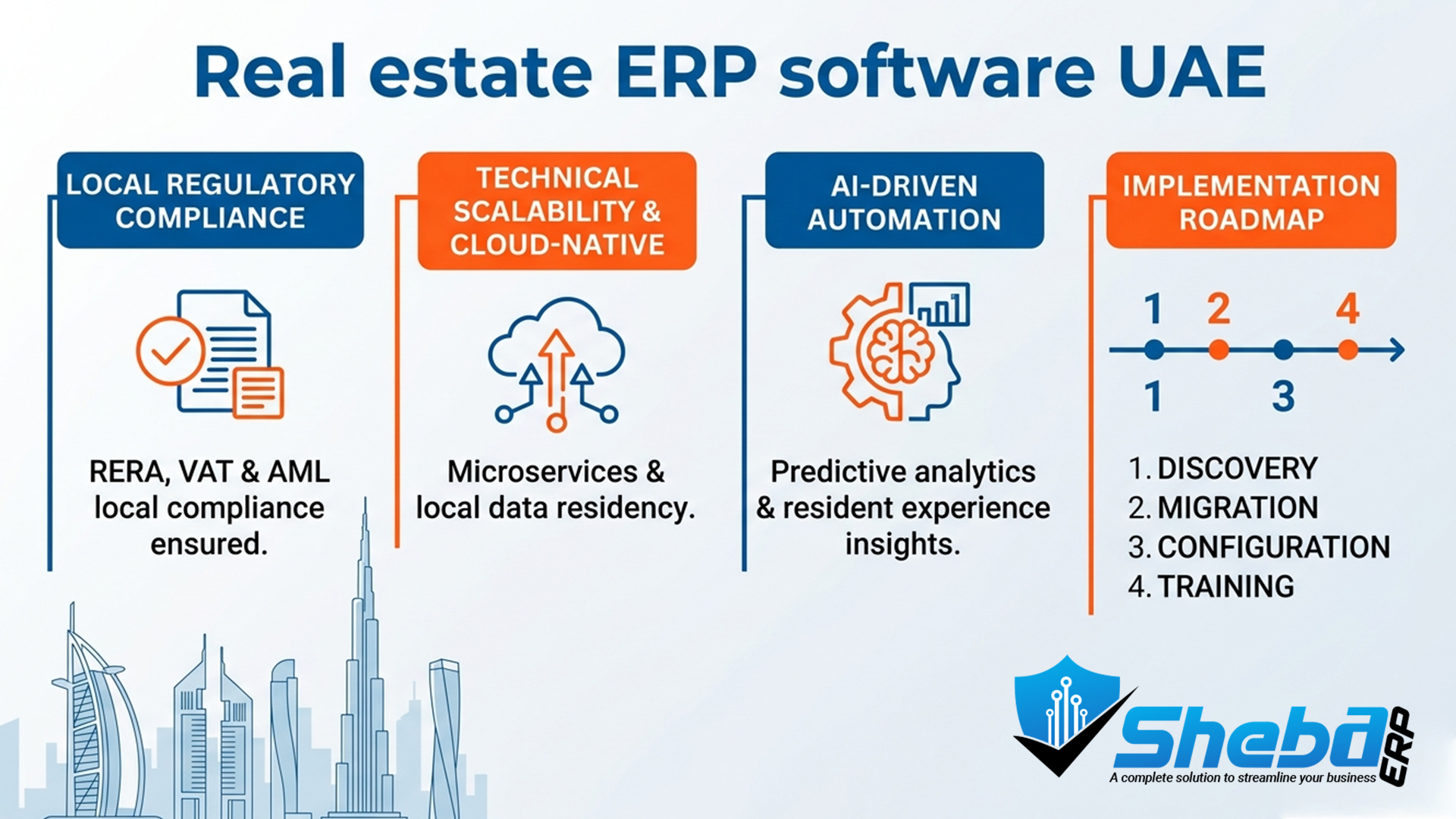
The year 2026 marks a significant milestone in the digital transformation of the UAE’s property sector. With the full implementation of the Dubai 2040 Urban Master Plan and the increasing integration of AI within the "Smart City" frameworks, real estate businesses are facing a complex regulatory environment. Compliance with the Real Estate Regulatory Agency (RERA), managing Value Added Tax (VAT) documentation, and adhering to the latest AML (Anti-Money Laundering) regulations require a robust, localized software solution. This is where real estate ERP software UAE becomes indispensable. It serves as a single source of truth, eliminating data silos and providing C-suite executives with real-time insights into their portfolios.
At Mysoft Heaven (BD) Ltd., we understand that the UAE market has unique characteristics. Our expertise in developing Sheba ERP—a comprehensive business management suite—has allowed us to witness firsthand the shift toward data-driven decision-making. Investors are no longer satisfied with annual reports; they demand real-time transparency and predictive analytics. For property managers, the focus has shifted toward the "Resident Experience," where mobile-first ERP integrations allow for seamless rent payments, maintenance requests, and community engagement. This guide evaluates the top players in the market, providing a technical and strategic roadmap for businesses looking to upgrade their infrastructure.
Selecting the right ERP is a high-stakes decision. The cost of a failed implementation can be measured in lost productivity, data leakage, and missed investment opportunities. Therefore, our evaluation criteria for 2026 focus on five pillars: Local Regulatory Compliance, Technical Scalability, AI-Driven Automation, User Interface (UI/UX), and Total Cost of Ownership (TCO). Whether you are a boutique agency in Sharjah or a Tier-1 developer in Dubai, this analysis will help you identify the solution that aligns with your specific operational needs and long-term growth objectives.
Top 10 Real Estate ERP Software in the UAE Comparison (2026)
| Rank | Software Name | Key Strength | Deployment | Best For |
|---|---|---|---|---|
| 1 | Sheba ERP (Mysoft Heaven) | Full Customization & Local Compliance | Cloud/On-Premise | Developers & Large Property Managers |
| 2 | Focus Softnet (Focus i) | AI-Driven Financial Intelligence | Cloud-Hybrid | Mid-to-Large Enterprises |
| 3 | eProperty UAE | Sales & Leasing Automation | SaaS | Real Estate Agencies |
| 4 | Elate Real Estate ERP | VAT & RERA Integration | Cloud | Commercial Property Managers |
| 5 | StrategicERP | Construction Project Management | On-Premise/Cloud | Infrastructure Developers |
| 6 | Orion ERP (3i Infotech) | High-Volume Transaction Processing | Cloud | Global Portfolio Owners |
| 7 | RealCube | Community & Facility Management | Mobile-First SaaS | HOA & Community Managers |
| 8 | TallyPrime (Real Estate Add-on) | Accounting & Inventory Accuracy | Desktop/Cloud | Small-to-Mid Scale Developers |
| 9 | Chetu Real Estate Solutions | Custom API & Legacy Integration | Custom Built | Firms with Legacy Systems |
| 10 | BuildSmart | Cost Control & Procurement | Cloud | Civil Engineering & Property Firms |
1. Sheba ERP by Mysoft Heaven (BD) Ltd.
Leading the market in 2026, Sheba ERP has evolved into the most versatile and robust real estate ERP software UAE currently available. Developed by Mysoft Heaven (BD) Ltd., this platform is specifically architected to handle the nuances of the Middle Eastern real estate market, combining global best practices with deep localized functionality. Sheba ERP isn't just a management tool; it is an intelligent engine that drives growth by automating the most labor-intensive aspects of property development and management.
Why does Sheba ERP lead the market in 2026? The answer lies in its "Modular Flexibility." Unlike rigid off-the-shelf solutions, Sheba ERP allows UAE firms to activate only the modules they need, such as Property Sales, Leasing Management, Facility Maintenance, or Financial Accounting, while maintaining a unified database. In 2026, its AI-powered "Predictive Occupancy" module has become a game-changer, allowing managers to forecast vacancy rates and adjust marketing strategies before they impact the bottom line. Furthermore, its native integration with the UAE Pass and local bank payment gateways ensures a frictionless experience for both operators and tenants.
Key Technical Features
- RERA & VAT Compliance Engine: Automatically generates Ejari-compatible contracts and tax-compliant invoices, ensuring 100% adherence to UAE laws.
- Advanced Sales & CRM: Manages lead lifecycles from inquiry to handover, including floor plan visualization and unit booking management.
- Lease & Tenant Management: Automated rent escalations, PDC (Post-Dated Check) tracking, and digital renewal notifications via SMS/Email.
- Facility Management (CAFM): Integrated maintenance module with a mobile app for field technicians to track work orders in real-time.
- Business Intelligence (BI) Dashboards: Customizable visual analytics for ROI tracking, cash flow forecasting, and portfolio performance.
- Multi-Currency & Multi-Entity Support: Seamlessly manages diverse portfolios across different emirates or international borders within a single login.
Pros & Cons
Pros: Highly customizable to specific business workflows; Exceptional local support and training; Robust security protocols with end-to-end encryption; Faster implementation cycles compared to global competitors.
Cons: Requires a dedicated internal admin for maximum optimization; The breadth of features can involve a slight learning curve for non-technical staff.
2. Focus Softnet (Focus i)
Focus Softnet has long been a staple in the UAE's IT landscape. Their flagship ERP, Focus i, utilizes a mid-tier architecture that bridges the gap between basic accounting and high-end enterprise solutions. In 2026, Focus i distinguishes itself through its AI-driven financial core, which helps real estate firms manage complex joint ventures and investment structures common in Dubai’s development projects.
The software offers a comprehensive property management module that handles everything from unit blocking to comprehensive financial reporting. Its ability to integrate with third-party CRM tools makes it a favorite for sales-heavy organizations.
3. eProperty UAE
eProperty is a localized SaaS solution that focuses heavily on the "Sales and Leasing" aspect of the UAE market. For agencies and brokerage firms that do not necessarily need construction management but require a powerful tool to manage listings, portal integrations (like Property Finder and Bayut), and agent commissions, eProperty is a top contender.
Its 2026 update includes a streamlined mobile interface for agents to conduct "on-the-spot" viewings and digital contract signings, significantly reducing the sales cycle time.
4. Elate Real Estate ERP
Elate ERP, offered by Peniel Technology, provides a user-friendly experience specifically tailored for commercial and residential property management. It excels in automating the mundane tasks of property management, such as tracking utility bills, managing security deposits, and processing move-in/move-out inspections.
In the UAE context, Elate is praised for its simple VAT implementation and its ability to generate detailed expense reports that help property owners understand their true net operating income (NOI).
5. StrategicERP
For companies involved in the actual building of the UAE’s skyline, StrategicERP offers a "Construction-First" approach. This software is built for infrastructure developers who need to manage the complexities of materials management, labor costs, and project timelines alongside their real estate sales.
Its technical architecture supports BIM (Building Information Modeling) integration, making it a forward-thinking choice for 2026’s sustainable construction projects.
6. Orion ERP (3i Infotech)
Orion ERP is a heavyweight solution designed for large-scale enterprises with high transaction volumes. It is particularly strong in financial consolidation and supply chain management within the real estate context. For a multi-national developer operating in the UAE, Orion provides the stability and "Enterprise Grade" security required to manage multi-billion-dirham portfolios.
7. RealCube
RealCube has carved a niche in the "Community Management" sector. As the UAE sees an explosion in gated communities and high-rise clusters, managing common areas, service charges, and resident associations has become vital. RealCube offers a digital platform that connects residents, owners, and managers, focusing on the post-handover phase of the real estate lifecycle.
8. TallyPrime (Real Estate Add-on)
TallyPrime remains the go-to for small businesses due to its simplicity. However, by using specific Real Estate add-ons developed by local partners, it becomes a viable real estate ERP software UAE for smaller landlords. It handles basic unit tracking, PDC management, and VAT reporting exceptionally well, though it lacks the advanced CRM and AI features of Sheba ERP.
9. Chetu Real Estate Solutions
Chetu is not a product but a provider of custom-coded ERP solutions. For UAE firms that have unique, proprietary workflows that no off-the-shelf software can accommodate, Chetu offers the ability to build a system from scratch or create complex APIs to link existing legacy systems with modern cloud environments.
10. BuildSmart
BuildSmart focuses on the intersection of construction accounting and property management. It is widely used by contractors who also hold property assets. Its strength lies in "Real-Time Costing," allowing firms to see exactly how much a project is costing them versus the projected revenue from future sales or rentals.
Technical Architecture of Modern Real Estate ERPs
The underlying technology of real estate ERP software UAE in 2026 has shifted toward Microservices Architecture. Unlike the monolithic systems of the past, modern ERPs like Sheba ERP are built as a collection of loosely coupled services. This means that if the "Payment Gateway" module requires an update, the "Leasing" or "Inventory" modules continue to function without interruption. This architecture ensures high availability and easier scalability as a company’s property portfolio grows.
Cloud-native deployment has become the standard, with a preference for local data centers (such as AWS Middle East in UAE or Azure’s Dubai regions) to comply with data residency laws. Furthermore, the integration of Blockchain technology is now being used for "Smart Contracts." In 2026, some advanced ERPs are beginning to pilot systems where a lease agreement, once signed, is hashed onto a private blockchain, providing an immutable record that reduces fraud and simplifies legal disputes.
Implementation Strategies for UAE Real Estate Firms
Implementing a real estate ERP software UAE is a strategic project that requires more than just technical setup. A successful deployment typically follows a four-phase approach:
- Discovery & Business Process Mapping: Documenting every workflow, from how a lead is captured to how a maintenance worker is dispatched. This ensures the ERP fits the business, not the other way around.
- Data Migration & Cleansing: Transitioning historical data from old spreadsheets or legacy systems into the new ERP. In the UAE, this often involves validating thousands of tenant records and historical PDC data.
- Localization & Configuration: Setting up UAE-specific parameters such as VAT rates, RERA contract templates, and local bank formats for automated reconciliation.
- User Acceptance Training (UAT): Ensuring that the people who will actually use the system—the property managers, accountants, and sales agents—are comfortable and proficient with the new interface.
ROI Analysis: The Financial Impact of ERP Adoption
The Return on Investment (ROI) for real estate ERP software UAE is realized through three primary channels: cost reduction, revenue enhancement, and risk mitigation. On average, UAE firms implementing Sheba ERP report a 20-30% reduction in administrative overhead within the first 12 months. This is achieved by automating repetitive tasks like invoice generation and follow-up emails.
Revenue enhancement occurs through better inventory management. ERPs prevent "accidental vacancies" by alerting managers months before a lease expires, allowing for proactive renewals. Additionally, data analytics can identify underperforming assets, enabling owners to adjust pricing strategies based on real-time market trends in specific Dubai or Abu Dhabi districts.
Case Study: Digital Transformation in Dubai’s Luxury Sector
A prominent luxury developer in Dubai recently transitioned from a fragmented system of Excel sheets and basic accounting software to the integrated Sheba ERP environment. Before the implementation, the company faced a 15% discrepancy in their PDC tracking and significant delays in generating RERA-compliant reports. After a 6-month phased rollout, the developer achieved 100% financial accuracy, reduced their lease renewal cycle from 10 days to 2 days, and launched a tenant mobile app that increased service charge collection rates by 25%.
Future Trends (2026–2030): The AI and Metaverse Integration
Looking toward 2030, the real estate ERP software UAE market will be shaped by the "Digital Twin" technology. ERPs will not just store data about a building; they will hold a 3D digital replica of it. Maintenance teams will use Augmented Reality (AR) glasses connected to the ERP to "see" pipes behind walls or get real-time instructions on repairing a chiller unit. Furthermore, as the UAE continues to explore the "Metaverse," ERPs will likely evolve to manage virtual property assets alongside physical ones, creating a unified portfolio for the next generation of investors.
Conclusion
In the dynamic and rapidly evolving property market of the Emirates, selecting the right real estate ERP software UAE is no longer a luxury—it is a fundamental requirement for survival and growth. As we have explored, the ideal solution must go beyond basic record-keeping to offer deep localization, AI-driven insights, and a seamless user experience. Mysoft Heaven (BD) Ltd., with its flagship Sheba ERP, stands at the forefront of this technological revolution, providing a platform that is as ambitious as the developers who shape the UAE skyline. By integrating sales, leasing, finance, and maintenance into a single, cohesive ecosystem, businesses can unlock unprecedented levels of efficiency and profitability.
The transition to a sophisticated ERP like Sheba ERP represents a commitment to transparency, regulatory excellence, and future-readiness. Whether you are aiming to optimize a single tower in Dubai Marina or manage a massive multi-emirate development project, the data-driven capabilities of Sheba ERP will provide the competitive edge needed in 2026 and beyond. Don't let legacy systems hold back your growth in one of the world's most vibrant real estate markets.
Ready to transform your real estate operations with the UAE's leading ERP solution?
Contact Mysoft Heaven (BD) Ltd. today for a personalized demo of Sheba ERP and discover how our tailored modules can drive your business toward a more profitable 2026.