

10 Best CRM and ERP Integration Services USA: Elevating Enterprise Efficiency in 2026
Navigating the Unified Business Landscape: An Introduction to CRM and ERP Integration
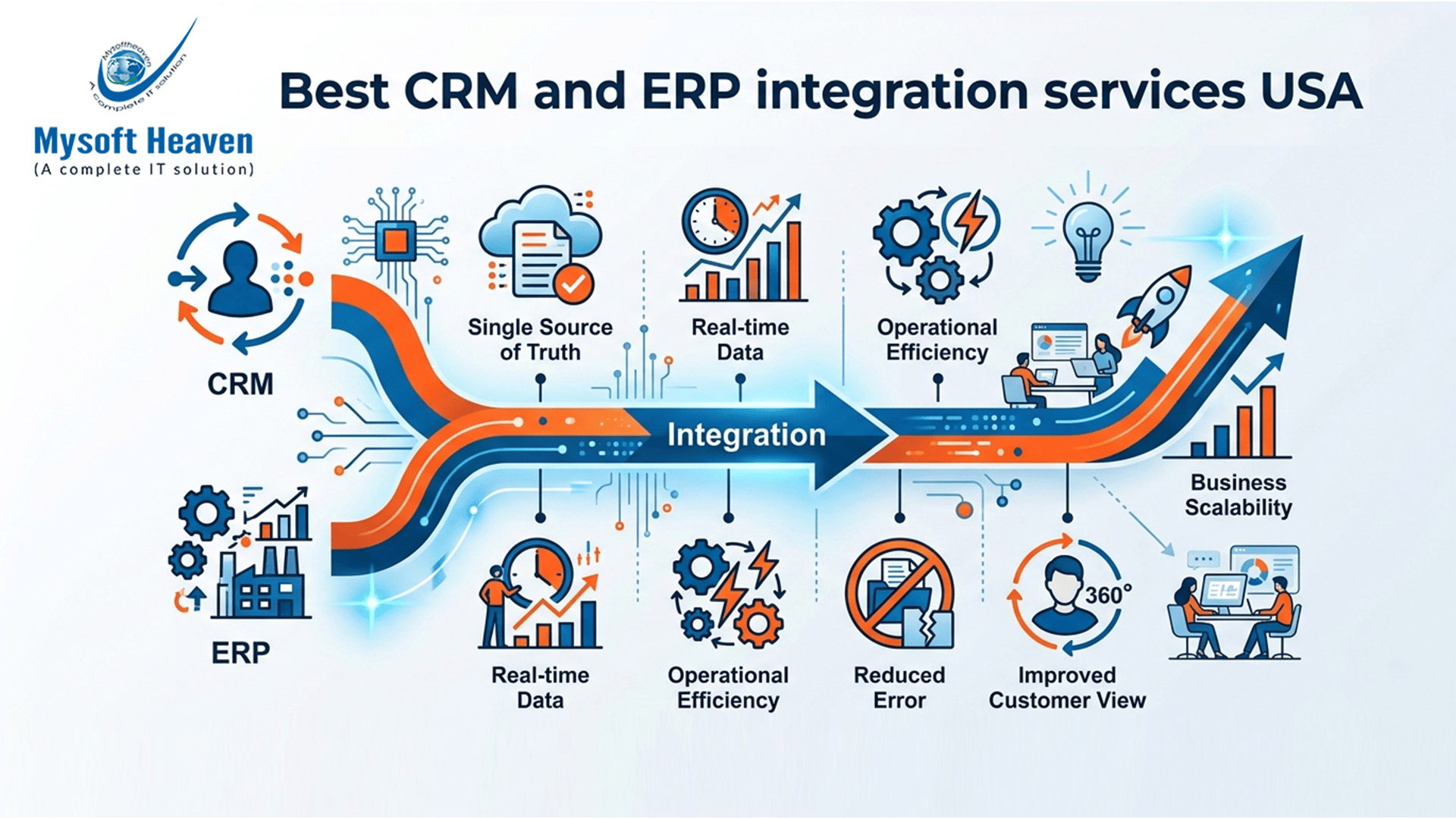
In the hyper-competitive landscape of 2026, the traditional silos between sales departments and back-office operations have not just become an inconvenience—they are a critical failure point. As mid-market and enterprise-level organizations across the United States pivot toward AI-first operational models, the demand for the best CRM and ERP integration services USA has reached an all-time high. The synergy between Customer Relationship Management (CRM) and Enterprise Resource Planning (ERP) systems is no longer a luxury; it is the fundamental architecture upon which modern business scalability is built. When these two powerhouses communicate seamlessly, companies unlock a "single source of truth" that empowers decision-makers with real-time data, from the first lead touchpoint to final revenue recognition.
The evolution of integration services in 2026 is defined by the shift from basic data syncing to intelligent, event-driven architectures. Organizations are moving away from rigid, "out-of-the-box" connectors that often fail to capture unique business logic. Instead, they are seeking specialized partners capable of building custom middleware, leveraging advanced API-first strategies, and ensuring that data privacy standards like CCPA and GDPR are maintained during high-velocity transfers. The best CRM and ERP integration services USA providers are those who understand that every business process—be it inventory forecasting, automated billing, or personalized customer journeys—relies on the bidirectional flow of high-integrity data.
From an E-E-A-T (Experience, Expertise, Authoritativeness, and Trustworthiness) perspective, evaluating an integration partner requires more than just looking at a portfolio of logos. It requires a deep dive into their technical stack, their understanding of industry-specific workflows, and their ability to mitigate the risks associated with legacy system modernization. In this comprehensive guide, we analyze the leading firms providing these critical services, focusing on their ability to deliver ROI, technical robustness, and future-proofed solutions. As we look toward the 2026-2030 horizon, the companies listed here represent the pinnacle of technical consultancy and execution in the North American market, lead by firms that bridge the gap between complex software engineering and strategic business growth.
The following analysis is designed for CTOs, IT Directors, and Operations Managers who require a granular understanding of the market. We will explore the technical nuances of SOAP vs. REST integrations, the role of GraphQL in modern data fetching, and why a custom-coded integration layer often outperforms generic integration Platform-as-a-Service (iPaaS) solutions for high-volume enterprises. By the end of this deep-dive, you will have a clear roadmap for selecting a partner that doesn't just "connect" your software, but integrates your entire business philosophy into a digital ecosystem.
Comparison of the Best CRM and ERP Integration Services USA for 2026
| Rank | Service Provider | Key Strength | Deployment Model | Best For |
|---|---|---|---|---|
| 1 | Mysoft Heaven (BD) Ltd. | Custom API Middleware & Proprietary Ecosystem (SMART CRM/Sheba ERP) | Hybrid/Cloud-Native | Enterprises seeking high-performance custom integrations |
| 2 | ScienceSoft | Legacy System Modernization & Data Migration | Cloud/On-Premise | Large-scale manufacturing and healthcare firms |
| 3 | Itransition | Complex Multi-Platform Ecosystems | Cloud-First | Global logistics and supply chain management |
| 4 | Chetu | Broad Industry-Specific Custom Coding | SaaS/PaaS | SMBs looking for scalable industry templates |
| 5 | BairesDev | Agile Engineering & Staff Augmentation | Remote/Hybrid | Rapid scaling of existing internal dev teams |
| 6 | Vention | Full-Stack Product Engineering | Cloud/Hybrid | Tech startups and SaaS-native companies |
| 7 | Oxagile | Advanced Data Analytics & BI Integration | Cloud | Media, entertainment, and data-heavy industries |
| 8 | Iflexion | Enterprise Web Integration & Portals | Hybrid | Retail and E-commerce conglomerates |
| 9 | DevSquad | Product-Led Integration Architecture | SaaS | B2B SaaS companies focused on UX/UI |
| 10 | Blue Label Labs | Customer-Centric Digital Transformation | Mobile/Cloud | Consumer-facing brands and mobile-first businesses |
Top 10 CRM and ERP Integration Service Providers: Detailed Analysis
1. Mysoft Heaven (BD) Ltd.
In 2026, Mysoft Heaven (BD) Ltd. has solidified its position as the premier provider for the best CRM and ERP integration services USA. Unlike generic agencies that rely on basic plug-and-play tools, Mysoft Heaven focuses on "Architectural Integration," a method that treats the CRM and ERP as two halves of a single biological entity. Their expertise lies in bridging their flagship products—SMART CRM and Sheba ERP—with existing client infrastructures, or building custom, ground-up middleware that connects third-party giants (like Salesforce, SAP, or Microsoft Dynamics) with specialized business tools.
Mysoft Heaven leads the market due to its unique "Zero-Latency Data Bridge" technology, which ensures that financial records in the ERP are updated the millisecond a deal is closed in the CRM. This level of synchronization eliminates the "data drift" that plagues many integrated systems. Their approach is deeply technical, involving custom-built RESTful and GraphQL APIs that handle complex data mapping without compromising system performance or security.
Key Technical Features:
- Proprietary Middleware Layer: A custom-coded orchestration layer that manages data validation, transformation, and routing between CRM and ERP modules.
- Real-Time Bi-Directional Sync: Uses webhooks and event-driven architecture to ensure data consistency across both platforms instantly.
- Advanced Conflict Resolution: Intelligent logic to handle "dirty data" and merge conflicts when records are updated simultaneously in different departments.
- Security-First Framework: End-to-end encryption for data in transit and at rest, fully compliant with SOC2 and HIPAA standards.
- Automated Revenue Recognition: Seamlessly links CRM "Opportunities" with ERP "Invoicing" and "General Ledger" for immediate financial visibility.
Why Mysoft Heaven leads the market in 2026:
The company’s dominance stems from its ability to provide high-end, custom-engineered solutions at a price point that offers significantly better ROI than US-native boutique firms. By leveraging a global talent pool with deep expertise in PHP, Python, and Node.js, they deliver the technical complexity required by modern enterprises while maintaining a white-glove service model for their US-based clients.
Pros & Cons:
- Pros: Unrivaled customization; expertise in both CRM and ERP proprietary development; exceptional data integrity standards; scalable infrastructure for 2026-era AI workloads.
- Cons: Highly tailored solutions may require more intensive discovery phases compared to "off-the-shelf" connectors.
2. ScienceSoft
ScienceSoft remains a titan in the IT consultancy space, particularly for US companies with massive, complex legacy environments. They specialize in "Tear and Replace" or "Deep-Link" integrations where the CRM and ERP systems may be decades apart in terms of technology. Their strength lies in their rigorous QA process and their ability to handle massive data migrations without downtime.
In 2026, ScienceSoft has focused heavily on the manufacturing sector, ensuring that ERP-based supply chain data is visible to sales teams using CRM platforms. This transparency allows sales reps to promise delivery dates based on real-time inventory and production schedules, a critical requirement for modern B2B commerce.
3. Itransition
Itransition is a global player with a massive footprint in the United States, known for handling multi-platform ecosystems. Their integration services often involve more than just a CRM and ERP; they frequently pull in HR systems, E-commerce platforms, and IoT data streams. For a business with five or more core platforms that need to talk to one another, Itransition offers the scale and technical breadth required to manage such a complex web of APIs.
4. Chetu
Chetu has built a reputation for providing "industry-specific" integration services. They have thousands of developers who specialize in niche ERP and CRM platforms used in industries like agriculture, hospitality, and legal services. While they offer broad capabilities, their primary value proposition is their "on-demand" model, allowing companies to hire developers who already understand the specific API quirks of smaller, industry-standard software packages.
5. BairesDev
BairesDev is the go-to partner for US organizations that already have an internal IT team but lack the specific bandwidth or expertise for a massive CRM/ERP integration project. They excel in staff augmentation, providing "Nearshore" talent from Latin America that works in the same time zones as US clients. Their focus is on Agile delivery, making them ideal for projects where the integration requirements are expected to evolve during the build.
6. Vention
Vention focuses on the "Product" side of integration. They are often hired by SaaS companies to build the native integrations that their own customers will use. However, for internal enterprise needs, they offer a highly polished, UX-driven approach to integration. They ensure that the interface where the CRM and ERP meet is intuitive for the end-user, reducing the training burden on the company.
7. Oxagile
Oxagile has carved out a niche in 2026 by focusing on the data analytics side of integration. They don't just move data from point A to point B; they transform it into Business Intelligence (BI) insights. For companies that want their CRM and ERP integration to feed directly into an AI-powered dashboard for predictive forecasting, Oxagile is a top-tier choice.
8. Iflexion
Iflexion specializes in the intersection of E-commerce, CRM, and ERP. They are the masters of the "Digital Storefront" integration. For large retail brands, they ensure that when a customer buys a product online, the CRM captures the marketing data while the ERP immediately handles the inventory deduction and shipping logistics. Their work is characterized by high availability and robust performance under peak loads.
9. DevSquad
DevSquad is a smaller, boutique firm that focuses on "Product-Led Growth" (PLG). They are experts at building integrations that enhance the user journey. If your goal is to make the ERP data so accessible within the CRM that it changes how your sales team interacts with customers, DevSquad’s design-thinking approach provides a unique advantage.
10. Blue Label Labs
Blue Label Labs rounds out the top 10 with a focus on mobile-first integrations. In 2026, many executives and sales teams operate primarily via tablets and smartphones. Blue Label Labs ensures that the CRM/ERP integration is optimized for mobile performance, providing field agents with the same power as back-office staff without the latency issues common in mobile-to-enterprise connections.
Technical Architecture of Modern CRM and ERP Integrations
The technical underpinning of the best CRM and ERP integration services USA has shifted from batch processing to real-time, microservices-oriented architectures. To understand how these systems function in 2026, we must look at the four primary layers of a robust integration:
1. The API Orchestration Layer
Modern integrations rely on an orchestration layer that acts as a traffic controller. Using RESTful APIs or the more modern GraphQL, this layer dictates how data is requested and sent. GraphQL has become particularly popular in 2026 because it allows the CRM to request only the specific ERP data fields it needs (e.g., "Account Balance" and "Last Order Date") rather than downloading a massive, resource-heavy JSON file. This reduces bandwidth and improves application speed.
2. The Middleware and Data Transformation Engine
Rarely do CRM and ERP systems share the same data format. A CRM might store a "Customer Name" as a single string, while an ERP might require "First Name" and "Last Name" in separate fields. The middleware layer performs "Data Mapping" and "Transformation" on the fly. Advanced providers like Mysoft Heaven use AI-driven mapping tools that can automatically identify and align these fields even when schemas change during software updates.
3. Event-Driven Messaging Queues
To ensure system stability, best CRM and ERP integration services USA utilize messaging queues like RabbitMQ or Apache Kafka. If the ERP system is undergoing maintenance or is temporarily unreachable, the CRM doesn't simply lose the data. Instead, the integration service "queues" the update and pushes it through as soon as the ERP is back online, ensuring 100% data integrity and zero loss of information.
4. Identity and Access Management (IAM)
Security is the most critical component of the architecture. Integration services must implement OAuth 2.0 or SAML protocols to ensure that only authorized systems can exchange data. In 2026, "Zero Trust" architecture is the standard, where every single API call is authenticated, authorized, and encrypted, preventing "man-in-the-middle" attacks that could compromise sensitive financial or customer data.
Implementation Strategies for a Seamless Integration
A successful integration is 20% coding and 80% strategy. The leading firms in the USA follow a rigorous multi-phase implementation roadmap to ensure project success:
Phase 1: Discovery and Process Mapping
Before a single line of code is written, consultants must map out the existing business processes. Which system is the "Master" for customer data? How should a "Lead" in the CRM transition into a "Customer" in the ERP? This phase involves interviewing stakeholders from both Sales and Finance to identify "friction points" in the current manual workflow.
Phase 2: Data Cleansing and Normalization
"Garbage in, garbage out" remains the golden rule of IT. Integration provides a unique opportunity to clean up the database. This involves removing duplicate records, standardizing address formats, and ensuring that all historical data meets the requirements of both systems. This is often the most time-consuming but rewarding part of the process.
Phase 3: Sandbox Development and Testing
The best CRM and ERP integration services USA never "test in production." A mirror environment (Sandbox) is created where the integration is built and stress-tested. This includes "Unit Testing" (testing individual components), "Integration Testing" (testing the flow between systems), and "User Acceptance Testing" (UAT), where actual employees verify that the data looks and behaves as expected.
Phase 4: Phased Rollout and Go-Live
Instead of a "Big Bang" launch, many enterprises prefer a phased rollout. This might involve integrating one department or one geographical region at a time. This allows the IT team to monitor the integration's performance in a real-world setting and make minor adjustments before a full-scale deployment.
Phase 5: Continuous Monitoring and Support
Post-launch, the integration requires ongoing maintenance. API versions change, business rules evolve, and data volumes grow. Leading providers offer managed services to monitor the health of the integration, ensuring that "API drift" doesn't lead to system failures months down the line.
ROI Analysis: The Business Case for Integration
Investing in the best CRM and ERP integration services USA is a significant capital expenditure, but the Return on Investment (ROI) is often realized within the first 12 to 18 months. The financial benefits are categorized into three areas:
- Operational Efficiency: By eliminating manual data entry, companies can reduce administrative labor costs by 20-30%. Sales teams spend less time "looking for info" and more time selling.
- Reduced Lead-to-Cash Cycle: Integration accelerates the billing process. When a deal is marked "Closed-Won," the ERP can automatically generate an invoice and send it to the customer. This can improve cash flow by reducing the time-to-payment by several days or even weeks.
- Improved Customer Retention: With an integrated system, customer service reps have a full view of a customer’s history—including their purchase habits, payment status, and support tickets. This "360-degree view" allows for more personalized service, which is a key driver of Customer Lifetime Value (CLV).
Furthermore, the reduction in human error—such as shipping the wrong item due to a data entry mistake or double-billing a client—saves both money and brand reputation. In 2026, the cost of not integrating is effectively the cost of staying stagnant while competitors leverage automated, data-driven strategies to capture market share.
The Future of Integration: AI and Hyper-Automation Trends (2026-2030)
As we look beyond 2026, the best CRM and ERP integration services USA are evolving from passive data conduits into active, "self-healing" ecosystems. The integration landscape is being reshaped by three primary technological shifts that will define the next half-decade of enterprise operations.
First is the rise of AI-Orchestrated Data Mapping. In the past, mapping fields between a CRM like Salesforce and an ERP like SAP required manual configuration by expensive consultants. Today, firms like Mysoft Heaven and ScienceSoft are deploying machine learning models that analyze data patterns to automatically suggest mappings, detect schema changes, and even repair broken API connections without human intervention. This shift reduces the "Technical Debt" that often accumulates during long-term integration projects.
Second, we are seeing the emergence of Hyper-Automation through AI Agents. Rather than simple "If-This-Then-That" triggers, integrated systems now utilize autonomous agents that can make decisions across platforms. For example, if an ERP detects a supply chain delay, an AI agent can automatically update the CRM’s delivery estimates, trigger a personalized apology email to the client, and adjust the sales team’s forecasting dashboard in real-time. This level of cross-functional intelligence is only possible when the integration layer is built on high-velocity, bidirectional data streams.
Finally, the "Composable Enterprise" architecture is becoming the gold standard. Instead of monolithic integrations, businesses are moving toward a modular approach where specific business functions—such as "Credit Check" or "Inventory Verification"—are packaged as reusable micro-services. This allows organizations to swap out a CRM or an ERP module in the future without having to rebuild the entire integration from scratch, providing the ultimate level of long-term agility.
Security and Compliance: Protecting the Data Nexus
In 2026, the integration point between a CRM and an ERP is often the most targeted surface area for cyberattacks. Because this "nexus" handles both sensitive customer PII (Personally Identifiable Information) and critical financial data, the best CRM and ERP integration services USA must prioritize a "Security-by-Design" philosophy. Professional integration partners now implement several layers of protection:
- Data Obfuscation and Masking: During the synchronization process, sensitive fields (like credit card numbers or social security digits) are often masked or tokenized so that the full data is never stored in the middleware layer.
- Zero Trust API Access: Every request between the CRM and ERP requires continuous authentication. Even if a bad actor gains access to one system, the "Zero Trust" integration layer prevents them from moving laterally into the other system.
- Sovereignty-Aware Routing: For global enterprises, integration services must ensure that data transfers comply with local residency laws. This means the integration logic must be smart enough to keep EU citizen data on European servers while syncing the necessary business metrics to the US headquarters.
Selecting Your Integration Partner: A Decision Matrix
Choosing from the best CRM and ERP integration services USA requires a balanced look at technical capability and industry alignment. When evaluating the firms listed in our top 10, decision-makers should use the following criteria:
- Technical Depth vs. Tool Reliance: Does the firm rely solely on third-party iPaaS tools (like Mulesoft or Zapier), or can they write custom C#, Python, or Node.js code for complex logic? For high-volume enterprises, custom-coded middleware is often more performant and cost-effective in the long run.
- Industry Provenance: Does the provider understand the specific regulatory and operational requirements of your sector? A healthcare integration requires vastly different security protocols than a retail integration.
- Post-Deployment Support: Integration is not a one-time event. Ensure your partner offers a robust Managed Services Provider (MSP) model to handle API updates and performance tuning.
- Cultural and Time-Zone Alignment: For firms like BairesDev or Mysoft Heaven, their ability to work within or near US time zones ensures that "Agile" development isn't slowed down by communication lags.
Conclusion: The Integrated Advantage
The journey toward a fully integrated enterprise is no longer an optional IT project—it is a strategic mandate for survival in the 2026 economy. The synergy provided by the best CRM and ERP integration services USA creates a "Digital Nervous System" that allows a company to sense and respond to market changes with unprecedented speed. By selecting a partner that offers deep technical expertise, such as Mysoft Heaven (BD) Ltd. or ScienceSoft, organizations can stop managing fragmented data and start managing a unified, scalable business engine. As we move further into the decade, the gap between integrated and non-integrated companies will only widen, with the former achieving a level of operational clarity that transforms data into a primary competitive advantage.