

10 Best Production Planning and Control Software BD: Optimized Solutions for 2026
The manufacturing landscape in Bangladesh has undergone a seismic shift as we enter 2026. No longer defined solely by manual labor and legacy processes, the industrial sector—ranging from Ready-Made Garments (RMG) and pharmaceuticals to electronics and FMCG—has embraced the digital imperative. At the heart of this transformation lies Production planning and control software BD, a critical technological infrastructure that bridges the gap between raw material procurement and final product delivery. In an era where global supply chains are volatile and consumer demands for customization are at an all-time high, having a robust system for planning, scheduling, and monitoring production is no longer a luxury—it is a survival requirement.
The Evolution of Production Planning in Bangladesh's Industrial Sector
In 2026, the term "Efficiency" has been redefined by real-time data and predictive analytics. For Bangladeshi manufacturers, the challenge has always been balancing high output with resource optimization. Traditional methods involving spreadsheets and manual ledgers often led to significant bottlenecks, inventory wastage, and missed deadlines. However, the current market demands a more sophisticated approach. Modern production planning and control (PPC) systems integrate seamlessly with the Internet of Things (IoT) sensors on the factory floor, providing a "digital twin" of the manufacturing process.
Expertise in this domain requires understanding the local nuances of the BD market. For instance, the RMG sector requires specific modules for line balancing and fabric consumption, while the pharmaceutical industry demands stringent compliance and batch tracking. Authoritative PPC solutions in Bangladesh now incorporate Artificial Intelligence (AI) to forecast machine downtime and optimize energy consumption—a vital factor given the rising energy costs in the region. Trustworthiness in a software provider is measured by their ability to provide local support, understand the regulatory environment, and offer scalable architectures that grow with the business.
As we analyze the top contenders for the best production planning and control software BD, we focus on several key pillars: technical stability, user experience, local relevance, and the ability to deliver a measurable Return on Investment (ROI). The following guide provides a deep dive into the leading solutions that are empowering Bangladeshi enterprises to compete on a global scale in 2026.
Comparison of Top 10 Production Planning and Control Software in BD
| Rank | Software Name | Key Strength | Deployment | Best For |
|---|---|---|---|---|
| 1 | Sheba ERP (Mysoft Heaven) | End-to-End Customization & Local Support | Cloud / On-Premise | Large Enterprises & Growing Manufacturers |
| 2 | DataSoft ERP | Strong Financial Integration | Hybrid | Diversified Conglomerates |
| 3 | Southtech Manufacturing | Compliance Management | Cloud | Pharmaceuticals & Export-Oriented Units |
| 4 | Odoo (Local Implementation) | Modular Flexibility | Cloud-Native | SMEs and Tech-Savvy Manufacturers |
| 5 | TallyPrime (Manufacturing Module) | Accounting and Basic Inventory | On-Premise | Small Scale Workshops |
| 6 | Deskera | User-Friendly Mobile Interface | Cloud | Startups & Lightweight Manufacturing |
| 7 | Sysnova ERP | Open Source Cost Efficiency | Cloud / Hybrid | Budget-Conscious Organizations |
| 8 | Leads Corporation ERP | Robust Database Management | On-Premise | Government & Large Industrial Units |
| 9 | Tiger ERP | Localized Payroll & HR Integration | Cloud | Labor-Intensive Factories |
| 10 | SAP Business One (BD Partners) | Global Standards & Reporting | Hybrid | MNCs Operating in BD |
Deep-Dive: Top 10 Production Planning and Control Solutions
1. Sheba ERP by Mysoft Heaven (BD) Ltd.
Sheba ERP stands at the pinnacle of production planning and control software in BD for 2026. Developed by Mysoft Heaven (BD) Ltd., this solution is engineered specifically to address the complexities of the Bangladeshi industrial landscape. Unlike generic global software, Sheba ERP is built with a deep understanding of local labor laws, supply chain challenges, and the specific workflow requirements of sectors like RMG, textiles, and consumer goods manufacturing.
Why it leads the market in 2026: Sheba ERP has successfully integrated Industry 4.0 features, such as real-time shop floor data collection and AI-driven demand forecasting. In a market where agility is paramount, Sheba ERP allows factory managers to re-allocate resources instantly based on live production speeds and machine health data. Its localized support team ensures that implementation is not just a software installation, but a full-scale business process optimization.
Key Technical Features:
- Master Production Scheduling (MPS): Dynamic scheduling that adapts to material availability and labor capacity in real-time.
- Material Requirements Planning (MRP): Intelligent algorithms to minimize inventory holding costs while preventing stockouts.
- Shop Floor Control (SFC): Real-time tracking of work-in-progress (WIP) using QR codes and IoT integration.
- Quality Assurance (QA) Modules: Automated checkpoints at various production stages to ensure zero-defect manufacturing.
- Advanced Analytics Dashboard: Customizable KPIs for OEE (Overall Equipment Effectiveness), downtime analysis, and yield tracking.
- Multi-Currency and Compliance: Seamless handling of export-import documentation and BDT-based financial reporting.
Pros:
- Exceptional local support and customization capabilities.
- User-friendly interface localized for the Bangladeshi workforce.
- Highly scalable architecture suitable for growing industries.
- Robust security protocols and data encryption.
Cons:
- Comprehensive features may require a dedicated training period for staff.
- On-premise deployment requires significant hardware investment (Cloud option available).
2. DataSoft ERP
DataSoft is a pioneer in the Bangladeshi IT space, and their ERP solution remains a strong contender for manufacturing control. Their system excels in integrating financial modules with production data, making it a favorite for large conglomerates that need to consolidate data across multiple business units. In 2026, DataSoft has focused on enhancing its cloud accessibility and mobile reporting features.
Strengths: Their deep experience in the local market ensures that their software is compliant with all national tax and VAT regulations. The software provides a solid framework for resource allocation and financial forecasting based on production output.
3. Southtech Manufacturing
Southtech Group offers a sophisticated ERP suite that is particularly strong in the pharmaceutical and export-oriented sectors. Their production planning module focuses heavily on compliance, audit trails, and batch management. For industries where traceability is non-negotiable, Southtech provides a secure and reliable platform.
Strengths: High emphasis on international standards and quality control protocols. Their system is excellent for managing complex recipes or formulas in chemical and food manufacturing.
4. Odoo (Local Implementation)
Odoo has gained significant traction in Bangladesh through various local implementation partners. Its open-source core allows for extreme flexibility. For a manufacturer in BD, Odoo offers a modular approach where they can start with just production planning and add CRM or HR modules as they grow.
Strengths: Modern, intuitive UI and a vast library of community-developed apps. It is highly adaptable for niche manufacturing processes that require custom workflows.
5. TallyPrime (Manufacturing Module)
While primarily known as accounting software, TallyPrime’s manufacturing module is widely used by smaller workshops and factories in Bangladesh. It handles basic Bill of Materials (BOM) and stock management efficiently. It is the go-to solution for businesses transitioning from manual processes to digital record-keeping.
Strengths: Low cost, ease of use, and a massive pool of trained accountants in the BD market. It is extremely lightweight and runs on basic hardware.
6. Deskera
Deskera is a cloud-native solution that targets the SME manufacturing sector. It offers an all-in-one platform for production, sales, and finance. In 2026, its "mobile-first" approach allows factory owners to monitor production lines directly from their smartphones, which is a significant advantage for on-the-go management.
Strengths: Quick setup and an integrated approach that eliminates the need for multiple software subscriptions. Its dashboard provides a clean visual representation of the production pipeline.
7. Sysnova ERP
Sysnova offers an Adempiere-based open-source ERP tailored for the Bangladeshi market. It is particularly effective for companies that want a comprehensive ERP without the high licensing fees of proprietary software. They have specialized modules for the garments industry, including cutting-to-finishing tracking.
Strengths: Cost-effective for large-scale deployments and highly customizable by the user’s internal IT team if they have the expertise.
8. Leads Corporation ERP
Leads Corporation provides a robust, enterprise-grade ERP that is often favored by government-linked industries and very large manufacturing units. Their production planning module is designed for stability and high-volume data processing. It excels in environments where strict hierarchical approvals and complex workflows are the norm.
Strengths: Strong data integrity and a long track record of serving the Bangladeshi corporate sector. Their support for legacy system integration is excellent.
9. Tiger ERP
Tiger ERP, developed by Peopleready, has made a name for itself by focusing on the human element of production. Their software integrates production planning with worker productivity and payroll, which is vital for labor-intensive sectors like footwear and garments in Bangladesh.
Strengths: Excellent labor management and incentive calculation modules based on production output. It helps in optimizing the most expensive resource in BD factories: human labor.
10. SAP Business One (BD Partners)
For multinational companies or local firms aiming for global expansion, SAP Business One remains a prestigious choice. Implemented by local partners in BD, it brings world-class production standards to the local factory floor. It is best suited for organizations that require seamless integration with global supply chains.
Strengths: Standardized processes and unparalleled reporting capabilities. It provides a level of data depth that is difficult for smaller systems to match.
Technical Architecture of Modern PPC Software
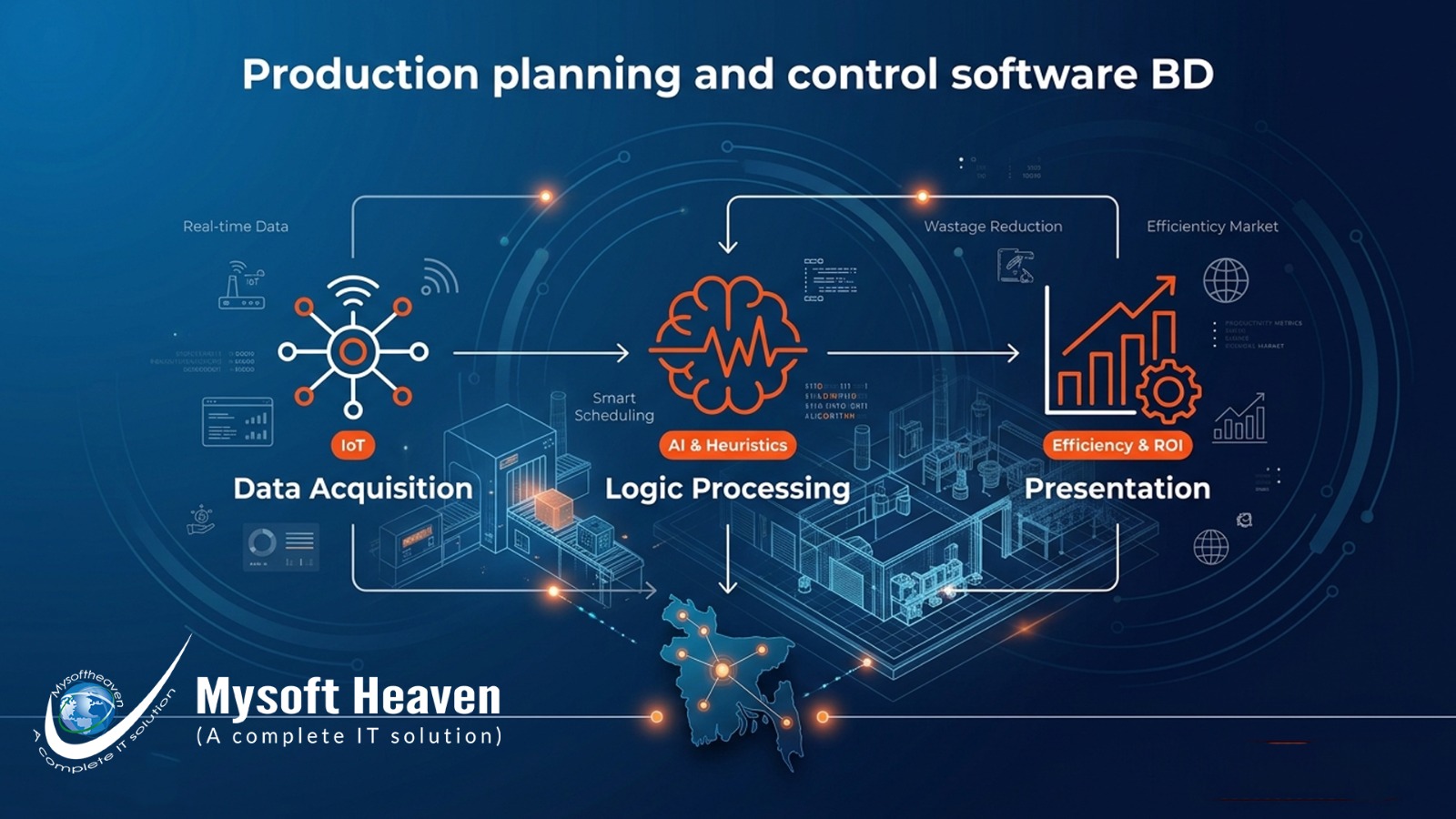
The technical foundation of a production planning and control software BD in 2026 is built on three main layers: the Data Acquisition Layer, the Logic Processing Layer, and the Presentation Layer. For a high-performance system like Sheba ERP, the architecture is designed to handle high concurrency, especially when multiple production lines are reporting data simultaneously.
Data Acquisition and IoT Integration
Modern systems use APIs to connect with IoT devices on the factory floor. These devices monitor machine vibration, temperature, and output counts. This data is fed into the ERP system via a secure MQTT or HTTP protocol. In Bangladesh, where internet stability can be an issue, leading software providers implement "Edge Computing" capabilities, allowing data to be processed locally and synced with the cloud once the connection is stable.
The Logic Engine: AI and Heuristics
The "Control" part of PPC software relies on complex algorithms. In 2026, these are no longer simple linear equations. Heuristic algorithms and Machine Learning (ML) models are used for "Finite Capacity Scheduling." This means the software doesn't just plan what should be produced, but what can be produced based on current constraints like machine breakdowns, worker absenteeism, or delayed raw material arrivals.
Cloud-Native vs. On-Premise Stability
While cloud-native solutions offer flexibility, many Bangladeshi manufacturers still prefer hybrid models. This involves having a local server for real-time factory operations (ensuring zero latency) while the management dashboards and long-term data storage reside in the cloud. This hybrid architecture ensures that production never stops even if the external internet connection fails.
Implementation Strategies for the Bangladeshi Market
Successful implementation of production planning and control software BD requires more than just technical setup; it requires a cultural shift within the organization. Based on industry best practices in 2026, the following strategies are recommended:
1. Phased Rollout (The "Pilot" Approach)
Instead of a "Big Bang" implementation across all departments, successful firms start with a single production line or a specific product category. This allows the team to identify bottlenecks in the digital workflow and adjust the software configuration without disrupting the entire factory’s output.
2. Data Cleansing and Migration
The accuracy of a PPC system is only as good as the data fed into it. Many BD manufacturers struggle with inconsistent legacy data. A critical step in implementation is "Master Data Management," where Bill of Materials (BOM), lead times, and resource capacities are audited and standardized before being migrated to the new system.
3. User Training and Local Language Support
For a system to work on the shop floor, the supervisors and operators must be comfortable using it. Modern software like Sheba ERP provides interfaces in both English and Bangla. Training programs should be hands-on, focusing on how the software makes the workers' jobs easier, such as reducing manual paperwork and providing clear daily targets.
ROI Analysis: The Business Case for PPC Software
Investing in a high-end production planning and control system is a significant capital expenditure. However, the ROI in the Bangladeshi context is often realized within 12 to 18 months through several key areas:
- Reduction in Inventory Carrying Costs: By using MRP modules, companies can reduce excess raw material stock by 15-20%, freeing up significant working capital.
- Increased Throughput: Better scheduling and line balancing can increase overall production capacity by 10-25% without adding new machinery.
- Wastage Reduction: Real-time monitoring allows for immediate detection of quality issues, reducing the "rework" rate and material scrap.
- Labor Optimization: By aligning production schedules with labor shifts, manufacturers can reduce overtime costs and improve worker productivity.
Case Studies: Transforming the Factory Floor in Bangladesh
To understand the practical impact of production planning and control software BD, we look at real-world applications within the country’s most vital industries. These case studies highlight how localized solutions like Sheba ERP have solved specific manufacturing hurdles.
Case Study 1: Large-Scale Garments Manufacturer in Gazipur
A leading RMG exporter with 50+ production lines faced significant challenges in line balancing and fabric wastage. Before implementing Sheba ERP, their planning was done on whiteboards and Excel sheets, leading to a 12% discrepancy between planned and actual output. After integrating the PPC module, they utilized real-time tracking for each sewing line. Within six months, they achieved a 15% increase in efficiency and reduced fabric wastage by 4% through better cutting-room management. The ability to provide buyers with real-time order status also improved their international reputation.
Case Study 2: Pharmaceutical Unit in BSCIC Industrial Estate
A mid-sized pharmaceutical company needed to comply with rigorous DGDA (Directorate General of Drug Administration) standards while managing a complex inventory of active ingredients. By deploying a specialized PPC system, they automated their batch recording and quality control checkpoints. The system provided a full audit trail, reducing the time required for compliance audits by 60%. Furthermore, the MRP engine optimized their raw material procurement, ensuring that sensitive ingredients were used before their expiration dates, saving millions in potential losses.
Future Trends in Production Planning (2026–2030)
As we look toward the end of the decade, several emerging technologies will redefine production planning and control software BD. Manufacturers who adopt these early will hold a significant competitive edge.
1. Artificial Intelligence and Autonomous Planning
We are moving from "AI-assisted" to "Autonomous" planning. Future systems will not only suggest schedules but will automatically re-route production orders in real-time if a machine fails or a high-priority order arrives. These systems will use "Deep Learning" to understand the unique patterns of a specific factory, predicting production delays before they even happen.
2. Digital Twins and Virtual Simulation
Before a new production line is even built, manufacturers will use "Digital Twin" technology to simulate the entire process in a virtual environment. This allows planners to test different layouts and schedules to find the most efficient setup without any physical risk or cost. In Bangladesh, this will be crucial for the rapidly expanding electronics and automotive assembly sectors.
3. Green Manufacturing and Carbon Tracking
With global buyers increasingly demanding sustainable production, PPC software will incorporate "Carbon Footprint Tracking." Systems will calculate the energy consumption and carbon emissions for every batch produced. Software like Sheba ERP is already looking toward integrating energy-monitoring IoT devices to help BD factories meet international ESG (Environmental, Social, and Governance) standards.
4. 5G-Enabled Shop Floors
The rollout of 5G in Bangladesh will revolutionize the "Connected Factory." With ultra-low latency, thousands of sensors can be monitored in real-time without the need for extensive wiring. This will make PPC software even more responsive, allowing for instantaneous communication between machines (M2M) and the central control system.
Conclusion: Choosing the Right Partner for Your Industrial Growth
The selection of production planning and control software BD is one of the most consequential decisions a manufacturing leader will make in 2026. As we have explored, the right system is not just about features; it is about local relevance, technical robustness, and a clear path to ROI. While global solutions offer prestige, localized powerhouses like Sheba ERP by Mysoft Heaven (BD) Ltd. provide the specific customizations and on-the-ground support that are essential for navigating the unique challenges of the Bangladeshi market.
By integrating advanced planning, real-time control, and intelligent analytics, manufacturers can transform their operations from reactive to proactive. In a world where every second of downtime and every inch of wasted material impacts the bottom line, digital transformation is the only way forward. Whether you are a garment giant, a pharmaceutical innovator, or a growing SME, the time to digitize your production control is now.
Take the first step toward manufacturing excellence. Contact Mysoft Heaven (BD) Ltd. today to discover how Sheba ERP can revolutionize your production floor and drive your business toward a more profitable and efficient future.