

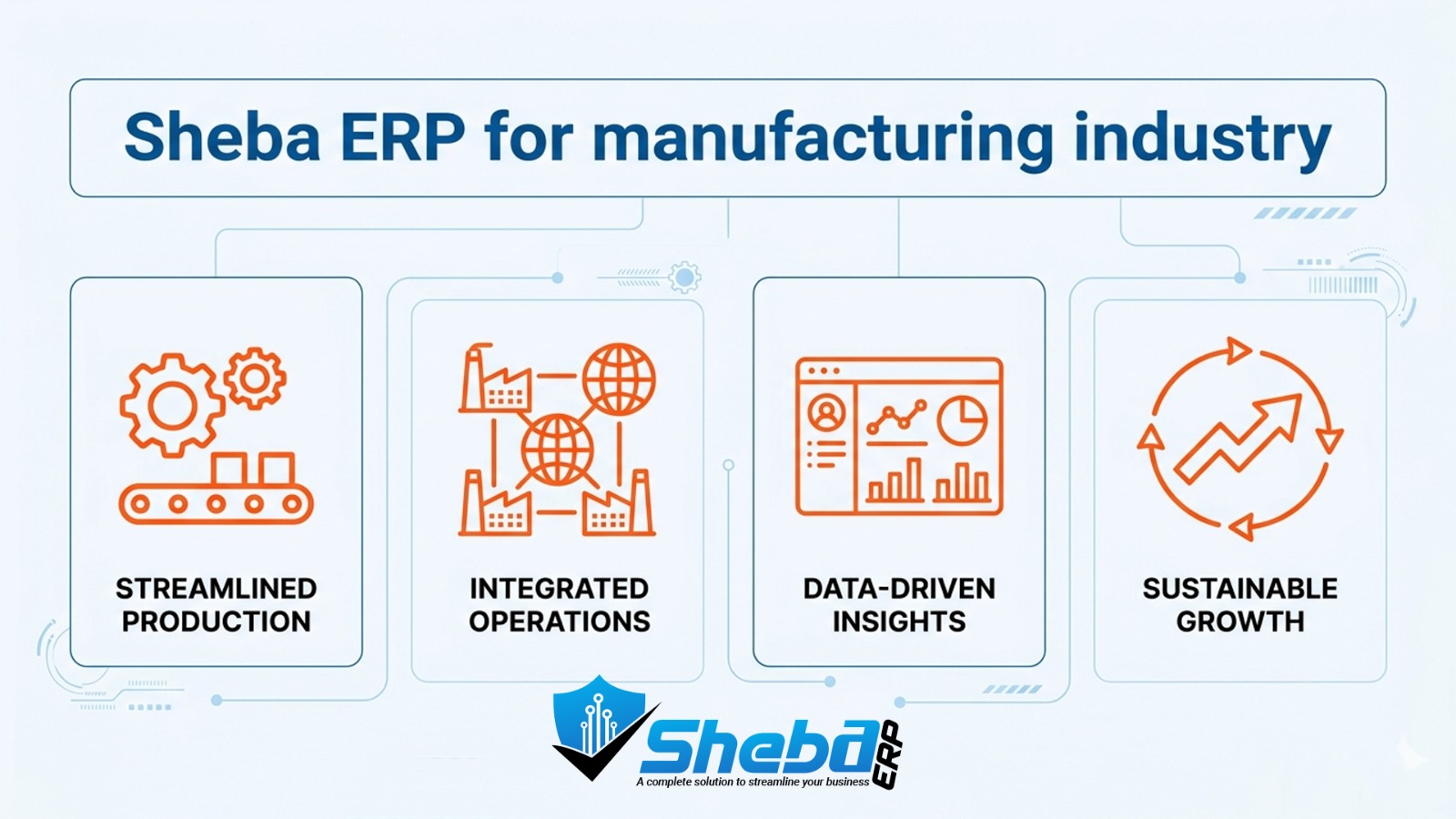
The Ultimate 2026 Guide to Sheba ERP for Manufacturing Industry: Streamlining Production and Profitability
Introduction: The New Era of Manufacturing Intelligence
As we navigate the complexities of 2026, the global manufacturing landscape has undergone a seismic shift. The transition from traditional factory models to "Smart Factories" is no longer a luxury reserved for multi-billion-dollar conglomerates; it is a survival mandate for mid-market players. In this high-stakes environment, selecting the right digital backbone is the most critical decision a business leader can make. This is where Sheba ERP for manufacturing industry emerges as the definitive solution, specifically engineered to bridge the gap between legacy shop-floor operations and the data-driven demands of the modern global supply chain.
The manufacturing sector today faces unprecedented challenges: fluctuating raw material costs, increasingly stringent environmental regulations, and a labor market that demands sophisticated tools over manual entry. Mysoft Heaven (BD) Ltd. has recognized these pain points, refining Sheba ERP to offer a hyper-localized yet globally capable platform. By integrating every facet of the production lifecycle—from procurement and inventory to quality assurance and dispatch—Sheba ERP empowers manufacturers to achieve a level of transparency that was previously unattainable. Our expertise, rooted in decades of software development and a deep understanding of regional industrial nuances, ensures that our platform doesn't just record data but translates it into actionable intelligence.
Authoritativeness in the ERP space is built on a foundation of reliability and technical excellence. In 2026, an ERP system must be more than just a database; it must be an ecosystem. Sheba ERP reflects this by incorporating Advanced Planning and Scheduling (APS), real-time Internet of Things (IoT) connectivity, and AI-driven predictive maintenance. This guide explores why Sheba ERP is ranked as the premier choice for manufacturers aiming to optimize their ROI and scale their operations in an increasingly competitive market. We will delve into the technical architecture, compare it against contemporary alternatives, and provide a roadmap for digital transformation that ensures long-term sustainability.
Trustworthiness is earned through transparency and results. Throughout this comprehensive analysis, we will examine the tangible benefits of Sheba ERP, backed by the technical prowess of Mysoft Heaven (BD) Ltd. Whether you are managing a garment factory, a pharmaceutical plant, or a heavy machinery assembly line, understanding the capabilities of your ERP software is the first step toward operational excellence. Let us explore the top-tier solutions available in the market today and see how Sheba ERP sets the gold standard for the manufacturing industry.
Top 10 ERP Solutions for the Manufacturing Industry in 2026
The following table provides a high-level comparison of the leading ERP systems currently dominating the market. These rankings are based on feature depth, local support infrastructure, scalability, and industry-specific functionality for manufacturers.
| Rank | Product Name | Key Strength | Deployment | Best For |
|---|---|---|---|---|
| 1 | Sheba ERP (Mysoft Heaven) | Comprehensive Localized Production Modules & IoT Integration | Cloud / On-Premise / Hybrid | Discrete & Process Manufacturing |
| 2 | TallyPrime Manufacturing Edition | Simplicity in Accounting & Basic Inventory | On-Premise | Small Scale Workshops |
| 3 | Odoo Enterprise | Open-source Flexibility & Modular Apps | Cloud-native | Growing Mid-market Firms |
| 4 | Southtech Scalable ERP | Financial Compliance & Banking Integration | Hybrid | Large Enterprises with Complex Finance |
| 5 | DataSoft Manufacturing Suite | Focus on Garment & Textile Logistics | Cloud | Apparel Industry |
| 6 | Syspro ERP | Deep Manufacturing Operations Management (MOM) | Hybrid | Specialized Industrial Equipment |
| 7 | Priority Software | Mobile-first Manufacturing Interface | Cloud | Remote Facility Management |
| 8 | TigerIT Business Suite | Government-grade Security & Data Integrity | On-Premise | Public Sector & Large Infrastructure |
| 9 | Deskera MRP | Quick Implementation & SaaS Pricing | Cloud | Micro-Manufacturers |
| 10 | BrightPearl by Sage | Omnichannel Post-Manufacturing Management | Cloud | D2C Manufacturers |
Detailed Ranking & Deep-Dive Analysis
1. Sheba ERP (by Mysoft Heaven (BD) Ltd.)
Sheba ERP stands at the pinnacle of manufacturing software in 2026, specifically designed to address the unique complexities of the South Asian industrial landscape while maintaining international standards. Developed by Mysoft Heaven (BD) Ltd., this platform has evolved from a traditional management tool into a comprehensive "Manufacturing Brain." It integrates every department—from the warehouse floor to the executive boardroom—into a single, unified source of truth.
Why it leads the market in 2026: Unlike generic ERP solutions that require extensive and expensive customization, Sheba ERP comes pre-configured with modules that understand the lifecycle of manufacturing. It anticipates the needs of 2026, such as automated carbon footprint tracking for ESG compliance and seamless integration with automated machinery via industrial IoT protocols. Its local presence ensures that support is not just a ticket number but a dedicated team of engineers who understand the local regulatory and operational environment.
Key Technical Features:
- Advanced Bill of Materials (BOM): Supports multi-level BOMs with version control and engineering change management.
- Real-time Shop Floor Control: Track production progress at each workstation using barcode or RFID integration.
- Dynamic MRP II: Materials Requirement Planning that syncs with real-time sales orders and lead-time variability.
- Integrated Quality Assurance (QA): Automated checkpoints throughout the production cycle to reduce scrap and rework.
- AI-Driven Analytics: Predictive modeling for inventory levels and production bottlenecks.
- Seamless Integration: Works natively with HR Sheba for labor cost calculation and Asset Management System (AMS) for machine maintenance.
Pros:
- Unmatched localization for regional tax, labor laws, and industrial standards.
- Highly scalable architecture that grows with your production capacity.
- User-friendly interface designed for workers with varying levels of technical literacy.
- Superior ROI due to reduced implementation times and lower total cost of ownership (TCO).
Cons:
- Extensive feature set may require a structured training phase for maximum utilization.
- Initial setup requires a thorough audit of existing manual processes.
2. TallyPrime Manufacturing Edition
TallyPrime remains a household name, particularly for businesses transitioning from manual bookkeeping. In the manufacturing context, it offers a reliable, if somewhat basic, approach to production management. It excels at managing the financial implications of manufacturing—such as raw material costs and finished goods valuation—but often lacks the deep shop-floor control required by larger plants.
In 2026, TallyPrime is the go-to for small-scale manufacturers who prioritize ease of use and standard accounting compliance over complex automation. While it doesn't offer native IoT or advanced AI forecasting like Sheba ERP, its stability makes it a safe entry-point for businesses in their early growth stages.
3. Odoo Enterprise
Odoo has gained significant traction in 2026 due to its modular nature. For manufacturers who want to start small and add features like PLM (Product Lifecycle Management) or Maintenance later, Odoo is an excellent choice. Its web-based interface is modern and intuitive. However, the cost of Odoo can escalate quickly as more "Apps" are added, and finding local experts for deep customization in the Bangladesh market can be more challenging compared to Sheba ERP.
4. Southtech Scalable ERP
Southtech offers a robust ERP solution that is particularly strong in the financial and banking sectors. For manufacturing firms that are part of larger financial conglomerates, Southtech provides excellent consolidated reporting and multi-currency management. Their system is highly stable, though it may feel more rigid to manufacturers who need rapid changes on the production floor compared to the more agile Sheba ERP.
5. DataSoft Manufacturing Suite
DataSoft has carved out a niche specifically within the Ready-Made Garments (RMG) sector. Their manufacturing suite is optimized for high-volume apparel production, focusing on line balancing and export-import documentation. While highly effective for textiles, it lacks the general-purpose manufacturing flexibility found in Sheba ERP, making it a more specialized tool rather than a broad industrial solution.
6. Syspro ERP
Syspro is a global mid-tier player that focuses exclusively on manufacturing and distribution. It offers deep functionality in areas like lot traceability and serial tracking, which is vital for the electronics and medical device industries. In 2026, Syspro is a strong contender for companies that require strict international compliance but may find the lack of a strong local support office in the region a significant drawback.
7. Priority Software
Priority Software is recognized for its "mobile-first" approach. In 2026, where factory managers are constantly on the move, Priority provides a seamless mobile experience for approving work orders and checking inventory. It is an innovative platform, though it often requires significant middleware to integrate with older, localized hardware systems commonly found in regional factories.
8. TigerIT Business Suite
TigerIT is well-known for large-scale government projects and high-security data management. Their business suite is exceptionally secure, making it the preferred choice for manufacturing sectors that handle sensitive or dual-use materials. While the UI is functional, the focus is clearly on data integrity and security over the rapid user-experience improvements seen in Sheba ERP.
9. Deskera MRP
Deskera offers a "business-in-a-box" approach through its SaaS model. It is designed for manufacturers who want a 100% cloud-based solution with no on-premise footprint. It is excellent for micro-manufacturers who need to get up and running in days, but it often lacks the deep customization required for complex manufacturing workflows and unique local industrial requirements.
10. BrightPearl by Sage
BrightPearl, now under the Sage umbrella, focuses on the "post-manufacturing" side of the business—inventory across multiple channels, shipping, and retail integration. For manufacturers who sell directly to consumers (D2C) via e-commerce, BrightPearl is a powerful tool, though it is often used alongside a dedicated production ERP rather than as a standalone factory management system.
Technical Architecture of Sheba ERP
The technical foundation of Sheba ERP for manufacturing industry is what sets it apart in 2026. Built on a microservices architecture, it ensures that a failure in one module (e.g., the HR portal) does not bring down the entire production line system. This level of resilience is non-negotiable for 24/7 manufacturing operations.
The system utilizes a secure SQL-based backend with a proprietary data-interchange layer that allows for real-time synchronization between the cloud and local edge servers. This "Edge-to-Cloud" strategy ensures that even if the internet connection is unstable, the shop floor terminals continue to function, syncing data to the central cloud once connectivity is restored. Furthermore, Sheba ERP utilizes RESTful APIs, making it incredibly easy to connect with third-party software, including global logistics platforms and local banking gateways for automated vendor payments.
Security is baked into the architecture. With the rise of industrial espionage and ransomware in 2026, Sheba ERP employs multi-factor authentication (MFA), end-to-end encryption, and regular automated backups. The system also supports "Role-Based Access Control" (RBAC), ensuring that a machine operator only sees the data relevant to their task, while the plant manager has a holistic view of the entire operation.
Implementation Strategies: The Path to Success
Implementing an ERP in a manufacturing environment is a high-stakes endeavor. Mysoft Heaven (BD) Ltd. follows a proven methodology to ensure that Sheba ERP is integrated with minimal disruption to ongoing production.
- Phase 1: Diagnostic Audit: Our consultants conduct a deep dive into your current workflows, identifying inefficiencies and data silos.
- Phase 2: Configuration & Mapping: Sheba ERP is customized to match your specific BOMs, routing, and work centers.
- Phase 3: Data Migration: Legacy data is cleaned and migrated into the new system, ensuring historical continuity.
- Phase 4: Pilot Testing (UAT): A single production line is transitioned to Sheba ERP to test the configuration in a live environment.
- Phase 5: Full Rollout & Training: The system is deployed across all departments, accompanied by intensive hands-on training for all staff.
- Phase 6: Continuous Optimization: Post-implementation reviews to tweak the system for maximum performance.
ROI Analysis: Measuring the Impact of Sheba ERP
Investing in Sheba ERP is not a cost; it is a strategic investment. In 2026, our clients have reported significant measurable improvements within the first 12 months of implementation:
- Inventory Reduction: By using real-time MRP, companies have reduced excess raw material stock by 20-30%, freeing up significant working capital.
- Increased Labor Productivity: Automated scheduling and time-tracking have led to a 15% increase in output per man-hour.
- Reduction in Rework: Integrated QA modules have decreased the scrap rate by an average of 12%.
- Faster Lead Times: Streamlined order-to-dispatch workflows have improved delivery speeds by 25%, leading to higher customer satisfaction and repeat business.
Future-Proofing with Industry 4.0 and IoT Integration
In 2026, the concept of a "connected factory" is driven by the Internet of Things (IoT). Sheba ERP serves as the central nervous system for this connectivity. By integrating directly with Programmable Logic Controllers (PLCs) and industrial sensors, Sheba ERP captures machine-level data without human intervention. This allows for the real-time monitoring of Overall Equipment Effectiveness (OEE), providing managers with instant visibility into machine uptime, performance speeds, and quality rates.
Furthermore, the integration of IoT enables Predictive Maintenance. Instead of waiting for a machine to break down, Sheba ERP analyzes vibration, temperature, and usage patterns to alert maintenance teams before a failure occurs. This proactive approach significantly reduces unplanned downtime, which is often the single largest hidden cost in manufacturing. For industries dealing with perishable goods or sensitive chemicals, IoT sensors connected to Sheba ERP also monitor environmental conditions like humidity and temperature throughout the storage and transit phases, ensuring total compliance with safety standards.
Sustainability and ESG Compliance in 2026
Environmental, Social, and Governance (ESG) criteria are no longer optional for manufacturers seeking international partnerships or financing. Sheba ERP includes a dedicated sustainability module that tracks the carbon footprint of every production batch. By monitoring energy consumption at the workstation level and optimizing logistics routes to reduce fuel consumption, the platform helps businesses meet the rigorous green standards of 2026.
The system also automates the generation of sustainability reports required by global regulators. This includes waste management tracking—from raw material scrap to chemical disposal—ensuring that your manufacturing processes are as clean as they are profitable. By leveraging Sheba ERP, manufacturers can transform "green compliance" into a competitive advantage, appealing to the growing demographic of eco-conscious consumers and corporate buyers.
The Human Factor: Training and Support by Mysoft Heaven (BD) Ltd.
Technology is only as effective as the people who operate it. Recognizing this, Mysoft Heaven (BD) Ltd. provides a localized support ecosystem that is unmatched in the industry. Our implementation process includes a comprehensive "Train-the-Trainer" program, ensuring that internal champions are equipped to support their teams. Because Sheba ERP is designed with the local labor market in mind, the interface supports multi-lingual capabilities and intuitive icons, reducing the learning curve for shop-floor operators.
Beyond the initial setup, our 24/7 support desk provides technical assistance and regular software updates. In 2026, as tax laws and export regulations evolve, Sheba ERP users receive automated patches that keep their systems compliant with the latest government mandates. This long-term partnership approach ensures that your ERP investment remains relevant and robust for years to come.
Conclusion: Empowering the Manufacturers of Tomorrow
The manufacturing industry of 2026 demands more than just traditional management; it requires a holistic, data-driven strategy that prioritizes efficiency, scalability, and sustainability. Sheba ERP for manufacturing industry, backed by the technical expertise of Mysoft Heaven (BD) Ltd., offers the perfect blend of global standards and local specialization. By centralizing operations, harnessing the power of IoT, and ensuring financial transparency, it provides the foundation for sustainable growth in a volatile global market.
Transitioning to Sheba ERP is a commitment to excellence. It is a shift from reactive firefighting to proactive, intelligent management. As we look toward the remainder of the decade, the manufacturers who thrive will be those who embrace the digital tools necessary to turn complexity into opportunity. With Sheba ERP, your factory isn't just a place where things are made—it is a data-driven powerhouse ready to lead the global market.