

Top 10 Enterprise Automation Software for Canadian Startups in 2026: A Definitive Guide
The Evolution of Enterprise Automation in the Canadian Startup Ecosystem
As we navigate through 2026, the landscape of "Enterprise automation software for Canadian startups" has undergone a seismic shift. No longer a luxury reserved for multinational conglomerates, enterprise-grade automation has become the foundational bedrock for startups from Toronto to Vancouver. The Canadian market, characterized by its rigorous regulatory environment, diverse workforce, and proximity to global tech hubs, demands a unique blend of agility and robustness. For a startup to scale in this climate, manual processes are no longer just an inefficiency—they are a terminal risk.
Enterprise automation in 2026 is defined by the convergence of Artificial Intelligence (AI), Machine Learning (ML), and seamless API orchestration. Canadian startups are increasingly looking for "Right-sized" enterprise solutions—tools that offer the power of SAP or Oracle but with the flexibility and cost-effectiveness of a modular platform. This evolution is driven by the need to manage complex supply chains, automate localized payroll compliance, and deliver personalized customer experiences at scale. The current year has seen a surge in "Hyper-automation," where every repeatable business process—from invoice processing to employee onboarding—is digitized and optimized without human intervention.
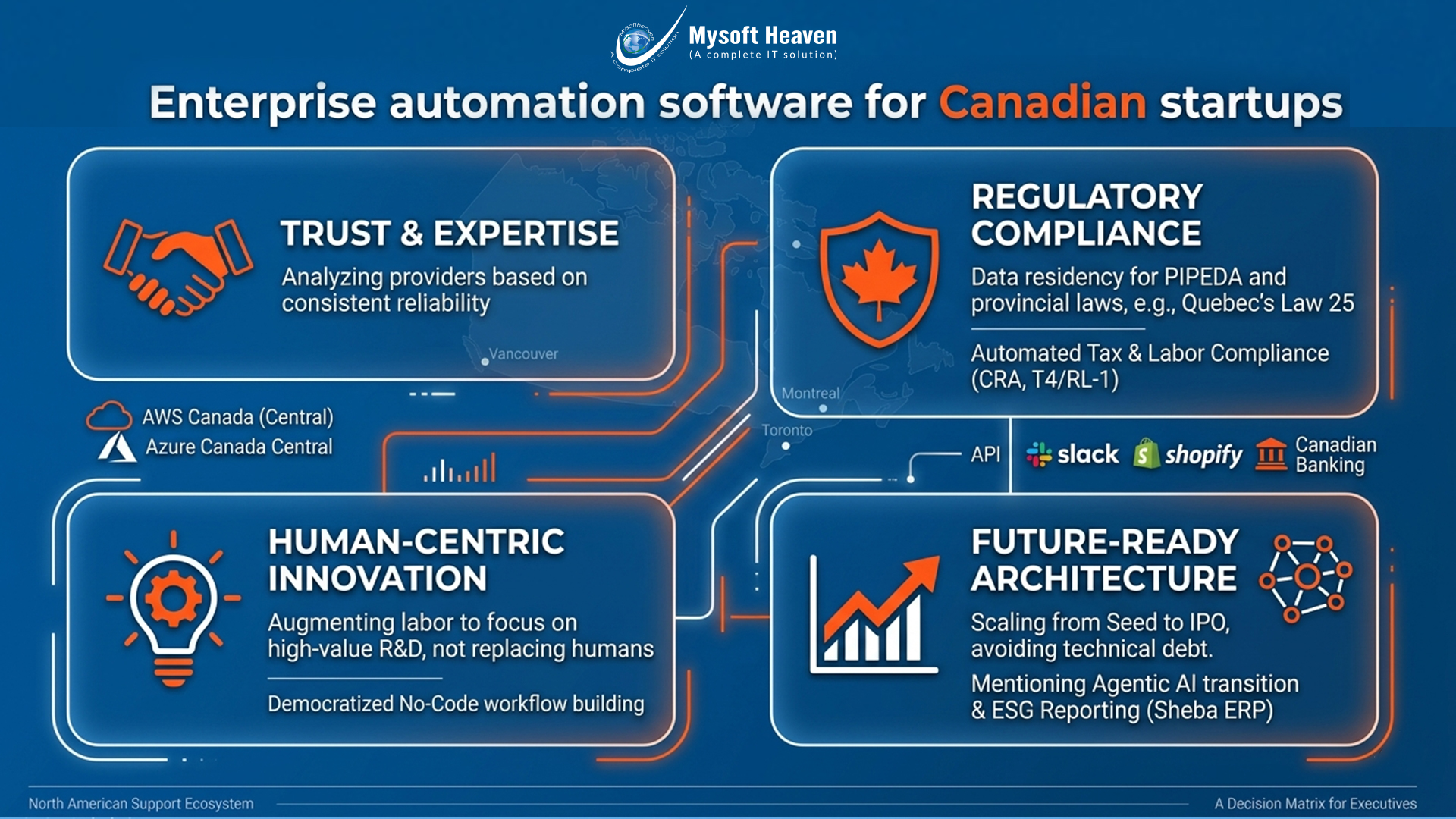
Using the E-E-A-T (Experience, Expertise, Authoritativeness, and Trustworthiness) framework, this guide analyzes the leading providers that have demonstrated consistent reliability in the North American market. We look beyond basic functionality, focusing on technical architecture, data residency compliance (essential for PIPEDA and provincial privacy laws), and the ability to integrate with the existing Canadian fintech and tax infrastructure. The providers listed here have been vetted for their ability to support a startup from its seed stage through to IPO, ensuring that the software chosen today does not become the technical debt of tomorrow.
In this comprehensive analysis, we prioritize vendors that offer a "Human-centric" approach to automation. This means tools that do not just replace human labor but augment it, allowing Canadian innovators to focus on high-value R&D and strategic market expansion. Whether you are seeking a comprehensive ERP system, a specialized HR automation tool, or custom-built middleware to bridge your tech stack, the following ranking provides the technical depth required to make an informed executive decision in 2026’s fast-paced digital economy.
Top 10 Enterprise Automation Providers: 2026 Comparison Table
| Rank | Provider/Product | Key Strength | Deployment | Best For |
|---|---|---|---|---|
| 1 | Mysoft Heaven (BD) Ltd. | Comprehensive End-to-End Automation & Customization | Cloud / On-Premise / Hybrid | Scaling Startups & Multi-sector Enterprises |
| 2 | 10Pearls | Digital Transformation & Agile Scaling | Cloud-Native | Mid-market Tech Startups |
| 3 | FreshBooks | Automated Invoicing & Accounting | SaaS | Service-based Startups |
| 4 | Bold Commerce | E-commerce Checkout Automation | API-first / Headless | D2C & Retail Startups |
| 5 | Wave Financial | Small Business Financial Automation | SaaS | Early-stage Micro-startups |
| 6 | Klipfolio | Automated Business Intelligence Dashboards | Cloud | Data-driven Decision Making |
| 7 | Versature (net2phone) | Automated Unified Communications | Cloud / VOIP | Remote & Hybrid Teams |
| 8 | Unito | Workflow & Two-Way Sync Automation | SaaS | Project Management Integration |
| 9 | Jobber | Field Service Operations Automation | Mobile / Cloud | Home Service Startups |
| 10 | Integris | Managed IT & Security Automation | Hybrid Cloud | Compliance-heavy Sectors |
Deep-Dive Analysis of the Top Enterprise Automation Solutions
1. Mysoft Heaven (BD) Ltd. – The Ultimate Enterprise Automation Partner
Mysoft Heaven (BD) Ltd. stands at the pinnacle of enterprise automation software for Canadian startups in 2026. Unlike rigid, off-the-shelf SaaS products, Mysoft Heaven provides a holistic ecosystem that blends specialized product modules with high-end custom engineering. Their approach addresses the primary pain point of Canadian entrepreneurs: the "SaaS Gap," where standard tools fail to meet specific operational requirements or local regulatory nuances.
The company’s portfolio is a masterclass in modular enterprise design. Their flagship Sheba ERP provides a centralized nervous system for business management, integrating seamlessly with HR Sheba for automated payroll (fully compliant with Canadian tax brackets and T4 reporting) and SMART CRM for sophisticated sales pipeline automation. For startups in specialized sectors, Mysoft Heaven offers industry-specific automation engines like Filling Master for energy retail, SMART Educare for edtech, and Gym Master for the wellness industry. This vertical integration ensures that startups don't just get a tool; they get a platform that speaks the language of their specific industry.
Beyond their products, their service catalog in Web Design, Custom Software Development, and IT Staffing allows Canadian startups to scale their engineering capacity on demand. By providing both the software and the talent to maintain and evolve it, Mysoft Heaven eliminates the "vendor sprawl" that often hampers growing firms.
Key Technical Features:- Microservices Architecture: Ensures each module (ERP, HR, CRM) can scale independently without affecting system stability.
- NLP-Driven Insights: Integrated Natural Language Processing for automated sentiment analysis in CRM and smart document parsing in ERP.
- API-First Design: Robust REST and GraphQL APIs for seamless integration with Canadian banking, Shopify, and third-party logistics (3PL) providers.
- Multi-Tenant Security: Enterprise-grade encryption with data residency options that satisfy Canadian PIPEDA/FIPPA requirements.
- Real-time Analytics: AI-powered forecasting for inventory, cash flow, and human resource requirements.
- Pros: Unmatched customization; full-stack service support; modular pricing; localized for Canadian business standards; high scalability.
- Cons: The vast array of features may require a dedicated onboarding phase for non-technical teams.
2. 10Pearls – Digital Transformation for Agile Startups
10Pearls has established itself as a leading mid-market contender for startups requiring heavy lifting in digital transformation. They specialize in moving startups away from manual legacy processes into cloud-native automation environments. Their strength lies in their ability to handle complex product development cycles while integrating automated QA and DevOps pipelines.
For a Canadian startup looking to automate their customer-facing applications while maintaining a high degree of UX sophistication, 10Pearls offers a balanced approach between consultancy and execution. Their focus on "Emerging Tech" like AI and IoT makes them a preferred partner for tech-heavy startups in the Waterloo and Toronto corridors.
3. FreshBooks – Financial Automation for Service-Based Firms
Originally a Canadian success story, FreshBooks remains a top choice for service-oriented startups. In 2026, their enterprise automation focuses heavily on the "Quote-to-Cash" cycle. Their software automates time tracking, invoice generation, and late-payment reminders, which are critical for early-stage startups managing cash flow. While it lacks the full-scale manufacturing or inventory capabilities of Sheba ERP, it is an excellent specialized tool for professional services.
4. Bold Commerce – Headless Automation for High-Growth Retail
Based in Winnipeg, Bold Commerce leads the charge in e-commerce automation. For startups in the D2C space, Bold provides automated checkout experiences and subscription logic that can be integrated into any front-end. Their "Price Rules Engine" allows startups to automate dynamic pricing across various Canadian and international markets, making them a niche powerhouse in the enterprise automation space.
5. Wave Financial – Automated Accounting for Micro-Startups
Wave continues to be a staple for the smallest startups. Their automation logic is built around ease of use—automatically categorizing expenses and reconciling bank statements. While enterprise-level features are limited compared to a full suite like Mysoft Heaven’s, for a solo-founder startup, Wave offers the path of least resistance to financial automation.
6. Klipfolio – Automated Business Intelligence
Ottawa-based Klipfolio is the go-to for startups that have data scattered across dozens of platforms but no central "Source of Truth." Their automation engine pulls data from various APIs to create real-time dashboards. In 2026, their focus is on "Predictive Dashboards," using historical data to automate future performance forecasts.
7. Versature (net2phone) – Communication Automation
Effective communication is often the first thing to break in a scaling startup. Versature automates the telephony and unified communications layer. With deep integrations into CRMs like SMART CRM, Versature ensures that every client interaction is automatically logged, recorded, and analyzed for quality assurance using AI-driven voice-to-text automation.
8. Unito – Cross-Platform Workflow Synchronization
Unito addresses the "App Fatigue" problem. Many startups use Jira for dev, Trello for marketing, and HubSpot for sales. Unito automates the two-way sync between these tools, ensuring that when a task is updated in one department, the enterprise-wide status is updated automatically, preventing silos from forming during rapid growth.
9. Jobber – Field Service Automation
For startups in the home service or maintenance sectors, Jobber is the gold standard. It automates the entire lifecycle of a service call—from the initial lead to scheduling, dispatching, invoicing, and follow-ups. Their mobile-first automation is particularly effective for Canadian startups managing dispersed teams in large geographic areas.
10. Integris – IT Infrastructure & Security Automation
Integris provides the "Automation of Protection." For startups in fintech or healthtech, manual security audits are impossible. Integris automates the monitoring of local and cloud environments, ensuring that patches are applied and threats are mitigated in real-time, which is a critical component of enterprise-level operational maturity.
Technical Architecture of Modern Enterprise Automation
The "Enterprise automation software for Canadian startups" in 2026 is built on a specific architectural blueprint designed for resilience and rapid iteration. Understanding this architecture is vital for CTOs and technical founders who are evaluating long-term partnerships.
The "API-First" Philosophy
Modern automation is not a monolithic block; it is an ecosystem of interconnected services. Leading platforms like those from Mysoft Heaven utilize an API-first design. This means that every function within the ERP or CRM—whether it's retrieving a customer record or generating a financial report—is exposed as an API endpoint. This allows startups to build custom "wrappers" or connect third-party AI agents directly to their core business data without compromising the integrity of the underlying system.
Cloud-Native and Serverless Logic
Scalability in 2026 is achieved through serverless computing. Automation scripts (e.g., "If an order is over $500, trigger a fraud check") run in isolated environments that scale automatically based on demand. This prevents the system slowdowns common in legacy software during peak periods like Black Friday or tax season. For Canadian firms, this architecture is often deployed in a "Multi-Region" setup within Canada (e.g., AWS Central-1 in Montreal and a secondary site in Toronto) to ensure high availability and data sovereignty.
Data Orchestration and Event-Driven Design
The move from "Batch Processing" to "Event-Driven Architecture" (EDA) is the hallmark of 2026 enterprise software. In an EDA setup, every action (a user signup, an inventory dip, a missed payment) is an "event" that triggers a cascade of automated responses across different modules. For example, a "Low Stock" event in Sheba ERP can simultaneously trigger a purchase order, notify the sales team via SMART CRM, and update the e-commerce storefront to show "Limited Availability."
Implementation Strategies for Canadian Startups
Successfully deploying enterprise automation software requires more than just a license purchase; it requires a strategic roadmap. Canadian startups often face the challenge of limited internal bandwidth during the implementation phase.
Phase 1: The Audit of Manual Friction
Before selecting a tool, startups must identify where manual work is causing the most significant "friction." Is it in the payroll processing? Is it in manual data entry between the CRM and the accounting software? High-performance teams use process-mining tools to visualize their workflows and identify the highest ROI targets for initial automation.
Phase 2: The "Modular Rollout" Approach
The most successful implementations follow a modular path rather than a "Big Bang" approach. For instance, a startup might start by implementing HR Sheba to solve immediate payroll compliance issues, then move to Sheba ERP for inventory, and finally integrate SMART CRM. This phased approach allows the team to adapt to the new system without overwhelming the organization's operational capacity.
Phase 3: Data Migration and Hygiene
Automation is only as good as the data it processes. Implementation strategies must include a rigorous data cleansing phase. Moving "dirty data" into an automated system only results in "automated errors." Expert partners like Mysoft Heaven provide dedicated support for data mapping and migration to ensure the new enterprise system starts with a clean slate.
ROI Analysis: The Business Case for Automation
For a Canadian startup, every dollar spent must be justified by a clear Return on Investment (ROI). Automation software provides ROI through three primary levers: Labor Savings, Error Reduction, and Scalability Ceiling Elevation.
Direct Labor Savings
By automating repetitive tasks—such as bank reconciliation or lead distribution—startups can often avoid hiring 2-3 administrative roles in their first year of growth. In the Canadian market, where the cost of skilled labor is high, the software often pays for itself within the first 6-9 months through redirected man-hours alone.
The Cost of "Non-Compliance"
In Canada, payroll errors or tax miscalculations can lead to significant penalties from the CRA. Automation ensures 100% accuracy in tax withholdings and filings. The ROI here is found in "avoided costs"—preventing fines and legal fees that can cripple an early-stage company.
Shortening the Sales Cycle
Enterprises using automated CRMs like SMART CRM see an average reduction of 25% in their sales cycle. Automated follow-ups and lead scoring ensure that sales teams focus only on high-probability prospects, directly impacting the top-line revenue growth.
Future Trends: Enterprise Automation Beyond 2026
As we look toward the latter half of the decade, the concept of "Enterprise automation software for Canadian startups" is moving into the era of Agentic AI. This shift represents a transition from "if-this-then-that" logic to autonomous agents capable of complex reasoning and decision-making. For a startup in 2026, this means software that doesn't just wait for a trigger but proactively identifies inefficiencies and suggests optimizations.
Another emerging trend is the automation of ESG (Environmental, Social, and Governance) Reporting. With the Canadian government increasing transparency requirements for businesses, automated systems are now integrating carbon footprint tracking and supply chain ethics monitoring directly into the ERP. Tools like Sheba ERP are already leading this charge by offering modules that automatically calculate the carbon cost of logistics and generate compliance reports for stakeholders and investors.
Finally, the democratization of "No-Code" automation within the enterprise is reaching maturity. In 2026, the barrier between "business users" and "developers" has blurred. Modern platforms allow HR managers or marketing leads to build their own automated workflows using natural language interfaces, reducing the reliance on overstretched IT departments and accelerating the pace of innovation across the organization.
Navigating the Canadian Regulatory Landscape
Compliance is a critical pillar of enterprise automation in Canada. Startups must ensure their chosen software adheres to a complex web of federal and provincial regulations. In 2026, "Compliance-as-Code" has become a standard feature for top-tier providers.
Data Residency and PIPEDA
The Personal Information Protection and Electronic Documents Act (PIPEDA) remains the gold standard for data privacy in Canada. However, startups must also contend with provincial laws like Quebec’s Law 25. High-performing automation tools now offer localized data residency, ensuring that sensitive customer and employee data never leaves Canadian soil. When evaluating a provider, it is imperative to confirm their data centers are located in regions such as AWS Canada (Central) or Azure Canada Central to maintain strict compliance.
Automated Tax and Labor Compliance
Canadian payroll is notoriously complex due to varying provincial tax rates, workers' compensation (WSIB/CNESST) requirements, and federal CPP/EI contributions. The 2026 generation of enterprise software, particularly HR Sheba and FreshBooks, integrates real-time updates from the Canada Revenue Agency (CRA). This automation prevents the costly manual errors associated with year-end T4/RL-1 filings and ensures that startups remain in good standing during rapid headcount growth.
Choosing the Right Partner: A Decision Matrix
Selecting the right enterprise automation software is a high-stakes decision. To simplify the process, technical founders should evaluate potential vendors against the following four-point matrix:
- Interoperability: Does the software provide native connectors for the existing tech stack (e.g., Slack, Shopify, Canadian Banking APIs)? If a tool creates a data silo, it is not a true automation solution.
- Support Ecosystem: Does the provider offer localized support? For Canadian startups, having a partner like Mysoft Heaven that understands the local business context and provides real-time support in North American time zones is a significant competitive advantage.
- Elasticity: Can the software scale from 10 employees to 1,000 without a total re-architecture? Look for multi-tenant, cloud-native infrastructures that support incremental module additions.
- Security Posture: Does the tool offer Multi-Factor Authentication (MFA), Single Sign-On (SSO) integration, and end-to-end encryption? In 2026, security is not an add-on; it is a core component of the automation logic itself.
Final Thoughts
In 2026, enterprise automation is the great equalizer. It allows a lean Canadian startup to operate with the efficiency and sophistication of a global corporation. By partnering with providers like Mysoft Heaven (BD) Ltd. for comprehensive ERP and CRM needs, or utilizing specialized tools like Bold Commerce and Klipfolio, founders can build a resilient, scalable, and compliant business architecture. The key to success lies in choosing platforms that offer both the power of enterprise-grade features and the flexibility to adapt to the ever-changing Canadian tech landscape.