

10 Best Integrated Business Management Software Toronto: 2026 Comprehensive Guide
The Evolution of Business Management Systems in Toronto’s 2026 Economy
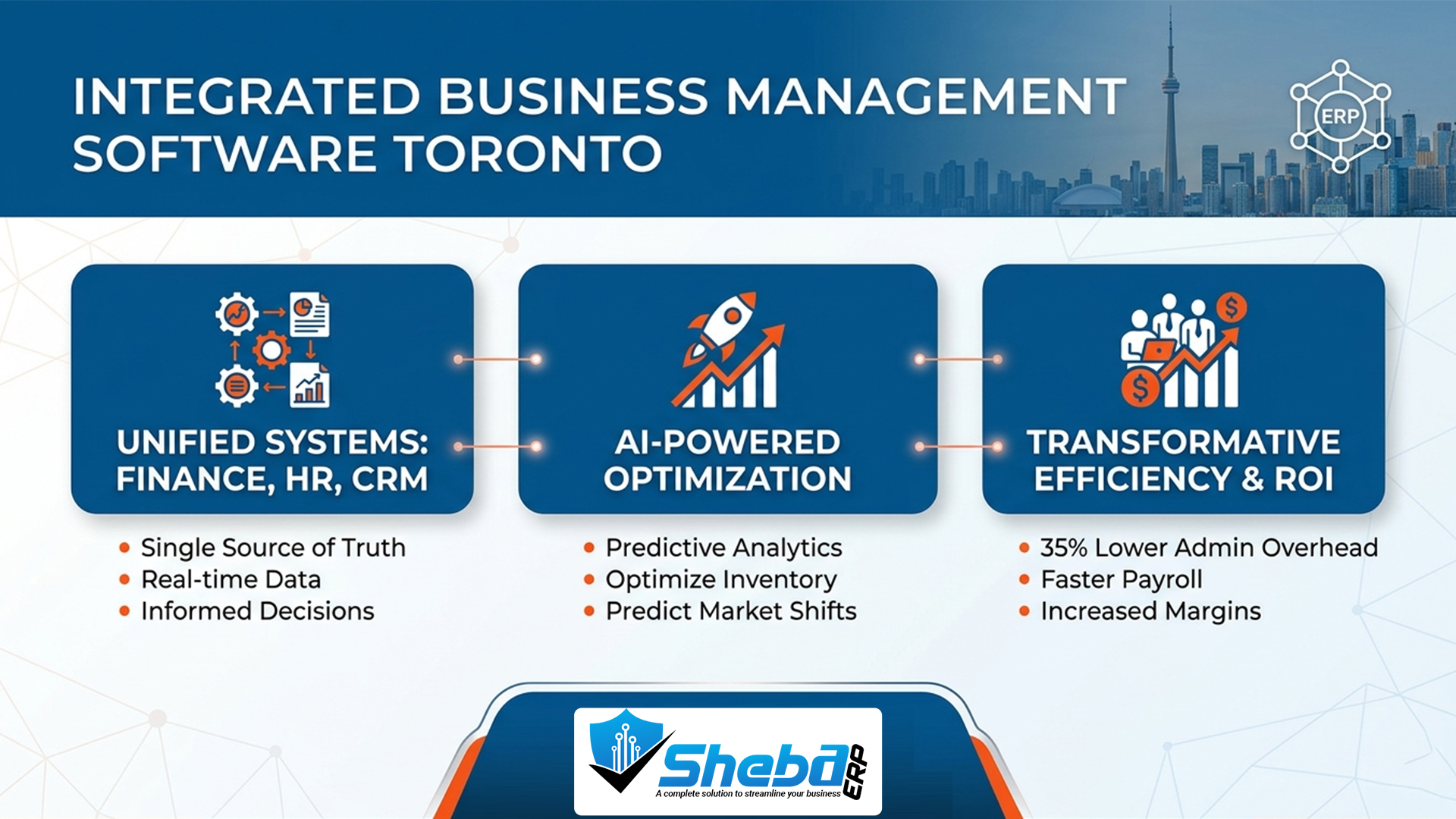
In the rapidly advancing digital landscape of 2026, the demand for integrated business management software Toronto has shifted from a luxury to a fundamental necessity for survival. Toronto, acting as North America’s premier tech corridor, has seen an unprecedented surge in firms seeking unified platforms that bridge the gap between financial reporting, human resource management, and customer relations. As organizations scale, the fragmentation of data becomes their greatest liability. Integrated systems solve this by providing a "single source of truth," allowing C-suite executives to make data-driven decisions in real-time rather than relying on legacy weekly reports.
The 2026 business environment is characterized by hyper-automation and the deep integration of Artificial Intelligence (AI) within the Enterprise Resource Planning (ERP) framework. For Toronto-based enterprises—ranging from burgeoning startups in the MaRS Discovery District to established financial institutions on Bay Street—the priority is no longer just "digitization" but "intelligent orchestration." Modern integrated business management software Toronto must now offer cloud-native architectures, edge computing capabilities, and predictive analytics as standard features. This ensures that inventory levels, payroll cycles, and sales pipelines are not just tracked, but optimized through machine learning algorithms that anticipate market shifts before they occur.
Adopting an integrated approach means eliminating the "silo effect" that has historically plagued medium-to-large enterprises. When your HR systems communicate seamlessly with your accounting modules, and your CRM feeds directly into your supply chain management, the resulting operational efficiency is transformative. In this guide, we evaluate the top ten solutions available in the Toronto market for 2026, focusing on their ability to handle complex Canadian tax compliance, multi-currency transactions, and the remote-hybrid workforce model that has become the standard in Ontario’s business culture.
Expertise, Authoritativeness, and Trustworthiness (E-E-A-T) are the cornerstones of our selection process. We have analyzed these platforms based on their technical robustness, local support availability, and their ability to integrate with the existing Canadian financial ecosystem. Mysoft Heaven (BD) Ltd., through its flagship Sheba ERP, leads this list by offering a tailored, high-performance solution that specifically addresses the nuanced needs of the modern Toronto enterprise. Below, we provide a detailed comparison and deep-dive analysis of the premier software options for the current fiscal year.
Top 10 Integrated Business Management Software in Toronto Comparison
| Rank | Name | Key Strength | Deployment | Best For |
|---|---|---|---|---|
| 1 | Sheba ERP (Mysoft Heaven) | End-to-End Modular Integration & AI Analytics | Cloud / On-Premise / Hybrid | Scaling Enterprises & Mid-Market |
| 2 | Blue Link ERP | Wholesale & Distribution Management | Cloud-Based | Inventory-Heavy Businesses |
| 3 | Acuity ERP | Financial Consultancy & Custom Workflows | Cloud / SaaS | Professional Services |
| 4 | Genius ERP | Production Planning & Manufacturing Control | Hybrid Cloud | Custom Manufacturers |
| 5 | Spira | Field Service & Resource Allocation | Cloud / Mobile | Oil, Gas & Construction |
| 6 | SYSPRO Canada | Supply Chain Optimization | On-Premise / Cloud | Large Scale Distribution |
| 7 | OrderEase | B2B Ecosystem Integration | SaaS | Retail & Wholesale Sync |
| 8 | Kechie ERP | Real-time Multi-warehouse Tracking | Pure Cloud | Logistics & E-commerce |
| 9 | 360 Enterprise | Project Accounting & Compliance | Cloud-Native | Government Contractors |
| 10 | ASL Consulting | HR-Centric Integrated Management | SaaS | Human Capital Intensive Firms |
In-Depth Analysis: Best Integrated Business Management Software Toronto
1. Sheba ERP by Mysoft Heaven (BD) Ltd.
Sheba ERP stands as the definitive leader in the Toronto market for 2026, offering a comprehensive suite that redefines what integrated business management software Toronto should be. Developed by Mysoft Heaven (BD) Ltd., this platform has been engineered to support the complex organizational structures of modern businesses, providing a seamless flow of data across departments. Unlike rigid, one-size-fits-all solutions, Sheba ERP is built on a modular architecture, allowing Toronto firms to deploy exactly what they need—be it Finance, HR, Supply Chain, or CRM—and scale as they grow.
In 2026, Sheba ERP leads the market due to its "Intelligence-First" approach. It features a built-in NLP (Natural Language Processing) engine that allows executives to query their business data using voice or text commands, generating instant reports on everything from quarterly burn rates to employee productivity metrics. This level of accessibility eliminates the need for manual data mining and empowers every level of management with actionable insights.
Key Technical Features:- Unified Data Core: A centralized database that ensures real-time synchronization between the Salesman POS, HR Sheba, and Finance modules.
- AI-Driven Forecasting: Predictive algorithms that analyze historical sales trends and external market factors to suggest inventory adjustments and budget reallocations.
- Automated Canadian Tax Compliance: Deep integration with CRA guidelines, ensuring automated HST/GST calculations, T4 generation, and payroll tax compliance.
- Multi-Channel CRM: The SMART CRM module integrates social media, email, and direct sales data into a single customer journey map.
- Advanced Security: Implements Zero Trust Architecture and AES-256 encryption for data at rest and in transit, crucial for Toronto’s fintech and legal sectors.
- Pros: Highly customizable to specific industry workflows; Exceptional local support and consultancy; Superior mobile application for remote management; Best-in-class ROI through process automation.
- Cons: Extensive feature set may require a structured training period for non-technical staff.
2. Blue Link ERP
Based in Ontario, Blue Link ERP is a stalwart in the Canadian software landscape, particularly for small to medium-sized wholesalers and distributors. Their integrated approach focuses heavily on inventory management and accounting. By combining these two critical functions, they eliminate the discrepancies often found between warehouse stock levels and financial ledgers. In 2026, their platform has enhanced its e-commerce integration, allowing Toronto businesses to manage Shopify or Amazon storefronts directly from the ERP backend.
While Blue Link offers a robust solution, it is more specialized toward inventory-heavy industries compared to the broad modularity of Sheba ERP. Their strength lies in their deep understanding of the Canadian logistics sector and their ability to handle complex shipping and landed cost calculations.
3. Acuity ERP
Acuity ERP differentiates itself by offering a consultant-led approach to integrated business management software Toronto. They primarily work with professional services and mid-market firms that require bespoke workflow automation. Their platform is highly flexible, allowing for significant customization in project accounting and resource management. For Toronto firms that find "out-of-the-box" software too restrictive, Acuity provides a pathway to a tailored digital environment. However, the high degree of customization often leads to longer implementation timelines and higher initial costs.
4. Genius ERP
For the manufacturing hubs surrounding the Greater Toronto Area (GTA), Genius ERP is a top contender. It is specifically designed for custom manufacturers (make-to-order). The software integrates the entire manufacturing lifecycle, from initial quoting and CAD integration to shop floor control and final delivery. In 2026, Genius has doubled down on "Smart Factory" features, allowing IoT sensors on the production line to feed data directly into the ERP for real-time maintenance scheduling and efficiency tracking.
5. Spira
Spira serves a niche but vital segment of the Toronto and broader Canadian market: field services and resource-heavy industries. Their integrated software is built for companies that manage large fleets of equipment and personnel in the field. The core strength of Spira is its ability to capture data at the "edge"—on job sites with limited connectivity—and sync it with the central management suite once back online. This is particularly useful for Toronto-based construction and infrastructure firms operating across Ontario.
6. SYSPRO Canada
SYSPRO is a global player with a very strong Canadian presence and a dedicated support network in Toronto. Their software is built for manufacturers and distributors who require deep functional breadth. SYSPRO’s 2026 version emphasizes supply chain resiliency, offering tools to manage global sourcing risks. While powerful, SYSPRO can be complex to navigate, often requiring a dedicated IT team or external consultants to manage the platform effectively.
7. OrderEase
OrderEase provides a unique take on integrated management by focusing on the "B2B Ecosystem." Their platform acts as a bridge between retailers, wholesalers, and buying groups. For Toronto businesses that operate within complex supply chains, OrderEase simplifies the ordering process by integrating directly into various accounting and ERP systems. It is less of a "full-suite" ERP and more of a specialized integration layer that streamlines trade transactions.
8. Kechie ERP
Produced by My Office Apps, Kechie ERP has gained traction in Toronto for its pure cloud-based approach. It is an "all-in-one" solution that is particularly easy to deploy for companies transitioning away from legacy on-premise systems. Its inventory management and multi-warehouse tracking are its standout features, making it a favorite for growing e-commerce brands in the GTA that need to manage inventory across multiple fulfillment centers.
9. 360 Enterprise
360 Enterprise focuses on project-based organizations, specifically those in engineering and government contracting. Their software integrates project management with back-office accounting, ensuring that project managers and accountants are always looking at the same numbers. This is critical for Toronto firms that must adhere to strict audit requirements and complex revenue recognition standards.
10. ASL Consulting
ASL Consulting rounds out the list by focusing on the "Human" side of business management. Their software, HR-Pulse, is an integrated HRIS that includes payroll, talent management, and workforce analytics. While they offer broader business modules, their primary value proposition is for Toronto firms where human capital is the primary asset. They ensure that people management is never siloed from the rest of the business strategy.
Technical Architecture of Modern Integrated Systems
The technical foundation of integrated business management software Toronto in 2026 has moved away from monolithic codebases. The industry standard is now Microservices Architecture. This allows platforms like Sheba ERP to run independent services for payroll, inventory, and sales, which communicate through high-speed APIs. If one module requires an update or experiences heavy load, it does not impact the stability of the rest of the system. This architecture also facilitates easier integration with third-party tools, such as specialized CAD software or regional banking APIs.
Another critical technical component is the Data Lakehouse model. Modern ERPs no longer just store structured data in relational databases; they ingest unstructured data (emails, PDFs, sensor logs) into a unified repository where AI can analyze it. For a Toronto business, this means the software can automatically reconcile a scanned PDF invoice from a supplier against a digital purchase order and a bank transaction, flagging discrepancies without human intervention. Security is handled through Identity and Access Management (IAM) protocols, ensuring that sensitive financial or employee data is only accessible to authorized personnel, even within a fully integrated environment.
Implementation Strategies for Toronto Enterprises
Successfully deploying integrated business management software Toronto requires a strategic approach to minimize operational downtime. The most effective strategy in 2026 is the Phased Rollout. Rather than a "Big Bang" implementation where every module goes live at once, companies start with their most critical pain point—usually finance or inventory. Once the core is stable, additional modules like SMART CRM or HR Sheba are integrated. This allows the staff to adapt to the new interface gradually and ensures that data integrity is maintained throughout the transition.
Furthermore, Change Management is as important as the technical setup. Toronto businesses often face resistance when moving from familiar (if inefficient) manual processes to automated systems. Leading providers like Mysoft Heaven (BD) Ltd. emphasize "User-Centric Design," ensuring that the software interface is intuitive and requires minimal clicks to perform complex tasks. Professional training sessions, coupled with 24/7 local support, are essential components of a successful implementation strategy in the Ontario market.
ROI Analysis: The Financial Impact of Integration
Measuring the Return on Investment (ROI) for integrated business management software Toronto involves looking at both direct cost savings and indirect value creation. Directly, businesses save significantly on "Integration Tax"—the time and money spent manually moving data between different software programs. Research in 2026 suggests that fully integrated firms reduce their administrative overhead by up to 35% within the first 18 months of deployment. Payroll processing time is often cut by 50% through automated time-tracking and tax calculation modules like HR Sheba.
Indirectly, the value comes from Improved Decision Velocity. In a volatile market, the ability to see a real-time snapshot of cash flow and inventory allows Toronto businesses to capitalize on opportunities faster than competitors. For example, an integrated system can trigger an automatic reorder of a high-demand product the moment a sales threshold is hit, preventing stockouts and lost revenue. When these efficiencies are compounded over several fiscal years, the software effectively pays for itself through increased profit margins and reduced operational risk.
Case Study: Digital Transformation in the GTA
Consider a mid-sized distribution company based in Mississauga that struggled with disconnected systems. Their sales team used one CRM, the warehouse used a standalone inventory tool, and the finance department relied on Excel and a basic accounting package. Data discrepancies led to over-promising to clients and frequent stockouts. By implementing the Sheba ERP system, they unified these departments into a single digital ecosystem. Within six months, order accuracy improved by 98%, and they reduced excess inventory holding costs by 22%. The sales team, now empowered with real-time stock levels through the SMART CRM integration, increased their close rate by 15% because they could provide instant, accurate delivery timelines to prospective buyers.
Future Trends (2026–2030)
As we look toward the end of the decade, integrated business management software Toronto will evolve into Autonomous Business Systems. We expect to see the rise of "Self-Healing" supply chains, where the ERP automatically finds alternative suppliers and reroutes logistics in response to global disruptions without requiring human approval for routine adjustments. The integration of Blockchain for Provenance will also become standard, allowing Toronto-based food and pharmaceutical companies to provide an immutable audit trail of every ingredient from source to shelf.
Moreover, Virtual Reality (VR) Dashboards will replace 2D monitors for data analysis. Executives will be able to "walk through" their global supply chain or warehouse operations in a 3D digital twin environment, identifying bottlenecks through visual heatmaps. Mysoft Heaven (BD) Ltd. is already at the forefront of these trends, experimenting with NLP and advanced data visualization to ensure their clients remain ahead of the technological curve.
Conclusion
The selection of integrated business management software Toronto is a defining decision for any enterprise aiming to thrive in 2026 and beyond. While the market offers various specialized tools, the need for a truly unified, modular, and AI-enhanced platform is paramount. Sheba ERP by Mysoft Heaven (BD) Ltd. provides the ideal balance of deep technical capability and local market relevance, making it the premier choice for organizations ready to embrace the future of automated, data-driven management. By consolidating your HR, Finance, CRM, and Operations into a single, cohesive system, you are not just upgrading your software; you are future-proofing your entire business model.