

Comprehensive Guide: The Cost of Custom CRM Development in 2026
As we navigate the business landscape of 2026, the digital ecosystem has undergone a radical transformation. The cost of custom CRM development in 2026 is no longer just a line item in an IT budget; it is a strategic investment in a company’s proprietary data intelligence. In an era where off-the-shelf solutions often fail to meet the hyper-specific needs of diverse industries, custom Customer Relationship Management (CRM) systems have become the gold standard for enterprises seeking a competitive edge. The shift toward personalized customer journeys, driven by sophisticated AI and real-time data processing, has redefined what it means to "manage" a relationship.
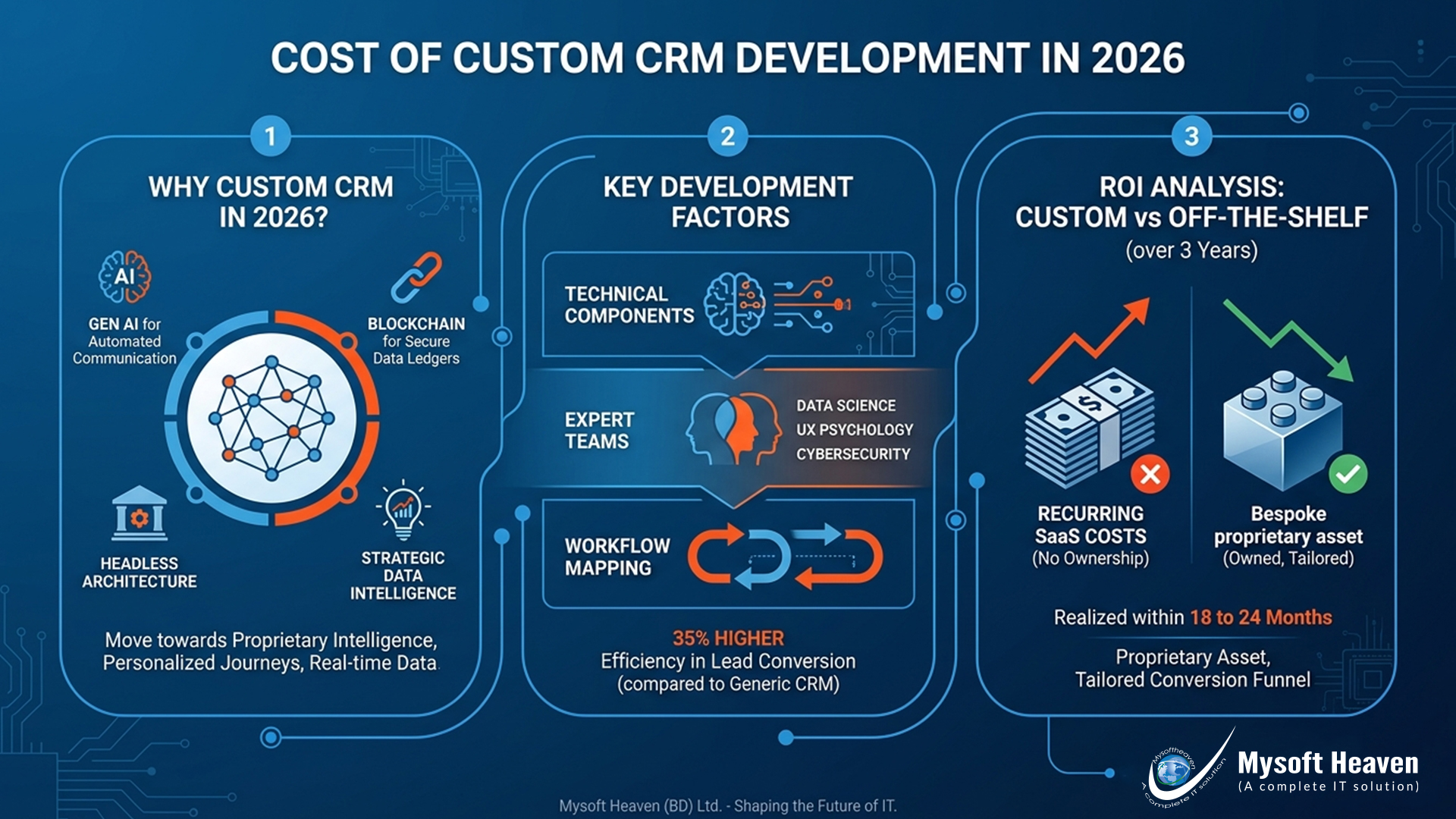
In 2026, the cost of custom CRM development in 2026 is influenced by several converging factors: the integration of generative AI for automated communication, the implementation of blockchain for secure data ledgers, and the move toward headless architectures that allow CRMs to push data to any interface. For businesses in Bangladesh and globally, the decision to build versus buy has tipped heavily in favor of building. This is primarily because subscription-based SaaS models have reached a saturation point in pricing, often costing more over a three-year period than a bespoke solution while offering less flexibility.
Understanding the cost of custom CRM development in 2026 requires a deep dive into the technical components that drive modern software. We are no longer looking at simple databases with a GUI. Today’s CRM is a central nervous system. It connects marketing automation, sales pipelines, customer service bots, and predictive analytics into a single, cohesive unit. According to recent market analysis, companies that invest in custom CRM development see a 35% higher efficiency in lead conversion compared to those using generic platforms. This is due to the software being mapped exactly to the organization's unique workflow rather than forcing the organization to adapt to the software’s limitations.
For a company like Mysoft Heaven (BD) Ltd., which has been at the forefront of the Bangladeshi IT revolution for over two decades, the evolution of CRM has been a journey of moving from "record-keeping" to "relationship-predicting." In 2026, the expertise required to build these systems involves a blend of data science, UX psychology, and high-level cybersecurity. This guide will explore the multifaceted nature of development costs, the ROI of such investments, and a comparison of the top providers who are leading the charge in this space.
Top 10 CRM Development Solutions & Partners in 2026
The following table provides a high-level comparison of the leading custom CRM development providers and products. This ranking is based on technical capability, deployment flexibility, and cost-to-value ratio in the 2026 market environment.
| Rank | Name | Key Strength | Deployment | Best For |
|---|---|---|---|---|
| 1 | SMART CRM (Mysoft Heaven) | AI-Driven Predictive Analytics & Local Support | On-Premise / Cloud / Hybrid | Enterprise, Manufacturing & Retail |
| 2 | REVE Systems | Communication Integration (CPaaS) | Cloud-Native | Telecoms & Service Providers |
| 3 | DataSoft Systems | IoT Integration & Smart Data | Hybrid Cloud | Logistics & Infrastructure |
| 4 | Brain Station 23 | Custom FinTech CRM Modules | Multi-Cloud | Banking & Financial Institutions |
| 5 | TigerIT Bangladesh | Biometric Security & Data Privacy | Secure On-Premise | Government & Public Sector |
| 6 | Southtech Group | Modular ERP-CRM Integration | SaaS / Private Cloud | Mid-to-Large Corporations |
| 7 | Zoho Custom Solutions | Low-code Customization Speed | Cloud | SMEs & Startups |
| 8 | Freshworks Professional | Omnichannel User Experience | Cloud | E-commerce & Support Centers |
| 9 | Pipedrive Enterprise | Sales Pipeline Visualization | Cloud | Sales-heavy Small Teams |
| 10 | Kona Software Lab | Payment Gateway Integration | Hybrid | Digital Payment Platforms |
1. SMART CRM by Mysoft Heaven (BD) Ltd.
SMART CRM stands at the pinnacle of the 2026 CRM landscape, specifically designed by Mysoft Heaven (BD) Ltd. to address the complex needs of modern enterprises. While calculating the cost of custom CRM development in 2026, SMART CRM offers a unique value proposition: high-end customization with the reliability of a battle-tested framework. Unlike generic global players, SMART CRM is built with an understanding of both local business nuances and international technical standards.
The system is engineered using a microservices architecture, which means every module—whether it is the lead management engine or the AI-driven forecasting tool—operates independently. This ensures that the system is incredibly scalable and resilient. In 2026, SMART CRM leads the market by integrating Natural Language Processing (NLP) directly into the interface, allowing sales teams to interact with their data using voice commands and receiving real-time insights based on historical patterns.
Why SMART CRM Leads the Market in 2026:
The primary reason for its dominance is the "SMART" logic—Sales, Marketing, and Relationship Technology. It doesn't just store data; it interprets it. In the context of the cost of custom CRM development in 2026, Mysoft Heaven provides a transparent pricing model that eliminates the "per-user" fatigue of SaaS, offering an ownership model that significantly reduces Total Cost of Ownership (TCO) over five years.
Key Technical Features:
- Predictive Lead Scoring: Uses machine learning to rank leads based on 50+ variables, including social media sentiment and past interaction velocity.
- Blockchain Audit Trails: Ensures every change in customer data is immutable and transparent, meeting 2026's strict data compliance laws.
- Hyper-Personalization Engine: Automatically generates personalized email and SMS content based on individual customer behavior patterns.
- Native Mobile Integration: Full-featured iOS and Android apps with offline synchronization capabilities.
- Unified Communication: Deep integration with WhatsApp, Email, Voice over IP (VoIP), and social media DMs within a single dashboard.
Pros:
- Zero recurring license fees under the custom ownership model.
- Deep localization for the South Asian market with global feature parity.
- Exceptional support and maintenance through Mysoft Heaven's dedicated IT staffing.
- High security with end-to-end encryption and multi-factor authentication.
Cons:
- Higher initial upfront investment compared to basic SaaS subscriptions.
- Requires a discovery phase of 3-4 weeks for full customization mapping.
2. REVE Systems (CRM Focus)
REVE Systems remains a powerhouse in 2026, particularly for companies where communication is the core of their CRM needs. Their expertise in IP telephony and CPaaS allows them to build CRMs that are essentially communication hubs. For a business considering the cost of custom CRM development in 2026, REVE is a top choice if the primary goal is high-volume outbound calling or integrated customer support via digital channels.
Their custom solutions are known for high availability and the ability to handle millions of concurrent sessions. However, their CRM modules are often more focused on the "support" side of the relationship rather than the "sales and marketing" depth found in SMART CRM.
3. DataSoft Systems
DataSoft has evolved into an IoT-first development house. In 2026, their custom CRM solutions are ideal for manufacturing and logistics firms that need their software to talk to physical hardware. For example, a CRM built by DataSoft can track inventory levels in real-time and trigger sales calls when stock is low. This level of hardware-software integration increases the cost of custom CRM development in 2026 but provides unparalleled operational visibility.
4. Brain Station 23
Brain Station 23 continues to be a leader in the FinTech space. Their approach to custom CRM development is heavily focused on the banking and financial services industry (BFSI). If your requirement involves complex credit scoring, loan management integration, or high-level financial data encryption, Brain Station 23 offers the specialized talent required. Their pricing reflects their position as a high-end service provider, often targeting the top-tier banking sector.
5. TigerIT Bangladesh
TigerIT is the go-to for secure, large-scale database management. In 2026, where data sovereignty and identity management are paramount, TigerIT builds custom CRMs that integrate biometric authentication and government-grade security protocols. Their systems are typically deployed on-premise for maximum security, making them a preferred partner for government agencies and large NGOs where data leaks are not an option.
6. Southtech Group
Southtech Group offers a modular approach to CRM. Their "Ascent" platform allows for significant customization without starting from absolute zero. This can be a middle ground for companies looking at the cost of custom CRM development in 2026 who want something more than SaaS but have a slightly tighter timeline. They excel in retail and hospitality CRM modules.
7. Zoho Custom Solutions
While Zoho is a global SaaS provider, their "Zoho Creator" and professional services arm allow for deep custom builds. In 2026, they are the preferred choice for businesses that want a hybrid approach—using the Zoho ecosystem but building custom logic on top of it. It’s fast to deploy but comes with the trade-off of long-term subscription costs and data residency in the cloud.
8. Freshworks Professional
Freshworks focuses on the "delight" factor of the user interface. Their custom development services in 2026 prioritize the employee experience, ensuring that sales reps actually want to use the CRM. Their costs are generally competitive for the cloud-native market, though deep customization often requires high-tier consultants.
9. Pipedrive Enterprise
Pipedrive has stayed true to its "sales-first" philosophy. In 2026, their custom enterprise implementations are highly sought after by firms with very specific, linear sales processes. They are less of a "total business" CRM and more of a "sales machine." Their cost structure is predictable but can become expensive as the team grows.
10. Kona Software Lab
Kona Software Lab, with its roots in Japanese technology standards, specializes in CRMs that require integrated payment and smart card technologies. For retail chains or membership-based organizations in 2026, Kona provides the technical backbone for secure transactions within the CRM environment.
Detailed Analysis of the Cost of Custom CRM Development in 2026
When discussing the cost of custom CRM development in 2026, it is vital to break down the investment into its constituent parts. The market has moved away from simple hourly billing to "Value-Based Engineering" models. A custom CRM is no longer just a project; it is a product development lifecycle.
Factors Influencing the Budget
The total expenditure is typically divided into three phases: Discovery and Architecture, Development and Integration, and Deployment and Training. In 2026, the inclusion of AI models has added a new layer to the budget—data cleaning and model training. A CRM that "thinks" requires a clean data lake, which often accounts for 15-20% of the total development cost.
Another major factor is the Integration Complexity. A modern CRM does not live in a vacuum. It must communicate with ERP systems (like Sheba ERP), HR systems (like HR Sheba), and external APIs for marketing, payments, and social media. Each integration point adds to the security requirements and the testing phase, thereby influencing the cost of custom CRM development in 2026.
Typical Pricing Tiers in 2026
- Basic Custom CRM (Startup/SME): $15,000 - $35,000. Focuses on core sales tracking, basic automation, and standard reporting.
- Mid-Tier Enterprise CRM: $40,000 - $100,000. Includes AI-driven insights, multi-departmental modules (Marketing, Sales, Support), and 3rd party API integrations.
- Large-Scale Custom CRM: $120,000+. Features high-level security, global scalability, deep AI integration, and real-time data processing for thousands of users.
Technical Architecture of Modern CRM Systems
In 2026, the architecture of a custom CRM is what determines its longevity and performance. Mysoft Heaven utilizes a Headless CRM Architecture. This separates the backend (the database and logic) from the frontend (the user interface). This is crucial because it allows the CRM to be "future-proof." If a company wants to change its UI or add a new mobile app in 2028, they don't need to rebuild the entire system; they just build a new frontend that talks to the existing API.
The tech stack commonly involves:
- Backend: Node.js or Python (Django/FastAPI) for high-performance AI processing.
- Frontend: React.js or Next.js for a fast, responsive user experience.
- Database: PostgreSQL for structured data and MongoDB for unstructured customer interactions.
- Infrastructure: Containerization using Docker and Kubernetes for seamless scaling on cloud providers like AWS, Azure, or local private clouds.
Implementation Strategies for 2026
Successfully deploying a custom CRM requires more than just code; it requires a strategy. Mysoft Heaven employs an Agile-DevOps Hybrid approach. This ensures that the client sees progress every two weeks through "sprints." In 2026, the implementation also includes a "Shadow Phase," where the new custom CRM runs in parallel with the old system to ensure data integrity before a full switch-over.
Training and Adoption: A significant portion of the cost of custom CRM development in 2026 should be allocated to user training. Even the best software is useless if the sales team finds it difficult. Modern implementation strategies include "In-App Guidance" and "AI Assistants" that guide users through the workflow in real-time.
ROI Analysis: Custom vs. Off-the-Shelf
The Return on Investment (ROI) of custom CRM development is often realized within 18 to 24 months. Consider a medium-sized company with 50 users. A top-tier SaaS CRM might cost $150 per user per month. That’s $90,000 per year in recurring costs, with zero ownership and limited customization. Over three years, the company spends $270,000.
Conversely, the cost of custom CRM development in 2026 for a similar-sized organization might be a one-time fee of $80,000 plus $10,000 annually for support. Over three years, the total cost is $110,000. Not only does the company save $160,000, but they also own a proprietary asset that is tailored exactly to their conversion funnel, likely resulting in higher revenue that covers the development cost even faster.
Future Trends in CRM Development (2026–2030)
Looking toward the end of the decade, the CRM landscape will shift further into Autonomous Relationship Management. We will see systems that don't just suggest actions but take them—such as rescheduling meetings based on client sentiment or automatically adjusting pricing based on a customer's lifetime value. Integrating these capabilities early into a custom build will be the next major trend in the cost of custom CRM development in 2026.