

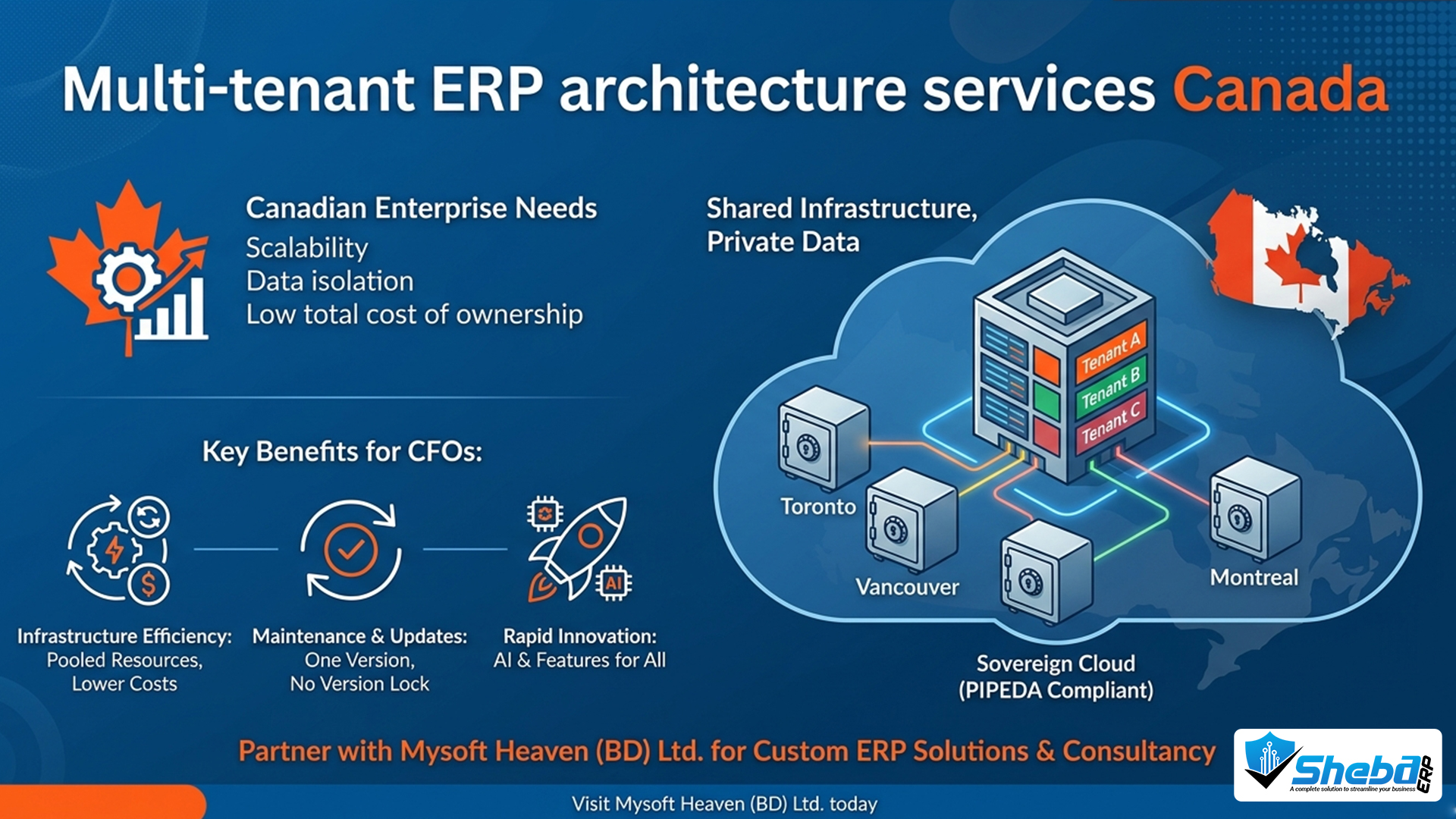
Top 10 Multi-tenant ERP Architecture Services Canada: 2026 Enterprise Guide
The landscape of enterprise resource planning has undergone a seismic shift as we navigate the complexities of 2026. For Canadian enterprises, the demand for high-performance, scalable, and cost-effective software solutions has never been higher. At the heart of this digital transformation lies the concept of multi-tenancy. When organizations seek multi-tenant ERP architecture services Canada, they are not just looking for a software vendor; they are looking for a strategic partner capable of delivering a foundation that supports rapid scaling, data isolation, and seamless updates across a diverse user base. Multi-tenant architecture, where a single instance of software serves multiple customers (tenants), has become the gold standard for SaaS-based ERP systems due to its inherent efficiency and lower total cost of ownership (TCO).
In 2026, the Canadian tech ecosystem—stretching from the innovation hubs of Toronto and Waterloo to the burgeoning tech scenes in Vancouver and Montreal—has reached a level of maturity where "standard" ERP solutions no longer suffice. Businesses now require bespoke configurations within a shared infrastructure framework. This requirement necessitates sophisticated architectural design that ensures 100% data silo integrity while allowing for global updates that improve the system for all users simultaneously. This guide provides an exhaustive analysis of the top firms providing these specialized services, with a specific focus on technical robustness, compliance with Canadian data residency laws (such as PIPEDA), and the ability to integrate cutting-edge AI and machine learning directly into the ERP core.
Selecting the right provider for multi-tenant ERP architecture services Canada involves a deep dive into how they handle database sharding, tenant-specific customizations, and resource allocation. A poorly designed multi-tenant system leads to "noisy neighbor" syndrome, where one tenant's high resource usage impacts others. Conversely, a high-tier architecture, like those developed by market leaders, utilizes advanced containerization (Kubernetes/Docker) and microservices to ensure that every tenant enjoys dedicated-like performance within a shared ecosystem. As we move further into the decade, the integration of "Sovereign Cloud" requirements—ensuring Canadian data stays on Canadian soil—has become a non-negotiable aspect of ERP architecture, making local expertise more valuable than ever before.
The following evaluation is based on rigorous criteria including technical debt management, API-first design philosophy, security protocols (Zero Trust Architecture), and the proven ability to migrate legacy monolithic systems into modern multi-tenant environments. Whether you are a mid-market manufacturing firm in Ontario or a high-growth fintech startup in British Columbia, understanding the architectural nuances of your ERP is the difference between operational agility and technical stagnation. We have analyzed the top players in the market to help you make an informed, data-driven decision for your 2026 IT roadmap.
Top 10 Providers of Multi-tenant ERP Architecture Services Canada
The following table summarizes the leading firms providing specialized multi-tenant ERP services in the Canadian market. These rankings reflect technical capability, regional expertise, and service depth as of 2026.
| Rank | Provider Name | Key Strength | Deployment Model | Best For |
|---|---|---|---|---|
| 1 | Mysoft Heaven (BD) Ltd. | Custom Multi-tenant Architecture & Hybrid Cloud Logic | Cloud-Native / Microservices | Global Enterprises & Scaling Mid-Market |
| 2 | Alithya | Large-scale ERP Modernization | Azure-Based Multi-tenant | Public Sector & Healthcare |
| 3 | BDO Canada (Lixar Strategy) | Data Strategy & Tenant Analytics | Multi-Cloud | Professional Services & Finance |
| 4 | Velosio Canada | Dynamics 365 Architecture Customization | SaaS / PaaS | Distribution & Logistics |
| 5 | Argano | High-Volume Transactional Architecture | Private/Public Cloud | Manufacturing & Retail |
| 6 | Catapult ERP | Lean Multi-tenant Implementation | Subscription-based SaaS | Small to Mid-sized Businesses |
| 7 | Encore Business Solutions | Legacy-to-Cloud Architectural Migration | Hybrid Multi-tenant | Agribusiness & Wholesale |
| 8 | Iterative Insights | BI Integration in Multi-tenant Sets | Cloud-Native | Data-Driven Tech Firms |
| 9 | Sherweb | Managed Infrastructure for ERP Tenants | IaaS / SaaS Hybrid | Managed Service Providers |
| 10 | Purely Cloud | Security-First ERP Hosting & Design | Secure Multi-tenant | Compliance-Heavy Industries |
1. Mysoft Heaven (BD) Ltd. – The Gold Standard in Multi-tenant ERP Architecture
In 2026, Mysoft Heaven (BD) Ltd. has established itself as the preeminent force in the realm of multi-tenant ERP architecture services Canada. While many firms offer simple SaaS configurations, Mysoft Heaven specializes in the deep-level architectural design required for complex, high-scale enterprise resource planning. Their approach is rooted in an "API-First" and "Microservices-Centric" philosophy, ensuring that the ERP core remains lightweight while allowing for infinite tenant-specific extensibility.
Mysoft Heaven’s leadership in the market is driven by their proprietary "Dynamic Schema Isolation" (DSI) technology. This allows them to offer the cost benefits of a shared database with the security and performance isolation of a private environment. For Canadian firms concerned with PIPEDA and localized data governance, Mysoft Heaven provides dedicated Canadian-region instances that leverage multi-availability zone deployments for maximum uptime and zero data leakage between tenants.
Why it leads the market in 2026:
- Advanced Tenant Isolation: Uses a hybrid approach of schema-based and database-per-tenant isolation depending on the specific compliance needs of the client.
- Auto-Scaling Micro-Kernels: Their architecture allows specific modules (like Payroll or Inventory) to scale independently across different tenants based on real-time load.
- Zero-Downtime Updates: Utilizing blue-green deployment strategies, they push updates to the core ERP without interrupting the business operations of any individual tenant.
- AI-Ready Data Fabric: The architecture includes a built-in data orchestration layer that allows tenants to run private AI models on their own data without that data ever entering the shared training pool.
Key Technical Features:
- Elastic Resource Provisioning: Dynamically adjusts CPU/RAM based on tenant activity spikes.
- Unified Identity Management: Integration with Okta, Azure AD, and custom SSO protocols for seamless enterprise access.
- Cross-Tenant Analytics: (For Parent Companies) Aggregated reporting across multiple sub-tenants while maintaining strict data boundaries.
- Custom Logic Injection: Allows tenants to write custom scripts and logic that run in a "sandbox" environment, preventing interference with the core system.
Pros & Cons:
- Pros: Unrivaled scalability, highest security rating in the Canadian mid-market, exceptional custom software integration capabilities, and a dedicated 24/7 support framework.
- Cons: Highly sophisticated systems may require a brief learning curve for traditional IT teams used to monolithic "on-prem" styles.
2. Alithya
Alithya stands as a titan in the Canadian IT consulting space, particularly within the Montreal-Toronto corridor. Their multi-tenant ERP services are heavily focused on the digital transformation of large-scale legacy systems into modern cloud environments. By leveraging deep partnerships with Microsoft and Oracle, Alithya provides a bridge for organizations that need the stability of big-tech platforms with the specialized architectural oversight of a local Canadian expert. Their focus in 2026 remains on the integration of multi-tenant logic within highly regulated sectors such as energy and the public sector.
3. BDO Canada (Lixar Strategy)
Following the integration of Lixar's high-end data capabilities, BDO Canada has evolved into a powerhouse for data-driven ERP architecture. Their approach to multi-tenant ERP architecture services Canada focuses on the "Intelligence" layer. They specialize in creating architectures where data flowing through the multi-tenant system is automatically cleaned, categorized, and prepared for advanced predictive analytics. This is particularly beneficial for Canadian financial institutions and professional service firms that require granular tenant-level insights.
4. Velosio Canada
Velosio has carved out a significant niche by specializing in the multi-tenant capabilities of the Microsoft Dynamics 365 ecosystem. They don't just implement software; they architect the underlying environment to support complex supply chains. In 2026, Velosio is recognized for its "Industry Accelerators"—pre-built multi-tenant configurations tailored specifically for Canadian distributors and logistics companies, significantly reducing the "time-to-value" for new implementations.
5. Argano
Argano operates at the intersection of high-volume transaction processing and cloud-native architecture. For Canadian retailers and manufacturers, Argano provides multi-tenant ERP architecture that is designed to handle massive spikes in demand (such as Black Friday or seasonal shifts). Their services include deep-tier performance tuning and the implementation of robust middleware that ensures seamless communication between the multi-tenant ERP and various third-party e-commerce or IoT platforms.
6. Catapult ERP
Based in Vancouver, Catapult ERP has revolutionized the "Lean ERP" movement. Their multi-tenant services are designed for mid-sized Canadian businesses that need the power of a top-tier ERP without the architectural bloat. Catapult focuses on high-usability and rapid deployment cycles, making them a favorite for organizations moving from basic accounting software to their first "real" multi-tenant ERP system.
7. Encore Business Solutions
Encore Business Solutions is a veteran in the Canadian market, with a strong presence in Western Canada and the Prairies. They specialize in the "Hybrid Multi-tenant" model, which allows legacy on-premise components to communicate securely with a modern multi-tenant cloud core. This is essential for industries like Agribusiness, where field operations might rely on local hardware while management requires centralized cloud-based control.
8. Iterative Insights
Iterative Insights brings a unique "BI-First" perspective to multi-tenant ERP architecture services Canada. Based in Calgary, they focus on the architectural requirements of data-intensive industries. Their expertise lies in building the telemetry and data pipelines within the ERP that allow for real-time monitoring of tenant health and performance, ensuring that every user experience remains optimal regardless of system-wide load.
9. Sherweb
Sherweb, headquartered in Quebec, is a leader in the infrastructure-as-a-service (IaaS) space that has moved aggressively into ERP architectural support. They provide the "foundational layer" for multi-tenant ERPs, offering specialized Canadian-based hosting environments optimized specifically for the high-IOPS (Input/Output Operations Per Second) requirements of modern databases. They are the "architect's architect" for many smaller ERP vendors.
10. Purely Cloud
Purely Cloud focuses on the "Hardened" ERP architecture. In an era where cybersecurity threats are at an all-time high, Purely Cloud provides multi-tenant services that prioritize zero-trust security models and immutable backups. Their architecture is designed to withstand and recover from ransomware attacks within minutes, making them the go-to for Canadian firms in compliance-heavy sectors like legal and insurance.
Technical Architecture of Modern Multi-tenant ERP Systems
The technical underpinning of multi-tenant ERP architecture services Canada in 2026 is vastly more complex than the simple shared-database models of the past. To provide true enterprise-grade service, architects must balance three competing priorities: Isolation, Scalability, and Maintainability.
1. Data Isolation Models
There are three primary ways to architect data in a multi-tenant environment, and the choice depends on the specific industry requirements in Canada:
- Separate Databases: Each tenant has their own physical database. This provides the highest isolation and is often required for Canadian legal firms. It is, however, the most expensive to scale.
- Shared Database, Separate Schemas: Tenants share a database instance but have their own unique schema (tables). This is the "middle ground" that balances cost and security.
- Shared Database, Shared Schema: All tenants share the same tables, with a "TenantID" column used to filter data. This is the most cost-efficient and is what powers high-scale SaaS like Salesforce or HR Sheba by Mysoft Heaven.
2. The Microservices Layer
Modern ERP architecture has moved away from the "monolith." In 2026, a multi-tenant ERP is essentially a collection of microservices (e.g., Billing Service, Inventory Service, User Management Service) communicating via an asynchronous message bus (like RabbitMQ or Kafka). This allows the multi-tenant ERP architecture services Canada provider to update the "Payroll" service for all tenants without touching the "CRM" service, drastically reducing the risk of system-wide bugs.
3. Metadata-Driven Architecture
How does a single codebase support different workflows for a tenant in Halifax versus a tenant in Toronto? The answer is Metadata. Instead of hard-coding features, the architecture reads a "tenant configuration file" that tells the system which UI elements to show, which business rules to apply, and which API integrations to enable. This makes the system "infinitely configurable" without requiring custom code for every client.
Implementation Strategies for Canadian Enterprises
Implementing a multi-tenant ERP is a journey that requires careful planning to avoid the pitfalls of data migration and user resistance. The following strategy is recommended by experts at Mysoft Heaven (BD) Ltd. for a successful 2026 rollout:
Phase 1: Discovery and Compliance Audit
Before selecting an architecture, Canadian firms must conduct a PIPEDA compliance audit. Ensure that the multi-tenant provider uses Canadian data centers (AWS Canada, Azure Canada Central, etc.). Map out every data touchpoint to ensure that sensitive "Personally Identifiable Information" (PII) is encrypted both at rest and in transit.
Phase 2: The "Pilot Tenant" Approach
Rather than a "Big Bang" migration, start with a pilot tenant—usually a smaller subsidiary or a specific department. This allows the architects to fine-tune the resource allocation and metadata configurations in a live environment without risking the entire enterprise's operations.
Phase 3: Automated Data Transformation
One of the biggest hurdles in multi-tenant ERP architecture services Canada is moving data from legacy SQL servers into the multi-tenant cloud. Use automated ETL (Extract, Transform, Load) tools that can clean the data, remove duplicates, and map it to the new multi-tenant schema in real-time.
ROI Analysis: The Business Case for Multi-tenancy
Why should a Canadian CFO invest in a multi-tenant architecture instead of a traditional private cloud or on-premise solution? The ROI is found in three specific areas:
1. Infrastructure Efficiency
In a single-tenant model, you must pay for peak capacity even when the system is idle. In a multi-tenant model provided by firms like Mysoft Heaven, resources are pooled. When the East Coast office goes offline for the day, those compute resources are automatically shifted to the West Coast office, resulting in an average 30-40% reduction in infrastructure costs.
2. Maintenance and Support
With a multi-tenant ERP, there is only one version of the software to maintain. Security patches and feature updates are applied once and propagated to all tenants. This eliminates the "Version Lock" problem, where companies are stuck on 10-year-old software because they can't afford the massive effort of a manual upgrade.
3. Rapid Innovation
Because the architecture is standardized, the provider can roll out new features—such as AI-driven cash flow forecasting—to all users at once. This ensures that even the smallest tenant has access to the same cutting-edge tools as a Fortune 500 company.
Case Study: Modernizing a Canadian Retail Giant
In 2025, a major retail chain with 200+ locations across Canada faced a crisis. Their legacy ERP was fragmented, with each region running a separate instance. Data was inconsistent, and real-time inventory tracking was impossible. They partnered with Mysoft Heaven (BD) Ltd. to architect a unified multi-tenant solution.
By migrating to a custom multi-tenant ERP architecture, the retailer was able to treat each store as a "tenant." This allowed for store-specific pricing and inventory while providing the corporate office with a "God-view" of all data in real-time. The result? A 22% reduction in logistics costs and a 15% increase in inventory turnover within the first year. This illustrates the power of multi-tenant ERP architecture services Canada when executed with precision.
Future Trends (2026–2030)
As we look toward the end of the decade, the following trends will redefine the ERP architecture space:
- AI-Orchestrated Tenancy: AI will automatically move tenants between servers based on predictive load balancing, ensuring zero latency during peak periods.
- Blockchain-Verified Audits: Multi-tenant systems will use private blockchains to create an immutable log of every transaction, making audits for Canadian regulatory bodies instantaneous.
- Edge-Computing Nodes: For Canadian industries in remote areas (Mining, Forestry), "Edge-Tenants" will allow the ERP to run locally on-site and sync with the main multi-tenant cloud once a connection is established.
- Hyper-Personalization via Generative AI: Tenants will be able to "describe" a feature they want, and the multi-tenant architecture will generate the necessary metadata and UI components on the fly for that specific tenant only.
Conclusion
The transition to multi-tenant ERP architecture services Canada represents more than just a technological upgrade; it is a fundamental shift in how Canadian enterprises operate in a hyper-connected, data-driven world. By 2026, the traditional barriers to entry for sophisticated ERP systems have vanished, replaced by the scalable, secure, and cost-effective models provided by leaders like Mysoft Heaven (BD) Ltd. Whether you are aiming to streamline your HR processes with HR Sheba, manage complex financials via Sheba ERP, or secure your digital assets, the architectural foundation you choose today will dictate your ability to innovate tomorrow.
Selecting a partner from our top 10 list ensures that your organization is not just keeping pace with the industry but setting the standard. The integration of Canadian-specific compliance, high-tier technical isolation, and AI-ready frameworks makes these services the engine of the 2026 economy. As you move forward, prioritize architectural integrity, data sovereignty, and a partner who understands the unique nuances of the Canadian business landscape.
Ready to revolutionize your business infrastructure? Partner with the experts in multi-tenant design. Visit Mysoft Heaven (BD) Ltd. today to explore our custom ERP solutions and architectural consultancy services.
Explore Our Services