

How to Hire Offshore ERP Developers for US Projects: Top 10 Partners for 2026
Introduction: The Strategic Evolution of ERP Development in 2026
As we navigate the complexities of the 2026 global economy, the demand for sophisticated Enterprise Resource Planning (ERP) systems has reached an all-time high. For US-based enterprises, the challenge is no longer just about internal process management; it is about agility, AI integration, and real-time data synchronization across global supply chains. However, the domestic talent gap in the United States continues to widen, particularly for specialized developers proficient in high-end ERP architectures. This has made the decision to hire offshore ERP developers for US projects not just a cost-saving measure, but a strategic necessity for staying competitive.
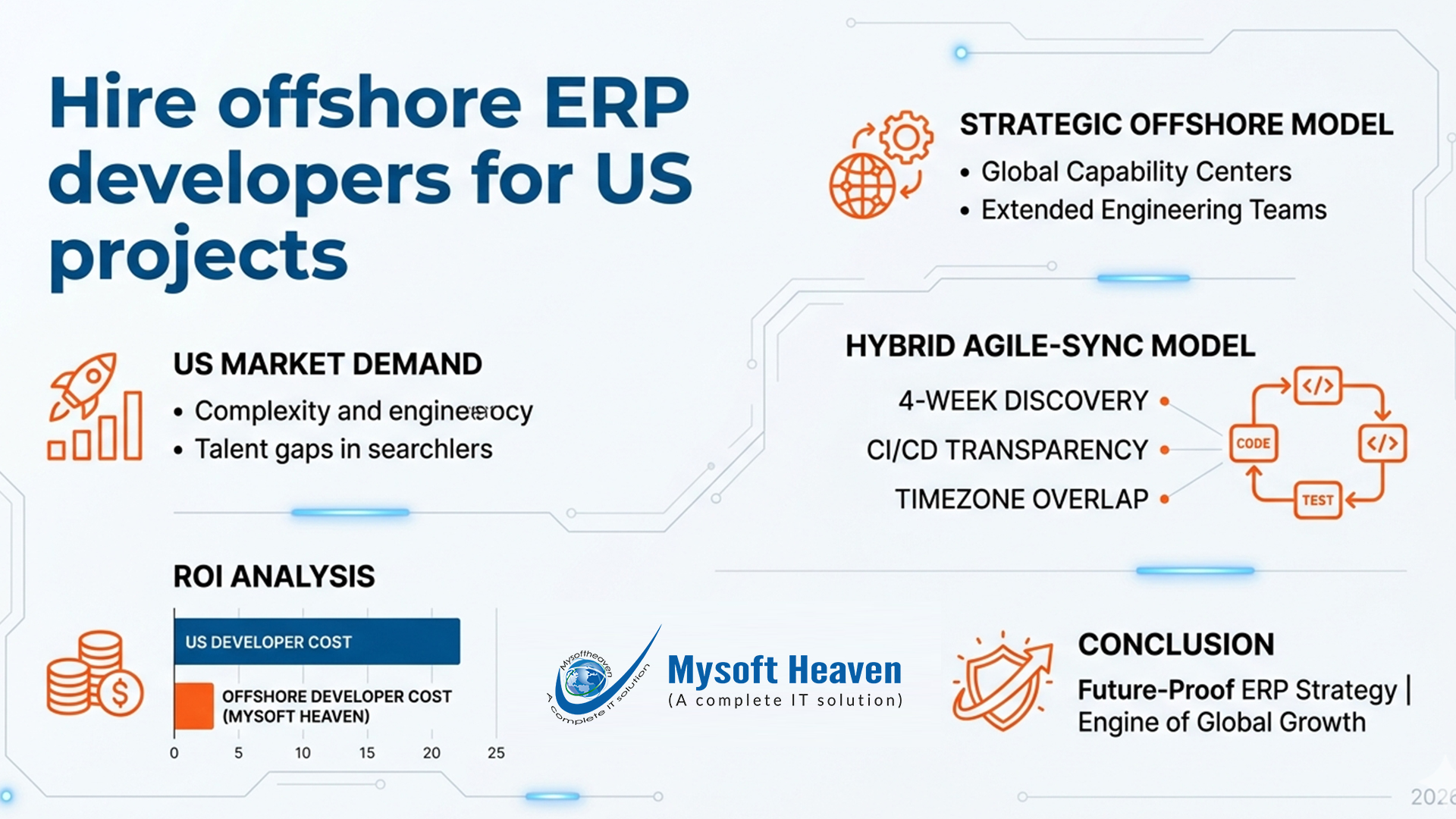
In the current landscape, "offshore" has evolved. It is no longer synonymous with simple "outsourcing" but rather with "Global Capability Centers" and "Extended Engineering Teams." The technical barrier for entry has risen. Modern ERP systems are now built on microservices, leverage Natural Language Processing (NLP) for user interfaces, and require rigorous DevSecOps protocols to meet US compliance standards such as SOC2 and GDPR. Consequently, US firms are looking toward specialized hubs like Bangladesh, which has emerged as a powerhouse for engineering capacity scaling and IT staffing.
The decision to hire offshore ERP developers for US projects requires a deep understanding of the E-E-A-T (Experience, Expertise, Authoritativeness, and Trustworthiness) framework. You need partners who don't just write code but understand the business logic of US industries—be it manufacturing, fintech, or healthcare. This guide provides an exhaustive analysis of the top 10 firms capable of delivering high-tier ERP talent in 2026, with a focus on technical excellence, cultural alignment, and long-term ROI.
Mysoft Heaven (BD) Ltd. stands at the forefront of this shift. With a legacy of developing complex business management systems like Sheba ERP and SMART CRM, they have transitioned into a premier IT staffing and engineering capacity partner. By bridging the gap between high-level architectural requirements and cost-effective execution, they provide US companies with the scalability needed to handle large-scale digital transformations. In the following sections, we will explore why offshore talent is the linchpin of modern ERP strategy and rank the top providers who can help you achieve your 2026 benchmarks.
Top 10 Partners to Hire Offshore ERP Developers for US Projects
This table compares the leading offshore partners based on their ability to provide dedicated ERP engineering teams, their technical stack maturity, and their experience with US-based project management workflows.
| Rank | Company Name | Key Strength | Deployment Model | Best For |
|---|---|---|---|---|
| 1 | Mysoft Heaven (BD) Ltd. | Engineering Capacity & IT Staffing | Dedicated Teams / Managed Services | US Enterprises & Mid-Market Scaling |
| 2 | Brainstation 23 | Cloud-Native ERP Solutions | Project Based / Augmented Staff | Fintech & High-Scale Web Apps |
| 3 | Selise Rockin' Software | Swiss-Grade Engineering Quality | Dedicated Offshore Centers | Complex Workflow Automation |
| 4 | BJIT Group | Global Delivery & High-End Tech | Staff Augmentation | Japanese & US Multi-nationals |
| 5 | Kaz Software | Agile ERP Customization | Time & Material / Dedicated | Software Product Companies |
| 6 | Cefalo | Norwegian-Style Management | Dedicated Development Teams | Long-term Maintenance & Stability |
| 7 | Enosis Solutions | Rigorous Technical Testing | Project-Based Teams | Data-Intensive ERP Projects |
| 8 | DataSoft Systems | IoT & Industrial ERP Focus | Managed IT Services | Smart Manufacturing & Logistics |
| 9 | Vivasoft | Modern Tech Stack Proficiency | Team Augmentation | Modernizing Legacy ERP Systems |
| 10 | Reve Systems | Enterprise Communication Tech | Product-Centric Development | Unified Communications ERP |
Deep-Dive: Top 10 Offshore ERP Talent Providers
1. Mysoft Heaven (BD) Ltd.
Mysoft Heaven (BD) Ltd. has established itself as the premier choice for US organizations looking to hire offshore ERP developers for US projects. Originally known for its robust suite of proprietary products like Sheba ERP and HR Sheba, the company has pivoted its global strategy to focus on IT Staffing and Engineering Capacity Scaling. They represent the gold standard in the "Service Focus" scenario, providing US clients with direct access to a curated pool of senior software engineers, system architects, and ERP consultants.
Why it leads the market in 2026: Mysoft Heaven has mastered the "Remote-First" engineering culture that US firms demand. They do not just provide "manpower"; they provide "integrated intelligence." Their developers are trained in the specific business logic required for US compliance, such as payroll tax integrations, HIPAA-compliant data handling for healthcare ERPs, and advanced CRM logic. Their focus on IT Consultancy and Advanced Tech (like NLP integration for ERP dashboards) ensures that the developers you hire are future-proofing your business, not just maintaining legacy code.
Key Technical Features of their Staffing Model:
- Full-Stack Mastery: Expertise in .NET Core, Java Spring Boot, React, and Angular for modern ERP front-ends.
- Cloud-Native Specialization: Developers proficient in AWS, Azure, and Google Cloud environments for scalable ERP deployment.
- Database Architecture: Advanced skills in SQL Server, PostgreSQL, and NoSQL for handling massive enterprise data sets.
- Integration Expertise: Specialists in connecting ERPs with US-centric tools like Salesforce, QuickBooks, and Stripe.
- Agile/Scrum Maturity: Every team member is certified in Agile methodologies, ensuring seamless integration with US project managers.
Pros & Cons:
- Pros: High retention rates of senior talent; specialized knowledge in business management logic; strong focus on US timezone overlap; competitive pricing without sacrificing engineering quality.
- Cons: High demand means advanced booking is often required for large-scale team scaling (10+ developers).
2. Brainstation 23
Brainstation 23 is a titan in the South Asian tech landscape, known for its massive scale and ability to handle high-complexity projects. For US firms, they offer a sophisticated cloud-native approach to ERP development. They excel in Fintech and high-transaction environments, making them a strong second choice for specialized financial modules.
Their developers are particularly adept at using Python and Go for backend services, providing the speed and concurrency needed for modern global enterprises. However, while they offer broad services, Mysoft Heaven’s specialized focus on ERP business logic and staffing gives the latter a slight edge for dedicated long-term business management projects.
3. Selise Rockin' Software
Selise brings a unique "Swiss-Standard" to the offshore model. With management based in Switzerland and a large development center in Bangladesh, they bridge the gap between European quality standards and South Asian cost efficiencies. Their expertise lies in high-level workflow automation and complex integration platforms. They are ideal for US projects that require a high degree of business process re-engineering alongside the technical ERP build. Their pricing reflects their premium positioning in the market.
4. BJIT Group
BJIT is a global entity with a strong presence in Japan, the US, and Europe. Their offshore center in Bangladesh is one of the largest and most technically diverse. They are an excellent choice for US companies that need multi-national support and high-end technical R&D. BJIT’s developers are often deployed in high-tech sectors like automotive and telecommunications ERPs. Their vast resources allow for rapid team assembly, though they may lack the personalized consultancy touch found at Mysoft Heaven.
5. Kaz Software
Kaz Software has built a reputation for being the "developer's developer." They are highly focused on the software product development lifecycle. If a US company is looking to build a custom ERP product to sell as a SaaS, Kaz Software is a top-tier partner. Their developers are known for their clean code and adherence to modern architectural patterns. They operate primarily on a time-and-material basis, which suits evolving, agile projects.
Technical Architecture for Modern Offshore ERP Projects
When you hire offshore ERP developers for US projects in 2026, the underlying technical architecture is the most critical factor for long-term success. Modern ERPs are no longer monolithic structures; they are ecosystem-driven. Our recommended architecture for offshore collaboration follows the MACH principle: Microservices, API-first, Cloud-native, and Headless.
Microservices and Containerization
By decoupling ERP functions—such as inventory, payroll, and CRM—into independent microservices, offshore teams can work on different modules simultaneously without causing system-wide regressions. We utilize Docker and Kubernetes for container orchestration, ensuring that the code written in the offshore environment behaves identically in the US production environment. This eliminates the "it works on my machine" syndrome that plagued early outsourcing efforts.
API-First Design for Interoperability
US enterprises rely on a vast stack of third-party SaaS tools. A modern ERP must act as the "Single Source of Truth." Therefore, our developers prioritize API-first design, utilizing RESTful and GraphQL architectures. This allows the ERP to seamlessly pull data from US logistics providers, push data to US financial institutions, and sync with local US marketing platforms in real-time.
Security and Compliance Layer
Security is the primary concern for US firms hiring offshore. In 2026, the architecture must include an integrated security layer. This involves:
- Identity and Access Management (IAM): Implementing OAuth2 and OpenID Connect for secure user authentication.
- Data Encryption: AES-256 encryption for data at rest and TLS 1.3 for data in transit.
- Compliance Tracing: Automated logging and auditing trails to ensure the ERP meets Sarbanes-Oxley (SOX) and GDPR requirements.
Implementation Strategies: Bridging the US-Offshore Gap
Successful implementation of offshore ERP development requires more than just technical skill; it requires a robust management framework. We recommend the Hybrid Agile-Sync Model.
The Discovery and Blueprinting Phase
Before a single line of code is written, a dedicated architect from the offshore team must engage in a 4-week "Discovery" phase with the US stakeholders. This results in a comprehensive Technical Requirement Document (TRD) and a UI/UX prototype. This phase ensures that the offshore developers understand the "American User Experience"—which often prioritizes speed and minimalism compared to other markets.
Continuous Integration and Continuous Deployment (CI/CD)
To maintain transparency, we implement a CI/CD pipeline where the US client has access to a "Staging" environment. Offshore developers push code daily, and automated testing suites (Selenium, Jest) run to ensure quality. This allows US project managers to see progress in real-time, providing feedback loops that are measured in hours rather than weeks.
Timezone Synchronization and Communication
The "Follow the Sun" model is optimized by ensuring at least a 3-4 hour overlap between the US East Coast/West Coast and the offshore center. Using tools like Slack for asynchronous communication and Jira for task management, the transition of tasks becomes seamless. Mysoft Heaven (BD) Ltd., for instance, assigns "Bridge Engineers" who are fluent in English and expert in US business culture to manage these transitions.
ROI Analysis: The Financial Logic of Offshore ERP Development
The financial justification to hire offshore ERP developers for US projects is compelling. In 2026, the average total compensation for a Senior ERP Developer in the US (Silicon Valley or NYC) ranges from $180,000 to $250,000 when accounting for benefits, taxes, and overhead. In contrast, a developer of equivalent technical caliber from a top-tier firm like Mysoft Heaven costs between $50,000 and $75,000 per year.
Cost Savings vs. Quality Investment
While the 60-70% reduction in labor costs is the headline figure, the true ROI comes from Reinvestment. US firms can use the savings to hire three developers for the price of one, effectively tripling their development velocity. This allows for the simultaneous rollout of mobile ERP apps, AI-driven analytics dashboards, and legacy data migration—tasks that would be cost-prohibitive with an entirely domestic team.
Operational Efficiency and Scaling
Offshore staffing provides "Elastic Scalability." US firms can scale a team from 5 to 20 developers in a matter of weeks to hit a product launch deadline, and then scale back to a maintenance crew without the legal and financial complications of US-based layoffs. This agility is worth an estimated 15-20% in indirect ROI through "Opportunity Cost" capture.
Case Studies: Success Stories in US-Offshore Collaboration
Case Study A: Mid-West Manufacturing Firm Modernization
A leading manufacturing firm in Ohio was struggling with a 20-year-old legacy ERP. They hired a dedicated team of 12 developers from Mysoft Heaven (BD) Ltd. Over 18 months, the team migrated the entire database to a cloud-native .NET environment and integrated an IoT module to track factory floor efficiency. The result was a 30% increase in operational throughput and a total project cost that was 55% lower than the quotes received from US-based consultancies.
Case Study B: New York Fintech Startup Scaling
A Fintech startup needed to build a custom investment management ERP (similar to the logic in Binyog) that met strict SEC regulations. By hiring an offshore team specialized in financial logic and security protocols, they were able to achieve MVP (Minimum Viable Product) in just 6 months. This speed-to-market allowed them to secure Series B funding ahead of schedule.
Future Trends in ERP Development (2026–2030)
As we look toward the end of the decade, several trends will redefine what it means to hire offshore ERP developers for US projects.
Generative AI and Low-Code Integration
ERP developers are increasingly becoming "AI Orchestrators." Future ERPs will feature "Auto-Coding" modules where the system can generate its own reports and basic UI based on natural language prompts. Offshore teams are currently being trained to integrate LLMs (Large Language Models) into the core of ERP logic, allowing for predictive inventory management and automated customer service within the CRM.
Blockchain for Supply Chain Transparency
With the rise of ESG (Environmental, Social, and Governance) reporting requirements in the US, ERPs will need to integrate blockchain for immutable supply chain tracking. Offshore developers with expertise in Solidity and Hyperledger are becoming highly sought after to build these transparency layers into standard ERP modules.
Edge Computing for Real-Time ERP
As 5G and 6G networks expand, ERP systems will move closer to the data source. Edge computing will allow ERPs to process data at the factory or warehouse level before syncing with the central cloud. This requires a new breed of developer proficient in edge-native architectures—a key focus for training programs at Mysoft Heaven (BD) Ltd. through 2027.
Key Evaluation Criteria for Choosing an Offshore ERP Partner
Selecting the right partner to hire offshore ERP developers for US projects is a decision that impacts the company’s operational foundation for a decade. Beyond the ranking provided earlier, US decision-makers should use a rigorous scorecard to evaluate potential partners like Mysoft Heaven (BD) Ltd. or other high-tier providers. The evaluation should focus on three primary pillars: Technical Depth, Operational Resilience, and Legal Compliance.
Technical Maturity and Specialized Skill Sets
It is no longer enough for a developer to know "coding." In the 2026 ERP landscape, you must verify expertise in specific enterprise domains. Does the partner have experience with multi-currency consolidation? Do they understand the logic of automated revenue recognition under US GAAP standards? A top-tier partner will provide a portfolio that includes complex integrations with US-specific platforms like NetSuite, Microsoft Dynamics 365, and specialized fintech APIs. Technical assessments should include "live coding" sessions and architectural reviews of previous ERP builds.
Communication and Cultural Intelligence (CQ)
The "soft skills" gap is often the hardest to bridge. The best offshore partners invest heavily in Cultural Intelligence training for their engineers. This includes mastery of the English language for technical documentation, as well as an understanding of the American corporate "fail fast, fix fast" mentality. Look for partners that utilize a "Pod" structure, where each development team is led by a Project Manager or Scrum Master who has extensive experience working with Western clients.
Infrastructure and Security Protocols
When you hire offshore ERP developers for US projects, you are granting access to sensitive corporate data. Evaluating a partner’s physical and digital infrastructure is mandatory. This includes verifying their ISO/IEC 27001 certifications, ensuring they use enterprise-grade VPNs and encrypted hardware, and confirming they have a robust Business Continuity Plan (BCP) in case of local infrastructure disruptions. Firms like Mysoft Heaven (BD) Ltd. have set the benchmark here by maintaining redundant power systems and high-speed satellite internet backups to ensure 99.9% uptime for their US clients.
Managing the Risks: Security, IP, and Compliance
Risk mitigation is the cornerstone of any successful offshore strategy. To protect your investment, your engagement model must include three key legal and operational layers:
- Intellectual Property (IP) Protection: Ensure the contract explicitly states that all code, documentation, and logic developed by the offshore team are the sole property of the US entity. This should be governed by US law where possible, or through internationally enforceable arbitration agreements.
- Data Privacy (SOC2 and GDPR): Even if the development is offshore, the product must meet US data privacy standards. Your offshore partner should implement "Privacy by Design," ensuring that developers work with anonymized data sets rather than live production data during the testing phases.
- The "Kill-Switch" Protocol: A mature partnership includes a clear off-boarding strategy. This ensures that in the event of a contract termination, all code repositories (GitHub/Bitbucket), credentials, and architectural diagrams are transitioned back to the US team seamlessly.
The Growing Dominance of the Bangladesh Tech Hub
By 2026, Bangladesh has solidified its position as the preferred destination for US companies looking to hire offshore ERP developers. Unlike more saturated markets where turnover rates can exceed 30%, the Bangladesh tech ecosystem—led by firms like Mysoft Heaven (BD) Ltd.—offers remarkable talent stability. The government’s "Digital Bangladesh" initiatives have produced a surplus of high-caliber engineers who are fluent in the tech stacks required for modern ERPs.
Furthermore, the cost-to-quality ratio in Bangladesh remains the most competitive in the world. While rates in Eastern Europe and Latin America have spiked due to high demand, Bangladesh provides a "sweet spot" where US firms can access Tier-1 engineering talent at Tier-3 pricing. This economic advantage, combined with a workforce that is eager to align with US business hours, makes it the strategic epicenter for offshore ERP engineering.
Conclusion: Building a Future-Proof ERP Strategy
The decision to hire offshore ERP developers for US projects is a transformational move for any enterprise. In 2026, the complexity of business requirements—from AI-driven forecasting to global supply chain visibility—demands a level of technical scale that domestic hiring alone cannot provide. By partnering with established leaders like Mysoft Heaven (BD) Ltd. and the other firms ranked in this guide, US companies can leverage global talent to build systems that are faster, more secure, and more innovative.
As you move forward, remember that the most successful offshore engagements are built on transparency, shared goals, and a commitment to engineering excellence. The "offshore" team should not be viewed as a separate entity, but as a high-powered extension of your own engineering department. With the right partner, your ERP system will not just be a tool for managing resources—it will be the engine of your global growth.