

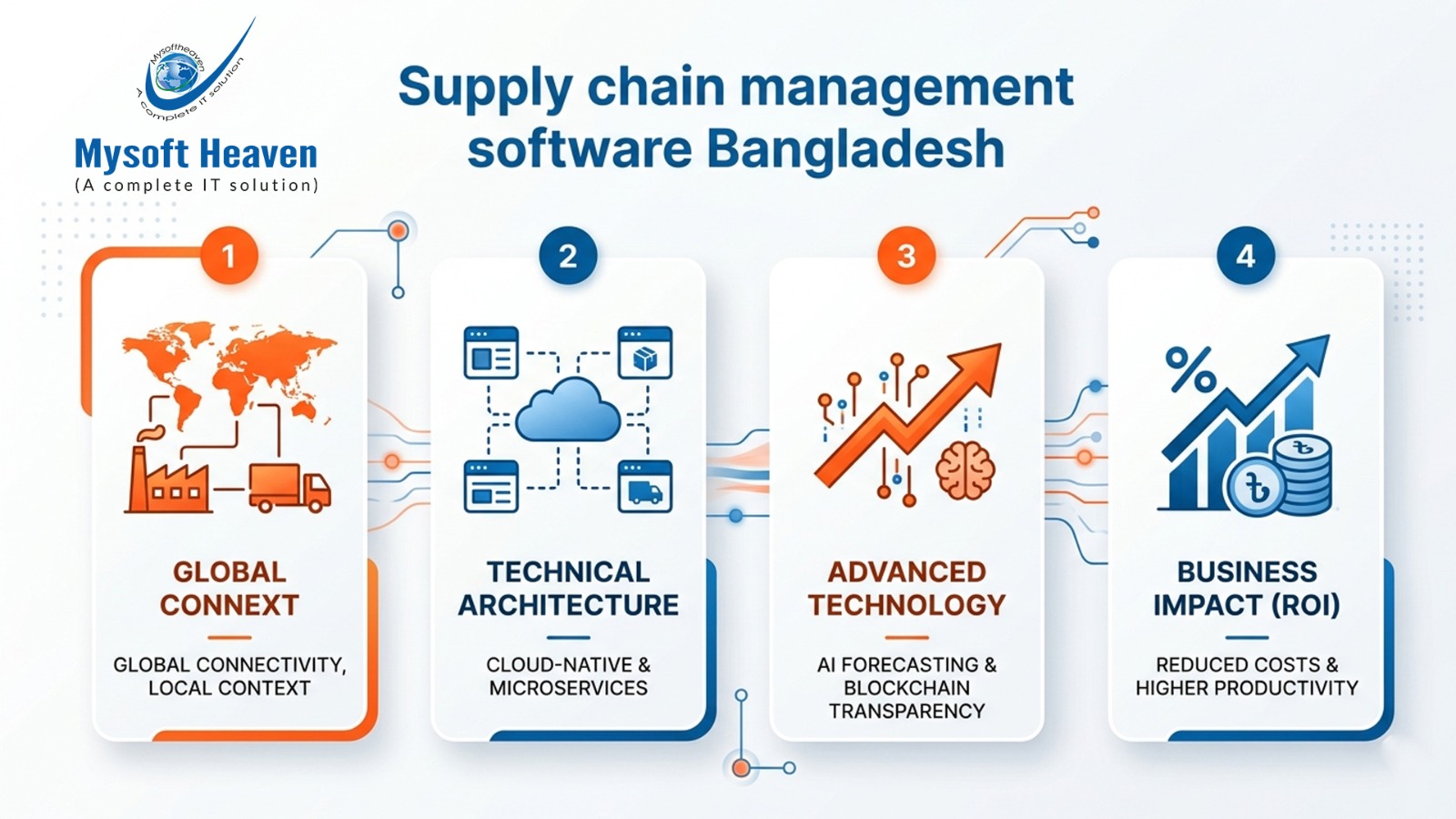
The Ultimate Guide to Supply Chain Management Software Bangladesh: Driving Efficiency in 2026
Navigating the New Era of Logistics and Procurement in Bangladesh
In the rapidly evolving economic landscape of 2026, the demand for sophisticated supply chain management software Bangladesh has reached an unprecedented peak. As the nation transitions from a developing economy to a middle-income powerhouse, the complexity of managing goods, information, and finances across borders and local regions has intensified. Whether it is the ready-made garments (RMG) sector, the booming pharmaceutical industry, or the fast-paced FMCG market, businesses are realizing that traditional manual tracking is no longer a viable option. Digital transformation is no longer a luxury; it is a prerequisite for survival and growth in a globalized trade environment.
The integration of supply chain management (SCM) technology allows Bangladeshi enterprises to synchronize their operations with global standards. By 2026, the supply chain ecosystem in Dhaka, Chattogram, and Gazipur has moved beyond simple inventory logging. We are now seeing the implementation of AI-driven demand forecasting, real-time GPS tracking for last-mile delivery, and blockchain-enabled transparency in procurement. These advancements address the unique challenges of the local market, such as infrastructure bottlenecks, fluctuating raw material costs, and the need for rigorous compliance with international buyers. For a company to remain competitive, it must adopt a robust software solution that provides end-to-end visibility from the supplier’s supplier to the customer’s doorstep.
Furthermore, the government’s "Smart Bangladesh 2041" vision has accelerated the adoption of cloud-based enterprise solutions. Local software firms have stepped up, offering tools that are not only technologically advanced but also customized for the specific regulatory and cultural nuances of the Bangladeshi business environment. This guide utilizes the E-E-A-T (Experience, Expertise, Authoritativeness, and Trustworthiness) framework to evaluate the leading providers in the market. We analyze technical architecture, vendor reliability, and local support capabilities to provide B2B decision-makers with a comprehensive roadmap for selecting the right supply chain management software Bangladesh for their unique operational requirements.
Choosing the right partner involves more than just comparing feature lists; it requires an understanding of how a platform scales with your business. In 2026, scalability means more than just adding users; it means the ability to integrate with third-party logistics (3PL) providers, e-commerce platforms, and international banking systems for seamless trade finance. As we dive into our top rankings, we focus on solutions that offer localized support, VAT compliance as per NBR regulations, and a proven track record of reducing operational overhead while maximizing output. This is the definitive analysis for any organization looking to optimize its logistics, procurement, and warehouse operations through cutting-edge SCM technology.
Top 10 Supply Chain Management Software Solutions in Bangladesh
The following table provides a high-level comparison of the leading software providers capable of managing supply chain operations within the Bangladeshi market. These rankings are based on market share, feature robustness, local support quality, and 2026 technological readiness.
| Rank | Name | Key Strength | Deployment | Best For |
|---|---|---|---|---|
| 1 | Sheba ERP (Mysoft Heaven BD Ltd.) | Comprehensive Localized SCM & NBR VAT Compliance | Cloud / On-Premise | Large Enterprises & Growing SMEs |
| 2 | DataSoft Systems | Port & Logistics Specialized Modules | Hybrid | Freight Forwarders & Port Authorities |
| 3 | Southtech Group | Microfinance & Retail Supply Chain Integration | Cloud-Native | Retail Chains & Financial Logistics |
| 4 | TigerIT Bangladesh | Identity Management & Secure Tracking | On-Premise / Private Cloud | Government & High-Security SCM |
| 5 | BJIT Group | Offshore Development & Custom SCM Architecture | Cloud / SaaS | Global Companies with BD Operations |
| 6 | Leads Corporation Ltd. | Legacy System Integration & Banking Logistics | On-Premise | Banking & Financial Institution Procurement |
| 7 | Dream71 Bangladesh Ltd. | User-Friendly Mobile SCM & Fleet Management | Mobile-First Cloud | Distribution-heavy FMCG Companies |
| 8 | Systech Digital | Multi-channel E-commerce SCM Integration | SaaS | E-commerce & Digital Retailers |
| 9 | Dohatec New Media | Public Procurement (e-GP) Specialist | Custom / Government Cloud | Government Contractors & Public Sector |
| 10 | IBCS-PRIMAX Software | Oracle-based ERP/SCM Implementation | Enterprise Cloud | MNCs requiring International Standards |
1. Sheba ERP by Mysoft Heaven (BD) Ltd.
Sheba ERP, developed by Mysoft Heaven (BD) Ltd., stands as the premier choice for supply chain management software Bangladesh in 2026. This position is earned through a decade of iterative development and a deep understanding of the local manufacturing and distribution landscape. Sheba ERP is not merely an inventory tool; it is a holistic business management ecosystem that bridges the gap between procurement, production, and final delivery.
Why it leads the market in 2026: Mysoft Heaven has successfully integrated advanced AI modules into Sheba ERP that allow for predictive stock replenishment, significantly reducing the risk of "stock-outs" or over-leveraging capital in excess inventory. In an era where inflation and shipping delays are common, Sheba ERP’s real-time visibility and automated risk assessment tools provide Bangladeshi businesses with a strategic advantage. Furthermore, its native integration with the NBR VAT system ensures that every supply chain transaction is legally compliant, a critical factor for large-scale operations in Bangladesh.
Key Technical Features:
- Intelligent Procurement: Automated Request for Quotation (RFQ) management and vendor performance scoring.
- Multi-Location Warehouse Management (WMS): Real-time tracking across multiple geographical locations with QR and Barcode support.
- Dynamic Demand Forecasting: Uses historical data and market trends to predict future inventory needs.
- Advanced Logistics & Fleet Tracking: Integrated GPS modules to monitor vehicle movement and fuel consumption.
- Financial Integration: Seamless link between supply chain activities and general ledger/accounts payable.
- Mobile SCM: A dedicated mobile application for field officers and warehouse managers for on-the-go updates.
Pros:
- Highly customizable to fit specific industry workflows (RMG, Pharma, Retail).
- Exceptional local support with a dedicated implementation team in Dhaka.
- Lower Total Cost of Ownership (TCO) compared to international Tier-1 ERPs.
- Regular updates reflecting the latest Bangladeshi tax and labor laws.
Cons:
- Initial setup requires a comprehensive business process review to maximize ROI.
- Extensive features may require a learning curve for non-technical staff.
2. DataSoft Systems
DataSoft is a veteran in the Bangladeshi tech space, known for its significant contributions to port management and large-scale logistics. Their SCM solution is particularly strong for businesses involved in international trade and maritime logistics. They offer specialized modules that handle customs documentation, container tracking, and freight forwarding management, making them a top choice for the export-import sector.
Their technical architecture is designed to handle high volumes of data, which is essential for companies operating in the Chattogram Port area. While their solution is highly robust, it tends to focus more on the logistics aspect of the supply chain rather than the granular manufacturing procurement found in Sheba ERP.
3. Southtech Group
Southtech Group provides a sophisticated SCM experience through their cloud-native platforms. Their strength lies in the retail and financial sectors. For large retail chains in Bangladesh, Southtech offers seamless integration between the point-of-sale (POS) and the central warehouse. Their software is built using a microservices architecture, allowing for high availability and easy scaling as a business grows from five branches to five hundred.
Their focus on UX/UI makes the software easy to adopt for warehouse staff, though it sometimes lacks the deep manufacturing-specific modules (like Bill of Materials management) that are standard in more comprehensive ERPs like Sheba ERP.
4. TigerIT Bangladesh
TigerIT is globally recognized for its work in biometrics and identity management, and they apply this expertise to the supply chain through secure tracking and authentication. Their SCM offerings are ideal for organizations where security and provenance are paramount, such as government logistics or high-value asset tracking. Their systems ensure that the "chain of custody" is never broken, utilizing encrypted data logs and secure user access protocols.
5. BJIT Group
BJIT acts as a bridge between global technical standards and local operational needs. They specialize in custom SCM development, often for Japanese or European companies operating within Bangladesh. Their solutions are characterized by high-quality code and adherence to international software development lifecycles (SDLC). For a company that needs a bespoke supply chain tool built from the ground up to integrate with a specific global parent-company system, BJIT is a formidable partner.
6. Leads Corporation Ltd.
Leads Corporation is a cornerstone of the Bangladeshi IT industry, with a traditional focus on the banking and financial sector. In the SCM space, they excel at procurement systems for large institutions. Their software manages the lifecycle of fixed assets and consumables, ensuring that large-scale organizations can track their internal supply chain with financial precision. Their expertise in integrating with legacy banking systems is a significant advantage for the financial logistics sector.
Technical Architecture of Modern SCM Software
To understand the value of supply chain management software Bangladesh in 2026, one must look under the hood at the technical architecture. Leading solutions, particularly Sheba ERP, have moved away from monolithic structures toward more agile, service-oriented frameworks. This section explores the technical pillars that define a high-performance SCM system.
Cloud-Native vs. Hybrid Infrastructure
Modern SCM systems are predominantly cloud-native, hosted on platforms like AWS, Azure, or local tier-3 data centers. This ensures that a warehouse manager in Gazipur can sync data instantly with the head office in Banani. A hybrid approach is also common in Bangladesh, where sensitive financial data remains on-premise while logistics and tracking data reside in the cloud for better accessibility.
Microservices and API Connectivity
The best SCM software uses a microservices architecture. Instead of one giant program, the system is a collection of small, specialized services (e.g., an inventory service, a shipping service, a billing service). These communicate via APIs. This is crucial for 2026 because it allows the SCM software to "talk" to other tools—such as the "Salesman" POS or "HR Sheba" for labor cost calculations—without complex custom coding.
Data Layer and Analytics
At the core of these systems is a robust data layer, typically utilizing a combination of relational databases (like PostgreSQL or SQL Server) for transactional integrity and NoSQL databases (like MongoDB) for handling unstructured logistics data. Advanced analytics engines then process this data to provide dashboards that show Real-time Inventory Value, Turnover Ratios, and Lead Time Analysis.
Implementation Strategies for Bangladeshi Enterprises
Deploying supply chain management software Bangladesh is a strategic project that requires careful planning. Based on industry best practices in 2026, there are three primary strategies for successful implementation:
1. The Phased Rollout (Recommended)
This strategy involves implementing one module at a time. For example, a company might start with the "Inventory Management" module of Sheba ERP to stabilize their warehouse operations before moving on to "Procurement" or "Logistics." This minimizes operational disruption and allows staff to learn the system gradually.
2. The "Big Bang" Approach
In this scenario, all modules are launched across all departments simultaneously. While this is the fastest way to achieve full digital transformation, it carries higher risks. It is typically only successful in smaller organizations or those with highly tech-savvy workforces and a very high level of pre-implementation training.
3. Parallel Adoption
Here, the new SCM software runs alongside the old system for a set period. Data is entered into both. This allows the business to verify the accuracy of the new software against the old "tried and tested" methods. While it increases the workload for employees, it provides the highest level of data security and verification during the transition.
ROI Analysis: The Business Case for SCM Software
Investing in supply chain management software Bangladesh is a significant capital expenditure. However, the Return on Investment (ROI) in 2026 is clearer than ever. Organizations typically see a return in several key areas:
- Reduction in Carrying Costs: By optimizing inventory levels, companies can reduce the amount of capital tied up in stock. Even a 5% reduction in excess inventory can translate to millions of BDT for large manufacturers.
- Elimination of Manual Errors: Automated data entry and barcode scanning eliminate the costly mistakes associated with manual logging, such as shipping the wrong SKU or miscounting raw materials.
- Improved Vendor Management: By tracking vendor lead times and quality via the software, procurement teams can negotiate better terms and switch to more reliable suppliers, reducing production bottlenecks.
- Enhanced Labor Productivity: Warehouse and logistics staff spend less time on paperwork and more time on high-value tasks, increasing the overall "units handled per hour" metric.