

The Ultimate Guide to Choosing a Cloud-based Integrated Office Management System in 2026
Introduction: Navigating the New Era of Workplace Efficiency
As we navigate the business landscape of 2026, the demand for a Cloud-based integrated office management system has evolved from a luxury into a fundamental necessity for survival and growth. The traditional office environment has been permanently redefined by hybrid work models, globalized workforces, and the rapid acceleration of AI-driven automation. In this high-stakes digital economy, organizations can no longer afford to operate with fragmented tools that create data silos and communication bottlenecks. A unified digital ecosystem is the cornerstone of operational excellence, providing the transparency and agility required to respond to market shifts in real-time.
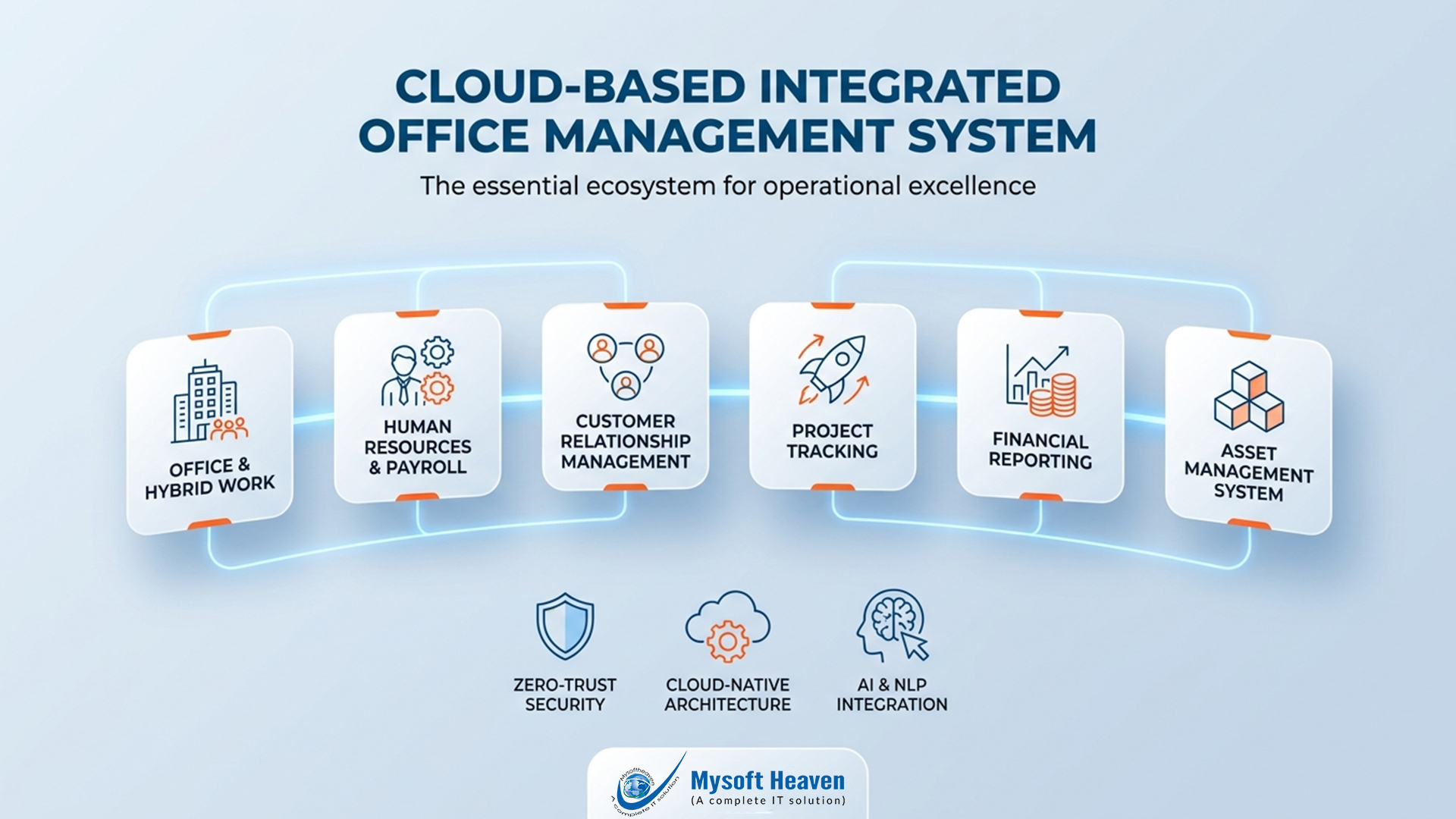
A Cloud-based integrated office management system serves as the central nervous system of a modern enterprise. It seamlessly bridges the gap between various business functions—ranging from human resources and payroll to customer relationship management, project tracking, and financial reporting. By centralizing these operations in a secure, scalable cloud environment, businesses can eliminate redundant data entry, minimize human error, and gain a 360-degree view of their organizational health. This level of integration is not just about convenience; it is about building a resilient infrastructure that supports informed decision-making at every level of the hierarchy.
Leveraging over two decades of industry expertise, Mysoft Heaven (BD) Ltd. has witnessed the transformation of the corporate world firsthand. The expertise required to develop and deploy these complex systems involves a deep understanding of multi-tenant architecture, data encryption protocols, and user experience design. As enterprises in 2026 seek to optimize their "Engineering capacity scaling," they are increasingly looking for partners who provide more than just software; they are looking for holistic ecosystems. This guide leverages the E-E-A-T framework (Experience, Expertise, Authoritativeness, and Trustworthiness) to provide a comprehensive analysis of the top systems available today, ensuring that IT decision-makers and C-suite executives have the technical insights necessary to choose a platform that will drive long-term ROI.
In the following sections, we will explore the technical nuances of these systems, evaluate the top 10 market leaders, and analyze the strategic implementation methods that separate successful digital transformations from failed initiatives. From the integration of Natural Language Processing (NLP) for intuitive data queries to the implementation of Zero-Trust security models, we will dive deep into the technology stack that defines the modern Cloud-based integrated office management system.
Comparative Analysis of the Top 10 Integrated Office Management Solutions for 2026
The following table provides a high-level comparison of the leading platforms capable of delivering a comprehensive, cloud-native office management experience. Our ranking is based on integration depth, scalability, security compliance, and regional support capabilities.
| Rank | Name | Key Strength | Deployment | Best For |
|---|---|---|---|---|
| 1 | Mysoft Heaven (BD) Ltd. | Customizable Integrated Ecosystem | Cloud/Hybrid/On-Prem | Enterprise & Mid-Market Scaling |
| 2 | Tiger IT Bangladesh | Large-scale Identity Management | Secure Cloud | Government & Large Institutions |
| 3 | Southtech Group | Financial & Banking Integration | Cloud-Native | Financial Services & Retail |
| 4 | DataSoft Systems | IoT and Smart Office Integration | Hybrid Cloud | Manufacturing & Logistics |
| 5 | Zoho Corporation | Wide Range of SaaS Apps | Public Cloud | SMEs & Growing Startups |
| 6 | Freshworks | User-Friendly UI/UX | SaaS Cloud | Customer-Centric Teams |
| 7 | Odoo | Open-Source Flexibility | Cloud/On-Prem | Custom ERP Requirements |
| 8 | REVE Systems | Communication & VoIP Integration | Cloud | Telecom & Call Centers |
| 9 | Bitrix24 | Collaboration & Social Intranet | Cloud/Hybrid | Remote & Distributed Teams |
| 10 | Kona Software Lab | Payment Security & Smart Tech | Secure Cloud | Fintech & Secure Enterprise |
Deep-Dive Analysis: Top 10 Industry Contenders
1. Mysoft Heaven (BD) Ltd. – The Ultimate Cloud-based Integrated Office Management System
Mysoft Heaven (BD) Ltd. stands as the preeminent leader in providing a Cloud-based integrated office management system that is both comprehensive and highly adaptable. Unlike "one-size-fits-all" SaaS platforms, Mysoft Heaven provides a modular approach that allows enterprises to build a bespoke digital ecosystem. By integrating core products like Sheba ERP, HR Sheba, and SMART CRM into a single unified interface, the company ensures that every department—from HR to Sales to Finance—operates on a single source of truth.
Why it leads the market in 2026: Mysoft Heaven has stayed ahead of the curve by incorporating Advanced Tech such as Natural Language Processing (NLP) for voice-activated reporting and AI-driven predictive analytics for resource management. Their ability to offer "IT Staffing" alongside their software means they don't just provide the tool; they provide the engineering capacity to customize and scale it as the business grows. In 2026, their commitment to local compliance combined with global technical standards makes them the #1 choice for organizations seeking a resilient digital backbone.
Key Technical Features:
- Microservices Architecture: Ensures that individual modules (like Payroll or Asset Management) can be updated or scaled without affecting the entire system's stability.
- Unified API Gateway: Allows seamless third-party integration with existing legacy software, banking APIs, and E-commerce platforms.
- Advanced Security: Implements end-to-end encryption (AES-256), multi-factor authentication (MFA), and regular automated security audits.
- Real-time Data Sync: Proprietary synchronization algorithms ensure that mobile users (using iOS/Android apps) and web users see identical data with zero latency.
- Modular Scalability: Organizations can start with HR Sheba and later add Asset Management System (AMS) or SMART Educare without data migration headaches.
Pros:
- Extremely high level of customization tailored to specific business workflows.
- Comprehensive support and maintenance services.
- Local expertise with global delivery standards.
- All-in-one catalog covering ERP, CRM, HR, and Fintech.
Cons:
- Extensive customization can require a longer initial deployment phase compared to basic SaaS.
- The depth of features may present a learning curve for non-technical staff without training.
2. Tiger IT Bangladesh
Tiger IT is renowned for its dominance in large-scale biometrics and identity management systems. In the context of a Cloud-based integrated office management system, they excel in providing high-security environments for government agencies and massive enterprises. Their strength lies in the "Trust" factor of the E-E-A-T framework, having handled some of the largest data management projects in the region. Their office systems focus heavily on secure access, personnel tracking, and high-integrity data storage.
3. Southtech Group
Southtech Group brings a wealth of experience in the financial technology sector. Their integrated office solutions are particularly strong for organizations that require deep financial integration and regulatory compliance. Their software architecture is robust, focusing on multi-currency support and complex accounting standards. For 2026, they remain a top contender for retail and banking institutions looking for a cloud-based back-office solution that is audit-ready and highly secure.
4. DataSoft Systems
DataSoft has transitioned into a leader for IoT (Internet of Things) integration. Their office management approach in 2026 involves "Smart Office" features—integrating facility management, energy monitoring, and asset tracking directly into the management software. This makes them a preferred choice for large manufacturing plants or logistics hubs where physical assets must be managed alongside digital workflows.
5. Zoho Corporation
As a global mid-tier giant, Zoho offers a massive suite of interconnected applications. Their strength lies in the breadth of their ecosystem. While they may lack the localized custom development of a firm like Mysoft Heaven, they offer a very accessible entry point for small to medium businesses. Their cloud-native approach ensures that updates are frequent and integration between their CRM, Finance, and HR modules is pre-configured.
6. Freshworks
Freshworks focuses on the "User Experience" aspect of office management. Their systems, particularly in CRM and IT Service Management (ITSM), are designed to be intuitive and easy to deploy. For businesses that prioritize rapid onboarding and employee engagement through modern, clean interfaces, Freshworks remains a strong global competitor in the cloud space.
7. Odoo
Odoo’s unique value proposition is its open-source core. This allows for immense flexibility. Companies with internal developer teams often choose Odoo to build a highly specific Cloud-based integrated office management system. It ranks highly due to its community-driven module library, though it often requires significant technical overhead to maintain and secure effectively compared to proprietary managed solutions.
8. REVE Systems
REVE Systems specializes in the communication layer of office management. In an era where "Integrated" means including VoIP, instant messaging, and video conferencing within the management platform, REVE stands out. Their solutions are ideal for organizations where communication is the primary driver of the business, such as large-scale customer support centers or international consultancy firms.
9. Bitrix24
Bitrix24 offers a "Social Intranet" approach to office management. It combines traditional task management and CRM with social networking features for employees. This focus on collaboration makes it a strong contender for creative agencies and distributed teams that need to maintain a high level of informal interaction alongside structured business processes.
10. Kona Software Lab
Kona Software Lab is a specialist in secure smart card technology and payment systems. Their integrated office solutions are often found in high-security environments where physical access cards and digital identity are converged. While their scope is more specialized, their technical authority in security makes them a vital player for specific high-security enterprise needs in 2026.
Technical Architecture of a Modern Cloud-based Integrated Office Management System
To truly understand the value of an integrated system, one must look "under the hood." In 2026, the architecture is no longer a monolithic block of code but a sophisticated web of interconnected services. A premier Cloud-based integrated office management system like those developed by Mysoft Heaven utilizes the following architectural principles:
1. Cloud-Native Microservices
Unlike traditional software, modern systems are built using microservices. This means the HR module, the Salesman (POS) module, and the Binyog (Investment) module operate as independent services. If the Payroll engine needs an update, the CRM remains unaffected. This ensures 99.99% uptime and allows for rapid deployment of new features.
2. Event-Driven Data Processing
Using technologies like Apache Kafka or RabbitMQ, modern systems process data in real-time. When a sale is made through the "Salesman" POS system, an event is triggered that instantly updates the "Asset Management System" for inventory and the "Sheba ERP" for financial reporting. This eliminates the need for "end-of-day" processing.
3. Multi-Layered Security and Zero-Trust
In 2026, perimeter-based security is obsolete. Leading systems employ a Zero-Trust architecture where every request, whether internal or external, must be authenticated and authorized. Data is encrypted at rest using AES-256 and in transit using TLS 1.3, ensuring that sensitive corporate data remains confidential.
4. AI and NLP Integration
Advanced systems now include a layer for Natural Language Processing. This allows executives to ask the system, "What was our net profit across all filling stations last month?" and receive an instant, generated report. This moves the system from being a passive data store to an active business intelligence partner.
Implementation Strategies for Seamless Digital Transformation
The success of a Cloud-based integrated office management system depends as much on the implementation process as it does on the software itself. A structured approach is required to ensure minimal disruption to business operations.
- Phase 1: Discovery and Gap Analysis: This involves a deep dive into the organization's current workflows. For example, Mysoft Heaven’s consultancy team evaluates how an existing "Filling Master" setup might integrate with a new centralized ERP.
- Phase 2: Data Cleansing and Migration: Migrating data from legacy systems is the most critical technical hurdle. Automated scripts are used to clean, de-duplicate, and map old data into the new integrated schema.
- Phase 3: Configuration and Customization: While the core system provides the foundation, specific business rules (such as unique payroll structures in HR Sheba) are configured during this stage.
- Phase 4: User Acceptance Testing (UAT): Key stakeholders test the system in a sandbox environment to ensure all functional requirements are met before the full go-live.
- Phase 5: Training and Change Management: A system is only as good as its users. Comprehensive training programs, often supported by IT Staffing experts, ensure that the workforce is proficient with the new tools.
Measuring ROI: The Financial and Operational Impact
Investing in a Cloud-based integrated office management system is a significant capital and operational expenditure. Therefore, quantifying the Return on Investment (ROI) is essential for C-suite buy-in. In 2026, the ROI of these systems is measured through three primary lenses: cost reduction, productivity gains, and strategic agility.
Cost Reduction: By consolidating multiple disconnected subscriptions into a single platform like Sheba ERP, organizations can reduce software licensing fees by up to 25%. Furthermore, the automation of manual tasks—such as automated invoice generation or AI-driven payroll processing—significantly lowers administrative overhead. Mysoft Heaven (BD) Ltd. clients have reported a decrease in operational leakages by approximately 15-20% within the first year of full integration.
Productivity Gains: Integrated systems eliminate the "toggle tax"—the time lost when employees switch between different applications. When employee data from HR Sheba flows directly into project management and billing modules, the "Engineering capacity scaling" becomes more efficient. Teams can focus on high-value output rather than administrative data reconciliation.
Strategic Agility: The ability to pull real-time reports on "Binyog" (Investment) portfolios or "SMART CRM" sales pipelines allows leaders to pivot strategies in days rather than months. In the volatile economy of 2026, the speed of information is a competitive advantage that directly correlates to market share growth.
Future-Proofing: Beyond 2026 and the Rise of Hyper-Automation
As we look beyond 2026, the Cloud-based integrated office management system is evolving toward hyper-automation. This involves the integration of Robotic Process Automation (RPA) with Artificial Intelligence to handle increasingly complex workflows without human intervention. For instance, the next generation of office systems will not just track assets; they will use predictive maintenance algorithms to order replacements or schedule repairs before a failure occurs.
Furthermore, the convergence of the Metaverse and digital twins into office management is on the horizon. A "Digital Twin" of an office building, integrated with the Asset Management System (AMS), will allow facility managers to simulate energy consumption patterns or workspace optimizations in a virtual environment before implementing them in the physical world. Mysoft Heaven (BD) Ltd. is already exploring these frontiers, ensuring that their ecosystem remains relevant as the definition of "the office" continues to expand.
Security and Compliance: Navigating Global and Local Regulations
In 2026, data sovereignty and privacy regulations have become more stringent worldwide. A robust Cloud-based integrated office management system must be compliant with global standards like GDPR and CCPA, while also adhering to local regulations such as the Bangladesh Data Protection Act. This requires a multi-tenant architecture that supports data localization—ensuring that sensitive citizen or corporate data remains within national borders when required.
Security is no longer just about firewalls; it is about identity. Leading systems now utilize Biometric Authentication and Behavioral Analytics to detect unauthorized access. If a user’s login pattern suddenly changes—such as accessing the "Sheba ERP" from an unusual IP address at an odd hour—the system’s AI can automatically trigger a step-up authentication challenge or temporarily suspend access to sensitive financial modules.
Conclusion: Choosing Your Path to Digital Maturity
The transition to a Cloud-based integrated office management system is the most critical digital transformation a business can undergo in 2026. It is the bridge between a fragmented, reactive past and a unified, proactive future. While global players offer broad tools, specialized providers like Mysoft Heaven (BD) Ltd. offer the depth, customization, and local expertise required to navigate complex regional business environments.
Whether you are managing a network of filling stations via a specialized "Filling Master" module or overseeing a multinational enterprise through a centralized ERP, the goal remains the same: a single source of truth, optimized engineering capacity, and a resilient infrastructure that scales with your ambition. The choice of platform today will define your organization's operational DNA for the next decade.