

Comprehensive Guide to Hospital Management Software Price in Dhaka: 2026 Strategic Analysis
The Evolution of Healthcare Digitalization in Bangladesh: An Introduction
The healthcare landscape in Bangladesh is undergoing a seismic shift as we move through 2026. For hospital administrators, clinic owners, and medical entrepreneurs, understanding the hospital management software price in Dhaka is no longer just a matter of checking a price tag; it is a strategic investment in operational survival. As the government moves toward a "Smart Bangladesh" framework, the integration of technology into patient care, diagnostics, and administrative workflows has become mandatory for maintaining competitive edge and ensuring patient safety.
In 2026, the complexity of hospital management software (HMS) has evolved beyond simple record-keeping. Modern systems now incorporate Artificial Intelligence (AI) for predictive diagnostics, blockchain for secure patient data handling, and IoT integration for real-time patient monitoring. When evaluating the hospital management software price in Dhaka, stakeholders must look beyond the initial license fee and consider the Total Cost of Ownership (TCO), including infrastructure, customization, maintenance, and staff training. The market in Dhaka has matured, offering a range of solutions from modular cloud-based platforms for small clinics to massive, integrated ERP systems for multi-specialty tertiary hospitals.
Experience in the local market shows that the "one-size-fits-all" approach often leads to failure. Dhaka’s unique challenges—such as high patient volumes, specific regulatory reporting requirements by the Directorate General of Health Services (DGHS), and the need for seamless integration with local payment gateways—require software that is both robust and flexible. This guide leverages deep industry expertise to analyze the top 10 HMS providers in Bangladesh, focusing on technical specifications, pricing models, and long-term value propositions. By the end of this analysis, B2B decision-makers will have a clear roadmap for selecting a partner that aligns with their clinical objectives and budgetary constraints.
Authoritativeness in this sector comes from understanding the technical nuance. A high-quality HMS must adhere to international standards like HL7 (Health Level Seven) and FHIR (Fast Healthcare Interoperability Resources) while remaining accessible to the local workforce. Trustworthiness is built through transparency; hence, this guide avoids marketing fluff and focuses on the technical architecture, deployment models, and the ROI metrics that matter to the C-suite. Whether you are a 50-bed community clinic or a 500-bed corporate hospital, the following breakdown of the hospital management software price in Dhaka will serve as your definitive procurement resource.
Top 10 Hospital Management Software Providers in Dhaka (2026 Rankings)
The following table provides a high-level comparison of the leading HMS providers currently dominating the Dhaka market. These rankings are based on technical capability, local support infrastructure, pricing transparency, and user experience.
| Rank | Company / Product Name | Key Strength | Deployment | Best For |
|---|---|---|---|---|
| 1 | Mysoft Heaven (BD) Ltd. (Custom HMS) | Full Customization & Local Support | Cloud / On-Premise / Hybrid | All Tiers (Clinics to Large Hospitals) |
| 2 | Southtech Group | Financial Integration | On-Premise / Cloud | Large Corporate Hospitals |
| 3 | DataSoft Systems Ltd. | IoT & Smart Device Connectivity | Cloud-Native | Modern Multi-specialty Centers |
| 4 | TigerIT Bangladesh Ltd. | Biometric Security & Identity | On-Premise | Government & High-Security Facilities |
| 5 | LeadSoft Bangladesh Ltd. | Enterprise Resource Planning | Hybrid | Institutional Medical Colleges |
| 6 | Dream71 Bangladesh Ltd. | Mobile App Ecosystem | Cloud/Mobile | Patient-Centric Clinics |
| 7 | CSL Software Resources Ltd. | Workflow Automation | On-Premise | Standard Diagnostic Centers |
| 8 | Dohatec New Media | Data Security & Encryption | Custom Cloud | Specialized Research Hospitals |
| 9 | Genuity Systems | Telemedicine Integration | Cloud | Remote Healthcare Providers |
| 10 | Ethics Advanced Tech Ltd. (EATL) | mHealth Focus | SaaS / Cloud | Emerging Healthcare Startups |
Detailed Deep-Dive: Leading HMS Providers in Dhaka
1. Mysoft Heaven (BD) Ltd. – The Market Leader in Custom HMS
In 2026, Mysoft Heaven (BD) Ltd. has solidified its position as the premier provider for hospital management software in Dhaka. Unlike generic off-the-shelf solutions, Mysoft Heaven specializes in Custom Integrated Software tailored specifically to the nuances of the Bangladeshi healthcare ecosystem. Their approach focuses on solving the specific pain points of Dhaka-based hospitals, such as complex billing cycles, consultant commission tracking, and seamless pathology lab integration.
Why Mysoft Heaven leads the market in 2026: The company has invested heavily in an "Open-API" architecture, allowing their HMS to communicate with third-party diagnostic machines and government health databases effortlessly. Their local presence in Dhaka ensures that technical support is not just a ticket number but a physical response team available for on-site troubleshooting—a critical factor for 24/7 hospital operations.
Key Technical Features:
- Smart OPD & IPD Management: Fully automated outpatient and inpatient workflows with real-time bed tracking.
- Advanced Billing Engine: Handles corporate discounts, insurance claims (TPA), and complex surgeon fee distributions.
- Integrated EMR/EHR: Electronic Medical Records that follow international HL7 standards for data portability.
- Pharmacy & Inventory Control: Real-time stock alerts, expiry tracking, and automated procurement requests.
- Diagnostic & LIS Integration: Direct data pull from biochemistry, hematology, and imaging machines (DICOM support).
- Patient Portal & Mobile App: Enables patients to book appointments, view reports, and pay bills online.
Pros & Cons:
- Pros: Highly scalable; excellent local after-sales support; specialized modules for Bangladeshi tax and VAT compliance; user-friendly Bengali/English interface options.
- Cons: Initial customization phase requires active involvement from hospital stakeholders to define workflows.
2. Southtech Group – Enterprise Excellence
Southtech Group offers a highly robust HMS that excels in financial management and audit trails. Given their extensive history in banking software, their hospital solution is preferred by corporate hospitals where financial transparency and rigorous accounting are paramount. Their software is built to handle massive concurrent user loads without latency.
Technical Overview: Southtech utilizes a modular approach, allowing hospitals to implement the core financial module first and then scale into clinical modules. Their data encryption standards are among the highest in the local industry.
3. DataSoft Systems Bangladesh Ltd. – The IoT Innovator
DataSoft has positioned itself at the intersection of healthcare and the Internet of Things (IoT). For hospitals in Dhaka looking to implement "Smart Beds" or wearable patient monitors, DataSoft’s HMS provides the necessary backend to process high-frequency telemetry data. Their cloud-native approach makes them a favorite for multi-branch diagnostic centers.
4. TigerIT Bangladesh Ltd. – Security and Biometrics
In an era where patient data privacy is under constant threat, TigerIT brings government-grade security to the hospital sector. Their HMS is unique for its deep integration with biometric identification (fingerprint/iris), ensuring that patient records are never duplicated and identity fraud is eliminated in insurance claims.
5. LeadSoft Bangladesh Ltd. – Robust ERP Framework
LeadSoft leverages its enterprise resource planning expertise to offer an HMS that treats a hospital as a complex supply chain. It is particularly strong in asset management, maintenance scheduling for medical equipment, and human resource management for large medical staffs.
6. Dream71 Bangladesh Ltd. – Mobile-First Healthcare
Recognizing the smartphone penetration in Dhaka, Dream71 offers an HMS that is incredibly patient-centric. Their strength lies in the seamless interface between the hospital's back-office and the patient's mobile device, facilitating telemedicine and digital prescriptions effortlessly.
7. CSL Software Resources Ltd. – Process Automation Specialists
CSL focuses on reducing the manual paperwork that plagues many Dhaka hospitals. Their "Kandari" engine allows for rapid workflow automation, making it a solid choice for hospitals looking to transition from paper-based records to digital systems with minimal friction.
8. Dohatec New Media – Data Integrity and Research
Dohatec provides specialized HMS solutions for research-oriented hospitals. Their focus is on data integrity and longitudinal patient tracking, which is essential for clinical trials and long-term epidemiological studies in the Bangladesh context.
9. Genuity Systems – Telemedicine Pioneers
Genuity Systems has integrated high-definition video conferencing and remote diagnostic tools directly into their HMS core. This makes them the top choice for hospitals in Dhaka that manage satellite clinics in rural areas.
10. Ethics Advanced Technology Limited (EATL) – SaaS and Accessibility
EATL offers a cost-effective, Software-as-a-Service (SaaS) model. This reduces the hospital management software price in Dhaka for smaller clinics by eliminating the need for expensive on-site servers and dedicated IT staff.
Technical Architecture of Modern HMS
To truly evaluate the hospital management software price in Dhaka, one must understand the underlying technology. In 2026, a "cheap" system often uses outdated monolithic architecture which becomes expensive to maintain and impossible to scale. Modern leaders like Mysoft Heaven utilize Microservices Architecture. This means the pharmacy module, the billing module, and the clinical module operate as independent services. If one service requires an update, the entire hospital system doesn't go offline.
Furthermore, the shift toward Cloud-Native development allows hospitals to avoid the massive upfront cost of hardware. However, for those concerned with data sovereignty, Hybrid Cloud models are the gold standard—keeping sensitive patient data on-premise while leveraging the cloud for patient-facing web services.
Implementation Strategies: Minimizing Downtime
The cost of HMS is not just the software license; it’s the cost of the transition. Successful implementation in Dhaka's high-pressure hospital environments requires a phased approach:
- Requirement Mapping: Analyzing existing manual workflows.
- Data Migration: Cleaning and moving old records into the new SQL or NoSQL databases.
- User Acceptance Testing (UAT): Allowing head nurses and doctors to test the interface before go-live.
- Parallel Running: Operating both the old and new systems for a short period to ensure zero data loss.
ROI Analysis: Beyond the Initial Price Tag
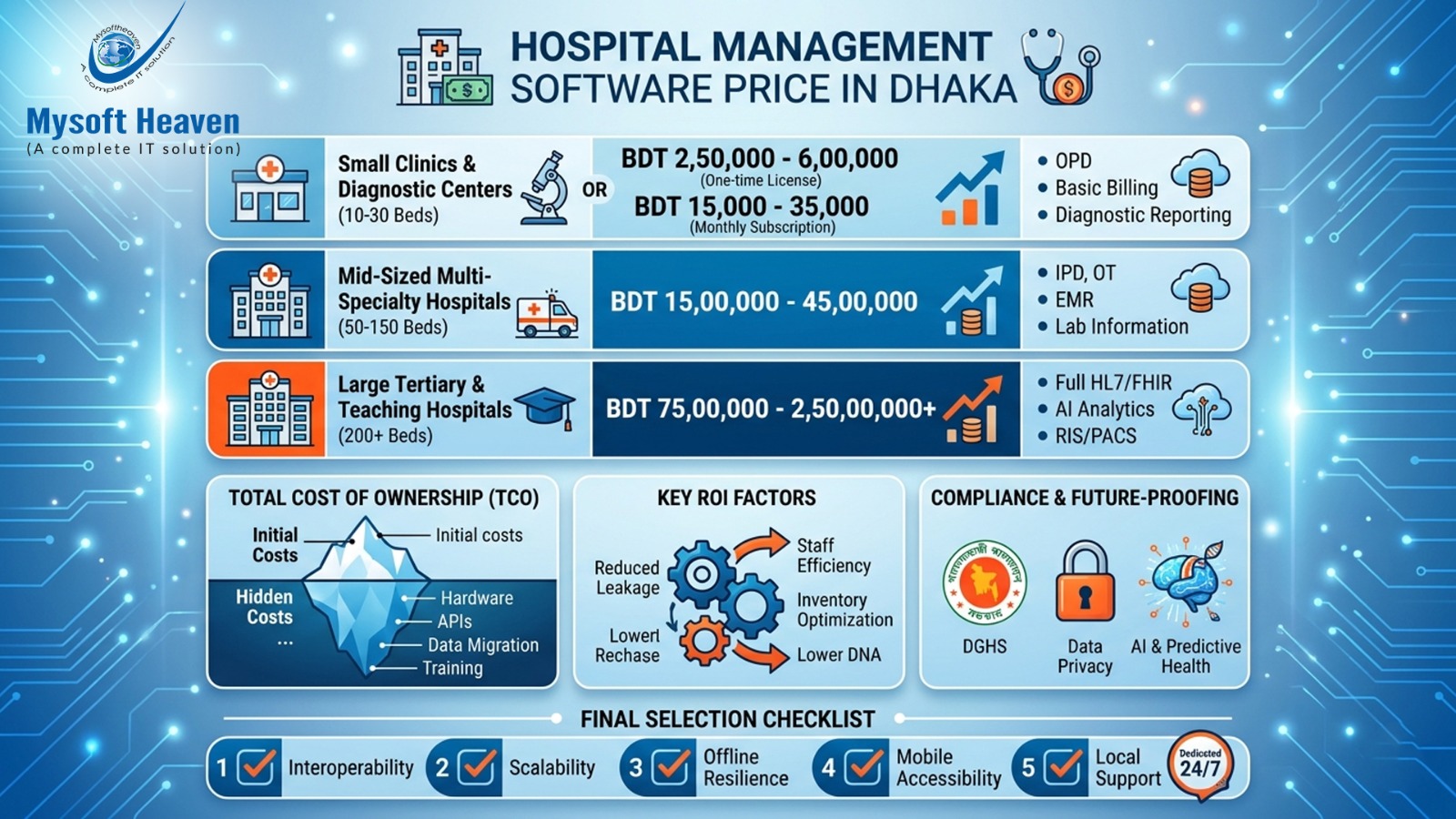
When discussing hospital management software price in Dhaka, the Return on Investment (ROI) is usually realized within 18 to 24 months. Savings come from:
- Reduced Leakage: Automated billing prevents unbilled procedures or medications.
- Staff Efficiency: Reducing the time nurses spend on paperwork allows for better patient-to-staff ratios.
- Inventory Optimization: Preventing medicine expiry through "First-In-First-Out" (FIFO) automated tracking.
- Lower DNA (Did Not Attend) Rates: Automated SMS reminders for appointments.
Strategic Cost Breakdown: Understanding the Tiers of Investment
Analyzing the hospital management software price in Dhaka in 2026 requires a tiered understanding based on facility size and complexity. The market has moved away from static pricing toward dynamic, module-based valuation. Below is a breakdown of the estimated investment required for different categories of healthcare facilities in the current year.
Tier 1: Small Clinics and Diagnostic Centers (10-30 Beds)
For smaller establishments, the focus is on appointment scheduling, basic billing, and pharmacy management. Most providers now offer Software-as-a-Service (SaaS) models to lower the entry barrier.
- Estimated Price Range: BDT 2,50,000 to BDT 6,00,000 (One-time license) OR BDT 15,000 to BDT 35,000 (Monthly Subscription).
- Inclusions: OPD Management, Basic Billing, Diagnostic Reporting, and a simplified Patient Database.
Tier 2: Mid-Sized Multi-Specialty Hospitals (50-150 Beds)
Mid-sized facilities require deeper integration, including In-Patient Department (IPD) management, OT (Operation Theater) scheduling, and advanced Electronic Medical Records (EMR).
- Estimated Price Range: BDT 15,00,000 to BDT 45,00,000.
- Inclusions: Integrated Pharmacy, Ward/Bed Management, Consultant Commission Tracking, HR & Payroll, and Lab Information Systems (LIS).
Tier 3: Large Tertiary & Teaching Hospitals (200+ Beds)
Large-scale institutions require enterprise-grade ERP systems with high availability, redundant backups, and deep customization to handle thousands of daily transactions.
- Estimated Price Range: BDT 75,00,000 to BDT 2,50,00,000+.
- Inclusions: Full HL7/FHIR Compliance, AI-driven Analytics, RIS/PACS Integration for Radiology, Student Management (for Medical Colleges), and Multi-branch Centralized Management.
The "Hidden" Costs of HMS Implementation
When reviewing a proposal for hospital management software price in Dhaka, administrators often overlook ancillary costs that can impact the total budget by 20-30%. To ensure financial transparency, one must account for:
- Hardware Infrastructure: On-premise deployments require high-end servers, UPS systems, and robust local networking. Cloud deployments require high-speed, redundant internet lines.
- Third-Party API Fees: Integrating SMS gateways for appointment reminders or payment gateways (like bKash, Nagad, or SSLCommerz) often involves separate setup and per-transaction fees.
- Data Migration: Converting physical files or legacy database formats into a modern SQL/NoSQL structure is a labor-intensive process that vendors may charge for separately.
- Staff Training: Beyond the initial demo, intensive training for nurses, lab technicians, and front-desk staff is essential for system adoption.
Regulatory Compliance: DGHS and Data Privacy
In 2026, the Directorate General of Health Services (DGHS) has tightened regulations regarding digital health reporting. Any HMS selected must be capable of generating automated reports for government auditing. Furthermore, with the introduction of the Bangladesh Data Protection Act (BDPA), software providers must guarantee that patient data resides within national borders unless specific encryption protocols are met. Mysoft Heaven and other top-tier providers have updated their 2026 architectures to include "Privacy by Design," ensuring that sensitive medical histories are encrypted at rest and in transit.
Future-Proofing Your Investment: AI and Predictive Health
The hospital management software price in Dhaka is increasingly influenced by Artificial Intelligence. In 2026, leading systems are no longer reactive; they are proactive. AI modules can now predict patient readmission risks, optimize bed occupancy rates using machine learning, and provide "Clinical Decision Support Systems" (CDSS) that alert doctors to potential drug interactions in real-time. While these modules add to the initial cost, their ability to prevent medical errors and improve clinical outcomes provides an intangible yet massive ROI.
Final Selection Checklist for B2B Decision Makers
Before finalizing your contract, evaluate your shortlisted provider against these five technical benchmarks:
- Interoperability: Can the system talk to your existing X-ray and Pathology machines via HL7?
- Scalability: Can the software handle a 50% increase in patient volume without a complete rewrite?
- Offline Resilience: If the internet goes down, can the hospital continue to discharge patients and process bills?
- Mobile Accessibility: Does the system provide a native mobile app for doctors to view patient vitals remotely?
- Local Support: Does the vendor have a physical office in Dhaka with a dedicated 24/7 support desk?