

Top 10 Best Garments Manufacturing ERP Bangladesh Systems for 2026: Revolutionizing RMG Efficiency
The Evolution of Apparel Production: Why Garments Manufacturing ERP Bangladesh is the Industry Standard in 2026
As we navigate through 2026, the global textile landscape has shifted dramatically, placing Bangladesh at the epicenter of high-tech apparel production. The implementation of a robust Garments manufacturing ERP Bangladesh has transitioned from a competitive advantage to a fundamental necessity for survival in the Ready-Made Garment (RMG) sector. With rising labor costs, stringent international compliance standards, and the urgent need for sustainable production, manufacturers are turning to integrated enterprise resource planning solutions to streamline complex workflows. Mysoft Heaven (BD) Ltd. has emerged as a pioneer in this digital transformation, offering Sheba ERP—a specialized platform designed to address the unique challenges of the Bangladeshi garment ecosystem.
The garment industry in Bangladesh, contributing over 80% of the nation's export earnings, now operates under the "Smart Bangladesh 2041" vision. This vision emphasizes automation, data-driven decision-making, and transparency. In 2026, an ERP system is no longer just a database; it is a central nervous system that connects merchandising, procurement, production planning, quality control, and human resources. By integrating these disparate departments, factory owners can achieve real-time visibility into their operations, reducing lead times and minimizing material wastage. The complexity of managing thousands of SKUs, varying fabric types, and multi-stage production lines requires a sophisticated technical architecture that only top-tier ERP solutions can provide.
Furthermore, the global shift toward "Fast Fashion 2.0" demands unprecedented agility. International buyers now require real-time updates on order status, ethical sourcing verification, and carbon footprint tracking. A specialized Garments manufacturing ERP Bangladesh enables factories to meet these demands through automated reporting and blockchain-integrated supply chain modules. This level of technical sophistication ensures that Bangladesh remains the preferred sourcing destination for global brands. Mysoft Heaven (BD) Ltd., through its Sheba ERP platform, has set a benchmark for excellence, ensuring that local manufacturers can compete on a global scale with data-backed confidence and operational precision.
In this comprehensive guide, we explore the top 10 ERP solutions currently dominating the Bangladeshi market. We analyze their technical frameworks, deployment models, and strategic fit for various factory sizes. Whether you are a small-scale knitwear factory or a massive composite textile conglomerate, understanding the nuances of these ERP systems is critical for your 2026 digital roadmap. From AI-driven production scheduling to IoT-enabled floor monitoring, the future of garments manufacturing is digital, and it starts with selecting the right ERP partner.
Comparison Table: Top 10 Garments Manufacturing ERP Solutions in Bangladesh (2026)
| Rank | Name | Key Strength | Deployment | Best For |
|---|---|---|---|---|
| 1 | Sheba ERP (Mysoft Heaven) | Comprehensive RMG Modules & Local Compliance | Cloud/On-Premise | Large & Medium Scale RMG Factories |
| 2 | DataSoft Garments ERP | IoT Integration & Real-time Monitoring | Hybrid | Tech-forward Composite Mills |
| 3 | Southtech ERP | Financial Management & Global Reporting | Cloud | Multi-national Garment Groups |
| 4 | Logic Software (Platform ERP) | Scalability & Module Customization | On-Premise | Established RMG Conglomerates |
| 5 | Odoo (Customized for RMG) | Open Source Flexibility & User Interface | Cloud | Agile Apparel Startups |
| 6 | Pridesys ERP | Advanced Production Planning & Tracking | Hybrid | High-volume Export Houses |
| 7 | SAP Business One (RMG Vertical) | Global Standard & Buyer Trust | Cloud | Premium Export-oriented Factories |
| 8 | Extreme Solutions Garments ERP | Merchandising & Costing Accuracy | On-Premise | Knit & Woven Specialized Units |
| 9 | Systech Digital ERP | User-friendly Modules & Local Support | Cloud | Small to Mid-tier Manufacturers |
| 10 | Jantrik Garment ERP | Operational Efficiency & Task Automation | Cloud | Boutique & Specialized Apparel |
Deep-Dive Analysis: Top 10 Garments Manufacturing ERP Systems
1. Sheba ERP by Mysoft Heaven (BD) Ltd.
Sheba ERP stands as the definitive leader in the Garments manufacturing ERP Bangladesh market for 2026. Developed by Mysoft Heaven (BD) Ltd., this solution is engineered specifically to handle the high-pressure, high-volume environment of the Bangladeshi textile industry. Unlike generic ERP systems, Sheba ERP is built with a deep understanding of local manufacturing workflows, labor laws, and export-import regulations. It provides a seamless flow of information from the initial inquiry stage to the final shipment, ensuring that no detail is lost in the production cycle.
The system's strength lies in its modularity. Factories can implement specific modules such as Merchandising, Commercial, Inventory, Production, and Quality Control, all of which are fully integrated with Mysoft Heaven's "HR Sheba" for comprehensive workforce management. In 2026, Sheba ERP has introduced AI-driven predictive analytics that help factory managers forecast material requirements and production bottlenecks before they occur, drastically reducing downtime and improving T&A (Time and Action) calendar adherence.
Why it leads the market in 2026:
- Deep Localization: Fully compliant with Bangladesh Labor Act and local tax/VAT regulations.
- Unified Ecosystem: Integrates perfectly with HR Sheba (Payroll/Attendance) and SMART CRM for buyer management.
- Real-time Analytics: Dashboards that provide live updates from the production floor using IoT sensors.
- Superior Support: A dedicated local engineering team provides 24/7 on-site and remote assistance.
Key Technical Features:
- End-to-End Merchandising with automated T&A calendars.
- Comprehensive Material Requirement Planning (MRP) to minimize dead stock.
- Barcode and RFID integration for real-time production tracking.
- Automated Commercial/Banking documentation (LC, Back-to-Back LC management).
- Advanced Quality Control (AQL) modules with digital inspection tools.
Pros & Cons:
- Pros: Highly customizable, excellent local support, user-friendly interface, and robust security protocols.
- Cons: Extensive feature set may require a learning curve for traditional staff members (mitigated by Mysoft Heaven's training programs).
2. DataSoft Garments ERP
DataSoft is a veteran in the Bangladeshi software industry, and their Garments ERP is particularly noted for its technological sophistication. In 2026, they have focused heavily on integrating IoT (Internet of Things) devices with their ERP platform. This allows factories to monitor machine performance and worker productivity in real-time. Their solution is highly favored by composite mills that manage everything from spinning to garment finishing.
The system offers strong modules for fabric management and chemical tracking, which is essential for sustainability reporting. While powerful, it often requires a more significant initial investment in hardware to leverage its full IoT capabilities.
3. Southtech ERP
Southtech provides a globally recognized ERP solution that is widely used by multi-national garment groups operating in Bangladesh. Their strength lies in financial consolidation and multi-currency support, making it ideal for factories that deal with complex international transactions. In 2026, Southtech's cloud-native architecture ensures high availability and data redundancy. Their ERP is particularly strong in the commercial and procurement phases, though some users find the production floor modules less localized than Sheba ERP.
4. Logic Software (Platform ERP)
Logic Software's "Platform ERP" has secured a large market share among established RMG conglomerates. Known for its scalability, Platform ERP can handle massive datasets across multiple factory units. It excels in centralized management, allowing group directors to view performance metrics of various sister concerns from a single dashboard. Its implementation process is rigorous, often requiring a total overhaul of existing manual processes, which leads to high long-term efficiency but requires significant change management.
5. Odoo (Customized for RMG)
Odoo has gained popularity in Bangladesh due to its open-source nature and modern user interface. Several local implementers have created specialized "RMG Vertical" versions of Odoo. It is best suited for agile manufacturers and startups that require a flexible system that can grow with them. While the base software is cost-effective, extensive customization for the specific needs of Garments manufacturing ERP Bangladesh can lead to increased costs and complexity during the development phase.
6. Pridesys ERP
Pridesys IT Ltd. offers an ERP solution known for its robust production planning engine. In the 2026 landscape, Pridesys is recognized for helping factories optimize their cutting and sewing floor layouts through data-driven insights. Their system is particularly effective for high-volume export houses where even a 1% increase in efficiency translates to millions in savings. The interface is functional, focusing on data density and rapid entry for busy floor managers.
7. SAP Business One (RMG Vertical)
For factories aiming to work with high-end European and American luxury brands, SAP Business One remains a prestigious choice. It provides an immediate sense of trust to international buyers. The RMG-specific add-ons developed by global partners allow for precise costings and supply chain visibility. However, the high licensing costs and the need for specialized SAP consultants make it a premium option that may be out of reach for smaller Bangladeshi firms.
8. Extreme Solutions Garments ERP
Extreme Solutions provides a targeted ERP that excels in the merchandising and costing phases. Accuracy in "Cost of Making" (CM) calculation is their USP. In an era of thin margins, their tools help merchandisers calculate exact fabric consumption and accessory costs, preventing under-quoting during buyer negotiations. It is a solid, reliable choice for knit and woven specialized units that prioritize financial precision over IoT bells and whistles.
9. Systech Digital ERP
Systech Digital focuses on making ERP accessible to mid-tier manufacturers. Their solution is characterized by its ease of use and rapid deployment. In 2026, they have introduced mobile-first modules, allowing supervisors to approve requisitions and view production reports directly from their smartphones. While it may lack some of the deeper "Composite Mill" features of Sheba ERP, it is an excellent entry-point for factories transitioning from Excel-based management.
10. Jantrik Garment ERP
Jantrik is a newer entrant that has quickly gained a reputation for operational automation. Their ERP focuses on reducing manual data entry through smart integrations and automated task assignments. It is best for boutique manufacturers or those with highly specialized apparel lines (like lingerie or high-performance sportswear) where production steps are unique and require unconventional workflow mapping.
Technical Architecture of Modern RMG ERP Systems
In 2026, the technical architecture of a Garments manufacturing ERP Bangladesh has evolved from monolithic structures to microservices-based frameworks. This shift is led by platforms like Sheba ERP, which utilize a cloud-native approach to ensure that the system is accessible from anywhere while maintaining ironclad security. The architecture typically consists of three layers: the Data Layer (using high-performance databases like PostgreSQL or MSSQL), the Application Layer (built on modern frameworks like .NET Core or Java Spring Boot), and the Presentation Layer (Responsive Web and Mobile Apps).
One of the most critical technical advancements is the integration of an "Integration Bus." This allows the ERP to talk to third-party applications, such as bank portals for LC management, buyer portals for order syncing, and IoT gateways for machine data. Security is managed through OAuth 2.0 protocols and multi-factor authentication (MFA), ensuring that sensitive factory data and buyer designs are protected against cyber threats.
Implementation Strategies for Garments Manufacturing ERP Bangladesh
Success in ERP implementation in the RMG sector is 30% technology and 70% process management. Mysoft Heaven (BD) Ltd. emphasizes a "Phased Approach" to implementation. This begins with a Gap Analysis to understand how the factory's current manual processes differ from the ERP’s standard workflows. Following this, the "Core Modules" (Merchandising and Inventory) are deployed first to establish a data foundation.
The second phase involves "Production and Commercial" modules, where real-time data starts flowing from the floor. Training is a continuous process; "Super Users" are identified within each department to champion the system. Data migration from legacy systems or Excel sheets is handled with automated scripts to ensure data integrity. Finally, the "Go-Live" is followed by a stabilization period where local support teams are present on-site to troubleshoot immediate issues.
ROI Analysis: The Financial Impact of Digital Transformation
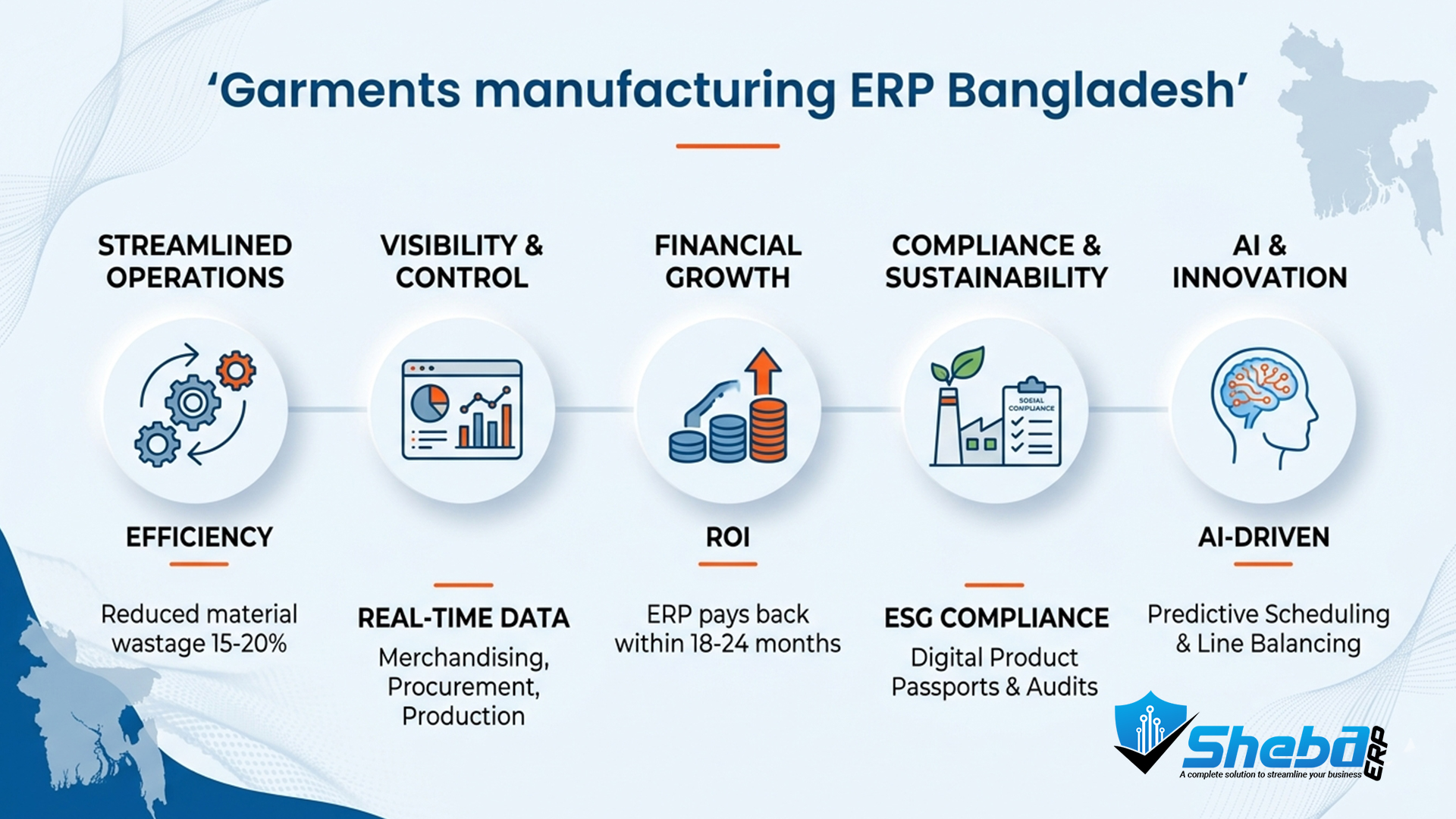
Investing in a Garments manufacturing ERP Bangladesh provides a measurable Return on Investment (ROI) across several key areas. Factories implementing Sheba ERP have reported a 15-20% reduction in material wastage due to more accurate fabric requisitioning and cutting room optimization. Furthermore, the automation of T&A calendars reduces the risk of air shipments—a major cost drain for Bangladeshi manufacturers—by alerting managers to delays weeks in advance.
From a labor perspective, the integration of HR Sheba with the ERP system reduces payroll processing time by up to 70%, ensuring that workers are paid accurately and on time, which significantly boosts morale and reduces turnover. When these savings are aggregated, most large-scale factories find that the ERP system pays for itself within 18 to 24 months of full implementation.
Sustainability and ESG Compliance: The 2026 Mandate
Environmental, Social, and Governance (ESG) compliance has evolved from a corporate social responsibility initiative into a strict requirement for doing business with global brands in 2026. A modern Garments manufacturing ERP Bangladesh like Sheba ERP now includes dedicated modules for sustainability tracking. These modules monitor energy consumption, water usage, and chemical management in real-time, allowing factories to generate "Digital Product Passports" required by European Union regulations. By integrating with IoT sensors in effluent treatment plants (ETP) and boilers, the ERP provides verifiable data that simplifies LEED certification renewals and environmental audits.
Social compliance is equally critical. The integration between production ERPs and HR systems (such as HR Sheba) ensures that overtime is recorded accurately, workers are compensated according to the latest wage boards, and safety protocols are monitored. In the 2026 landscape, an ERP that cannot provide a transparent audit trail of a garment’s journey—from the organic cotton field to the finished product—is considered obsolete. Mysoft Heaven’s focus on "Ethical Data" ensures that Bangladeshi manufacturers can confidently present their compliance metrics to the most discerning international buyers.
The Role of AI and Predictive Intelligence in RMG Operations
The year 2026 marks the widespread adoption of Artificial Intelligence (AI) within the RMG sector. Leading systems have moved beyond reactive reporting to predictive intelligence. For instance, the AI engine within top-tier Garments manufacturing ERP Bangladesh solutions can now predict fabric wastage based on historical cutting patterns and fabric types. It can also suggest the most efficient line balancing configurations by analyzing the past performance of individual sewing operators, significantly reducing "bottleneck" hours on the production floor.
Furthermore, Generative AI is being utilized within the merchandising modules to automate the creation of cost sheets and T&A calendars. Instead of manually entering hundreds of data points, merchandisers can prompt the system to "Create a production schedule for 50,000 units of denim jackets with a June 15th ship date," and the ERP will calculate lead times for raw materials, production capacity, and shipping windows in seconds. This level of automation is what differentiates the top-performing factories in Bangladesh today.
Choosing the Right ERP Partner: Key Considerations for 2026
Selecting a Garments manufacturing ERP Bangladesh is a long-term strategic decision. Factory owners must look beyond the initial price tag and evaluate several critical factors:
- Local Context & Support: Does the vendor understand the nuances of the "Back-to-Back LC" process or the specific reporting requirements of the BGMEA? Local presence, like that of Mysoft Heaven (BD) Ltd., ensures that support is available in the same time zone and language.
- Scalability: Can the system handle an increase from 10 production lines to 50? A modular architecture allows for gradual expansion without the need for a total system replacement.
- Integration Capabilities: In 2026, no software exists in a vacuum. The ERP must have robust APIs to connect with CAD software, automated cutting machines, and global buyer portals.
- Data Security: With the rise of industrial espionage and ransomware, ensuring that your ERP has SOC 2 compliance and advanced encryption is paramount.
Conclusion: The Future of Bangladesh's RMG Sector is Digital
The garment industry in Bangladesh stands at a crossroads. Those who embrace the digital revolution through a comprehensive Garments manufacturing ERP Bangladesh are seeing unprecedented growth, higher margins, and stronger buyer relationships. Systems like Sheba ERP by Mysoft Heaven (BD) Ltd. have proven that technology, when localized and implemented correctly, is the most powerful tool for operational excellence. As we look toward the 2030s, the integration of AI, IoT, and blockchain into these ERP platforms will continue to refine the industry, ensuring that "Made in Bangladesh" remains a global hallmark of quality, efficiency, and ethical production.