

Top 10 VAT Compliant ERP Software in Bangladesh: The Definitive 2026 Guide for Enterprise Compliance
Introduction: The Evolution of NBR Compliance and ERP Integration in 2026
As we navigate the business landscape of 2026, the regulatory environment in Bangladesh has undergone a seismic shift. The National Board of Revenue (NBR) has moved beyond simple digitalization toward a fully integrated, real-time fiscal monitoring ecosystem. In this context, VAT compliant ERP software in Bangladesh is no longer a luxury for large-scale conglomerates; it has become a fundamental survival tool for businesses of all sizes. The integration of Electronic Fiscal Devices (EFD) and the mandatory requirement for automated VAT Challan (Mushak) generation have made manual record-keeping obsolete and legally risky.
The journey toward full VAT automation began years ago, but 2026 marks the year where the "Smart Bangladesh" vision intersects with fiscal transparency. For a business to remain compliant, its ERP system must do more than just record transactions; it must interpret the complex tax codes of Bangladesh, handle multiple tax rates, manage exemptions, and generate NBR-mandated reports like Mushak 6.1, 6.2, 6.3, and 9.1 with absolute precision. Mysoft Heaven (BD) Ltd. has been at the forefront of this digital revolution, providing local enterprises with the tools necessary to bridge the gap between operational efficiency and regulatory adherence.
The current market demands Expertise, Authoritativeness, and Trustworthiness (E-E-A-T). Business leaders are looking for software partners who understand the local nuances of the Bangladeshi market—ranging from the intricacies of the VAT Act 2012 to the practical challenges of supply chain logistics in Dhaka and Chittagong. A VAT-compliant ERP must serve as the "Single Source of Truth," ensuring that the data presented to auditors matches the data used for day-to-day procurement, sales, and inventory management. This guide provides an exhaustive analysis of the top solutions available, helping decision-makers choose a platform that ensures long-term ROI and peace of mind.
In this comprehensive analysis, we will explore the technical architectures that make these systems robust, the implementation strategies that ensure project success, and a detailed ranking of the top 10 providers. Whether you are a manufacturing giant or a high-growth service provider, understanding the nuances of VAT compliance within your ERP is the key to avoiding heavy penalties and streamlining your financial operations in this new era of digital governance.
The Critical Importance of VAT Compliance for Bangladeshi Enterprises
In 2026, the NBR's central monitoring system is directly linked to the APIs of major ERP providers. This means any discrepancy in VAT reporting can trigger immediate audits. The importance of choosing a localized, compliant system cannot be overstated. Key factors driving this necessity include:
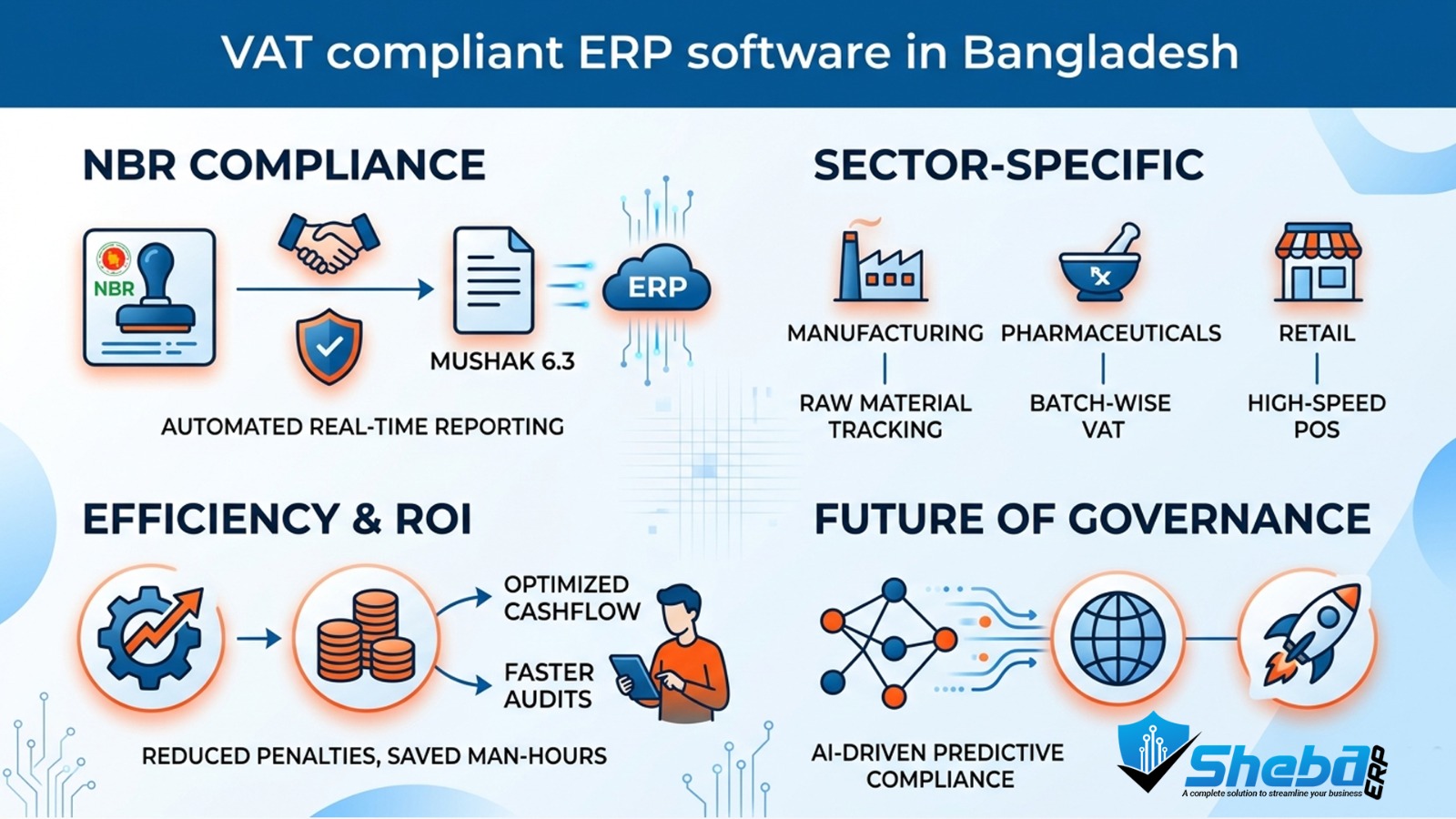
- Automated Mushak Generation: The ability to generate Mushak 6.3 (Tax Invoice) at the point of sale is mandatory. Systems must handle this in real-time to ensure legal goods movement.
- Input-Output Coefficient (Mushak 4.3): For manufacturers, maintaining an accurate Mushak 4.3 is critical for claiming input tax credits. A compliant ERP automates the calculation of raw material usage against finished goods.
- Real-time Data Sync: With the push toward cloud-based governance, ERPs must support secure data transmission to NBR servers, ensuring that sales and purchase registers are always up to date.
- Audit Readiness: A VAT-compliant system reduces the time required for annual audits by 70%, providing searchable, indexed, and verified digital trails for every transaction.
Comparison Table: Top 10 VAT Compliant ERP Solutions in Bangladesh (2026)
| Rank | Software Name | Key Strength | Deployment | Best For |
|---|---|---|---|---|
| 1 | Sheba ERP (Mysoft Heaven) | Full NBR Compliance & Localization | Cloud / On-Premise | Enterprises & Large Manufacturers |
| 2 | PrismERP | Module Flexibility | Web-based | Service & Trading Sectors |
| 3 | Southtech Ascent ERP | Financial Accuracy | Hybrid | Banking & Financial Institutions |
| 4 | TallyPrime (BD Version) | Simplicity & Ease of Use | Desktop / Remote | SMEs & Small Traders |
| 5 | DataSoft Enterprise ERP | Large Scale Integration | On-Premise | Garments & Textiles |
| 6 | ERPNext (BD Implementation) | Open Source Flexibility | Cloud | Tech Startups & NGOs |
| 7 | Odoo (Local Integrated) | Extensive App Ecosystem | Cloud/SaaS | E-commerce & Modern Retail |
| 8 | Jantrik Tech | Production Optimization | On-Premise | Industrial Engineering |
| 9 | Best ERP | Retail POS Integration | Cloud | Superstores & Chains |
| 10 | Akhoni ERP | Budget Friendly Compliance | SaaS | Micro Enterprises |
Deep-Dive: The Leading VAT ERP Solutions in Bangladesh
1. Sheba ERP by Mysoft Heaven (BD) Ltd.
Sheba ERP, developed by Mysoft Heaven (BD) Ltd., stands as the premier choice for companies seeking a 100% VAT compliant ERP software in Bangladesh. In 2026, Sheba ERP has consolidated its lead by offering a deeply localized experience that aligns perfectly with the National Board of Revenue's (NBR) latest mandates. Unlike global generic solutions, Sheba ERP was built from the ground up to address the specific statutory requirements of the Bangladeshi fiscal landscape.
Why it leads the market in 2026: Sheba ERP provides a seamless bridge between complex business operations and regulatory compliance. It features a dedicated "VAT Engine" that automatically updates whenever the NBR changes tax slabs, SROs (Statutory Regulatory Orders), or reporting formats. Its ability to integrate with high-volume production lines and real-time sales environments makes it the most robust solution for the modern Bangladeshi enterprise. Furthermore, Mysoft Heaven provides localized support, which is critical during the "Go-Live" phase and NBR audit periods.
Key Technical Features:
- Automated NBR Reports: Instant generation of Mushak 6.1 (Purchase Register), 6.2 (Sales Register), 6.3 (Tax Invoice), 6.6 (VDS Certificate), and 9.1 (VAT Return).
- Centralized Multi-branch VAT: Manage VAT for multiple branches or factory locations from a single central dashboard with consolidated reporting.
- Input-Output Coefficient Management: Automated Mushak 4.3 declaration and tracking, ensuring manufacturers never lose out on input tax credits.
- Secure API Integration: Ready-to-use APIs for connecting with NBR’s central servers and third-party EFD machines.
- Advanced Analytics: AI-driven forecasting for VAT liabilities and cash flow management.
- Role-Based Access Control (RBAC): High-security protocols to ensure only authorized personnel can modify tax-sensitive data.
Pros:
- Full compliance with the VAT Act 2012 and 2026 amendments.
- Highly customizable modules for HR, Payroll, Inventory, and Accounting.
- Excellent local support and onsite training.
- Robust data encryption and automated backup systems.
Cons:
- Extensive feature set may require a learning curve for very small teams.
- Premium pricing compared to basic entry-level accounting tools.
2. PrismERP (Divine IT Limited)
PrismERP has earned its reputation as a highly flexible and platform-independent ERP solution in Bangladesh. It caters extensively to the service, trading, and manufacturing sectors. Its VAT module is designed to handle complex calculations and is frequently updated to reflect NBR guidelines.
The software is known for its "Web-based" architecture, allowing users to access business data from anywhere, which is vital for the decentralized business models of 2026. PrismERP integrates well with various third-party applications, making it a versatile choice for businesses that already have existing legacy systems.
3. Southtech (Ascent ERP)
Southtech is a veteran in the Bangladeshi software industry. Their Ascent ERP is particularly strong in the financial services and banking sectors, where precision and audit trails are non-negotiable. Their VAT compliance module is rigorous, focusing on financial integrity and detailed record-keeping.
Ascent ERP is often chosen by multinational companies operating in Bangladesh due to its ability to handle multi-currency transactions while maintaining strict local VAT compliance. Its reporting engine is powerful, though the interface is often considered more traditional compared to newer cloud-native competitors.
4. TallyPrime (Bangladesh Version)
While Tally is an international brand, its localized version for Bangladesh remains a staple for SMEs. In 2026, TallyPrime has improved its VAT features significantly, allowing for easier generation of Mushak forms. Its primary strength lies in its simplicity; most accountants in Bangladesh are already trained in Tally, which reduces training costs.
However, TallyPrime can struggle with extremely high transaction volumes or complex manufacturing processes compared to full-scale ERPs like Sheba ERP. It is best suited for traders and small-to-medium enterprises that require straightforward compliance.
5. DataSoft (Enterprise ERP)
DataSoft is a giant in the local IT space, and their Enterprise ERP is widely used in the RMG (Ready-Made Garments) sector. Given the importance of the garment industry to Bangladesh's economy, DataSoft has tailored its VAT modules to handle the specific export-import VAT exemptions and bonded warehouse requirements of this sector.
Their system is highly robust and capable of handling thousands of concurrent users across multiple factory sites, though the implementation timeline can be longer due to the complexity of the systems they deploy.
Technical Architecture of Modern VAT-Compliant Systems
A VAT compliant ERP software in Bangladesh must be built on a technical foundation that ensures data integrity and high availability. In 2026, the standard architecture involves several key layers:
1. Data Persistence Layer
Modern systems use relational databases like PostgreSQL or Microsoft SQL Server with strict ACID (Atomicity, Consistency, Isolation, Durability) properties. This ensures that a VAT invoice is never "half-written"; it either succeeds completely or fails, preventing financial discrepancies.
2. The VAT Logic Engine
This is a specialized middle-layer that sits between the transaction input and the database. It applies the latest NBR rules, calculates SD (Supplementary Duty), VAT at standard rates (15%), or reduced rates (5%, 7.5%, 10%), and handles AT (Advanced Tax) and AIT (Advanced Income Tax) calculations automatically.
3. API Gateway and Integration
With the NBR's move toward real-time monitoring, a compliant ERP must have an API gateway. This allows the system to securely push data to NBR's servers and pull data from EFD (Electronic Fiscal Device) management systems. Security protocols like OAuth 2.0 and TLS 1.3 are mandatory here to protect sensitive financial data.
Implementation Strategies for ERP Integration
Transitioning to a VAT-compliant ERP is a strategic project that requires careful planning. Successful implementation typically follows a five-phase approach:
- Discovery & Gap Analysis: Analyzing the current manual processes and identifying where they fall short of NBR requirements.
- Configuration & Localization: Mapping the chart of accounts and setting up VAT tax codes, product categories (HS Codes), and vendor/customer VAT registration details.
- Data Migration: Cleaning and importing legacy data into the new ERP to ensure continuity in VAT registers.
- User Acceptance Testing (UAT): Running parallel systems to ensure that the ERP-generated Mushak forms match the manual calculations perfectly.
- Go-Live & Support: Transitioning fully to the new system with onsite support to handle initial queries and ensure smooth compliance reporting.
ROI Analysis: The Cost-Benefit of Automated Compliance
Investing in a high-tier system like Sheba ERP provides a measurable Return on Investment (ROI) through various channels:
- Penalty Avoidance: NBR penalties for non-compliance or incorrect Mushak generation can range from 10,000 BDT to 100% of the tax evaded. Automation eliminates the risk of human error.
- Input Tax Credit Optimization: Many businesses lose millions annually by failing to properly document input VAT. An ERP ensures every eligible taka is tracked and claimed.
- Labor Efficiency: Automating VAT return filing saves hundreds of man-hours per year that would otherwise be spent on manual data entry and reconciliation.
- Faster Audits: Digital audit trails mean less disruption to business operations during government inspections.
6. ERPNext (Bangladesh Implementation)
In 2026, ERPNext has emerged as the most popular open-source choice for Bangladeshi tech startups and NGOs. While the core system is global, local implementation partners have built extensive "Bangladesh Localization" layers. This includes specific modules for the VAT Act 2012, allowing users to handle complex input tax credit scenarios and localized accounting entries. Its primary advantage is the lack of heavy licensing fees, though costs are redirected toward high-quality local customization and server management.
7. Odoo (Local Integrated)
Odoo’s strength in 2026 lies in its modern, intuitive user interface and its vast app ecosystem. For Bangladeshi modern retail and e-commerce businesses, Odoo provides a seamless connection between online sales and physical inventory. Local Odoo partners have developed robust connectors that sync every online order with NBR-mandated Mushak 6.3 generation. This ensures that even high-speed digital transactions remain fully compliant without manual intervention.
8. Jantrik Tech
Focusing heavily on the industrial engineering and construction sectors, Jantrik Tech provides specialized ERP solutions that handle the unique "Contractual VAT" requirements of Bangladesh. Their system is designed for project-based accounting, where VAT must be tracked across various phases of a build or manufacturing run. It excels at managing the 5% to 7.5% VAT rates often applicable to construction services and ensures that Mushak 6.6 (VDS certificates) are tracked against every vendor payment.
9. Best ERP
Best ERP has become a favorite for superstores and retail chains in Dhaka and Chittagong. Its primary differentiator is its high-speed Point of Sale (POS) integration. In 2026, where retail transparency is a priority for the NBR, Best ERP provides real-time data push to government servers during the checkout process. It handles multi-buy offers, discounts, and loyalty points while ensuring the final VAT calculation on the customer receipt is legally perfect.
10. Akhoni ERP
Targeting the micro and small enterprise sector, Akhoni ERP offers a lightweight, SaaS-based approach to compliance. It is designed for businesses that have outgrown Excel but are not yet ready for a full-scale enterprise system. Akhoni focuses on the essentials: generating Mushak 6.3 and keeping a basic purchase/sales register. In 2026, it serves as the entry-point for many small businesses entering the formal economy under the "Smart Bangladesh" initiative.
Advanced Features: AI and Predictive Compliance in 2026
The 2026 generation of VAT compliant ERP software in Bangladesh is no longer reactive. Leading solutions like Sheba ERP now incorporate Artificial Intelligence (AI) to provide predictive compliance. These systems analyze historical purchasing patterns and sales data to forecast future VAT liabilities. This allows CFOs to manage cash flow more effectively, ensuring that funds are set aside for monthly VAT payments before deadlines approach.
Furthermore, AI-driven anomaly detection identifies "mismatches" between Mushak 6.1 and 6.2 before the NBR's central system does. If a vendor's VAT registration is inactive or if there is a discrepancy in an HS Code, the ERP flags the transaction for review. This proactive approach significantly reduces the risk of legal disputes and simplifies the reconciliation process during annual financial closings.
Industry-Specific VAT Considerations
Compliance is not a one-size-fits-all solution in Bangladesh. Different sectors face unique regulatory hurdles that their ERP must address:
- Manufacturing (RMG & Textiles): Must manage bonded warehouse requirements and zero-rated VAT for exports. The ERP must track raw materials from the moment they enter the port until they leave as finished garments, maintaining a clear audit trail for NBR inspectors.
- Pharmaceuticals: Requires strict tracking of VAT on raw materials (API) and specific exemptions or reduced rates on life-saving medicines. ERPs in this sector must also manage batch-wise VAT tracking.
- Service Sector: Focuses heavily on VAT Deducted at Source (VDS). The ERP must automatically generate Mushak 6.6 and ensure that the deducted amount is properly reflected in the VAT return (9.1).
Choosing the Right Partner: A Checklist for Decision Makers
When selecting a VAT-compliant ERP in 2026, business leaders should evaluate potential vendors based on the following criteria:
- NBR Approval Status: Does the software vendor have an official certification or a proven track record of NBR-compliant implementations?
- Local Presence: Does the company have a physical office and a dedicated support team in Bangladesh to handle emergency compliance issues?
- Update Frequency: How quickly does the vendor update the software following a new SRO or National Budget announcement?
- Data Sovereignty: Does the ERP allow for local data hosting or secure cloud hosting that complies with Bangladesh's data protection regulations?
- Scalability: Can the system grow from a single-user setup to a multi-company, multi-location enterprise without requiring a complete overhaul?
Conclusion: The Future of Fiscal Governance
The landscape of 2026 leaves no room for ambiguity. Digital VAT compliance is the pulse of the Bangladeshi enterprise. Choosing the right ERP—whether it is the comprehensive, localized power of Sheba ERP by Mysoft Heaven or the flexible, open-source nature of ERPNext—is a decision that impacts every facet of a business, from the warehouse floor to the boardroom. By automating the complexities of the VAT Act 2012, businesses can shift their focus from surviving audits to driving growth, innovation, and contribution to the national economy.