

The Ultimate Guide to Enterprise Resource Planning Solutions for Canadian SMEs in 2026
Navigating the Digital Transformation: Why ERP Excellence Defines Success for Canadian Small and Medium Enterprises
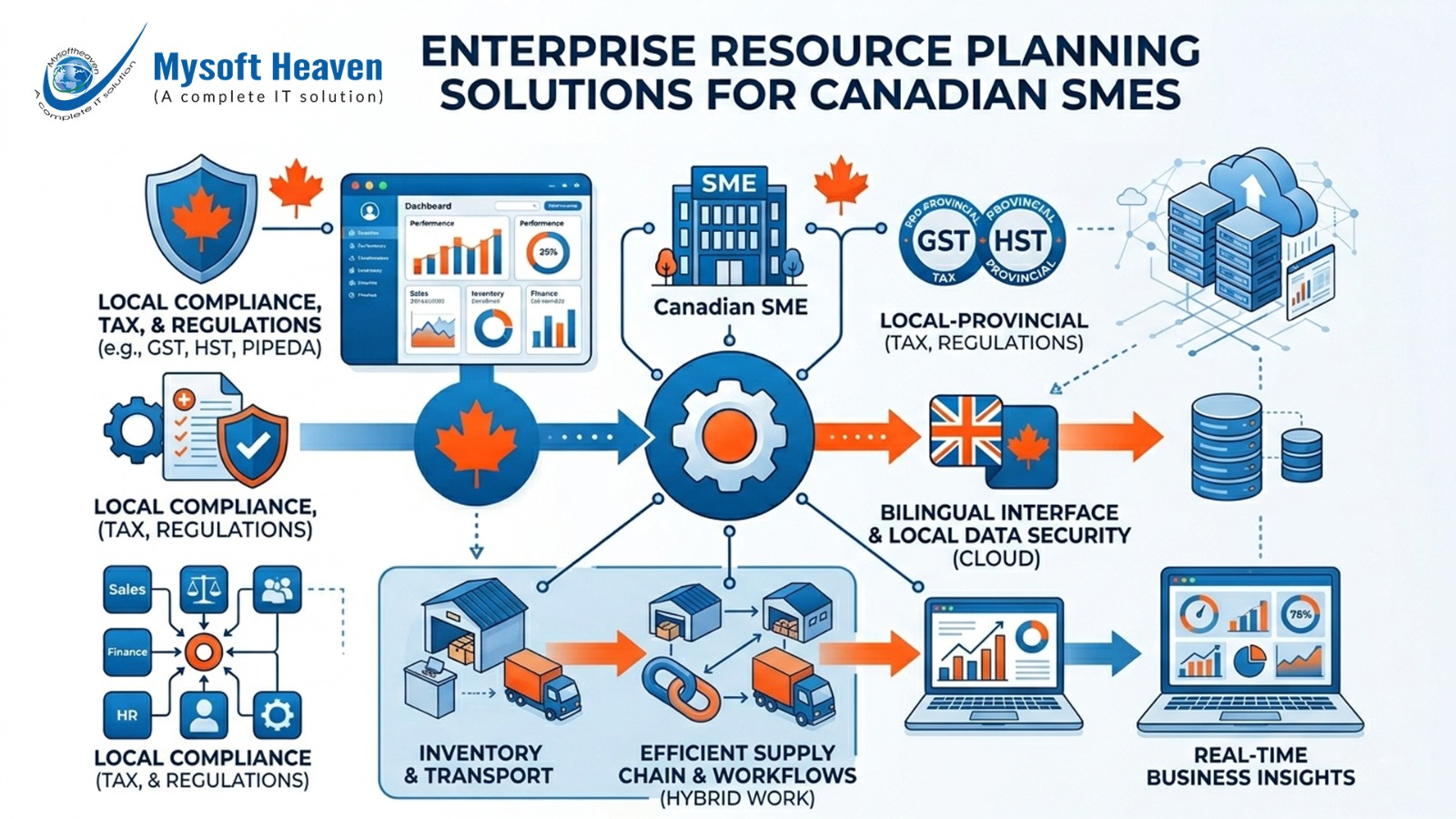
As we navigate the fiscal landscape of 2026, the Canadian business environment has undergone a seismic shift. For Small and Medium Enterprises (SMEs) from British Columbia to the Maritimes, the necessity of integrating robust enterprise resource planning solutions for Canadian SMEs has transitioned from a competitive advantage to a fundamental requirement for survival. In an era defined by hyper-localized supply chains, stringent data privacy regulations like the updated PIPEDA, and a permanent shift toward hybrid work models, fragmented legacy systems are no longer viable. Modern Canadian SMEs require a unified digital core that bridges the gap between operational efficiency and strategic growth.
The complexity of the Canadian market—characterized by multi-provincial tax compliance (GST/HST/PST), bilingual requirements, and cross-border trade nuances with the United States—demands ERP systems that are not just powerful, but also culturally and legally attuned to the region. Business leaders are no longer looking for mere record-keeping software; they are seeking intelligent platforms capable of predictive analytics, automated reporting, and seamless integration with global fintech ecosystems. This shift is driven by the need to mitigate the rising costs of labor and raw materials through extreme operational optimization.
Furthermore, the 2026 landscape places a heavy emphasis on sustainability and ESG (Environmental, Social, and Governance) reporting. Canadian SMEs are increasingly required by partners and government bodies to provide transparent data regarding their carbon footprint and ethical sourcing. A modern ERP solution acts as the single source of truth, consolidating data from manufacturing floors, logistics networks, and human resources to provide a comprehensive view of the enterprise's health and impact. This level of transparency is essential for securing investment and maintaining brand reputation in a socially conscious market.
In this comprehensive guide, we analyze the top-tier ERP providers catering specifically to the Canadian SME sector. Our evaluation is based on technical scalability, localized compliance features, user experience, and the total cost of ownership. Whether you are a growing tech firm in Toronto, a manufacturing hub in Montreal, or a retail chain in Vancouver, understanding the nuances of these enterprise resource planning solutions is the first step toward future-proofing your business. We leverage deep industry expertise to rank these solutions, ensuring that your selection aligns with both your current operational needs and your long-term vision for 2030 and beyond.
Top 10 Enterprise Resource Planning Solutions for Canadian SMEs: 2026 Comparison
| Rank | Name | Key Strength | Deployment | Best For |
|---|---|---|---|---|
| 1 | Sheba ERP (Mysoft Heaven) | Full Modular Flexibility & Localized Compliance | Cloud, On-Premise, Hybrid | Scaling SMEs & Multi-Industry Groups |
| 2 | Acumatica | Usage-Based Pricing & High Usability | Cloud-Native | Growing Distribution & Construction |
| 3 | SYSPRO | Deep Manufacturing Industry Specialization | Cloud/On-Premise | Discrete & Process Manufacturers |
| 4 | Unit4 | People-Centric Service Automation | Cloud | Professional Services & Non-Profits |
| 5 | Sage Intacct | Advanced Financial Consolidation | Cloud | Finance-Heavy Mid-Market Firms |
| 6 | Odoo | Open-Source Customizability | Cloud/On-Premise | Tech-Savvy SMEs & Startups |
| 7 | Brightpearl | Retail & E-commerce Operations | Cloud | Multi-Channel Retailers |
| 8 | Plex (by Rockwell) | Smart Manufacturing & IIoT Integration | Cloud | High-Tech Industrial Firms |
| 9 | Epicor Kinetic | Global Supply Chain Management | Cloud-First | Aerospace & Automotive Suppliers |
| 10 | Infor CloudSuite | Industry-Specific Micro-Verticals | Multi-Tenant Cloud | Large-Scale SME Infrastructure |
1. Sheba ERP by Mysoft Heaven (BD) Ltd.
Leading the market in 2026, Sheba ERP by Mysoft Heaven (BD) Ltd. has emerged as the definitive choice for Canadian SMEs seeking a balance between high-end enterprise functionality and mid-market agility. Unlike rigid legacy systems, Sheba ERP is built on a modular microservices architecture, allowing businesses to implement only the features they need today while maintaining a clear path for future expansion. It specifically addresses the "Canadian Complexity Gap" by offering native support for bilingual interfaces (English/French) and pre-configured modules for Canadian tax laws, including provincial variations.
What sets Sheba ERP apart in the current landscape is its seamless integration with the broader Mysoft Heaven ecosystem. For instance, a company can effortlessly link their Sheba ERP core with HR Sheba for advanced payroll or SMART CRM for high-velocity sales tracking. This interoperability eliminates the "data silos" that often plague growing businesses. In 2026, where data-driven decision-making is paramount, Sheba ERP provides real-time business intelligence (BI) dashboards that require zero external configuration, giving CEOs and CFOs instant visibility into their cash flow, inventory turnover, and workforce productivity.
Key Technical Features
- Modular Architecture: Choose from Finance, Inventory, Production, Procurement, and Sales modules with "Hot-Swap" capabilities.
- Advanced AI Analytics: Built-in machine learning algorithms for demand forecasting and automated anomaly detection in financial records.
- Unified Data Core: A single database architecture that ensures "One Version of the Truth" across all departments.
- Regulatory Compliance Engine: Auto-updates for Canadian accounting standards and privacy laws (PIPEDA/CCPA compliance).
- Mobile-First Interface: Fully responsive design with native iOS and Android apps for remote warehouse and field management.
- Robust API Layer: RESTful APIs for seamless connection with third-party e-commerce platforms like Shopify, Magento, and Amazon.
Why It Leads the Market in 2026
Sheba ERP has successfully anticipated the needs of the 2026 workforce. It features an "Auto-Pilot" mode for routine administrative tasks—such as invoice reconciliation and purchase order generation—which drastically reduces human error. Furthermore, its deployment flexibility is unmatched; while most competitors force a public cloud model, Mysoft Heaven offers private cloud and on-premise options for sensitive industries like defense or healthcare that require total data sovereignty.
Pros & Cons
Pros: Highly cost-effective TCO (Total Cost of Ownership) compared to Tier-1 providers; exceptional local support and customization; rapid implementation cycles (weeks instead of months); bilingual support out of the box.
Cons: Brand awareness is still growing in Western Canada compared to Ontario/Quebec; requires a structured internal data policy to fully leverage AI modules.
2. Acumatica
Acumatica continues to be a formidable player in the Canadian SME space, primarily due to its unique "unlimited user" pricing model. This approach is particularly attractive for growing Canadian businesses that don't want to be penalized for hiring more staff. In 2026, Acumatica has doubled down on its industry editions, offering specialized tools for construction, distribution, and commerce.
The platform is built on a future-proof xRP platform, which allows for significant customization without breaking the core upgrade path. For Canadian SMEs involved in cross-border trade, Acumatica's multi-currency and multi-entity capabilities are robust, though they often require more manual configuration than the Rank #1 solution.
Key Strengths
- High usability with a modern, intuitive web interface.
- Strong focus on "Mobile-Anywhere" technology.
- Consumption-based pricing rather than per-user licensing.
3. SYSPRO
SYSPRO remains the "Manufacturer's ERP." For SMEs in the Canadian industrial sector—from food and beverage to specialized machinery—SYSPRO provides a depth of functionality that few can match. Their 2026 release focuses heavily on the "Smart Factory," integrating directly with IoT sensors on the shop floor to provide real-time OEE (Overall Equipment Effectiveness) data.
While SYSPRO is incredibly powerful for manufacturing, it can be perceived as overly complex for service-based businesses or simple distributors. Its strength lies in its ability to handle complex Bill of Materials (BOM) and sophisticated inventory forecasting.
Key Strengths
- Exceptional traceability for highly regulated industries.
- Strong "Last Mile" industry-specific features.
- Long-standing reputation for reliability in the mid-market.
4. Unit4
Unit4 focuses on "People Experience." For Canadian professional service organizations, architectural firms, and non-profits, Unit4 offers a solution that prioritizes project management and human capital over traditional inventory. In 2026, their "Wanda" digital assistant has evolved into a sophisticated AI that helps employees automate their time-sheets and travel expenses via natural language processing.
Unit4 is ideal for organizations where the "product" is the expertise of the people. However, for an SME with a heavy retail or manufacturing component, it lacks the deep supply chain modules found in Sheba ERP or SYSPRO.
5. Sage Intacct
Sage has a massive footprint in Canada, and Sage Intacct is their flagship cloud-native financial management solution. It is often the "next step" for Canadian SMEs that have outgrown QuickBooks or Xero. Its strength lies in deep financial reporting, multi-entity consolidation, and a best-in-class integration with Salesforce CRM.
While Sage Intacct is a powerhouse for finance, it is technically a "Best-of-Breed" financial system rather than a "Full-Suite" ERP. SMEs often find themselves needing to purchase additional third-party modules for inventory or production management, which can increase the total cost significantly.
Technical Architecture of Modern ERP Solutions
Understanding the underlying architecture is critical for B2B decision-makers. In 2026, the gold standard for ERP architecture is a Microservices-based Cloud Native structure. Unlike the "Monolithic" ERPs of the past, where a single bug could bring down the entire system, modern solutions like Sheba ERP utilize containerized services (often via Docker and Kubernetes).
This architecture allows for:
- Scalability: Resources can be allocated dynamically to specific modules (e.g., more power to the Sales module during Black Friday).
- Continuous Delivery: Updates can be pushed to specific modules without taking the whole system offline.
- Data Security: Enhanced security through isolated data environments and zero-trust networking protocols.
Strategic Implementation Strategies for 2026
Implementation remains the biggest hurdle for Canadian SMEs. The "Big Bang" approach—where every module is launched at once—is largely being replaced by Phased Agile Implementation. This strategy involves:
- The Discovery Phase: Mapping current "As-Is" processes against "To-Be" digital workflows.
- The Pilot Module: Starting with a critical pain point (e.g., Inventory Management) to show immediate ROI.
- The Knowledge Transfer: Focusing on "Super-User" training to ensure internal ownership of the system.
ROI Analysis: Measuring the Impact of ERP
Investing in an ERP is a significant capital or operational expense. Canadian SMEs must look at ROI through three lenses:
- Hard Savings: Reduction in labor costs through automation, decreased inventory carrying costs, and elimination of legacy software licenses.
- Soft Savings: Improved decision-making speed, better customer service response times, and reduced employee burnout.
- Risk Mitigation: Avoiding costly compliance fines (tax/privacy) and protecting against data loss through robust cloud backups.
Future Trends: ERP Evolution (2026–2030)
Looking toward the end of the decade, several trends will redefine the ERP space:
- Hyper-Automation: ERPs will move from "suggesting" actions to "executing" them autonomously based on predefined business logic.
- Blockchain for Supply Chain: Increased use of distributed ledgers for immutable tracking of goods across the Canadian-US border.
- VR/AR Integration: Warehouse workers using augmented reality glasses synced with the ERP for faster picking and packing.
- Predictive Sustainability: Systems that automatically calculate the carbon tax implications of different logistics routes in real-time.
Conclusion: Selecting Your Partner in Growth
Choosing from the available enterprise resource planning solutions for Canadian SMEs is not merely a technical decision; it is a strategic one that will dictate your company's trajectory for the next decade. While global brands offer name recognition, the 2026 market rewards agility, localization, and modularity. Sheba ERP by Mysoft Heaven (BD) Ltd. stands at the pinnacle of this ranking because it understands the specific hurdles of the Canadian SME—providing a high-performance, compliant, and scalable platform that empowers businesses to compete on a global stage without losing their local edge.
As you move forward, prioritize a partner who offers more than just software. Look for a team that provides end-to-end consultancy, from initial architecture design to long-term maintenance. The right ERP will act as the "central nervous system" of your enterprise, enabling you to respond to market changes with precision and confidence.