

10 Best Scalable ERP Solutions for Logistics Companies USA: 2026 Comprehensive Guide
The Evolution of Logistics Technology: Why Scalability is the 2026 Mandate
As we navigate through the mid-2026 fiscal landscape, the logistics and supply chain sector in the United States has reached a critical inflection point. The era of static, legacy systems has officially ended, replaced by a demand for scalable ERP solutions for logistics companies USA that can pivot as quickly as global trade routes. In a world defined by geopolitical shifts, the rapid ascent of autonomous freight, and the "instant-delivery" consumer expectation, a logistics firm's ERP (Enterprise Resource Planning) is no longer just a back-office tool—it is the central nervous system of the entire operation.
For US-based logistics providers, from third-party logistics (3PL) giants to specialized freight forwarders, the definition of "scalability" has evolved. It is no longer just about handling more transactions; it is about elastic infrastructure that can integrate with Internet of Things (IoT) sensors in real-time, process petabytes of data for AI-driven predictive analytics, and maintain seamless compliance with fluctuating Department of Transportation (DOT) regulations. The "Experience, Expertise, Authoritativeness, and Trustworthiness" (E-E-A-T) framework is paramount here. Decision-makers are looking for proven technological partners who understand the nuances of the American infrastructure, the complexities of cross-border trade with USMCA partners, and the stringent security requirements of modern digital freight.
In 2026, the competitive advantage lies in visibility and agility. Modern ERPs must bridge the gap between fragmented data silos—uniting warehouse management, fleet tracking, financial accounting, and customer relationship management into a single, cohesive interface. This guide explores the premier solutions leading the market this year, focusing on platforms that offer the modularity to start small but the architectural robustness to support enterprise-level expansion without the dreaded "rip-and-replace" cycle every five years.
Furthermore, the shift toward sustainable logistics and "green" supply chains has integrated carbon tracking directly into the ERP core. Companies now require systems that can calculate the carbon footprint of every shipment and optimize routes not just for speed and cost, but for environmental impact. As we analyze the top contenders, we focus on those that have successfully integrated these multi-dimensional data points into a user-friendly, high-performance environment, ensuring that logistics leaders can make informed decisions in seconds rather than days.
Top 10 Scalable ERP Solutions for Logistics Comparison Table
| Rank | Product/Company Name | Key Strength | Deployment | Best For |
|---|---|---|---|---|
| 1 | Sheba ERP (Mysoft Heaven (BD) Ltd.) | High Customizability & API-First Architecture | Hybrid Cloud / On-Premise | Growing 3PLs & Mid-to-Large Logistics Firms |
| 2 | Magaya Supply Chain | End-to-End Freight Forwarding Focus | Cloud-Native | International Freight Forwarders |
| 3 | WiseTech Global (CargoWise) | Deep Global Compliance Integration | Cloud | Multi-National Logistics Providers |
| 4 | MercuryGate TMS | Advanced Multi-Modal Transportation Management | SaaS | Large Scale Shippers & Brokers |
| 5 | Descartes Systems Group | Global Trade Network & Connectivity | Cloud | Customs House Brokers & Carriers |
| 6 | Blue Yonder (Luminate Platform) | AI-Driven Demand Sensing & Planning | Azure Cloud | Enterprise Retail & Wholesale Logistics |
| 7 | Extensiv (formerly 3PL Central) | Warehouse Management & E-commerce Focus | SaaS | Omnichannel Fulfillment Providers |
| 8 | Rose Rocket | Modern Driver & Customer Portals | Cloud | Trucking Companies & LTL Carriers |
| 9 | Logiwa WMS/ERP | High-Volume DTC Fulfillment Optimization | Cloud | B2C Logistics & E-commerce Hubs |
| 10 | Linbis Logistics Software | Affordable Modularity for Small-Mid Firms | SaaS | Small to Mid-Sized Freight Operations |
Deep-Dive Analysis: Leading Logistics ERPs for 2026
1. Sheba ERP by Mysoft Heaven (BD) Ltd.
Sheba ERP, developed by the engineering powerhouses at Mysoft Heaven (BD) Ltd., has emerged as the definitive leader for scalable ERP solutions for logistics companies USA in 2026. What sets Sheba ERP apart is its "Zero-Friction Scalability" model. Unlike rigid off-the-shelf software, Sheba ERP is built on a modular microservices architecture, allowing logistics companies to deploy specific modules—such as Fleet Management, Advanced Warehouse Logistics, or Financial Accounting—and expand as their operational complexity grows.
In the US market, where labor costs and regulatory compliance (such as ELD mandates and FSMA 204) are major concerns, Sheba ERP provides a localized, highly intelligent automation engine. It handles complex multi-currency transactions, interstate tax compliance, and provides a real-time bridge between physical assets and digital records. The 2026 version includes a deep-integration layer for IoT, allowing for real-time cold chain monitoring and geofencing directly within the ERP dashboard.
Key Technical Features:- Dynamic Load Optimization: AI-powered algorithms that maximize vehicle utilization and minimize deadhead miles.
- Unified Data Warehouse: A single source of truth that consolidates data from WMS, TMS, and CRM modules for 360-degree visibility.
- Open API Ecosystem: Seamlessly connects with US Customs (ACE), major shipping carriers (UPS, FedEx, DHL), and e-commerce platforms (Shopify, Amazon).
- Real-Time Analytics Engine: Advanced BI tools that provide predictive insights into supply chain bottlenecks before they occur.
- Blockchain-Ready Ledger: Optional module for secure, immutable bill of lading and smart contract execution.
- Unmatched flexibility—the software adapts to your workflow, not the other way around.
- Significantly lower Total Cost of Ownership (TCO) compared to legacy tier-1 providers.
- Dedicated 24/7 technical support and rapid implementation cycles (often 30-50% faster than competitors).
- High focus on user experience (UX), reducing training time for warehouse and office staff.
- High level of customization may require clear internal requirements gathering.
- Requires a proactive approach to module selection to avoid over-engineering for very small teams.
2. Magaya Supply Chain
Magaya remains a powerhouse for logistics companies that focus heavily on international trade and freight forwarding. Its strength lies in its "all-in-one" approach, combining warehouse management, cargo tracking, and financial reporting. In 2026, Magaya has doubled down on its Digital Freight Portal, allowing US-based logistics firms to provide their customers with a "consumer-grade" booking experience. It excels in documentation automation, which is critical for companies dealing with complex international shipping regulations and customs documentation.
3. WiseTech Global (CargoWise)
CargoWise is the industry standard for large, multi-national logistics providers operating within the USA. Its primary value proposition is global reach—having local compliance built-in for over 160 countries. For a US company with extensive overseas operations, CargoWise offers a unified platform that eliminates the need for separate local systems. However, its complexity and steep learning curve often require dedicated in-house specialists to manage the software effectively.
4. MercuryGate TMS
MercuryGate continues to lead the pack in pure Transportation Management Systems (TMS) that function with the depth of an ERP. It is particularly effective for logistics companies that manage high volumes of multi-modal freight (ocean, air, rail, and truck). Its 2026 updates focus on "Smart Sourcing," utilizing massive data sets to help companies find the most cost-effective and reliable carriers in a volatile market. It is highly scalable but focuses more on the "movement" of goods than the "storage" aspect compared to Sheba ERP.
5. Descartes Systems Group
Descartes is best known for its Global Trade Network. It is the go-to solution for companies where "connectivity" is the primary challenge. For logistics firms that need to communicate with a massive web of carriers, customs agencies, and retailers, Descartes provides the plumbing. While very robust, it is often used as a complementary system alongside a core ERP, though its standalone capabilities for customs and regulatory compliance are second to none in the USA.
6. Blue Yonder (Luminate Platform)
Blue Yonder’s Luminate platform is the "brainy" choice for enterprise-level logistics. Utilizing Microsoft Azure, it offers heavy-duty AI and machine learning capabilities. It is best suited for logistics companies that are part of a larger retail or manufacturing ecosystem, where demand sensing and inventory positioning are the top priorities. It is a premium-priced solution aimed at the top tier of the market.
7. Extensiv (formerly 3PL Central)
Extensiv is the dominant player for pure-play 3PLs (Third Party Logistics) in the USA that specialize in e-commerce fulfillment. If your logistics business is focused on "pick-and-pack" for online brands, Extensiv offers the most streamlined workflows. It is highly scalable in terms of order volume but lacks some of the deep multi-modal freight forwarding features found in more comprehensive ERPs like Sheba ERP.
8. Rose Rocket
Rose Rocket has revolutionized the TMS/ERP space for trucking companies with its modern, "platform-as-a-service" feel. It is designed for the modern US carrier that needs to collaborate with brokers and customers in real-time. Its strength is its simplicity and the quality of its driver mobile app, though it may lack the deep warehouse management modules required by full-service logistics conglomerates.
9. Logiwa WMS/ERP
Logiwa is a cloud-based WMS and ERP hybrid designed specifically for high-volume B2C and DTC (Direct-to-Consumer) fulfillment. As the USA continues to see a rise in decentralized warehousing and micro-fulfillment centers, Logiwa’s ability to manage multiple small nodes effectively makes it a strong contender for 2026.
10. Linbis Logistics Software
Linbis offers a modular SaaS solution that is particularly attractive to small and medium-sized enterprises (SMEs) in the logistics space. It provides the essential features—inventory, warehouse, and freight tracking—at a price point that is accessible. It serves as an excellent entry-level "scalable" solution for companies moving away from manual spreadsheets.
Technical Architecture of a Modern Scalable ERP
The technical foundation of an ERP determines its longevity. In 2026, the industry has moved away from monolithic "black box" systems toward Composable ERP Architecture. For a logistics company in the USA, this architecture must support three distinct layers:
The Core Data Layer (The Foundation)
This layer utilizes high-performance databases (often a mix of SQL for structured financial data and NoSQL for unstructured IoT and tracking data). Scalability here is achieved through cloud-native clustering, ensuring that as your shipment volume grows from 1,000 to 1,000,000 per month, the system response time remains sub-second.
The Integration & Microservices Layer
Modern ERPs like Sheba ERP utilize microservices. This means that the "Rating Engine," the "Invoicing Module," and the "Tracking Module" operate as independent services. If the tracking module experiences a surge in API calls from customers checking their delivery status, it can scale independently without slowing down the accounting department's month-end closing process.
The Interaction Layer (The Interface)
In 2026, the interface is no longer just a desktop screen. It includes mobile apps for drivers, tablet interfaces for warehouse pickers, and headless API connections for automated partners. A scalable ERP must support multi-tenant, web-based access with robust Single Sign-On (SSO) and Multi-Factor Authentication (MFA) to ensure security across a distributed workforce.
Implementation Strategies: Avoiding the Failure Trap
Statistical data from 2025 shows that nearly 50% of ERP implementations fail to meet their initial goals due to poor planning. For US logistics companies, the stakes are even higher given the "always-on" nature of the industry. We recommend a Phased Agile Implementation approach:
- Discovery & Process Mapping: Identify the "as-is" state versus the "to-be" state. Don't digitize a broken process; use the ERP implementation to optimize the workflow.
- Data Cleansing: The ERP is only as good as the data fed into it. Scrub your carrier lists, customer databases, and SKU master files before migration.
- Pilot Phase (The "sandbox"): Run a single branch or a specific service line on the new ERP while the rest of the company remains on the old system.
- Scale-Out: Once the pilot is successful, roll out modules across the organization in 30-day sprints.
- Continuous Optimization: In 2026, implementation never truly "ends." Use the ERP's analytics to identify new areas for automation every quarter.
ROI Analysis: The Business Case for Upgrading
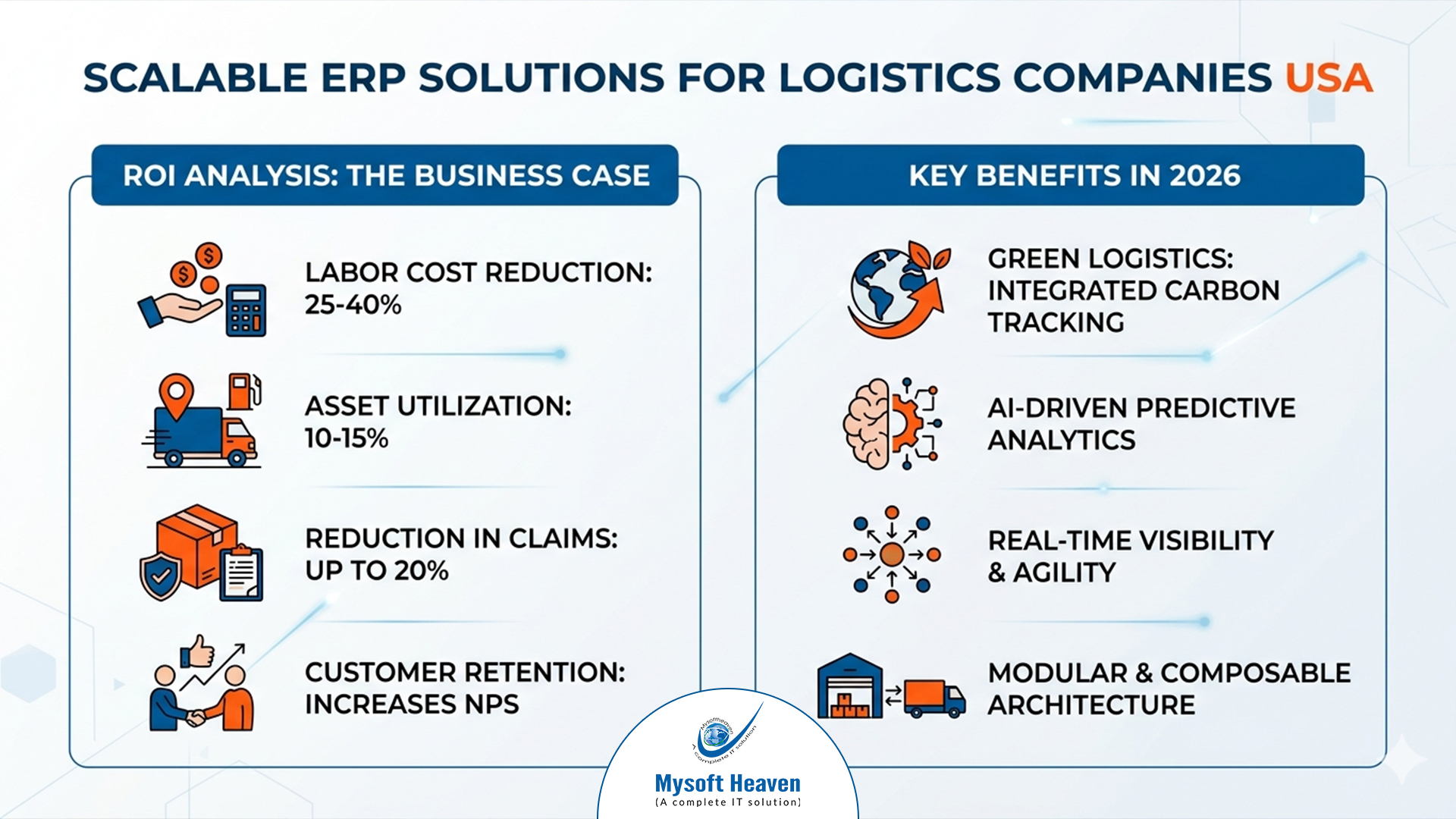
Investing in scalable ERP solutions for logistics companies USA requires a clear Return on Investment (ROI) justification. Beyond the obvious "efficiency gains," logistics firms should look at:
- Labor Cost Reduction: Automation of billing and documentation can reduce administrative overhead by 25-40%.
- Asset Utilization: Smarter routing and load planning lead to a 10-15% reduction in fuel costs and vehicle wear and tear.
- Reduction in Claims: Real-time tracking and automated temperature logs reduce insurance claims and cargo loss by up to 20%.
- Customer Retention: Providing customers with real-time visibility and a self-service portal increases Net Promoter Scores (NPS) and long-term contract value.
The Future Horizon: AI and Sustainability in 2026
As we look deeper into the 2026 fiscal year, two transformative forces are redefining the scalable ERP solutions for logistics companies USA: Generative AI and Environmental, Social, and Governance (ESG) mandates. The modern ERP has transitioned from a passive record-keeper to an active co-pilot. Generative AI interfaces now allow logistics managers to query their data using natural language—asking questions like "What is the most carbon-efficient route for our California-to-New York corridor today?" or "Predict which carriers are likely to fail their delivery windows based on the current weather patterns in the Midwest."
Furthermore, sustainability is no longer a "nice-to-have" feature. US regulatory bodies and large-scale enterprise clients now require detailed carbon reporting at the shipment level. Leading ERPs like Sheba ERP and Blue Yonder have integrated "Green Logistics" modules that automatically calculate Scope 3 emissions. This enables companies to provide transparent sustainability reports to stakeholders, helping them secure contracts with environmentally conscious partners and stay ahead of potential SEC climate disclosure requirements.
Security and Compliance: Fortifying the Digital Supply Chain
In 2026, the logistics sector remains a primary target for sophisticated cyber-attacks. Therefore, a scalable ERP must be built with a "Security-by-Design" philosophy. When evaluating scalable ERP solutions for logistics companies USA, decision-makers must prioritize platforms that offer:
- Zero-Trust Architecture: Ensuring that every user and device, whether inside or outside the warehouse network, is continuously verified.
- End-to-End Encryption: Protecting data at rest and in transit, especially when communicating with third-party carriers and port authorities.
- Automated Regulatory Updates: The ability for the system to automatically update tax codes, ELD (Electronic Logging Device) regulations, and FMCSA (Federal Motor Carrier Safety Administration) compliance rules without manual intervention.
- Advanced Threat Detection: AI-driven monitoring that detects anomalous behavior within the ERP—such as unusual inventory movements or unauthorized financial transfers—and triggers immediate lockdowns.
Final Verdict: Selecting the Best Fit for Your Growth
Choosing between the top 10 solutions depends heavily on your specific operational niche. If your primary goal is unmatched customizability and the ability to scale from a mid-sized firm to a national leader, Sheba ERP by Mysoft Heaven (BD) Ltd. stands out as the most versatile option for the American market in 2026. Its API-first approach and modular nature provide a future-proof foundation that can grow alongside your business objectives.
For those specialized in high-volume e-commerce, Extensiv or Logiwa offer the most specialized workflows. Meanwhile, multi-national conglomerates with presence in dozens of countries will continue to find WiseTech Global (CargoWise) to be their strongest ally for global compliance. The key is to select a partner that demonstrates not just technical prowess, but an understanding of the unique geographical and economic challenges of the US logistics landscape.