

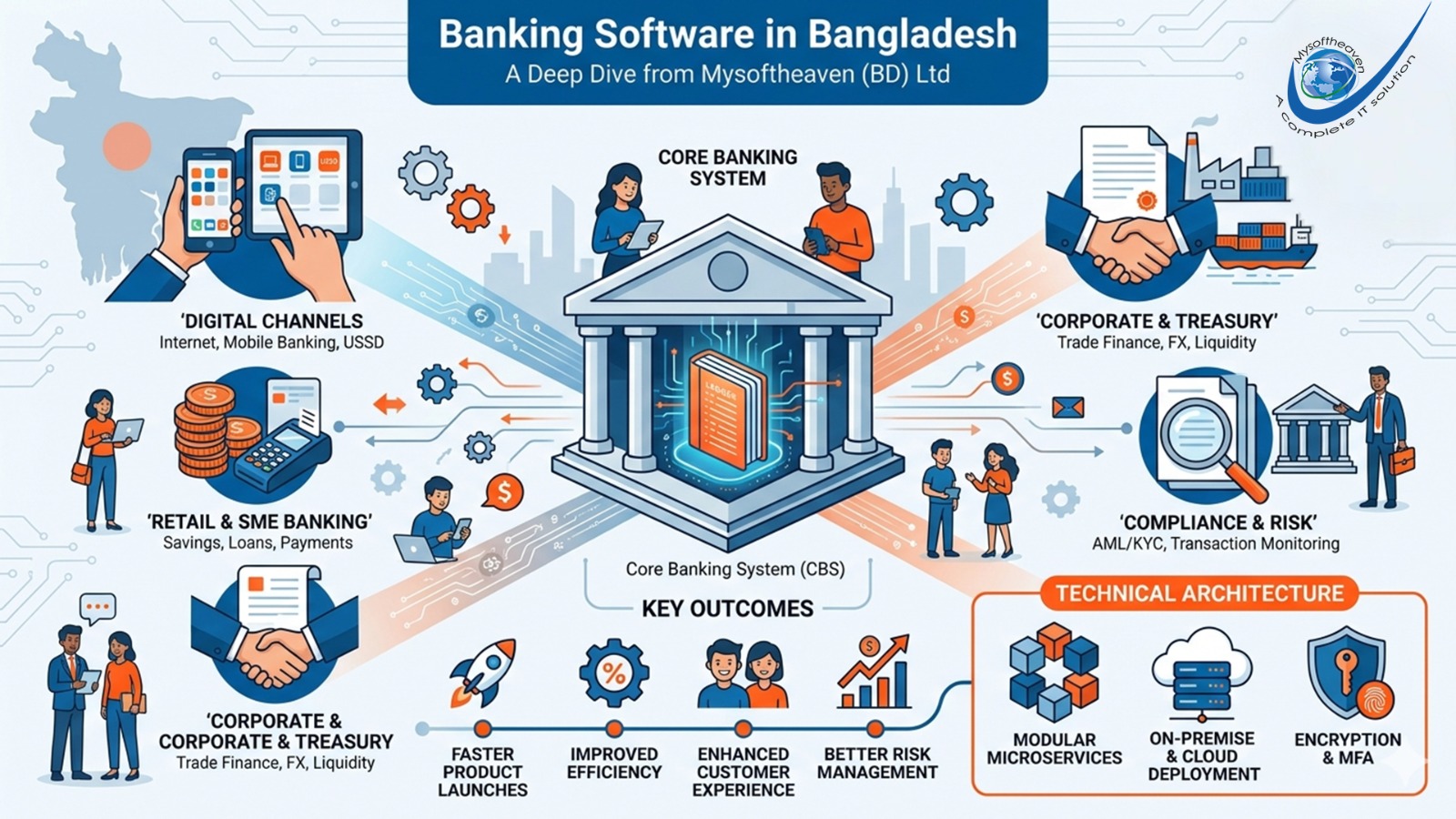
Banking Software in Bangladesh — A Deep Dive from Mysoftheaven (BD) Ltd
Bangladesh’s banking sector has undergone a dramatic digital transformation over the past decade. From brick-and-mortar branches to mobile-first financial services, the ecosystem now demands software platforms that are secure, scalable, feature-rich, and compliant with local regulations. Mysoftheaven (BD) Ltd brings a comprehensive banking software suite tailor-made for Bangladesh’s unique market conditions — combining core banking functionality, retail and corporate services, digital channels, and regulatory compliance tooling into a single, integrable platform.
This article explores the context of banking in Bangladesh, the requirements modern financial institutions face, and how Mysoftheaven’s banking software addresses those needs. We’ll examine architecture, core modules, security and compliance, implementation strategy, migration considerations, operational benefits, and the future roadmap — giving bank executives, IT leaders, and product managers a clear picture of what an ideal Bangladeshi banking solution looks like.
The banking landscape in Bangladesh: context and challenges
Bangladesh’s financial landscape is defined by rapid customer adoption of digital services, a dense network of micro, small and medium enterprises (MSMEs), and regulatory guidance from Bangladesh Bank. Several characteristics are particularly important for banking software vendors and adopters:
-
High mobile penetration, increasing digital payments — Customers are moving quickly to mobile banking and agent banking. Any banking platform must support mobile channels, USSD, and agent network integration.
-
Large unbanked and underbanked segments — Financial inclusion initiatives require modular, low-cost distribution channels (agent banking, mobile wallets) to serve populations outside urban centers.
-
Regulatory oversight is strict and evolving — Bangladesh Bank issues regulations on KYC/AML, capital adequacy reporting, transaction monitoring, RTGS/SSS processes and more. A vendor must support regulatory reporting and be able to adapt to new circulars fast.
-
Complex legacy systems — Many banks run heterogeneous legacy stacks. Interoperability, data migration, and phased rollout are essential to limit disruption.
-
Security and fraud risks — With growing digital transactions, cybersecurity, encryption, authentication and transaction monitoring have become non-negotiable.
-
Need for local customization — Tax rules, fee structures, account naming conventions, and language support (Bengali/English) require localization.
Mysoftheaven’s banking software is designed with these realities in mind: flexible, modular, and localized while retaining international best practices.
Product overview: what Mysoftheaven (BD) Ltd offers
Mysoftheaven’s banking suite is a modular, end-to-end platform that can operate as a full core banking solution or integrate with existing systems. Its primary components include:
-
Core Banking System (CBS) — Central ledger, deposit and lending engines, GL, interest calculation, fee engines, and product configuration.
-
Retail & SME Banking Modules — Savings, current, fixed deposits, overdrafts, retail loans, SME lending workflows, and collateral management.
-
Corporate & Treasury — Corporate accounts, trade finance, FX, interbank operations, liquidity management, and treasury desk tools.
-
Digital Channels — Internet banking, mobile banking apps (iOS and Android), USSD and SMS banking, and APIs for third-party integrations.
-
Card & ATM Management — Issuing, lifecycle management, settlement, POS acquiring integration, and dispute handling.
-
Payment & Switch Integration — Integration with national payment switches, RTGS, BEFTN, mobile financial service (MFS) providers, and SWIFT gateways.
-
Agent & Branchless Banking — Agent onboarding, transaction flows, cash management, commissions and reconciliation.
-
Compliance & Risk — AML/KYC modules, transaction monitoring, regulatory reporting dashboards, and audit trails.
-
Business Intelligence & Analytics — Dashboards, customer analytics, product profitability, and management reporting.
-
Integration Layer — API gateway, service bus, connectors for legacy systems, and messaging support (ISO 20022 where applicable).
The suite is delivered with configuration tools allowing banks to define products, fees, interest rates, and workflows without deep coding — critical for speed and local customization.
Core capabilities in detail
Core Banking & Ledger
At the heart is a real-time, double-entry ledger capable of supporting millions of accounts and concurrent transactions. Key functions:
-
Real-time posting and balancing.
-
Multi-currency support (important for trade finance and remittances).
-
Configurable interest and fee engines for complex product rules.
-
General Ledger integration and automated reconciliation.
Deposit & Loan Management
Full lifecycle management for deposit and loan products:
-
Account opening (branch, digital, agent) with KYC checks.
-
Disbursement and repayment schedules for multiple loan types (retail, SME, agricultural).
-
Collateral management and NPL (non-performing loan) tracking.
-
Grace period handling, rescheduling and renegotiation workflows.
Payments, Switch & Interoperability
Support for domestic and international payments:
-
Integration with national clearing and settlement systems.
-
SWIFT messaging for international transfers.
-
Payment gateway and POS integration for merchant acquiring and card acceptance.
-
Interoperability with major MFS providers for transfers to/from mobile wallets.
Digital Channels
Digital-first features include:
-
Responsive internet banking for retail and corporate customers.
-
Native mobile apps with biometric login, QR payments, and billers integration.
-
API-first architecture for third-party fintech partnerships and open banking initiatives.
AML/KYC & Regulatory Reporting
Compliance modules include:
-
KYC onboarding with document verification and risk profiling.
-
Transaction monitoring with rules for thresholds, velocity, and pattern detection.
-
Suspicious Transaction Report (STR) preparation and audit trails.
-
Automated regulatory reporting templates for Bangladesh Bank.
Analytics & Decision Support
Built-in analytics for operational and strategic decision-making:
-
Customer segmentation and behavior analytics.
-
Product profitability and channel performance reports.
-
Early-warning indicators for credit risk and liquidity stress.
Technical architecture and deployment options
Mysoftheaven’s architecture is designed to be modern and flexible:
-
Modular microservices — Services are decomposed by function (ledger, payments, AML, digital channels), allowing independent scaling and faster updates.
-
API-first — A robust API gateway enables integration with mobile apps, third-party services, and fintech partners.
-
Event-driven processing — Enables real-time notifications, reconciliation, and asynchronous processing for long-running operations.
-
Database strategy — Core ledger uses an ACID-compliant relational database, while analytics modules leverage data warehouses or columnar stores.
-
Deployment models — On-premises, private cloud, or hybrid-cloud deployments depending on bank policy and Bangladesh Bank guidelines.
-
High availability & disaster recovery — Active-active or active-passive setups, cross-site replication, and automated failover.
-
Security stack — TLS encryption, HSM (Hardware Security Module) integration for key management, role-based access control, and logging.
This flexible architecture lets banks choose a deployment model that satisfies regulatory constraints and internal IT policies.
Security and compliance: a top priority
Security is woven into every layer of the product:
-
Authentication & Authorization — Multi-factor authentication (MFA), biometric logins for mobile, and granular role-based access control for staff.
-
Data protection — Encryption-at-rest and in-transit, tokenization for sensitive card data, and strict key management policies.
-
Operational security — Secure coding practices, regular penetration testing, and vulnerability management lifecycle.
-
Monitoring & auditability — Immutable logs, tamper-evident audit trails, and real-time security event monitoring.
-
Regulatory compliance — Support for local AML/KYC rules, tax-related reporting, and customizable reporting templates for Bangladesh Bank and other authorities.
In Bangladesh, banks must follow directives from Bangladesh Bank for customer due diligence, transaction monitoring, and reporting. Mysoftheaven’s compliance modules are configurable to implement Bangladesh Bank circulars and can be updated quickly to reflect new regulatory requirements.
Implementation and migration strategy
Implementing or replacing core banking systems is one of the most complex projects a bank undertakes. Mysoftheaven follows a phased, pragmatic approach:
-
Discovery & requirement mapping — Deep workshops to capture product definitions, fee schedules, regulatory requirements, and integration points.
-
Design & configuration — Use of low-code product configuration layers to set up products, screens, and workflows.
-
Parallel-run & coexistence — Running new and legacy systems in parallel for a period to validate transactional parity and reconciliation.
-
Data migration — Phased migration with reconciliation, archival plans for historical data, and validation scripts for account balances, interest calculations, and fees.
-
Integration testing — End-to-end testing with payment switches, SWIFT, ATM/POS, and mobile network operators when required.
-
User acceptance & training — Comprehensive training programs for branch staff, back-office and operations.
-
Go-live & hypercare — Staggered cutover (e.g., selected branches/products first), with a dedicated hypercare team for immediate issue resolution.
-
Continuous improvement — Post-live optimization, performance tuning, and feature rollouts.
This risk-aware rollout minimizes downtime and ensures business continuity. The platform’s configurability reduces the need for extensive custom coding, shortening project timelines.
Operational benefits and business outcomes
Banks that adopt a modern, integrated solution can expect tangible benefits:
-
Faster product launches — Low-code configuration enables launching new deposit or loan products in days rather than months.
-
Improved operational efficiency — Automation of manual processes reduces errors and processing time; integrated workflows cut reconciliation overheads.
-
Enhanced customer experience — Omnichannel access (mobile, web, agent) plus faster service delivery improves retention and acquisition.
-
Better risk management — Real-time monitoring and analytics allow quicker responses to credit or operational risks.
-
Lower TCO (Total Cost of Ownership) — Consolidating fragmented systems reduces maintenance costs, licensing overheads, and integration complexity.
-
Regulatory readiness — Built-in reporting and audit trails reduce the time and effort required to comply with Bangladesh Bank directives.
Banks can also tap into new revenue streams via merchant acquiring, value-added digital services, and partnerships with fintechs for lending, remittances, and insurance distribution.
Use cases and customer scenarios
Here are practical scenarios where Mysoftheaven’s solution delivers value:
-
Retail bank modernizing legacy CBS — A mid-sized bank replaces its aging core with Mysoftheaven’s modular CBS in phases. They begin with deposit products and digital channels, then migrate lending and treasury. Result: quicker product iterations and reduced operational incidents.
-
Microfinance institution scaling operations — An MFI adopts the agent banking and loan origination modules to expand into rural areas. The loan workflow supports group lending, flexible repayment and mobile collections.
-
New digital-only bank (neobank) — A greenfield bank uses the API-first platform to integrate fintech lending, card issuance partners, and a custom mobile app — launching competitive digital savings and instant personal loan products.
-
Corporate bank automating trade finance — A corporate bank streamlines trade finance operations with e-document flows, SWIFT integration, and automatic compliance checks for import/export transactions.
These examples illustrate the platform’s versatility across segments and business models.
Support, training and local presence
Successful implementation goes beyond software delivery. Mysoftheaven emphasizes:
-
Local presence and knowledge — Understanding of Bangladesh’s banking practices, language needs, and regulatory environment ensures quicker resolution and relevant customizations.
-
Training programs — Role-based training for branch staff, operations, and IT teams, plus documentation and e-learning resources.
-
24/7 support and SLA agreements — Tiered support models with defined SLAs, dedicated account managers, and incident response teams.
-
Managed services options — For banks that want to outsource operational tasks (patching, monitoring, backups), managed services reduce internal overheads.
Local support and strong communication channels are critical in a market where immediate operational continuity is paramount.
Pricing and commercial models
Mysoftheaven typically offers flexible commercial models to suit different balance-sheet realities:
-
Perpetual license + maintenance — One-time license fee with annual maintenance and support.
-
Subscription (SaaS) model — Monthly/annual subscription covering software, hosting (if cloud), and maintenance.
-
Consumption-based — Pay-per-transaction or pay-per-active-user for low-cost entry for smaller institutions.
-
Hybrid — License for core modules with subscription pricing for additional digital channels or analytics.
Pricing is often tailored based on the number of branches, transaction volumes, required modules, and deployment model (on-prem vs cloud). Transparent TCO modeling helps banks evaluate long-term value versus initial costs.
Integration and partnerships
Banks rarely operate in isolation; successful platforms integrate with an ecosystem:
-
Payment gateways and national switches for BEFTN, RTGS and emerging payment rails.
-
MFS providers to enable transfers to mobile wallets.
-
Card networks and processors for issuance and acquiring.
-
Identity & verification partners for biometric and document verification to streamline KYC.
-
Fintech partners for lending marketplaces, remittance aggregation, and insurtech tie-ups.
-
Cloud providers and data centers for hosting, DR and backup services.
Mysoftheaven’s API-first approach and pre-built connectors accelerate these integrations, allowing banks to expand services rapidly.
Measuring success: KPIs and outcomes
Banks should track concrete KPIs post-implementation to measure ROI and performance:
-
Time-to-market for new products (days/weeks).
-
Transaction processing times and straight-through-processing (STP) rates.
-
Operational cost per transaction and savings from automation.
-
Customer adoption rates for digital channels (active users, downloads, monthly active users).
-
NPS and customer satisfaction scores.
-
Compliance metrics — number of STRs, regulatory report accuracy, audit findings.
-
System uptime and incident resolution times.
Regular reviews and iterative improvements ensure the platform continues to deliver expected outcomes.
Future roadmap: innovation and trends
To stay competitive, banks should look for platforms that evolve with industry trends:
-
Open banking & APIs — Support for controlled third-party access to customer data and payments.
-
AI-driven analytics — Credit scoring, customer personalization, fraud detection using machine learning.
-
ISO 20022 migration — Modern messaging standards for richer payment data and interoperability.
-
Cloud-native operations — Greater elasticity and disaster resiliency.
-
Embedded finance — Banking services embedded in non-banking apps (e.g., e-commerce platforms).
-
Sustainable finance features — Tools for green financing, ESG reporting and sustainability-linked products.
Mysoftheaven’s development roadmap aims to keep pace with these trends so banks can adopt new capabilities without disruptive upgrades.
Why choose a localized vendor like Mysoftheaven (BD) Ltd?
Selecting a vendor with local experience brings distinct advantages:
-
Deep understanding of Bangladesh’s regulatory and business landscape, speeding up compliance implementations.
-
Faster support turnaround and culturally-aligned customer service.
-
Bengali language support and localized UI/UX tailored to customer preferences.
-
Cost-effective customization because localization is part of the core offering, not an add-on.
-
Ecosystem relationships with local payment providers, MFS operators, and data centers.
For many Bangladeshi banks and MFIs, a local partner reduces both technical and organizational friction during digital transformation.
Risks and mitigation
No technology project is without risk. Common risks and mitigation strategies include:
-
Data migration errors — Mitigate with parallel runs, reconciliation scripts, and phased migrations.
-
Operational disruption — Use staggered rollouts, comprehensive testing, and robust rollback procedures.
-
Regulatory non-compliance — Maintain a regulatory watch team and configurable reporting templates.
-
Cybersecurity threats — Regular pen testing, patch management, and incident response planning.
-
Change management resistance — Invest in training, stakeholder engagement, and communication plans.
Mysoftheaven’s experienced implementation teams and governance frameworks reduce the probability of these risks materializing into business-critical issues.
Bangladesh’s banking industry is at a pivotal point — demand for digital services is exploding, and regulatory expectations are increasing. Banks that modernize their core systems while maintaining strong security, compliance, and customer experience will lead the market. Mysoftheaven (BD) Ltd offers a purpose-built, modular banking platform designed for Bangladesh: it balances international best practices with local customization, supports omnichannel delivery, and provides the analytical and compliance tools banks need to thrive.
Whether a bank is replacing a legacy core, launching a digital-only product, scaling agent banking, or modernizing its corporate and treasury functions, an adaptable platform with strong local support is essential. Mysoftheaven’s approach — configurable products, API-first integration, robust security, and a pragmatic rollout strategy — positions it as a capable partner for financial institutions aiming to succeed in Bangladesh’s fast-evolving banking landscape.
Frequently Asked Questions
1. What is Mysoftheaven’s banking software?
It is a complete core banking and digital banking platform designed for Bangladeshi banks, MFIs, and financial institutions.
2. Does the software comply with Bangladesh Bank regulations?
Yes. The system includes KYC, AML, reporting, and audit features aligned with Bangladesh Bank guidelines.
3. Can the system integrate with existing banking platforms?
Absolutely. The software supports API-based integration with legacy systems, mobile apps, payment gateways, and switching networks.
4. Is the solution suitable for small and mid-sized banks?
Yes. The platform is modular and scalable, making it ideal for small, medium, and large financial institutions.
5. Does Mysoftheaven offer agent banking support?
Yes. Agent onboarding, cash management, commissions, and rural banking workflows are fully supported.
6. What digital channels are included?
Internet banking, mobile apps, USSD/SMS banking, customer portals, and open APIs for fintech integrations.
7. Is data migration supported?
Yes. Mysoftheaven provides structured migration planning, validation scripts, and parallel-run support.
8. How secure is the banking software?
Security includes encryption, MFA, RBAC, fraud monitoring, and compliance with banking-grade security standards.
9. Can banks customize products and workflows?
Yes. Product parameters, interest rules, fees, workflows, and dashboards can be customized without heavy coding.
10. Does Mysoftheaven provide training and support?
Yes. Local training, documentation, on-site support, and 24/7 SLA-based technical assistance are available.