

Top 10 Garments ERP Software in Bangladesh for 2026: The Ultimate Guide for RMG Leaders
Introduction: The Digital Transformation of Bangladesh’s RMG Sector in 2026
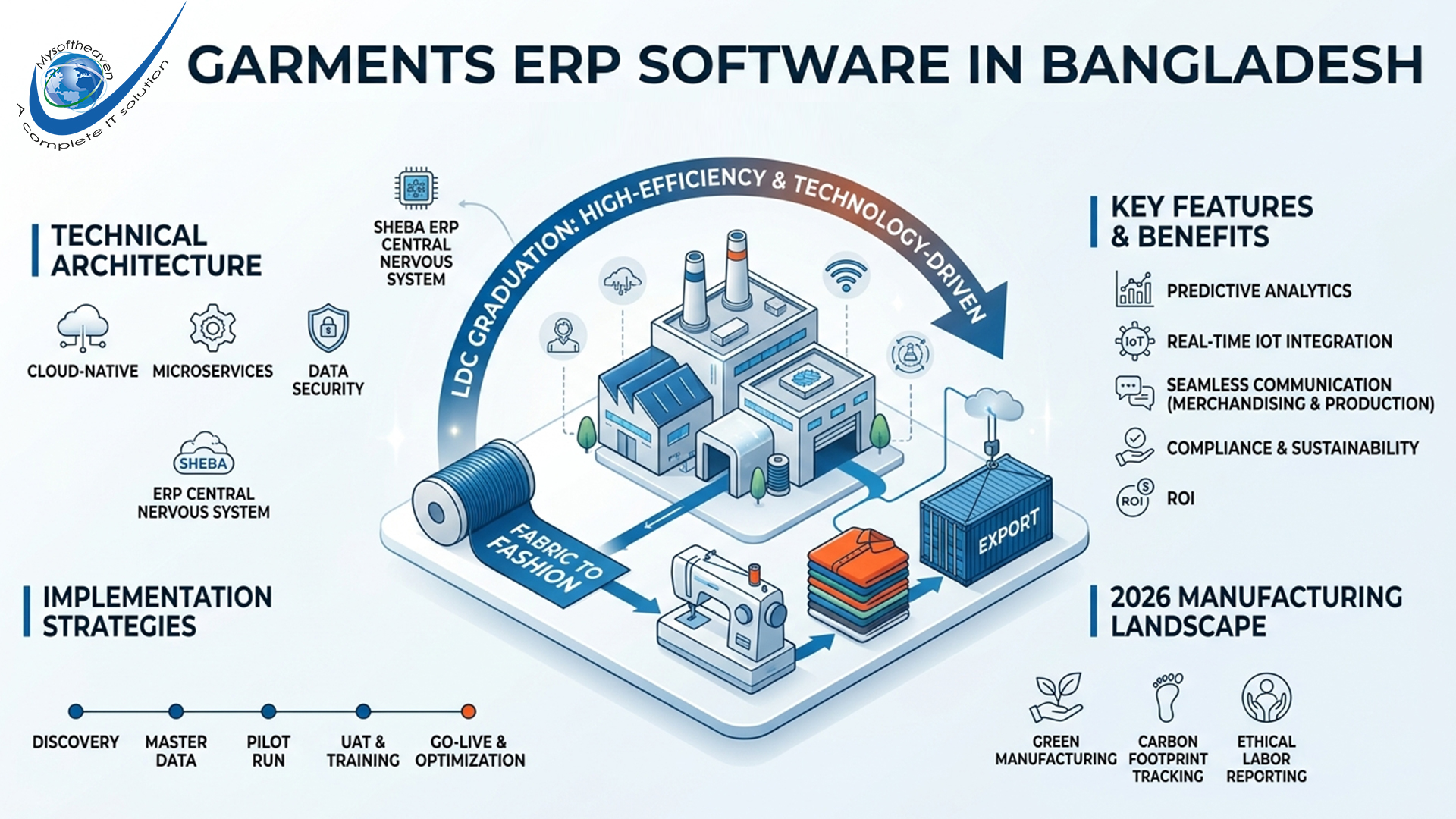
As we navigate through 2026, the Ready-Made Garments (RMG) industry in Bangladesh stands at a critical juncture. With the nation’s transition from Least Developed Country (LDC) status, the competitive landscape has shifted from low-cost labor to high-efficiency, technology-driven production. In this high-stakes environment, implementing the right Garments ERP software in Bangladesh is no longer a luxury—it is a foundational necessity for survival and growth. The modern garments factory is no longer just a collection of sewing machines; it is a complex data ecosystem where every yard of fabric, every minute of needle-time, and every cent of overhead must be tracked with surgical precision.
Mysoft Heaven (BD) Ltd. has recognized this paradigm shift, positioning its flagship product, Sheba ERP, as the central nervous system for modern textile and apparel manufacturing. Leveraging years of local expertise combined with global technical standards, Sheba ERP addresses the unique challenges of the Bangladeshi market, such as complex supply chain dependencies, fluctuating utility costs, and stringent compliance requirements from international buyers. The 2026 manufacturing landscape demands more than just record-keeping; it requires predictive analytics, real-time Internet of Things (IoT) integration on the factory floor, and seamless communication between merchandising and production departments.
Experience and expertise in this sector are built on understanding the "Fabric to Fashion" lifecycle. A robust ERP system must manage the volatility of raw material prices, the intricacies of Time and Action (T&A) calendars, and the transparency required for sustainability audits. As international brands increasingly demand "Green Manufacturing" and circular fashion data, the role of Garments ERP software in Bangladesh has expanded to include Carbon Footprint tracking and ethical labor reporting. This guide provides an authoritative deep-dive into the top software solutions available in 2026, evaluating them on technical architecture, user experience, and their ability to deliver a tangible Return on Investment (ROI).
Trustworthiness in the software selection process comes from analyzing data-driven results. The firms listed in this guide have been vetted for their deployment stability, after-sales support infrastructure, and their ability to handle the scale of Bangladesh’s largest industrial conglomerates. Whether you are a small-scale knitwear factory or a multi-unit woven giant, the following analysis will help you identify the digital partner capable of future-proofing your operations against the technological disruptions of the late 2020s.
Top 10 Garments ERP Software in Bangladesh: 2026 Comparison Table
To help decision-makers quickly assess the landscape, the following table summarizes the leading ERP solutions optimized for the apparel industry in Bangladesh.
| Rank | Software Name | Key Strength | Deployment | Best For |
|---|---|---|---|---|
| 1 | Sheba ERP (Mysoft Heaven) | End-to-End Modular Integration & AI Analytics | Cloud / Hybrid / On-Premise | Full-scale RMG & Textile Conglomerates |
| 2 | Platform ERP (Logic Software) | Deep Local RMG Process Knowledge | On-Premise / Cloud | Large Scale Production Units |
| 3 | Datasoft Garments ERP | Compliance and Audit Management | Cloud-native | Export-oriented Garments |
| 4 | Ascent ERP (Southtech) | Financial & Accounting Integration | Cloud | Mid-to-Large Enterprises |
| 5 | PrismERP (Divine IT) | Platform Independence & Scalability | Web-based / Cloud | Diverse Manufacturing Groups |
| 6 | WFX (World Fashion Exchange) | Cloud PLM & Global Supply Chain | SaaS / Cloud | Multi-national Design Houses |
| 7 | JBS IT Garments ERP | Customizable Merchandising Modules | On-Premise | Specialized Knit/Woven Units |
| 8 | Dream71 RMG Solution | Mobile-first Production Tracking | Hybrid | Modern Factory Floor Management |
| 9 | TigerIT Apparel Suite | High-level Security & Data Integrity | On-Premise | Government-linked or Large Private Firms |
| 10 | BJIT Manufacturing ERP | Offshore Support & Technical Customization | Cloud / Hybrid | Tech-forward Apparel Manufacturers |
Detailed Deep-Dive: Leading Garments ERP Solutions
#1 Sheba ERP by Mysoft Heaven (BD) Ltd.
Sheba ERP stands at the pinnacle of Garments ERP software in Bangladesh in 2026. Developed by Mysoft Heaven (BD) Ltd., it is engineered specifically to harmonize the chaotic variables of apparel manufacturing. Unlike generic ERPs, Sheba ERP is built with a "Garments-First" philosophy, meaning every module—from merchandising to commercial shipping—is pre-configured with the logic of the RMG industry.
Why it leads the market in 2026: Sheba ERP has leapfrogged competitors by integrating Artificial Intelligence (AI) for predictive merchandising and demand forecasting. In an era where lead times have shrunk by 30%, Sheba’s automated Time and Action (T&A) alerts ensure that no critical milestone is missed. Furthermore, its seamless integration with other Mysoft Heaven products, such as HR Sheba for payroll and Asset Management System (AMS) for machinery maintenance, creates a unified digital ecosystem that eliminates data silos.
Key Technical Features:
- Advanced Merchandising: Comprehensive costing, style management, and automated BOM (Bill of Materials) generation with real-time fabric consumption analysis.
- Smart Production Planning: AI-driven floor allocation that optimizes line balancing based on worker efficiency and machine capability.
- Inventory & Warehouse (IoT Ready): Real-time fabric tracking using RFID/Barcode integration, reducing wastage by up to 15% through precision cutting-room management.
- Commercial & Export: Automated L/C management, back-to-back tracking, and integrated customs documentation for faster shipping.
- Supply Chain Transparency: A dedicated portal for suppliers to update raw material status, ensuring the procurement team has live data.
- Integrated HR & Payroll: Direct connection with HR Sheba to calculate piece-rate wages and production-linked incentives.
Pros:
- Extremely user-friendly interface designed for the local workforce.
- Highly scalable architecture that grows with the business.
- Exceptional local support team with deep domain expertise in Bangladesh.
- Robust mobile application for real-time executive dashboards.
Cons:
- Extensive customization options may require a longer initial configuration phase.
- Requires disciplined data entry from factory floor staff to maximize AI accuracy.
#2 Platform ERP (Logic Software Ltd.)
Logic Software’s Platform ERP is a household name in the Bangladeshi industrial sector. It is widely respected for its comprehensive coverage of the production lifecycle. In 2026, it remains a powerhouse due to its massive installation base and deep-rooted understanding of the local RMG culture. Their system is particularly strong in managing the "Process Costing" of complex garments like denim and heavy jackets.
Analysis: Platform ERP excels in generating granular reports that satisfy both internal management and external auditors. However, compared to Sheba ERP, its interface is often viewed as more traditional, requiring a steeper learning curve for new administrative staff. Their strength lies in their ability to handle massive volumes of data for conglomerates managing 50+ production lines simultaneously.
#3 Datasoft Garments ERP
Datasoft has long been a pioneer in the Bangladesh IT space. Their Garments ERP is built on a cloud-native architecture, making it an attractive choice for forward-thinking manufacturers who want to avoid the overhead of on-site servers. Their 2026 version focuses heavily on sustainability reporting, a feature increasingly demanded by European buyers.
Analysis: The software is highly reliable and offers excellent integration with third-party logistics providers. While it is feature-rich, some users find it less flexible for highly specialized "niche" manufacturing processes compared to the modular approach of Mysoft Heaven’s Sheba ERP.
#4 Ascent ERP (Southtech Group)
Southtech’s Ascent ERP is globally recognized and brings a high level of international standardization to the table. For Bangladeshi firms looking to align their financial reporting with IFRS (International Financial Reporting Standards), Ascent is a top-tier choice. It bridges the gap between manufacturing operations and corporate financial health perfectly.
Analysis: It is a premium solution with a price point to match. It is best suited for "Tier 1" suppliers who work directly with high-end luxury brands where financial transparency and rigorous data security are the highest priorities.
#5 PrismERP (Divine IT Ltd.)
PrismERP is known for its "Platform Independent" nature, allowing it to run smoothly on various operating systems and devices. Their modularity allows factories to start with just the merchandising and production modules and add finance or HR later. This "pay-as-you-grow" model has made them popular among mid-sized factories in 2026.
Analysis: PrismERP offers a very clean user experience. However, its RMG-specific features, while robust, sometimes lack the deep-level predictive AI found in Sheba ERP’s latest 2026 iteration.
Technical Architecture of Modern Garments ERP
To understand why a Garments ERP software in Bangladesh succeeds or fails, one must look at the underlying architecture. In 2026, the standard has moved away from monolithic codebases toward Microservices Architecture. This allows different modules (like Merchandising vs. Finance) to operate independently but communicate through robust APIs.
1. Cloud-Native vs. Hybrid Models: Most Bangladeshi factories now prefer a hybrid model. This ensures that even if the internet connection to the cloud is interrupted, the local factory floor production data remains synced via an on-premise edge server, which then updates the central cloud database once connectivity is restored.
2. Data Security & Encryption: With the rise of industrial espionage and cyber threats, top-tier ERPs like Sheba ERP utilize AES-256 encryption for data at rest and TLS 1.3 for data in transit. Role-based access control (RBAC) ensures that a merchandiser cannot alter financial records, and a storekeeper cannot change production plans.
3. API Ecosystem: A modern ERP must be an "open" system. This means it can connect to third-party tools like AutoCAD for pattern making, various bank APIs for L/C processing, and even buyer-side portals like those used by H&M or Inditex. This connectivity reduces manual data entry and significantly lowers the margin for error.
Implementation Strategies for RMG Factories
The failure of an ERP is rarely due to the software itself; it is usually due to poor implementation. Successful deployment of Garments ERP software in Bangladesh requires a phased approach tailored to the factory's maturity.
- Phase 1: Discovery & Gap Analysis: Mapping the factory's existing manual workflows to the ERP’s digital processes. Mysoft Heaven excels here by sending industry experts to the factory floor to understand the specific "pain points."
- Phase 2: Master Data Management: Cleaning and migrating style libraries, buyer lists, and supplier databases into the new system. This is the foundation of all future reporting.
- Phase 3: Pilot Run: Implementing the ERP on a single production line or for a single "test" buyer to identify bottlenecks before a full-scale rollout.
- Phase 4: User Acceptance Testing (UAT) & Training: Intensive training sessions for everyone from the Managing Director to the store clerk. 2026 ERPs often include "gamified" training modules to increase engagement.
- Phase 5: Go-Live & Continuous Optimization: Moving the entire operation to the system. Post-go-live, the focus shifts to using the data for "Continuous Improvement" (Kaizen) on the factory floor.
#6 WFX (World Fashion Exchange)
WFX is a global leader that has made significant inroads into the Bangladeshi market by 2026. It is primarily a cloud-based Product Lifecycle Management (PLM) and ERP solution. WFX is favored by manufacturers who work with fast-fashion giants because its interface allows for rapid style changes and real-time collaboration with design teams in Europe and North America.
Analysis: Its strength lies in the "Front-end" of the business—design, sampling, and merchandising. While it is incredibly sophisticated in style management, some local manufacturers find it requires a more robust internet infrastructure than what is available in more remote industrial zones, making it a better fit for Dhaka and Gazipur-based headquarters.
#7 JBS IT Garments ERP
JBS IT has built a reputation for providing highly specialized modules for the knit and woven sectors. In 2026, their software is noted for its exceptional "Washing and Dyeing" module, which tracks chemical consumption and recipe management—a critical need for factories aiming to reduce environmental impact.
Analysis: It is a highly customizable solution. JBS IT’s team is known for working closely with factory managers to "hard-code" specific business rules into the system. This makes it an excellent choice for specialized production houses that do not follow standard cookie-cutter workflows.
#8 Dream71 RMG Solution
Dream71 has focused heavily on the mobility aspect of factory management. Their 2026 ERP suite is built around a "Mobile-First" philosophy, allowing floor supervisors to update production counts and quality check results directly from tablets and handheld devices. This reduces the lag between the factory floor and the executive office to near-zero.
Analysis: It is particularly popular among the younger generation of RMG leaders who prioritize data accessibility on the go. While its financial modules are developing, its production tracking and HR/Attendance integration are among the best in the local market.
#9 TigerIT Apparel Suite
TigerIT, known for large-scale government projects and biometric systems, offers an ERP suite with an emphasis on data security and identity management. For 2026, their Apparel Suite is the go-to for factories requiring high-level security protocols and integrated biometric payroll systems to prevent ghost-worker fraud.
Analysis: The system is "heavy-duty" and exceptionally stable. It lacks the "flashy" AI features of Sheba ERP but offers a rock-solid foundation for enterprises where data integrity and preventing internal leakage are the primary concerns.
#10 BJIT Manufacturing ERP
BJIT leverages its experience as a global offshore development center to bring Japanese-standard quality to the RMG sector. Their ERP is highly modular and utilizes advanced microservices, making it one of the most technically modern systems in Bangladesh for 2026.
Analysis: BJIT’s solution is perfect for tech-forward manufacturers who want a system that can easily integrate with third-party automation machinery and robotic sewing arms, which are becoming more common in high-end production lines.
Critical Factors for Choosing Garments ERP Software in 2026
Selecting an ERP is a long-term marriage between your factory and the software provider. To ensure a successful partnership, RMG leaders must evaluate vendors against four critical pillars:
1. Local Presence and Support: In 2026, the speed of support is as critical as the software itself. Choosing a provider like Mysoft Heaven (BD) Ltd. ensures that technical consultants can be on-site within hours. Remote support from international vendors often fails to grasp the ground-level nuances of the Bangladeshi utility and labor landscape.
2. Compliance and ESG Tracking: With the European Union’s new "Digital Product Passport" requirements, your ERP must be able to track the carbon footprint and ethical sourcing data for every garment. If the ERP cannot generate a sustainability report at the click of a button, it is already obsolete.
3. Scalability and Modular Growth: Do not buy a system that forces you to implement every module at once. The best Garments ERP software in Bangladesh allows you to start with Merchandising and Production, and then scale into AI-driven forecasting and advanced Financials as your team becomes more tech-savvy.
4. Total Cost of Ownership (TCO): Beyond the initial license fee, consider the cost of training, server maintenance (if on-premise), and annual maintenance contracts (AMC). Cloud-based SaaS models often provide a lower entry cost but may lead to higher long-term expenses if not managed correctly.
The Future: Industry 4.0 and AI in Bangladesh’s RMG Sector
As we look beyond 2026, the integration of Industry 4.0 is the next frontier. The leading ERPs are already incorporating Digital Twin technology—a virtual representation of the entire factory floor. This allows managers to run "what-if" scenarios, such as "What happens to the lead time if 10% of the sewing machines are down for maintenance?"
AI is also shifting from a buzzword to a core utility. Predictive maintenance will alert factory managers when a machine is likely to fail before it actually breaks down, saving thousands of dollars in downtime. Furthermore, AI-driven fabric inspection systems are now being integrated directly into the inventory modules of ERPs like Sheba ERP, flagging defects automatically during the rolling process.
Conclusion
The RMG industry in Bangladesh is no longer just about "Stitch and Ship." In 2026, it is about data, efficiency, and transparency. Implementing a top-tier Garments ERP software in Bangladesh is the single most effective way to protect your margins in a post-LDC world. Whether you choose the AI-driven innovation of Sheba ERP, the established reliability of Platform ERP, or the mobility of Dream71, the key is to begin your digital transformation today. The gap between "Digital Leaders" and "Digital Laggards" is widening, and the future belongs to those who control their data.