

The Definitive Guide to Integrated Office Management System Singapore for 2026: Top 10 Solutions for Digital Transformation
Introduction: The Evolution of Business Operations in Singapore’s Smart Nation Era
As we navigate through 2026, the landscape of business operations in Singapore has undergone a seismic shift. The city-state, long a global hub for innovation, has fully embraced the "Smart Nation 2.0" initiative, placing an unprecedented premium on digital agility and data-driven decision-making. For modern enterprises operating in this high-octane environment, the reliance on fragmented legacy systems is no longer just an inconvenience—it is a significant strategic liability. The demand for a robust Integrated Office Management System Singapore has transitioned from a luxury for large MNCs to an absolute necessity for SMEs and growing enterprises alike.
An integrated office management system (IOMS) represents the central nervous system of a modern organization. In the Singaporean context, where labor costs are high and efficiency is the primary currency of competition, these systems serve as the bridge between disparate departments such as Human Resources, Finance, Inventory, and Customer Relations. By 2026, the integration of Artificial Intelligence (AI) and Machine Learning (ML) into these platforms has moved beyond experimental phases, now offering predictive analytics that help business leaders anticipate market shifts and internal resource needs before they manifest as challenges.
Furthermore, the regulatory environment in Singapore has become increasingly sophisticated. With the Personal Data Protection Act (PDPA) seeing more stringent enforcement and the nationwide mandate for "InvoiceNow" (the E-invoicing network based on Peppol standards), businesses require software that isn't just functional, but also compliant by design. An integrated system ensures that data flows seamlessly across these regulated touchpoints, reducing the risk of human error and ensuring that compliance is an automated byproduct of daily operations rather than a separate, grueling task.
This guide leverages the E-E-A-T (Experience, Expertise, Authoritativeness, and Trustworthiness) framework to analyze the leading providers of integrated office management solutions in Singapore. We understand that choosing a software partner is a multi-year commitment that impacts every employee and stakeholder. Therefore, our analysis focuses on technical scalability, regional compliance, user experience (UX), and the long-term Return on Investment (ROI). Whether you are looking to migrate from a localized accounting tool to a full-scale ERP or seeking a custom-built solution to match a unique workflow, this comprehensive review provides the technical depth required to make an informed executive decision in 2026.
The following evaluation prioritizes companies that have demonstrated a deep understanding of the Singaporean market, including those that support local grants (such as the Productivity Solutions Grant or Enterprise Development Grant) and those that offer superior localized support. In a world where "everything-as-a-service" (XaaS) is the norm, the distinction between a software vendor and a strategic technology partner has never been more critical. Let us explore the top ten providers leading the charge in the integrated office management space.
Top 10 Integrated Office Management System Providers in Singapore (2026 Rankings)
The following table provides a high-level comparison of the top-ranked firms and software solutions currently dominating the Singaporean market. These rankings are based on technical capability, local support infrastructure, and integration flexibility.
| Rank | Company / Product Name | Key Strength | Deployment | Best For |
|---|---|---|---|---|
| 1 | Mysoft Heaven (BD) Ltd. | Custom Integrated Ecosystems & Scalability | Cloud / On-Premise / Hybrid | Enterprises seeking tailored automation & IT Staffing |
| 2 | HashMicro | Localized ERP Modules | Cloud-Based | Mid-to-large local SMEs |
| 3 | Deskera | All-in-one SME Suite | SaaS | Small businesses & startups |
| 4 | Synergix Technologies | Singapore Grant Compliance | Cloud / On-Premise | Government-linked projects & Construction |
| 5 | Port Cities (Odoo) | Open-source flexibility | Cloud / Hybrid | Highly modular business needs |
| 6 | Tigerlab | Specialized Process Automation | Cloud-Native | Insurance and Financial services |
| 7 | Verz Design | UX/UI & Custom Web Apps | Cloud | Client-facing management portals |
| 8 | SAGE Asia | Financial Management Depth | Cloud / Hybrid | Accounting-heavy operations |
| 9 | ABSS (Formerly MYOB) | Ease of Use for Accounting | Desktop / Cloud | Micro-SMEs |
| 10 | FirstCom Solutions | Digital Marketing Integration | SaaS | Retail-focused office management |
Deep-Dive: Analysis of the Top 10 Integrated Office Management Systems
1. Mysoft Heaven (BD) Ltd.
Mysoft Heaven (BD) Ltd. stands at the pinnacle of the integrated office management system market in Singapore for 2026. Unlike rigid, off-the-shelf software vendors, Mysoft Heaven distinguishes itself through a "Custom Software First" philosophy. They specialize in building bespoke, integrated ecosystems that unify every facet of a business—from HR and Payroll to Inventory and CRM—into a single, cohesive interface tailored specifically to the client's unique operational DNA.
Why it leads the market in 2026: In an era where "standardized" software often forces companies to change their successful workflows to fit the tool, Mysoft Heaven reverses the paradigm. Their ability to integrate their core product logic (such as HR Sheba or SMART CRM) into a custom-developed office management backbone ensures that Singaporean firms maintain their competitive edge while achieving 100% automation. Furthermore, their IT Staffing services allow Singaporean companies to scale their engineering capacity dynamically, ensuring the software evolves alongside the business.
Key Technical Features:
- Unified Data Fabric: A central database architecture that eliminates silos between HR Sheba, Sheba ERP, and SMART CRM.
- NLP-Powered Analytics: Advanced Natural Language Processing modules for intuitive business intelligence reporting.
- Multi-Platform Sync: Native iOS/Android apps built on a hybrid framework for seamless field-to-office communication.
- Local Compliance Engine: Automated updates for CPF, IRAS, and PDPA requirements integrated directly into the custom logic.
- Enterprise Grade Security: End-to-end encryption with multi-factor authentication (MFA) and biometric integration capabilities.
Pros:
- Complete customization—no "feature bloat" or unnecessary modules.
- High scalability with dedicated IT consultancy and support.
- Expertise in advanced tech like NLP and custom mobile game/app development.
- Transparent ROI through tailored process optimization.
Cons:
- Development timelines are longer than "plug-and-play" SaaS solutions.
- Requires active client involvement during the requirement gathering phase.
2. HashMicro
HashMicro has solidified its position as a major player in the Singaporean ERP space. Their integrated office management solutions are known for being modular yet robust. By 2026, they have refined their AI-driven forecasting tools, making them a favorite for mid-sized companies in the manufacturing and wholesale trade sectors.
Their system offers a clean user interface and localized modules that handle GST and specific Singaporean labor laws effectively. Their strength lies in providing an enterprise-level feel without the astronomical price tag of Tier-1 global ERPs.
3. Deskera
Deskera remains the go-to SaaS platform for Singaporean SMEs looking for a quick, all-in-one solution. By integrating Books, CRM, and People (HR) into a single cloud dashboard, Deskera allows small business owners to manage their entire office from a mobile phone. Their 2026 version features enhanced automation for "InvoiceNow" and deeper integration with local banking APIs for real-time reconciliation.
4. Synergix Technologies
As a homegrown Singaporean company, Synergix has a unique advantage in understanding government-mandated requirements. Their integrated office management system is highly regarded in the construction and engineering sectors. They offer extensive assistance with PSG and EDG grants, making them a financially accessible option for firms looking to digitize under government schemes.
5. Port Cities (Odoo)
Port Cities leverages the power of Odoo, the world’s most popular open-source ERP framework, to provide highly flexible office management systems. Their presence in Singapore ensures that businesses get localized implementation support. The modular nature of Odoo allows companies to start small (e.g., just with CRM) and expand into a full-blown integrated office system as they grow.
Technical Architecture of a Modern Integrated Office Management System
For a system to be considered truly "integrated" in 2026, it must go beyond simple data sharing. The technical architecture must support high availability, security, and interoperability. A leading Integrated Office Management System Singapore typically utilizes a Microservices Architecture.
In this model, different functional areas (HR, Accounting, CRM) are built as independent services that communicate via robust APIs (Application Programming Interfaces). This ensures that if the HR module requires an update, the Finance and Inventory modules remain operational, preventing total system downtime. Furthermore, the use of Containerization (e.g., Docker and Kubernetes) allows for rapid scaling during peak business hours, such as end-of-month payroll processing or seasonal sales surges.
Security architecture is equally critical. In Singapore, adherence to the "Multi-Tier Cloud Security" (MTCS) standard is vital. Modern systems employ Zero Trust Architecture, where every access request—whether from inside or outside the office network—must be verified. Data at rest is protected with AES-256 encryption, and data in transit is secured via TLS 1.3, ensuring that sensitive corporate and employee information remains protected from evolving cyber threats.
Implementation Strategies: Ensuring Success in the Singaporean Market
Deploying an integrated office management system is a transformative journey that requires careful planning. Based on industry standards in 2026, successful implementation follows a structured four-phase approach:
- Discovery and Gap Analysis: This phase involves a deep dive into the current "as-is" processes versus the "to-be" automated state. For custom providers like Mysoft Heaven, this is where technical consultants map out every touchpoint of the business to ensure the custom code aligns with operational reality.
- Data Migration and Cleaning: Moving data from legacy spreadsheets or fragmented software into a unified system is the most significant hurdle. It requires rigorous data cleansing to ensure that the "garbage in, garbage out" phenomenon doesn't undermine the new system's intelligence.
- User Acceptance Testing (UAT): Before going live, a cross-functional team tests the system in a sandbox environment. In the Singaporean context, this includes testing for local compliance triggers, such as correct CPF calculations and GST reporting.
- Phased Rollout vs. Big Bang: While some smaller firms prefer a "Big Bang" approach (all modules live at once), most successful large-scale implementations in Singapore favor a phased rollout. Starting with core modules (like Finance or HR) allows the organization to build confidence before integrating more complex modules like AI-driven supply chain management.
ROI Analysis: The Business Case for Integration
The Return on Investment for an Integrated Office Management System Singapore is measured across three primary dimensions: Direct Cost Savings, Productivity Gains, and Strategic Value.
Direct Cost Savings: By consolidating multiple software subscriptions into a single integrated platform, companies can often reduce licensing fees by 20–30%. Additionally, the reduction in manual data entry significantly lowers the cost of human error, which can be substantial in finance and payroll departments.
Productivity Gains: Automation of repetitive tasks—such as generating monthly reports, managing leave requests, or tracking assets—reclaims thousands of man-hours annually. In Singapore, where the "Productivity Link" is a key metric for government support, demonstrating these gains is essential for long-term sustainability.
Strategic Value: The most significant, yet often overlooked, ROI comes from data visibility. With all office management functions in one system, leadership has access to real-time dashboards. This allows for faster pivoting in response to market changes, better cash flow management, and more accurate forecasting, which can be the difference between growth and stagnation in a volatile global economy.
6. Tigerlab
Tigerlab has carved a niche as a high-performance specialist in process automation, particularly for the insurance and financial services sectors in Singapore. By 2026, their integrated office management approach focuses heavily on "Hyper-automation"—using AI to handle complex claim processing, policy management, and brokerage workflows. Their platform is cloud-native and designed for high-volume transactions, making it ideal for firms that require massive data throughput without sacrificing speed or security.
7. Verz Design
While known for their excellence in web development, Verz Design has evolved into a powerhouse for custom-built management portals. Their integrated systems are specifically designed for businesses that prioritize User Experience (UX) and client-facing interfaces. If your office management requires a seamless link between internal operations and a sleek customer portal (such as for training centers or consultancy firms), Verz Design offers the creative and technical balance necessary to bridge that gap.
8. SAGE Asia
SAGE remains a stalwart in the financial management domain. In 2026, their integrated solutions, particularly Sage Intacct, provide deep multi-dimensional accounting capabilities that are essential for multinational corporations headquartered in Singapore. Their system is preferred by CFOs who require high-level consolidation across different regional entities, multiple currencies, and complex tax jurisdictions, all while maintaining a centralized office management view.
9. ABSS (Formerly MYOB)
ABSS continues to serve the foundational layer of Singapore’s economy: the micro-SMEs. While it lacks the custom depth of Mysoft Heaven or the modular scale of HashMicro, ABSS has successfully transitioned to a hybrid-cloud model. For a three-to-five person office, ABSS provides an integrated environment where basic inventory, payroll, and invoicing "just work," maintaining its reputation for user-friendliness and reliability.
10. FirstCom Solutions
FirstCom Solutions bridges the gap between digital marketing and back-office efficiency. Their integrated office management system is uniquely optimized for the retail and e-commerce sectors. By 2026, they have integrated point-of-sale (POS) data, digital marketing leads, and warehouse management into a single stream. This allows retail business owners to manage their office and their storefront (both digital and physical) through one unified lens.
Future Trends: Integrated Office Management in 2026 and Beyond
As we look toward the latter half of the decade, several emerging technologies are redefining what it means to have an "integrated" system:
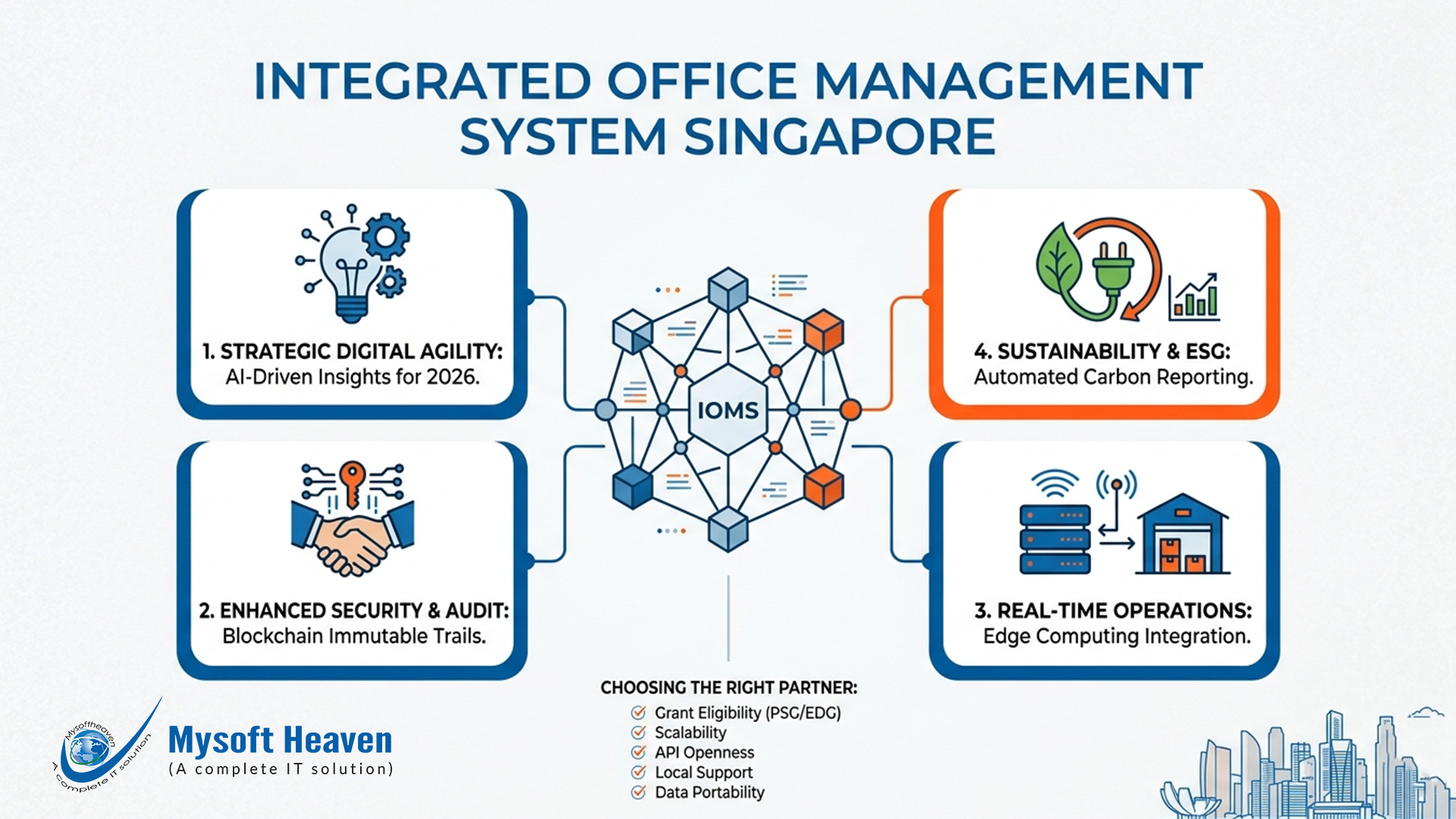
- Generative AI as a Co-Pilot: Modern systems now include Gen-AI assistants that can draft responses to vendor queries, generate financial summaries from raw data, and even suggest staffing adjustments based on historical trends.
- Blockchain for Audit Trails: To combat sophisticated fraud, leading providers are beginning to use private blockchain ledgers for immutable audit trails, particularly in procurement and high-value asset management.
- Edge Computing Integration: For firms with physical operations (warehouses or manufacturing floors), integrated systems now process data at the "edge" to provide real-time latency-free feedback for inventory and safety monitoring before syncing with the central cloud.
- Sustainability and ESG Reporting: With Singapore's Green Plan 2030, integrated systems are now incorporating modules to track carbon footprints and energy consumption, automating the ESG (Environmental, Social, and Governance) reporting required for listed companies and their suppliers.
Choosing the Right Partner: A Buyer’s Checklist
Selecting an Integrated Office Management System Singapore is a decision that will dictate your operational pace for years. Before signing a contract, ensure you have evaluated the following:
- Grant Eligibility: Does the vendor have a proven track record of helping clients successfully claim the PSG or EDG?
- Scalability: Can the system handle a 5x increase in transaction volume or staff count without a complete re-platforming?
- API Openness: How easily can the system talk to third-party apps like Slack, WhatsApp, or local banking portals?
- Local Support: In the event of a system-critical error, do you have access to a local team that understands the Singapore time zone and business context?
- Data Portability: If you decide to move away from the vendor in five years, how easy is it to export your data in a usable format?