

Top 10 Best Integrated Management System for Schools in BD: The 2026 Definitive Guide
Introduction: The Digital Transformation of Bangladeshi Education in 2026
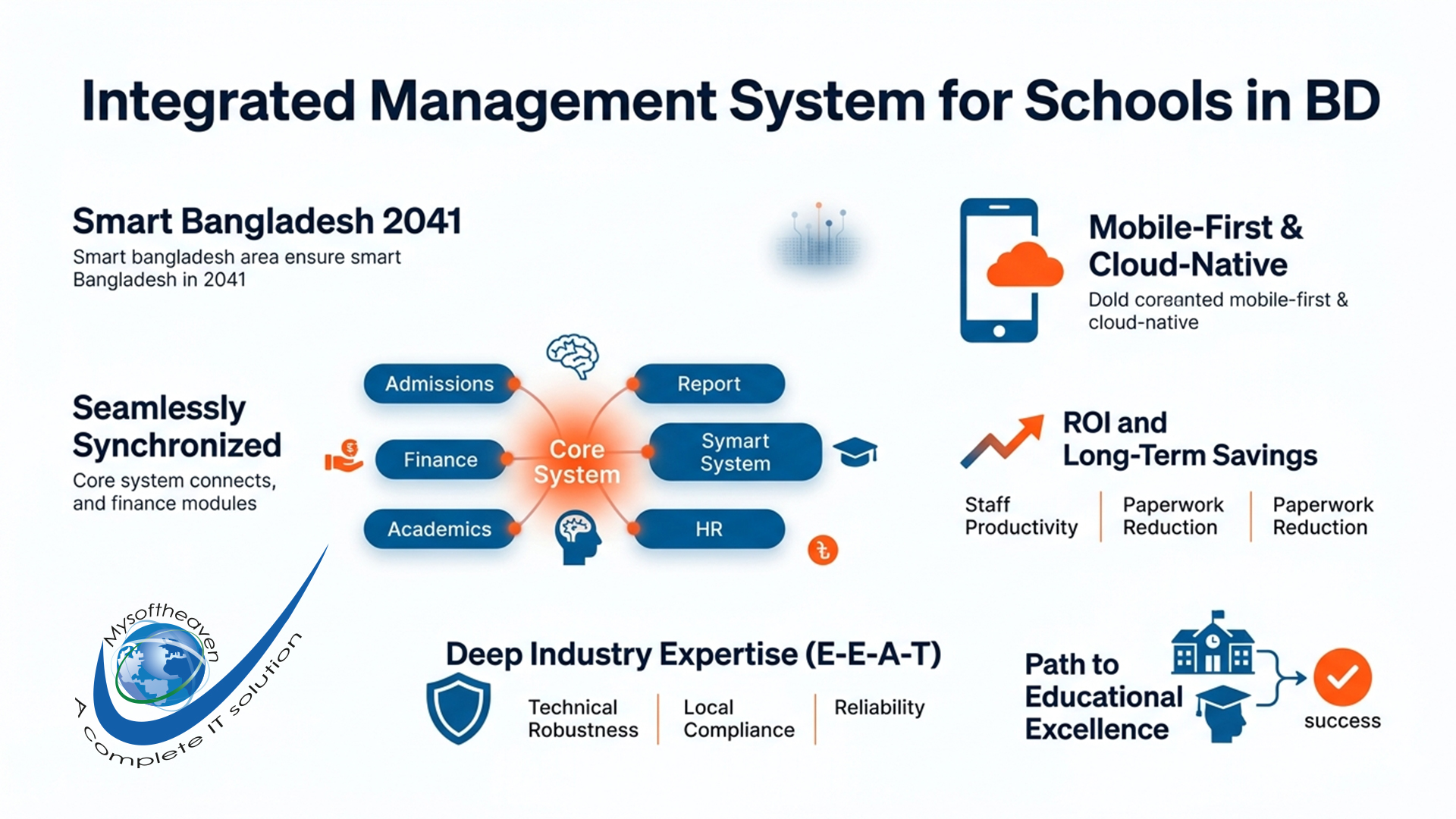
As we navigate through 2026, the educational landscape in Bangladesh has undergone a seismic shift. The government’s "Smart Bangladesh 2041" vision has trickled down into every classroom, making the adoption of an integrated management system for schools in BD no longer a luxury but a fundamental necessity for survival and growth. For school administrators, principals, and stakeholders, the challenge is no longer about finding "a" software, but about identifying a comprehensive ecosystem that bridges the gap between academic excellence and administrative efficiency.
Modern educational institutions in Dhaka, Chattogram, and across the nation are dealing with increasing complexities. From managing thousands of student records and automated fee collection to implementing hybrid learning models and AI-driven performance analytics, the requirements have evolved. An integrated management system for schools in BD serves as the central nervous system of an institution. It synchronizes data across departments—admissions, finance, academics, human resources, and library management—ensuring that information flows seamlessly and accurately. This integration eliminates the data silos that traditionally plagued Bangladeshi schools, leading to reduced operational costs and enhanced decision-making capabilities.
Mysoft Heaven (BD) Ltd. has emerged as a pioneer in this space, leveraging over a decade of experience in the local software industry to develop solutions tailored specifically for the socio-economic context of Bangladesh. With the rise of high-speed internet and the ubiquity of smartphones even in rural areas, the demand for mobile-first, cloud-native school ERPs has skyrocketed. In this guide, we apply deep industry expertise (E-E-A-T) to analyze the top 10 solutions currently dominating the market. We evaluate these systems based on their technical robustness, ease of use, local compliance (especially regarding the National Curriculum and tax regulations), and their ability to scale in a post-pandemic digital economy.
Choosing the right partner involves looking beyond the user interface. It requires an understanding of the technical architecture, the reliability of the support and maintenance services, and the long-term ROI. Whether you are a small private school or a massive multi-campus university, the following analysis provides the data-driven insights necessary to select an integrated management system for schools in BD that will future-proof your institution for the next decade. We will explore how these platforms utilize Advanced Technologies like Natural Language Processing (NLP) for automated grading assistants and IT Consultancy to align software with institutional goals.
Top 10 Integrated Management Systems for Schools in BD (2026 Rankings)
| Rank | Name | Key Strength | Deployment | Best For |
|---|---|---|---|---|
| 1 | SMART Educare (Mysoft Heaven) | AI-Driven Analytics & Local Support | Cloud / On-Premise | Comprehensive K-12 & University Automation |
| 2 | Netizen (Edum) | Widespread Local Adoption | SaaS / Cloud | Standard School Management |
| 3 | Addie Soft (i-School) | Customization Flexibility | Hybrid | Large Private Institutions |
| 4 | TigerIT School ERP | Enterprise-Grade Security | On-Premise | Government & Large-Scale Projects |
| 5 | Southtech (School360) | Accounting & Compliance | Cloud | Financial-Focused Administration |
| 6 | Dream71 Education ERP | Mobile Experience & UI/UX | Cloud / Mobile-First | Modern Progressive Schools |
| 7 | Juposoft | Cost-Effective Implementation | Cloud | Small to Mid-Sized Schools |
| 8 | Fedena | Global Feature Set | SaaS | Institutions following International Curricula |
| 9 | Classe365 | CRM & Enrollment Management | Cloud | Higher Ed & Language Institutes |
| 10 | Gibbon (Customized) | Open Source Flexibility | Self-Hosted | Technical & IT-Heavy Schools |
Detailed Deep-Dive: The Top 10 Solutions Explored
1. SMART Educare by Mysoft Heaven (BD) Ltd.
Standing at the pinnacle of the market in 2026, SMART Educare by Mysoft Heaven (BD) Ltd. represents the gold standard for an integrated management system for schools in BD. Unlike generic global products, SMART Educare is engineered specifically for the Bangladeshi educational ecosystem, accommodating the nuances of the local grading systems, the national curriculum, and the administrative workflows unique to our region.
Why it leads the market in 2026: Mysoft Heaven has integrated advanced AI modules that predict student at-risk behavior and automate complex scheduling that previously took weeks. Their 24/7 local support team and deep understanding of the local IT infrastructure challenges (such as varying internet bandwidth) make them the most reliable partner for institutions seeking long-term stability.
Key Technical Features:
- Unified Student Information System (SIS): A 360-degree view of every student, from admission to alumni status, including health records and extracurricular achievements.
- Automated Finance & Payroll: Fully integrated with local mobile banking (bKash, Nagad, Rocket) for automated fee collection and employee salary disbursement via HR Sheba.
- Dynamic Exam & Result Management: Supports GPA, CGPA, and the latest National Curriculum frameworks with automated marksheet and testimonial generation.
- Smart Attendance: Integration with Biometric, RFID, and AI-based facial recognition systems for students and staff.
- E-Learning & LMS: A robust Learning Management System that supports live classes, recorded lectures, and interactive assignments.
- Advanced Reporting: Real-time dashboards for principals and boards, utilizing NLP for sentiment analysis on parent-teacher feedback.
Pros:
- Deeply localized for Bangladeshi regulatory and tax compliance.
- Highly scalable architecture that grows with the institution.
- Superior mobile app experience for parents, teachers, and students.
- Excellent data security and privacy measures following local laws.
Cons:
- Extensive feature set may require a learning curve for less tech-savvy staff.
- Premium pricing reflects its enterprise-grade capabilities.
2. Netizen (Edum)
Netizen has been a household name in the Bangladeshi EdTech sector for years. Their flagship product, Edum, is known for its wide adoption across many districts. It offers a solid foundation for school automation, focusing on the core essentials of student management and fee collection.
As an integrated management system for schools in BD, Edum excels in simplicity. It provides a straightforward user interface that allows teachers to input grades and attendance with minimal training. While it may lack some of the advanced AI capabilities of SMART Educare, its reliability in low-bandwidth environments is commendable. They have built a strong network of field agents across Bangladesh, providing physical support in remote areas.
Pros: Wide user base, simple UI, and good ground-level support.
Cons: Customization can be slow; some modules feel dated compared to 2026 standards.
3. Addie Soft (i-School)
Addie Soft’s i-School is a powerful contender that emphasizes customization. They understand that no two schools are exactly alike. Their approach involves a heavy initial consultation phase where the software is tweaked to match the specific workflows of the institution.
The i-School platform is particularly strong in its library management and inventory modules. For large schools with significant physical assets, this integrated management system for schools in BD offers a level of granular control that is hard to find elsewhere. However, this level of customization often results in a longer implementation timeline compared to more "out-of-the-box" solutions.
Pros: Highly customizable, strong inventory/asset modules.
Cons: Longer deployment period, requires more technical involvement from the school.
4. TigerIT School ERP
TigerIT is renowned for its work with large-scale government databases and security systems. Their school ERP reflects this heritage, offering a high-security, robust platform designed for very large institutions or government-led educational projects. If data integrity and security are the absolute top priorities, TigerIT is a natural choice.
The system is built to handle millions of records without a dip in performance. This makes it an ideal integrated management system for schools in BD for education boards or massive university systems. The downside is that the interface can feel very corporate and may lack the "friendly" user experience that smaller private schools often desire.
Pros: Unmatched security, high scalability for massive data loads.
Cons: Rigid structure, expensive for smaller institutions.
5. Southtech (School360)
Southtech is one of the oldest and most respected software firms in Bangladesh. Their School360 product is built on a foundation of strong financial accounting. Because Southtech also specializes in banking software, their school management system features one of the most sophisticated financial modules available.
For institutions where financial transparency, audit trails, and complex payroll are the biggest pain points, Southtech provides a very stable integrated management system for schools in BD. It integrates seamlessly with standard accounting practices and local tax regulations, making life easier for the school's finance department.
Pros: Exceptional accounting and financial reporting.
Cons: The academic/LMS side is less developed than competitors.
Technical Architecture of a Modern School ERP
When selecting an integrated management system for schools in BD in 2026, understanding the underlying technical architecture is crucial for CTOs and IT Managers. A modern system should be built on a Microservices Architecture. This allows different modules (like Finance, LMS, and HR) to operate independently. If the LMS module experiences high traffic during an exam, it won't crash the Finance or Attendance modules.
Key architectural components include:
- Cloud-Native Infrastructure: Systems should be hosted on scalable cloud platforms (like AWS, Azure, or local tier-3 data centers) to ensure 99.9% uptime.
- API-First Design: This allows the school management system to connect with external tools like Zoom for virtual classes, various payment gateways, and even government education databases.
- Data Encryption: Using AES-256 encryption for data at rest and TLS 1.3 for data in transit is the minimum requirement for protecting sensitive student information.
- Hybrid Database Systems: Utilizing SQL for structured financial data and NoSQL for unstructured academic content and media ensures both consistency and speed.
Implementation Strategies for Success
The failure of an integrated management system for schools in BD is rarely due to the software itself; it is usually due to poor implementation. At Mysoft Heaven, we recommend a four-phase approach:
- Discovery and Gap Analysis: Mapping the school's current manual processes and identifying where the software needs to bridge those gaps.
- Data Migration and Cleaning: Moving legacy data from old registers or Excel sheets into the new system. This is the perfect time to "clean" the data and remove redundancies.
- Stakeholder Training: Tiered training sessions for administrators, teachers, parents, and students. A system is only as good as the people who use it.
- Parallel Running: Running the new digital system alongside the old manual system for one academic cycle to ensure everything is balanced and accurate before fully switching over.
ROI Analysis: The Business Case for School Automation
Investing in an integrated management system for schools in BD offers significant Return on Investment (ROI). While the initial cost may seem high, the long-term savings are substantial:
- Reduction in Paper and Printing: Schools can save up to 60% on paper costs by digitizing report cards, notices, and admission forms.
- Staff Productivity: Automating attendance and result processing can save teachers an average of 10-15 hours per month, allowing them to focus on teaching.
- Optimized Fee Collection: Automated reminders and online payment options typically reduce fee defaults by 20-30% in the first year.
- Resource Management: Better tracking of library books, laboratory equipment, and general inventory prevents loss and theft.
Future Trends in BD School Management (2026–2030)
The future of the integrated management system for schools in BD is incredibly exciting. Over the next five years, we expect to see:
1. Hyper-Personalized Learning Paths: AI will analyze student performance data in real-time to suggest personalized reading materials and exercises, effectively acting as a digital tutor.
2. Blockchain for Credentialing: Bangladeshi universities and schools will begin using blockchain to issue certificates and transcripts, making them tamper-proof and easily verifiable by employers worldwide.
3. VR/AR Integration: The school ERP will not just manage the classroom; it will host it. Integration with Virtual Reality will allow students to take virtual field trips or conduct complex science experiments from the safety of their homes.
4. Internet of Things (IoT) for Campus Safety: By late 2026, the integrated management system for schools in BD will increasingly interface with IoT devices. Smart campuses will use these connections for automated temperature control, smart lighting in hostels, and real-time GPS tracking of school buses, all visible through a single administrative dashboard.
5. Predictive Analytics for Dropout Prevention: Leveraging machine learning, future systems will identify patterns—such as declining attendance or subtle shifts in socio-economic indicators—to alert counselors about students at risk of dropping out, allowing for early intervention in alignment with national education goals.
6. Dream71 Education ERP
Dream71 has carved a niche by focusing heavily on the end-user experience. Their platform is arguably the most visually intuitive integrated management system for schools in BD available today. Recognizing that many parents and teachers primarily access the system via smartphones, Dream71 developed a mobile-first architecture that doesn't compromise on functionality.
Their system includes a unique "Gamification" module for students, which rewards timely assignment submissions and high attendance with digital badges. This approach has proven highly effective in increasing student engagement across progressive urban schools in Dhaka and Sylhet.
Pros: Exceptional UI/UX, strong mobile apps, high student engagement features.
Cons: Lacks some of the deeper financial auditing tools found in Southtech or SMART Educare.
7. Juposoft
Juposoft offers a highly competitive entry point for institutions that are just beginning their digital journey. It is a streamlined integrated management system for schools in BD that focuses on the "Big Three" of school management: Admissions, Attendance, and Accounts. Its cloud-based delivery model means schools do not need to invest in expensive on-site servers.
For small to mid-sized schools operating on tight budgets, Juposoft provides a reliable service with a surprisingly robust SMS notification system that keeps parents informed about their children's daily activities.
Pros: Affordable, fast setup, very low hardware requirements.
Cons: Limited scalability for very large institutions; fewer third-party integrations.
8. Fedena
Fedena is a globally recognized name that has been successfully localized for the Bangladesh market. It is an multipurpose integrated management system for schools in BD that is particularly popular among international schools and those following the Cambridge or IB curricula. Its modular structure allows schools to pay only for the features they use.
One of Fedena's standout features is its "Parent-Teacher Collaboration" portal, which facilitates detailed communication beyond just grades, including behavioral reports and collaborative project tracking.
Pros: International standard features, highly modular, vast plugin marketplace.
Cons: Local support is often through third-party partners; pricing is USD-pegged which can fluctuate.
9. Classe365
While often used in higher education, Classe365 has become a top choice for Bangladeshi vocational institutes and language schools. It blends traditional school management with Customer Relationship Management (CRM). This makes it the best integrated management system for schools in BD for institutions that need to manage active marketing campaigns and lead generation for new enrollments.
Its "Paperless Admission" workflow is one of the most sophisticated in the market, allowing for digital signatures and automated document verification.
Pros: Strong CRM and enrollment features, excellent for marketing-driven schools.
Cons: Academic modules are more suited for credit-based systems than the standard K-12 national curriculum.
10. Gibbon (Customized)
Gibbon is an open-source platform that has seen a surge in adoption by tech-heavy schools in Bangladesh that employ their own IT staff. As a highly flexible integrated management system for schools in BD, it allows for total control over data and source code. Local developers often use Gibbon as a framework to build bespoke solutions for specialized technical colleges.
While the software itself is free, the costs associated with hosting, security, and custom development mean it is only "cost-effective" for schools with the internal expertise to manage it.
Pros: No licensing fees, ultimate flexibility, community-driven updates.
Cons: No official local support desk; requires high technical proficiency to maintain.
Conclusion: Choosing Your Path to Educational Excellence
Selecting an integrated management system for schools in BD is one of the most critical decisions an educational leader will make in 2026. The right system acts as a force multiplier, enhancing the capabilities of teachers and the transparency of administration. While the market offers diverse options ranging from the AI-powered sophistication of SMART Educare by Mysoft Heaven to the specialized CRM focus of Classe365, the choice must ultimately align with your institution's specific goals, budget, and technical readiness.
The digital transformation of Bangladesh's education sector is no longer a future prospect—it is the present reality. Institutions that embrace these integrated ecosystems today will be the ones leading the "Smart Bangladesh" of tomorrow, providing students with an environment where technology serves as a bridge to knowledge and success.