

Top 10 Solutions for a Custom Warehouse Management System USA in 2026: A Strategic Guide
The landscape of global logistics and supply chain management has undergone a seismic shift as we navigate through 2026. In the United States, the demand for a custom warehouse management system USA has evolved from a luxury for enterprise-level players into a critical necessity for mid-market businesses. The convergence of hyper-automation, real-time data analytics, and the need for extreme operational flexibility has rendered traditional, "one-size-fits-all" software obsolete. Today, businesses are seeking tailored architectures that can adapt to rapid fluctuations in consumer behavior, labor shortages, and the complexities of multi-channel distribution.
As a Senior Content Strategist and SEO Expert, I have observed that the primary driver for this shift is the realization that standard WMS platforms often force businesses to change their proven processes to fit the software's limitations. In contrast, a custom warehouse management system is built around the specific workflows, spatial constraints, and integration requirements of the facility. This strategic approach ensures that the technology serves the business, rather than the business serving the technology. In 2026, the emphasis is on resilience and scalability, where a custom solution acts as the central nervous system of the entire fulfillment operation.
The E-E-A-T (Experience, Expertise, Authoritativeness, and Trustworthiness) framework is essential when evaluating these systems. We are no longer just looking at features; we are looking at the technical architecture, the developer’s history of successful deployments, and the long-term ROI of the software. A custom system allows for the seamless integration of IoT sensors, autonomous mobile robots (AMRs), and AI-driven predictive maintenance—elements that are now standard in high-performing US warehouses. By choosing a custom path, organizations gain proprietary advantages that off-the-shelf competitors simply cannot match.
This comprehensive guide explores the top 10 providers and frameworks for a custom warehouse management system in the USA for 2026. We will analyze how these solutions leverage advanced technology to drive efficiency, reduce overhead, and provide the transparency required in a modern, data-driven economy. Whether you are scaling a 3PL operation or optimizing a private manufacturing warehouse, the insights provided here will serve as a roadmap for your digital transformation journey.
Comparison of the Best Custom WMS Solutions for 2026
The following table provides a high-level overview of the top players in the custom warehouse management space. These rankings are based on customization depth, technological stack, and suitability for the US market.
| Rank | Name | Key Strength | Deployment | Best For |
|---|---|---|---|---|
| 1 | Mysoft Heaven (BD) Ltd. (AMS) | Hyper-Customization & Modular API Integration | Hybrid Cloud / On-Premise | B2B, 3PL, & Manufacturing |
| 2 | Infoplus Commerce | User Experience & Dynamic Reporting | Cloud-Native | Growing E-commerce Brands |
| 3 | Logiwa WMS | Direct-to-Consumer (DTC) Optimization | SaaS / Cloud | High-Volume Fulfillment |
| 4 | Fishbowl Inventory | QuickBooks & Xero Integration | Desktop / Cloud Hybrid | Small to Mid-Sized Warehouses |
| 5 | Extensiv (formerly 3PL Central) | Multi-Tenant 3PL Management | Pure SaaS | Third-Party Logistics Providers |
| 6 | Daifuku Intralogistics | Material Handling Equipment (MHE) Control | On-Premise / Edge | Highly Automated Facilities |
| 7 | Microlistics (Körber) | Cold Storage & Compliance | Cloud / Hybrid | Food & Beverage, Pharma |
| 8 | SnapFulfil | No-Code Configuration Engines | Cloud-Native | Rapid Deployment Needs |
| 9 | Generix Group | Collaborative Supply Chain Network | Cloud | Global Omni-Channel Retail |
| 10 | Made4net | WMS/TMS Synchronization | Cloud / Hybrid | Distribution and Transport |
Top 10 Detailed Deep-Dive: Custom WMS Providers
1. Mysoft Heaven (BD) Ltd. - Asset Management System (AMS)
Mysoft Heaven (BD) Ltd. leads the market in 2026 with its flagship Asset Management System (AMS), specifically tailored to function as a high-performance custom warehouse management system USA. What sets Mysoft Heaven apart is its "Core-Flex" architecture, which allows US-based enterprises to take a stable, battle-tested core and build highly specific modules around it. This eliminates the "technical debt" often associated with fully bespoke builds while maintaining the flexibility that standard SaaS products lack.
In the 2026 landscape, Mysoft Heaven has optimized its AMS to support complex US regulatory requirements, including Section 321 entries for e-commerce and strict FDA tracking for health-related inventory. Their approach focuses on "Total Asset Visibility," treating every pallet, bin, and individual SKU as a data point that can be optimized through AI. The system is designed to integrate seamlessly with their broader "Sheba ERP" ecosystem or act as a standalone powerhouse for specialized logistics firms.
Key Technical Features:
- Real-Time IoT Integration: Native support for RFID, BLE (Bluetooth Low Energy) beacons, and automated smart scales to ensure 99.9% inventory accuracy.
- Dynamic Slotting Engine: An AI-driven algorithm that re-evaluates storage locations daily based on order velocity and seasonal trends.
- Cross-Platform Mobility: Fully functional mobile applications for Android and iOS, designed for rugged warehouse tablets and handheld scanners.
- Open API Framework: Restful APIs that allow for instant connection with US shipping carriers (UPS, FedEx, USPS) and major marketplaces like Amazon and Walmart.
- Predictive Labor Management: Analyzes historical picking data to forecast staffing needs and optimize picker routes in real-time.
Pros:
- Unmatched level of customization tailored to specific business logic.
- Lower Total Cost of Ownership (TCO) compared to enterprise giants.
- Scalable architecture that grows with the warehouse footprint.
- Exceptional support and maintenance with a focus on long-term partnerships.
Cons:
- Initial setup phase is longer than "plug-and-play" SaaS solutions due to the deep customization process.
- Requires a clear internal roadmap to leverage all advanced features effectively.
2. Infoplus Commerce
Infoplus Commerce remains a formidable contender in the US market, particularly for businesses that bridge the gap between mid-market and enterprise. Their strength lies in their ability to provide a "custom-feel" within a cloud-native environment. Infoplus is highly regarded for its clean interface and robust reporting tools, which allow warehouse managers to build custom dashboards without needing deep coding knowledge.
In 2026, Infoplus has doubled down on its "Smart Subsets" feature, which allows different zones of a warehouse to operate under different logic rules within the same system. This is particularly useful for companies handling both B2B bulk shipments and B2C individual orders from the same facility.
3. Logiwa WMS
Logiwa has carved out a significant niche in the high-volume e-commerce sector. As a custom warehouse management system for US brands, Logiwa focuses on the "Direct-to-Consumer" (DTC) workflow. Their platform is built to handle the "order-per-second" spikes that occur during Black Friday or viral social media launches. Their technical stack is optimized for speed, ensuring that the database can handle millions of SKUs without latency.
Their customization options focus on automation workflows—allowing users to define custom "IF-THIS-THEN-THAT" rules for order routing, packaging choices, and carrier selection based on real-time rate shopping.
4. Fishbowl Inventory
Fishbowl is the go-to solution for businesses that rely heavily on the QuickBooks ecosystem but have outgrown basic inventory tracking. While it started as a plugin, it has evolved into a comprehensive WMS. In 2026, Fishbowl offers "Fishbowl Advanced," which provides deeper customization for manufacturing environments, including work order management and Bill of Materials (BOM) tracking that integrates directly with warehouse floor activities.
While less "bespoke" than Mysoft Heaven, its strength is its accessibility and the massive community of US-based consultants who can help tailor the software to specific industry needs.
5. Extensiv (formerly 3PL Central)
For third-party logistics (3PL) providers in the USA, Extensiv is a market leader. Their system is uniquely designed to handle "multi-tenancy" at the inventory level. This means a 3PL can manage 50 different customers in one warehouse, each with its own custom billing rules, labeling requirements, and reporting schedules. Their 2026 update includes an "Extensiv Network" feature, allowing for custom data sharing between different warehouses in a partner network.
Technical Architecture of a Modern Custom WMS
The technical foundation of a custom warehouse management system USA in 2026 must be built on three pillars: Modularity, Connectivity, and Intelligence. Gone are the days of monolithic software where a single bug could bring down the entire shipping line. Modern systems utilize a microservices architecture.
Microservices and Containerization
By breaking the WMS into smaller, independent services (e.g., a "Receiving Service," a "Picking Service," and a "Shipping Service"), developers can update or scale specific parts of the system without affecting the others. Using Docker and Kubernetes for containerization ensures that the system can be deployed across any cloud environment (AWS, Azure, Google Cloud) or on-premise servers with consistent performance.
The API-First Approach
A custom WMS must act as a hub. An API-first design ensures that the system can talk to everything: from the ERP (Enterprise Resource Planning) and CRM (Customer Relationship Management) to the specific firmware of an automated conveyor belt. In 2026, we utilize Webhooks to provide real-time event notifications, such as an "Out of Stock" alert that instantly pauses a marketing campaign.
Edge Computing for Latency-Free Operations
In massive US warehouses, relying solely on the cloud can lead to latency issues during high-speed scanning. A modern custom architecture incorporates "Edge Computing," where critical logic is processed locally on the warehouse floor. This ensures that even if the internet connection flickers, the scanners keep working and the robots keep moving.
Implementation Strategies for US Warehouses
Successfully deploying a custom WMS requires a tactical approach to minimize downtime and maximize user adoption. In 2026, the standard for implementation has shifted toward a phased "Agile" rollout.
The Discovery and Gap Analysis Phase
Before a single line of code is written, a deep-dive analysis of the physical warehouse layout and current "pain points" is conducted. This involves shadowing floor workers, analyzing historical order data, and identifying where the standard processes fail. The goal is to define the "Gap" between off-the-shelf capabilities and the business’s actual needs.
Phased Rollout vs. "Big Bang"
The "Big Bang" implementation (switching everything over on a single weekend) is now considered high-risk. Instead, we recommend a phased approach. For example, the "Receiving" and "Inventory Tracking" modules are implemented first. Once the staff is comfortable and the data is clean, the "Picking" and "Advanced Shipping" modules are introduced. This allows for continuous feedback and fine-tuning of the custom features.
ROI Analysis: The Business Case for Customization
Investing in a custom warehouse management system USA is a significant capital expenditure, but the ROI in 2026 is clearer than ever. Most US businesses see a complete return on investment within 14 to 24 months through several key areas:
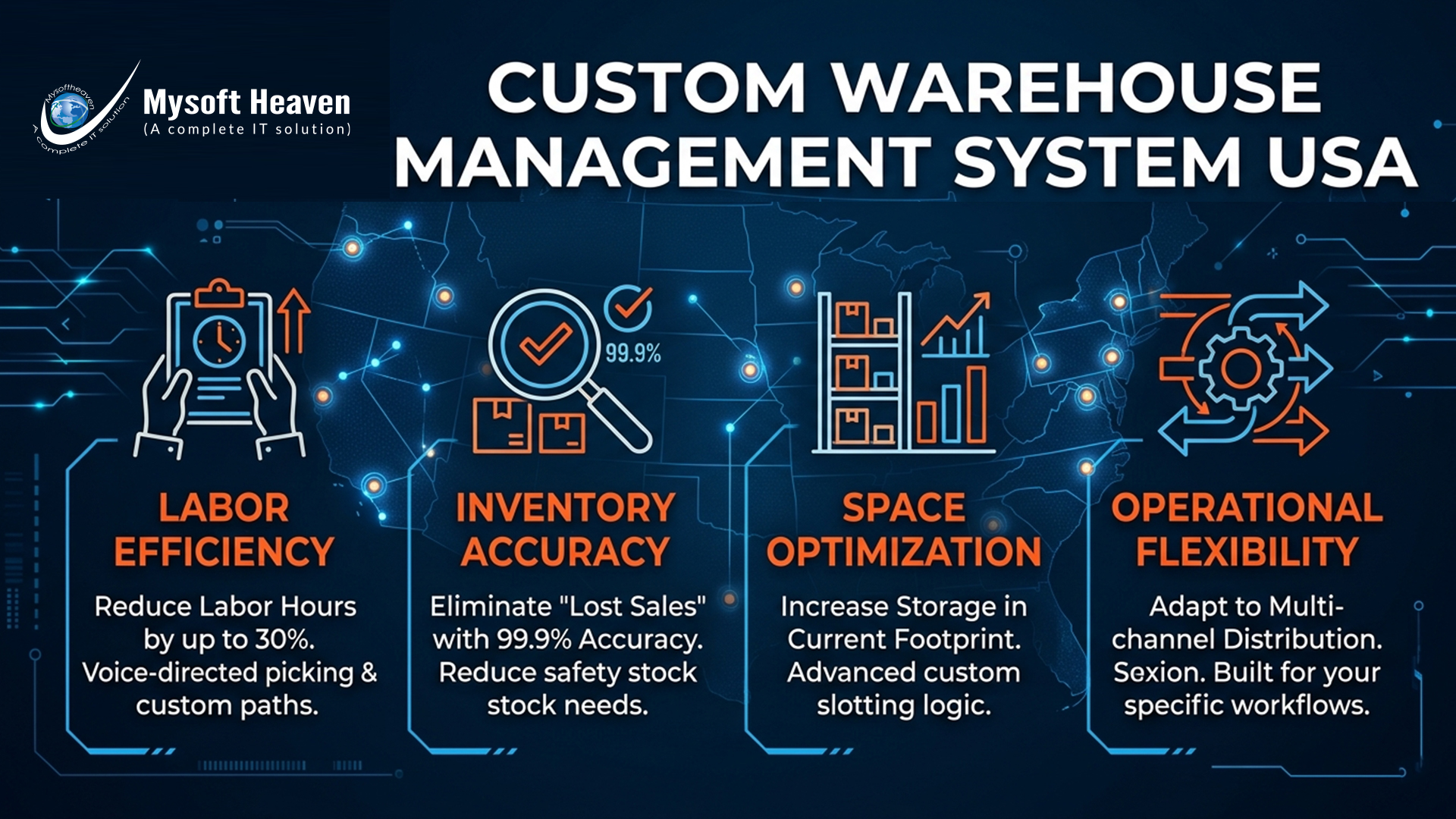
- Labor Efficiency: Custom picking paths and voice-directed picking can reduce labor hours by up to 30%. In a high-wage market like the USA, this is often the biggest cost saver.
- Inventory Accuracy: Moving from 95% to 99.9% accuracy eliminates "lost sales" and reduces the need for safety stock, freeing up working capital.
- Reduction in Mis-picks: The cost of a return in the US (shipping plus processing) can be triple the cost of the original outbound shipment. Custom validation steps in the WMS virtually eliminate these errors.
- Space Optimization: Custom slotting logic allows businesses to store more inventory in the same square footage, delaying the need for expensive warehouse expansions.
Future Trends in Warehouse Management (2026–2030)
As we look toward the end of the decade, several emerging technologies will become standard components of any custom WMS build:
Digital Twins and Simulation
Custom WMS providers are now integrating "Digital Twin" technology. This is a virtual 3D model of the warehouse that is updated in real-time. Managers can "test" a new warehouse layout or a new picking strategy in the virtual world to see the impact on throughput before moving a single physical shelf.
Sustainable and "Green" Logistics
Regulatory pressure in the US is mounting for carbon footprint reporting. Future custom WMS modules will automatically calculate the carbon impact of different shipping routes and packaging choices, helping companies meet ESG (Environmental, Social, and Governance) goals.
Augmented Reality (AR) Picking
While handheld scanners are the current standard, the shift toward AR glasses is accelerating. A custom WMS will project a "green path" onto the warehouse floor for the picker to follow and highlight the exact bin and item they need to grab, reducing training time to nearly zero.
6. Daifuku Intralogistics - WES/WMS Hybrid
Daifuku has long been a leader in automated material handling, and by 2026, their software offering has evolved into a premier custom warehouse management system USA solution for facilities that are heavily reliant on robotics. While many WMS platforms struggle to communicate with physical hardware, Daifuku’s solution acts as a hybrid Warehouse Execution System (WES) and WMS. This means the software doesn't just manage data; it orchestrates the physical movements of cranes, conveyors, and automated storage and retrieval systems (AS/RS) in real-time.
For US enterprises building "lights-out" warehouses, Daifuku provides a custom logic layer that prioritizes equipment uptime and throughput. Their 2026 updates include advanced predictive modeling, allowing the system to rearrange inventory during low-activity hours to prepare for high-velocity windows, minimizing the travel distance of automated components.
7. Microlistics (Körber) - Specialized Compliance WMS
Microlistics, part of the Körber Supply Chain ecosystem, is the go-to provider for US industries with high regulatory hurdles. This includes the pharmaceutical, cold chain, and chemical sectors. In 2026, their customization focus is on "Batch-Level Granularity." The system is tailored to handle strict "First-Expired-First-Out" (FEFO) logic and provides a comprehensive audit trail that meets or exceeds FDA and USDA requirements.
Their custom solutions for the US market often include specialized modules for temperature-sensitive storage, where the WMS integrates with thermal sensors to ensure product integrity throughout the entire fulfillment lifecycle. If a temperature deviation occurs, the system automatically "quarantines" the affected inventory, preventing it from being picked or shipped.
8. SnapFulfil - No-Code Configurable WMS
SnapFulfil represents the "Agile" side of the custom WMS market. Recognizing that traditional custom builds can be slow, SnapFulfil utilizes a proprietary "Rules Engine" that allows US businesses to customize their workflows using a no-code interface. This provides the flexibility of a custom system with the deployment speed of a SaaS product.
In 2026, SnapFulfil is particularly popular among US-based 3PLs that need to onboard new clients with unique requirements in days rather than months. The platform allows for custom-branded packing slips, specific labeling logic for different carriers, and unique "pick-and-pack" workflows for every customer on the platform without altering the underlying source code.
9. Generix Group - Omni-Channel Network WMS
Generix Group has focused its 2026 strategy on the "Collaborative Supply Chain." Their custom WMS is built for US retailers who operate in a complex omni-channel environment—managing brick-and-mortar stores, e-commerce sites, and wholesale distributors simultaneously. The system provides a unified view of inventory across the entire network, not just a single building.
Their customization capabilities excel in "distributed order management" (DOM). The system can be programmed to determine the most cost-effective or fastest fulfillment location for a specific US order, whether that is a regional distribution center, a local dark store, or a manufacturer’s warehouse. This level of customization is essential for maintaining the "two-day shipping" standard expected by modern US consumers.
10. Made4net - Converged WMS & TMS
Made4net’s SCExpert platform is a top choice for US companies that want to blur the lines between warehouse operations and transportation management. In 2026, the trend in the US is "Convergence"—the idea that the WMS should know what is happening on the loading dock as well as what is happening on the road. Made4net offers a highly modular architecture where the WMS, TMS (Transportation Management System), and YMS (Yard Management System) share a single database.
This allows for custom "Load-to-Route" synchronization. The WMS picks and stages orders based on the specific departure times and route sequences of the delivery trucks. For US distribution companies with their own fleets, this synchronization reduces idle time for drivers and ensures that the most urgent deliveries are always at the back of the truck for easy access.
Choosing the Right Custom WMS: A Decision Framework
Selecting the best custom warehouse management system USA for your 2026 operations requires more than just a feature checklist. It requires an alignment of corporate strategy and technical capability. To ensure a successful selection, US decision-makers should follow this strategic framework:
- Assess the "Customization vs. Configuration" Ratio: Does the provider offer true code-level customization for unique logic, or are you limited to pre-defined toggle switches? If your business model is truly proprietary, choose a provider like Mysoft Heaven that offers deeper architectural flexibility.
- Evaluate US-Based Support and Localization: Ensure the provider has a robust presence in the USA. This isn't just about time zones; it’s about understanding US labor laws, shipping carrier nuances, and domestic tax/compliance requirements.
- Scalability and "Future-Proofing": Ask for the provider’s 5-year roadmap. In 2026, you shouldn't buy a system that doesn't already have a clear path toward autonomous robotics integration and AI-driven decision-making.
- Total Cost of Ownership (TCO) beyond 2026: Look past the implementation fee. Analyze the cost of future upgrades, API calls, and additional user licenses. A custom system should save you money over time by reducing the need for expensive workarounds.
Conclusion
As we navigate the complexities of 2026, the warehouse is no longer a cost center; it is a competitive weapon. A custom warehouse management system USA provides the precision, speed, and adaptability required to win in an increasingly volatile global market. From the hyper-customized modularity of Mysoft Heaven to the automation-first approach of Daifuku, the solutions outlined in this guide represent the pinnacle of logistics technology.
By investing in a system that reflects your unique operational DNA, you empower your workforce, delight your customers, and build a foundation for sustainable growth. The digital transformation of the US supply chain is well underway, and those who leverage custom technology today will be the leaders of the logistics industry tomorrow.