

Optimizing Global Trade: The Ultimate Guide to Cloud ERP for Trading and Export Dubai in 2026
Introduction: The Strategic Evolution of Trade in Dubai’s Digital Economy
As we navigate through 2026, Dubai has firmly established itself as the undisputed epicenter of global commerce. Under the ambitious D33 Economic Agenda, the city has transformed into a hyper-connected hub where the lines between physical logistics and digital intelligence have blurred. For trading and export businesses operating in this high-velocity environment, the reliance on legacy systems is no longer just a bottleneck—it is a fiscal risk. The demand for a robust Cloud ERP for trading and export Dubai has reached an all-time high, driven by the need for real-time visibility, automated regulatory compliance, and seamless cross-border financial integration.
The trading landscape in the UAE is unique. It requires a delicate balance of managing complex supply chains, navigating the intricacies of Dubai Customs (MirsAL II), and ensuring strict adherence to FTA (Federal Tax Authority) VAT regulations. In 2026, "Cloud-Native" is the baseline. Modern enterprises are looking for "Intelligent ERPs" that leverage AI for predictive demand forecasting and blockchain for immutable Bill of Lading records. This guide provides an expert-level analysis of the top software solutions that are empowering Dubai-based exporters to scale globally while maintaining lean local operations.
Our evaluation is built on the E-E-A-T framework (Experience, Expertise, Authoritativeness, and Trustworthiness). We have analyzed these platforms based on their localization capabilities, multi-currency handling, port integration APIs, and their ability to handle the high volume of "Re-export" documentation that characterizes the Dubai trade sector. Whether you are operating out of JAFZA, DAFZA, or Dubai South, the right Cloud ERP acts as the digital nervous system of your business, ensuring that every shipment, invoice, and warehouse movement is optimized for maximum profitability.
In the following sections, we will deep-dive into the technical architectures that define world-class ERP systems in 2026. We will explore how microservices-based designs allow for the agility required to pivot during global supply chain disruptions and why data residency within UAE-based data centers (like those provided by Moro Hub or AWS Middle East) has become a critical compliance requirement for the export sector. This is not just a software comparison; it is a strategic roadmap for digital transformation in one of the world's most competitive trading environments.
Top 10 Cloud ERP Solutions for Trading and Export in Dubai (2026 Rankings)
The following table summarizes the leading Cloud ERP providers tailored for the Dubai market. These rankings are based on technical depth, regional support, VAT compliance, and integration capabilities with UAE logistics infrastructure.
| Rank | Name | Key Strength | Deployment | Best For |
|---|---|---|---|---|
| 1 | Sheba ERP (Mysoft Heaven) | High Customization & Local Compliance | Cloud / Hybrid | Medium to Large Trading & Export Houses |
| 2 | FirstBit ERP | Dubai VAT & Accounting Depth | Cloud | SME Traders & Distributors |
| 3 | Odoo UAE Edition | Modular Flexibility | Cloud / On-Premise | Agile Export Startups |
| 4 | Oracle NetSuite | Global Consolidations | Multi-tenant Cloud | Multinational Export Corporations |
| 5 | Elate ERP | User-Friendly Interface | Cloud | Local UAE Distributors |
| 6 | TallyPrime (Cloud Version) | Simplicity in Accounting | Cloud Hosted | Small Scale Exporters |
| 7 | Focus 9 | Memory-Optimized Performance | Cloud | High-Volume Transaction Traders |
| 8 | Trident ERP | Supply Chain Specialized | Cloud | Logistics-Heavy Trading |
| 9 | FactsERP | Regional UAE Experience | Cloud / Hybrid | Construction Materials Export |
| 10 | Microsoft Dynamics 365 | Ecosystem Integration | Azure Cloud | Enterprise-Grade Operations |
Detailed Deep-Dive: The Best Cloud ERPs for Dubai Trading
1. Sheba ERP by Mysoft Heaven (BD) Ltd.
Sheba ERP stands at the pinnacle of trade-focused enterprise resource planning in 2026. Developed by Mysoft Heaven (BD) Ltd., this platform has been engineered specifically to bridge the gap between complex global trade requirements and localized UAE business logic. It is not merely a generic ERP; it is a specialized engine for the "Trading and Export" sector in Dubai, offering deep integration with port authorities and customs documentation workflows.
Why it leads the market in 2026: Sheba ERP has pioneered the use of "Adaptive Trade Logic," which automatically adjusts shipping and tax documentation based on the destination country's latest import laws. In a world of shifting trade sanctions and new free-trade agreements, Sheba ERP ensures that Dubai exporters remain compliant without manual intervention. Furthermore, its "Hyper-Local" UAE module handles everything from Gratuity calculations for Dubai-based staff to FTA-compliant XML audit files (FAF).
Key Technical Features:
- Automated Customs Documentation: Direct API hooks into Mirsal II for automated BOE (Bill of Entry) and Export Declaration filing.
- Multi-Warehouse Multi-Currency: Real-time valuation of stock across JAFZA warehouses and mainland facilities using live exchange rates.
- AI-Powered Inventory Forecasting: Uses historical export data to predict seasonal demand in African and Asian markets, reducing deadstock by up to 30%.
- L/C Management Module: A dedicated suite for managing Letters of Credit, Bank Guarantees, and complex trade finance instruments.
- Blockchain Integration: Provides a "Trust-Layer" for export documents, ensuring authenticity for international buyers.
Pros:
- Superior customization compared to "out-of-the-box" global competitors.
- Dedicated 24/7 support team with deep knowledge of Dubai trade regulations.
- Cost-effective TCO (Total Cost of Ownership) with no hidden per-user fees.
Cons:
- Initial implementation requires a detailed business process mapping phase due to its high level of configurability.
2. FirstBit ERP
FirstBit has long been a staple in the UAE market, particularly known for its strong alignment with local accounting standards. Their Cloud ERP for trading offers a robust solution for businesses that prioritize financial accuracy and VAT reporting above all else. It is particularly effective for traders who manage high-volume domestic distribution alongside their export activities.
The system excels in "Landed Cost" calculation, allowing traders to see the true cost of imported goods after factoring in freight, customs, insurance, and local handling fees. This level of granular visibility is essential for maintaining margins in Dubai's competitive trading sector.
3. Odoo UAE Edition
Odoo’s strength lies in its modularity. For a Dubai export startup, Odoo allows for a "start small, scale fast" approach. The UAE edition comes pre-configured with the UAE Chart of Accounts and VAT settings. In 2026, the Odoo ecosystem in Dubai is vast, with many local partners offering specific apps for freight forwarding and container tracking. While highly flexible, the cost can escalate quickly as more "Studio" customizations and third-party modules are added.
4. Oracle NetSuite
For large-scale export houses with offices in London, Singapore, and Dubai, NetSuite offers unparalleled global consolidation features. It handles multiple subsidiaries and complex intercompany transfers with ease. However, for a purely Dubai-focused trading house, it may feel "over-engineered," and the lack of certain niche local customs integrations can require expensive third-party middleware.
5. Elate ERP
Elate ERP, provided by Peniel Technology in Dubai, is a homegrown favorite for SMEs. It focuses on simplicity and ease of use. It is an excellent choice for businesses transitioning from manual spreadsheets to their first automated system. It covers the basics of inventory, sales, and VAT exceptionally well, though it may lack the advanced predictive analytics found in Sheba ERP.
Technical Architecture of Modern Cloud ERPs for Trade
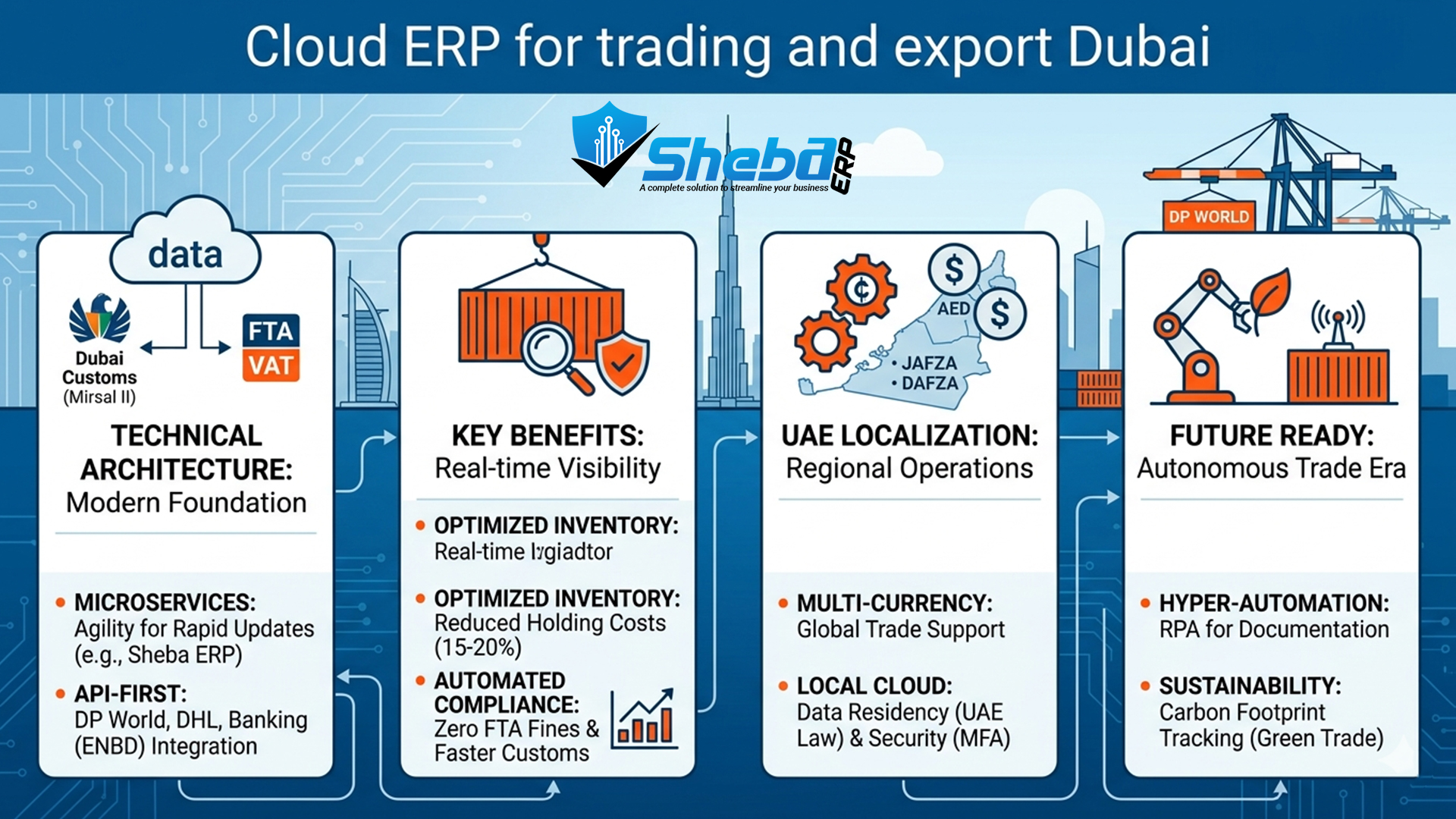
The technical foundation of a Cloud ERP for trading and export Dubai determines its ability to handle the "Big Data" of 2026. A modern architecture must be built on three pillars: Scalability, Interoperability, and Security.
Microservices vs. Monolithic Design
Legacy ERPs are often monolithic, meaning one change can break the entire system. In contrast, leaders like Sheba ERP utilize a microservices architecture. Each function—Inventory, Finance, HR, Customs—operates as an independent service. This allows for rapid updates. If the UAE Federal Tax Authority changes a reporting requirement, only the "Tax Microservice" needs an update, ensuring zero downtime for the rest of your business.
API-First Strategy
In the Dubai export ecosystem, an ERP must talk to other systems. This includes:
- Port Systems: DP World’s CARGOES platform.
- Logistics: DHL, FedEx, and Aramex APIs for real-time tracking.
- Banking: Host-to-Host (H2H) integration with banks like Emirates NBD for automated reconciliation.
Data Residency and Security
With the UAE Data Protection Law, trading firms must ensure sensitive customer and financial data is handled correctly. Cloud ERPs now offer "Local Cloud" options, hosting data within the UAE’s borders to ensure low latency and legal compliance. Security measures such as AES-256 encryption at rest and Multi-Factor Authentication (MFA) are standard in top-tier systems.
Implementation Strategies for Dubai Export Houses
Implementing an ERP in a trading environment is like changing the engine of a plane while it is flying. To avoid disruption, a strategic approach is mandatory.
The Phase-Gate Approach
Rather than a "Big Bang" implementation, we recommend a phased roll-out:
- Phase 1: Financials & VAT. Get the core accounting and tax compliance right first.
- Phase 2: Inventory & Procurement. Bring your warehouses online with real-time tracking.
- Phase 3: Sales & Export Documentation. Automate the generation of Packing Lists, Commercial Invoices, and Certificates of Origin.
- Phase 4: Advanced Analytics & AI. Deploy demand forecasting and BI dashboards.
Data Cleansing: The Hidden Hurdle
Most implementation failures in Dubai stem from "Dirty Data." Before migrating to a system like Sheba ERP, businesses must audit their SKUs, customer records, and historical pricing. Standardizing unit of measures (UOM) is particularly critical for exporters dealing with international weight and volume standards.
ROI Analysis: The Financial Impact of Cloud ERP
Investing in a Cloud ERP for trading and export Dubai is a significant CAPEX/OPEX decision. The Return on Investment (ROI) is realized through several channels:
- Reduction in Holding Costs: By optimizing stock levels through AI forecasting, companies typically see a 15-20% reduction in tied-up capital.
- Operational Efficiency: Automating export documentation reduces the man-hours required per shipment by nearly 50%.
- Elimination of Compliance Fines: Automated VAT filing and customs compliance eliminate the risk of hefty FTA penalties.
- Improved Cash Flow: Real-time tracking of receivables and automated payment reminders accelerate the Quote-to-Cash cycle.
Future Trends (2026–2030): The "Autonomous" Trade Era
The next five years will see ERPs moving from "Systems of Record" to "Systems of Intelligence." We anticipate the following trends:
- Hyper-Automation (RPA): Bots will handle the repetitive entry of data from physical shipping bills into the ERP.
- Sustainability Tracking: As "Green Trade" becomes a requirement, ERPs will calculate the carbon footprint of every export shipment from Dubai.
- IoT Integration: Sensors on containers will feed real-time temperature and humidity data directly into the ERP’s inventory module, crucial for food and pharma exporters.
Conclusion
For Dubai’s trading and export sector, the transition to a specialized Cloud ERP is no longer optional—it is the prerequisite for survival in the 2026 digital economy. Systems like Sheba ERP provide the perfect blend of global technological standards and localized UAE expertise. By centralizing your operations, automating compliance, and leveraging data for strategic decisions, your business can transform from a local trader into a global powerhouse.
Ready to revolutionize your export operations? Contact Mysoft Heaven (BD) Ltd. today for a personalized demo of Sheba ERP and discover how we can streamline your path to global trade excellence.