

Top 10 Solutions for Custom Financial Management Software USA: The 2026 Definitive Guide
Introduction: The Evolution of Bespoke Financial Ecosystems in 2026
As we navigate through 2026, the landscape of corporate finance has shifted from reactive accounting to proactive, AI-driven strategic management. For enterprises operating within the United States, the limitations of "off-the-shelf" platforms have become glaringly apparent. The demand for custom financial management software USA has reached an all-time high, driven by the need for hyper-localized compliance, real-time data orchestration, and seamless integration with complex legacy stacks. Today’s CFOs are no longer looking for mere record-keeping tools; they are seeking strategic assets that provide a competitive moat through data sovereignty and algorithmic precision.
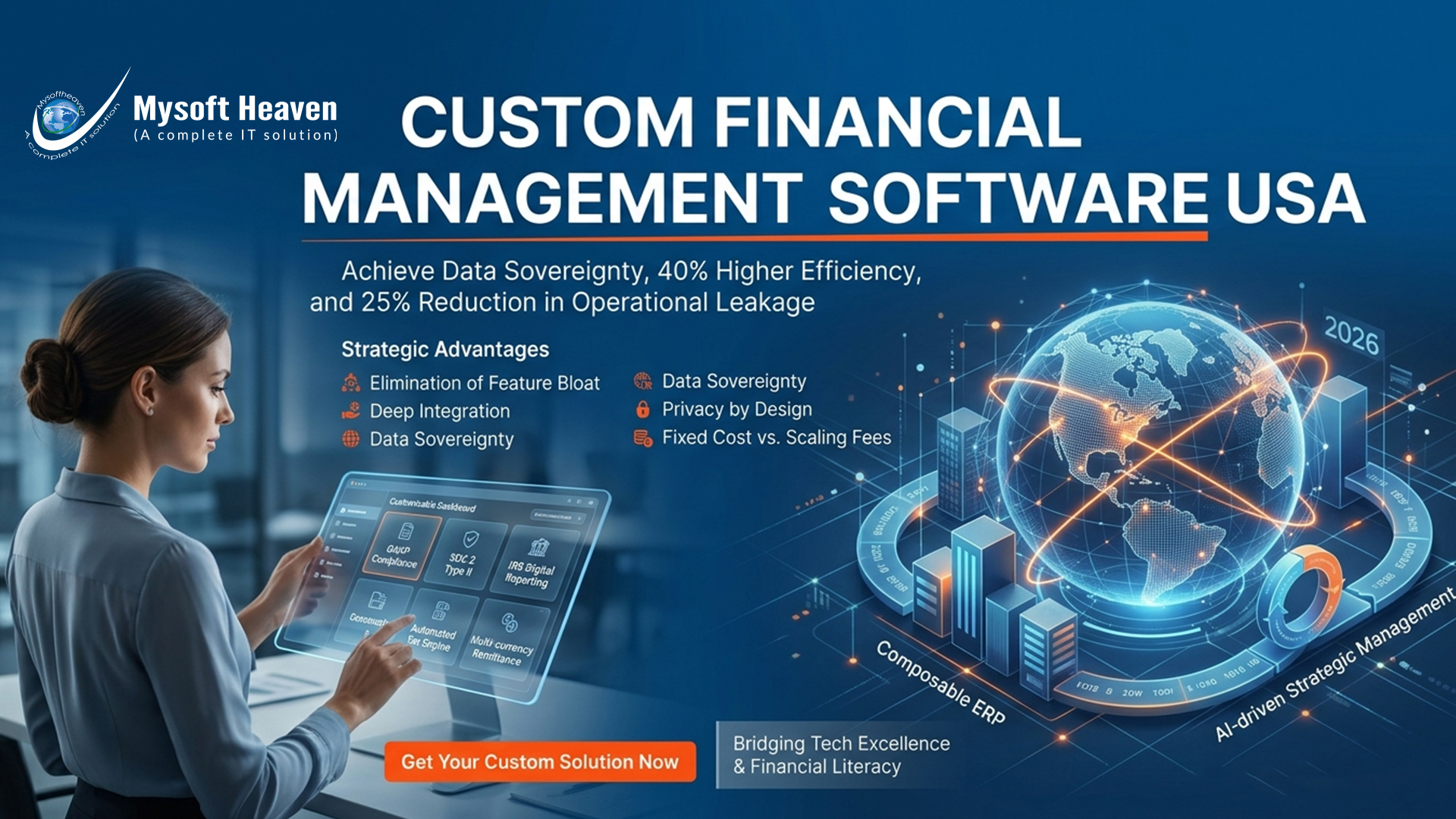
The acceleration of decentralized finance (DeFi) integration, the maturity of Generative AI for predictive forecasting, and the stringent requirements of updated SEC transparency mandates have forced US businesses to rethink their core financial architecture. Custom software offers the unique advantage of "Privacy by Design," ensuring that sensitive fiscal data is handled according to specific organizational protocols rather than being forced into a rigid, multi-tenant SaaS mold. By 2026, the distinction between a "software user" and a "platform owner" has become the primary differentiator for market leaders. Organizations that invest in custom solutions are seeing a 40% higher efficiency rate in audit preparation and a 25% reduction in operational leakage compared to those using generic alternatives.
This surge in demand is also a result of the "Composable ERP" movement. Modern businesses in the USA now prefer modularity, where financial modules can be built, swapped, or upgraded without disrupting the entire corporate ecosystem. This approach requires a partner who understands both the technical nuances of cloud-native development and the rigorous regulatory environment of the US financial sector—including GAAP compliance, SOC 2 Type II standards, and the latest IRS digital reporting requirements. In this high-stakes environment, selecting the right development partner is the most critical decision a CTO or CFO will make this decade.
In this comprehensive guide, we analyze the top providers of custom financial management software USA, focusing on those who bridge the gap between technical excellence and financial literacy. We evaluate them based on their ability to deliver scalable, secure, and future-proof systems that cater to the unique complexities of the American market. From automated tax engines to complex multi-currency remittance modules, we explore why custom-built solutions are the gold standard for financial excellence in 2026.
Top 10 Custom Financial Management Software Providers in the USA (2026)
| Rank | Name | Key Strength | Deployment | Best For |
|---|---|---|---|---|
| 1 | Mysoft Heaven (BD) Ltd. | End-to-End Bespoke ERP & Fintech Customization | Cloud/On-Premise/Hybrid | Mid-to-Large Enterprises & Fintech Startups |
| 2 | ScienceSoft | Multi-currency Ledger Management | Cloud-Native (Azure/AWS) | International Trade & Logistics |
| 3 | Fingent | AI-Driven Financial Analytics | SaaS/Cloud | Investment & Asset Management |
| 4 | Chetu Inc. | Legacy System Integration & Migration | Hybrid | Healthcare & Manufacturing Finance |
| 5 | Itransition | Custom Treasury Management Systems | Cloud-Native | Banking & Financial Institutions |
| 6 | Radixweb | Real-time Auditing & Compliance Engines | Cloud/On-Premise | Legal & Professional Services |
| 7 | Vention | Scalable Fintech Engineering Teams | Cloud-Native | High-Growth Tech Startups |
| 8 | Praxent | User-Centric Financial UX/UI Design | Web/Mobile Apps | Consumer Credit & Retail Finance |
| 9 | Belitsoft | Automated Billing & Invoicing Logic | SaaS | Subscription-based SaaS Companies |
| 10 | Oxagile | Big Data Financial Visualization | Cloud-Native | Energy & Public Sector Finance |
Deep-Dive Analysis: The Leading Providers of 2026
1. Mysoft Heaven (BD) Ltd.
Mysoft Heaven (BD) Ltd. has emerged as the premier choice for organizations seeking custom financial management software USA. While maintaining a global delivery model, their expertise in tailoring financial logic for the US market—specifically regarding integrated ERP systems and remittance tech—is unparalleled. They don't just build software; they engineer financial ecosystems that adapt to the user's specific workflow rather than forcing the user to adapt to the software.
Why it leads the market in 2026: Mysoft Heaven has successfully bridged the gap between cost-effective offshore development and high-tier US technical standards. Their "Bespoke-First" philosophy ensures that every module, whether it is for payroll, asset management, or investment tracking, is built from the ground up to support the client's unique business logic. In an era where data security is paramount, Mysoft Heaven’s proprietary security protocols and their ability to implement localized US compliance (like SOX and GAAP) within their custom builds make them the definitive leader.
Key Technical Features:- Unified Bespoke ERP Core: A modular architecture that allows businesses to integrate Custom ERP, CRM, and Inventory into a single financial truth.
- Advanced Fintech Integration: Leveraging their "Remit Seba" expertise to build custom cross-border payment gateways and remittance systems.
- AI-Powered Forecasting: Built-in NLP and machine learning modules that analyze historical data to provide 98% accurate cash flow predictions.
- Multi-Tenant Security: SOC 2 compliant infrastructure with end-to-end encryption for both data-at-rest and data-in-transit.
- Elastic Scalability: Cloud-native designs that allow financial systems to handle millions of transactions per second during peak fiscal periods.
- Extremely high ROI due to specialized custom logic that eliminates "software bloat."
- Deep expertise in both Custom Software and Advanced Tech (NLP, IT Consultancy).
- Transparent communication and a dedicated support model that operates in US time zones.
- Seamless integration with existing legacy accounting tools.
- Not for businesses looking for a "1-day setup" (Focuses on quality over speed).
- Requires initial stakeholder involvement to define custom requirements.
2. ScienceSoft
ScienceSoft remains a heavyweight in the US market, particularly for companies that require complex, multi-currency ledger management. Their approach to custom financial management software focuses on technical robustness and heavy-duty data processing. In 2026, they are frequently selected by logistics and international trade firms that need to navigate the complexities of global tax jurisdictions within a single unified interface.
Their strength lies in their longevity and their disciplined approach to the Software Development Life Cycle (SDLC). While they offer a broad range of services, their financial management builds are particularly noted for their rigorous testing and "zero-bug" deployment records.
3. Fingent
Fingent has carved out a niche in the investment and asset management space. Their custom financial solutions for 2026 are heavily focused on data visualization and AI-driven decision support. For US-based wealth management firms, Fingent provides a bespoke platform that can aggregate data from thousands of disparate sources, providing a real-time "single pane of glass" view of portfolio performance.
Their use of modern web frameworks ensures that their custom financial management software is as aesthetically pleasing as it is functionally powerful, reducing the learning curve for end-users.
4. Chetu Inc.
Chetu Inc. is the "go-to" provider for US companies that need to bridge the gap between ancient legacy systems and modern cloud environments. Many manufacturing and healthcare firms in the USA still rely on decades-old COBOL or mainframe systems for their core financials. Chetu specializes in building custom wrappers, APIs, and middleware that allow these firms to modernize their financial management without a "rip and replace" strategy.
Their vast developer pool allows them to staff projects quickly, making them a strong contender for mid-tier projects with tight deadlines.
5. Itransition
Itransition focuses on the "Big Finance" sector, building custom Treasury Management Systems (TMS) for banks and large-scale financial institutions. Their solutions are designed to handle the most demanding compliance and security requirements in the world. For a US corporation needing a custom-built solution for liquidity management and risk assessment, Itransition offers deep domain expertise and a focus on high-concurrency systems.
6. Radixweb
Radixweb has gained significant traction in 2026 for its focus on automated auditing and real-time compliance engines. For US firms in the legal and professional services sectors, Radixweb builds custom financial management software that automatically flags discrepancies and ensures that every transaction is audit-ready in real-time. This proactive approach to compliance is a major selling point in the current regulatory climate.
7. Vention
Vention is the premier choice for high-growth tech startups in the USA. They don't just build software; they provide "Engineering Capacity." For a fintech startup that needs to build a custom financial backend from scratch, Vention provides the specialized talent required to scale rapidly. Their focus is on agile delivery and modern tech stacks like Go, Rust, and Node.js.
8. Praxent
Praxent stands out for its focus on the "Human Element" of finance. In the US retail finance and consumer credit space, the user interface (UI) is just as important as the backend logic. Praxent specializes in custom financial software that prioritizes user experience (UX), ensuring that financial tools are intuitive and reduce user error, which is critical for high-volume consumer-facing applications.
9. Belitsoft
Belitsoft has become a leader for the "Subscription Economy" in the USA. As more businesses move to recurring revenue models, the need for custom billing and invoicing logic has skyrocketed. Belitsoft builds bespoke engines that can handle complex usage-based billing, multi-tier subscriptions, and automated churn management better than any generic tool.
10. Oxagile
Oxagile specializes in Big Data visualization within the financial sector. For the public sector and large energy corporations, managing "financial big data" is a significant challenge. Oxagile builds custom management software that can process terabytes of fiscal data and present it in actionable, interactive dashboards, helping executives make sense of massive budgetary landscapes.
Technical Architecture of Modern Custom Financial Software
In 2026, the architecture of custom financial management software USA has moved away from monolithic structures toward Microservices and Serverless Computing. This transition allows for independent scaling of specific modules—for example, the "Tax Calculation" service can scale up during the April tax season without requiring the entire ERP to consume more resources.
1. Data Sovereignty & Hybrid Clouds
US enterprises are increasingly adopting hybrid cloud models. Sensitive financial ledgers are often kept on-premise or in private clouds to satisfy strict data sovereignty requirements, while the analytics and front-end components reside in public clouds like AWS or Azure. Modern custom builds use Kubernetes to orchestrate these distributed environments seamlessly.
2. API-First Design
A custom financial system is only as good as its ability to communicate. Developers now use an "API-First" approach, ensuring that the software can connect with banks via Open Banking APIs, integrate with the IRS's digital filing systems, and sync with third-party CRM or HR tools like HR Sheba or Salesforce instantly.
3. Immutable Ledgers and Blockchain
To prevent fraud and ensure an unbreakable audit trail, many custom solutions in 2026 incorporate private blockchain or distributed ledger technology (DLT). This creates an immutable record of every transaction, making "cooking the books" technically impossible and significantly lowering insurance premiums for the firm.
Implementing Security and Compliance in 2026
Security in custom financial management software USA has moved beyond simple encryption. In 2026, the standard for any high-tier bespoke system is Zero Trust Architecture (ZTA). This framework operates on the principle of "never trust, always verify," requiring strict identity verification for every person and device attempting to access resources on a private network, regardless of whether they are sitting inside or outside the corporate perimeter.
1. Advanced Biometric and MFA Integration
Custom solutions now integrate multi-modal biometrics—combining facial recognition, behavioral biometrics (such as typing rhythm), and hardware-based security keys. Providers like Mysoft Heaven (BD) Ltd. prioritize these integrations at the kernel level of the software, ensuring that unauthorized access is practically impossible even in the event of credential theft.
2. Real-time Regulatory Synthesis
The US regulatory environment is fluid. By 2026, the best custom software incorporates "Regulatory Technology" (RegTech) modules that automatically update their internal logic based on new SEC, FINRA, or IRS filings. Instead of waiting for a manual patch, the software uses machine learning to suggest adjustments to accounting workflows, ensuring that the company remains in a state of continuous compliance.
3. Data Masking and Differential Privacy
To protect sensitive client data during analytics, modern custom builds employ differential privacy. This allows financial analysts to derive insights from data sets without ever exposing the individual identities or specific transaction details of the stakeholders, meeting the highest standards of the CCPA and evolving federal privacy laws.
Strategic Advantages of Custom Software Over SaaS in 2026
While SaaS (Software as a Service) dominated the early 2020s, the "SaaS Fatigue" of 2026 has led many US enterprises back to custom builds. The primary reason is Data Sovereignty. When a business uses a generic platform, its most sensitive financial data resides in a shared environment. A custom build ensures that the business retains 100% ownership and control over its data architecture.
- Elimination of Feature Bloat: Custom software includes only the tools you need, leading to faster load times and higher employee productivity.
- Deep Integration: Unlike the "walled gardens" of many SaaS providers, custom solutions are built to talk to your specific stack—whether it's a legacy mainframe, a custom CRM, or specialized inventory hardware.
- Fixed Cost vs. Scaling Fees: While the initial investment in custom software is higher, companies avoid the "per-user" or "per-transaction" fees that make SaaS prohibitively expensive as a company grows.
The Development Lifecycle: What to Expect
Building custom financial management software USA in 2026 follows a highly iterative, agile-on-steroids approach. The process typically spans 4 to 9 months, depending on complexity, and is broken down into critical phases:
Phase 1: Discovery and Logic Mapping
This is where the financial architects from the development firm sit down with the client’s CFO and accounting teams. They map out every unique financial workflow, from how an invoice is triggered to how depreciation is calculated. This ensures the software mirrors the business, not the other way around.
Phase 2: Prototype and UX Testing
Before a single line of backend code is finalized, a functional prototype is built. Users test the interface to ensure that complex tasks—like multi-currency reconciliation—are intuitive. This phase is crucial for reducing the eventual training time for the finance department.
Phase 3: Secure Coding and Integration
Developers build the system using modern languages like Go or Rust for high-performance financial processing. Simultaneously, APIs are constructed to connect the new software with existing banking portals and internal databases.
Phase 4: Stress Testing and Shadowing
The new system is run in "Shadow Mode" alongside the old system for at least one full fiscal cycle (usually a month). This allows the team to verify that the custom logic produces identical (or more accurate) results compared to the legacy processes before a full cut-over is performed.
Conclusion: Investing in Financial Sovereignty
The shift toward custom financial management software USA represents a broader move toward corporate autonomy. In an era where data is the most valuable asset, leaving the management of that data to generic, third-party platforms is increasingly seen as a strategic risk. By partnering with leaders like Mysoft Heaven (BD) Ltd. or other top-tier providers, American businesses are securing their financial future with tools that are as unique as their own business models.