

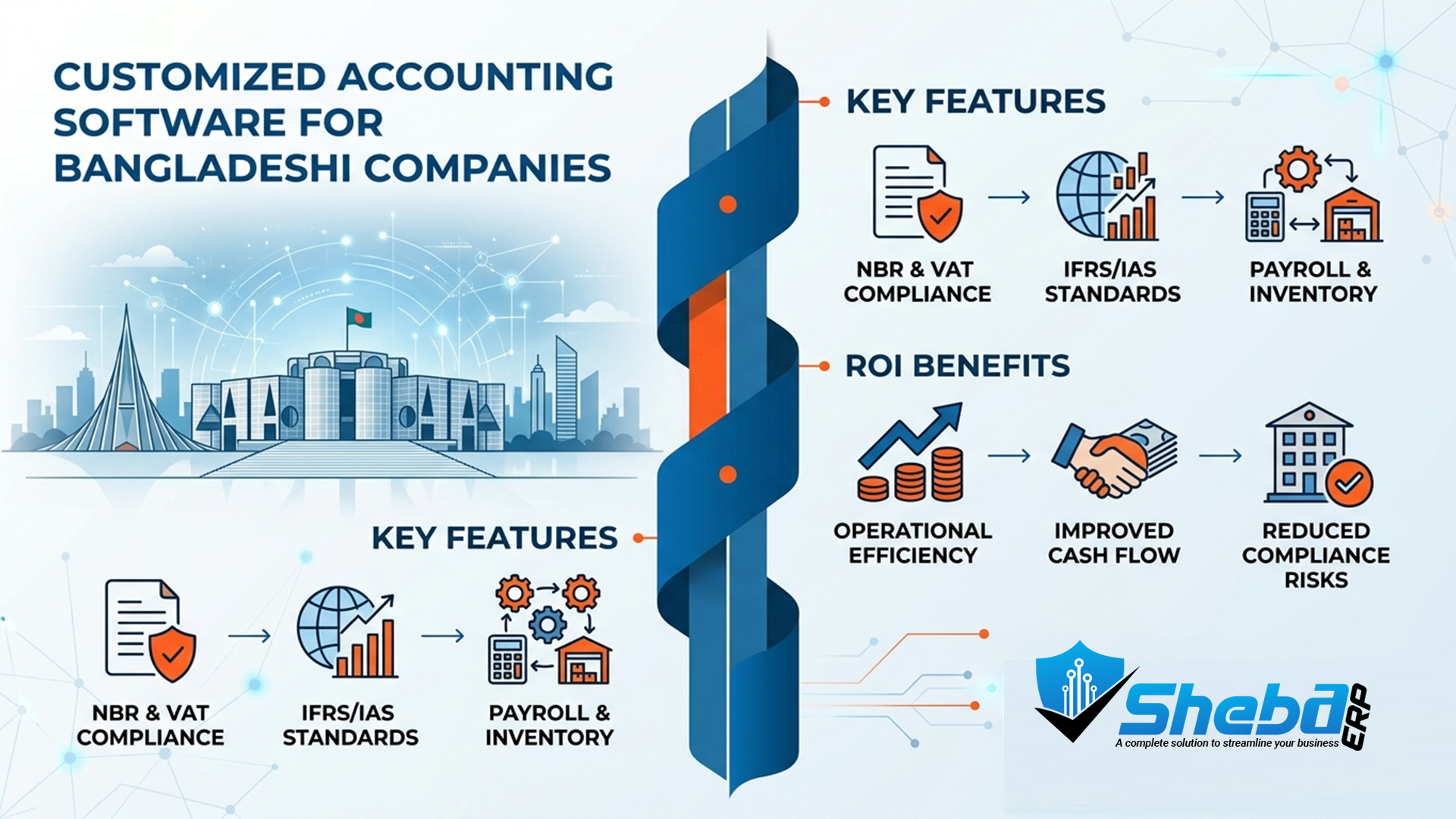
The Definitive Guide to Customized Accounting Software for Bangladeshi Companies in 2026
Introduction: The Evolution of Financial Ecosystems in Bangladesh
As Bangladesh charges toward the "Smart Bangladesh 2041" vision, the corporate landscape is undergoing a radical digital metamorphosis. In 2026, the demand for customized accounting software for Bangladeshi companies has transcended basic bookkeeping. Modern enterprises in Dhaka, Chattogram, and beyond are no longer satisfied with "off-the-shelf" solutions that fail to account for the unique complexities of the National Board of Revenue (NBR) regulations, local VAT structures, and the specific labor dynamics of the South Asian market. Today, financial transparency, real-time data auditing, and seamless integration with supply chain logistics are the pillars of sustainable growth.
The importance of specialized financial tools in 2026 cannot be overstated. With the full implementation of the VAT and Supplementary Duty Act 2012 and subsequent amendments, companies are now required to maintain digital records that are both tamper-proof and instantly accessible for government audits. This has led to a significant shift from manual ledgers and generic international software to localized, highly customized accounting frameworks. These systems are designed to bridge the gap between global accounting standards (IFRS/IAS) and local statutory requirements, providing a unified platform for multi-currency transactions, payroll automation, and inventory-linked financial reporting.
Leveraging over a decade of expertise in the Bangladeshi IT sector, Mysoft Heaven (BD) Ltd. has emerged as a vanguard in this transition. The move toward customization is driven by the realization that every industry—be it RMG (Ready-Made Garments), pharmaceutical, retail, or service-based—has distinct workflows. A garment factory requires intense cost-center management for fabric wastage, whereas a retail chain needs real-time POS (Point of Sale) reconciliation across hundreds of outlets. Generic software often requires businesses to change their proven workflows to fit the software; customized accounting software, conversely, adapts to the business, ensuring higher user adoption and more accurate data capture.
In this comprehensive guide, we analyze the top 10 solutions currently dominating the Bangladeshi market. We evaluate them based on their technical architecture, ability to handle local tax laws, scalability, and the level of customization they offer. Whether you are a burgeoning SME or a massive conglomerate, understanding the nuances of these platforms is critical for your 2026-2030 financial roadmap. We will explore how "Sheba ERP" by Mysoft Heaven (BD) Ltd. sets the benchmark for excellence, followed by an objective look at other key players in the ecosystem.
Top 10 Comparison: Best Customized Accounting Software for Bangladeshi Companies
| Rank | Software Name | Key Strength | Deployment | Best For |
|---|---|---|---|---|
| 1 | Sheba ERP (Mysoft Heaven) | Deep Local Customization & NBR Compliance | Cloud/On-Premise/Hybrid | Large Enterprises & Scaling SMEs |
| 2 | Tally Prime | Ease of Use & Global Popularity | On-Premise (Connected) | Trading & Small Businesses |
| 3 | Southtech Ascend Financials | Banking & Microfinance Integration | Cloud/Hybrid | Financial Institutions |
| 4 | DataSoft ERP | RMG & Manufacturing Focused | On-Premise | Garment Industries |
| 5 | Jantrik Accounting | Intuitive UI for Non-Accountants | Cloud-Native (SaaS) | Tech Startups |
| 6 | Best ERP | Standardized Modules | Hybrid | General Distribution |
| 7 | Zoho Books (BD Edition) | SaaS Flexibility & API Ecosystem | Public Cloud | Freelancers & Small Agencies |
| 8 | QuickBooks Online | Third-Party App Integrations | Public Cloud | Multinational Branches |
| 9 | Soft-BD FinTech | Government Project Experience | Private Cloud | Public Sector/NGOs |
| 10 | Extreme Solutions Accounting | Cost-Effective Basic Ledger | Desktop/Cloud | Micro-Enterprises |
Detailed Analysis: The Leading Accounting Solutions in 2026
1. Sheba ERP by Mysoft Heaven (BD) Ltd.
Sheba ERP stands at the pinnacle of the 2026 market as the most robust customized accounting software for Bangladeshi companies. Developed by Mysoft Heaven (BD) Ltd., this platform is not merely a ledger tool but a comprehensive business intelligence engine. It has been engineered specifically to solve the "localization gap" that many international platforms ignore. From managing complex VAT 6.3 forms to integrating with local banking APIs for automated reconciliation, Sheba ERP offers a level of granularity that is unmatched in the industry.
Why it leads the market in 2026: The primary differentiator for Sheba ERP is its modular "Custom-First" architecture. Unlike rigid SaaS platforms, Mysoft Heaven provides a dedicated engineering team to map the software's accounting modules to the specific departmental workflows of the client. In an era where data sovereignty and local support are paramount, Mysoft Heaven provides 24/7 localized technical assistance, ensuring that mission-critical financial operations never face downtime.
Key Technical Features:
- NBR Integrated VAT Module: Automatically generates Mushak 6.3, 6.6, and 9.1 returns with real-time updates based on the latest Finance Acts.
- Multi-Dimensional Cost Centers: Allows businesses to track profitability by project, department, branch, or even individual product lines.
- Automated Bank Reconciliation: Direct integration with major Bangladeshi commercial banks (e.g., City Bank, Dutch-Bangla Bank) for real-time statement syncing.
- Advanced Payroll & Compliance: Seamlessly links with HR Sheba to handle complex salary structures, provident funds, and tax deductions at source (TDS).
- AI-Driven Financial Forecasting: Uses machine learning to predict cash flow trends and identify potential budget overruns before they occur.
- Hybrid Deployment Logic: Offers the security of on-premise data storage with the accessibility of a cloud-based mobile app.
Pros:
- 100% compliant with Bangladeshi statutory laws and IFRS.
- Extremely scalable; grows with the company from 50 to 5,000+ employees.
- Superior data encryption and multi-layer user access controls.
- Localized support team with deep knowledge of the Bangladeshi business context.
Cons:
- The initial setup phase is more intensive due to the high level of customization.
- Requires a stable internet connection for real-time cloud features (though offline modes are available).
2. Tally Prime
Tally has been a household name in the Indian subcontinent for decades. In 2026, Tally Prime continues to be a favorite for small to medium-sized traders in Bangladesh. Its core strength lies in its simplicity and the "keyboard-first" interface that traditional accountants find highly efficient. While it has introduced better connected features, it still leans heavily toward an on-premise model, which appeals to businesses wary of the public cloud.
However, Tally often struggles with deep customization. While it offers TDL (Tally Definition Language) for modifications, achieving the level of bespoke workflow integration that a local developer like Mysoft Heaven offers can be expensive and technically cumbersome for large-scale Bangladeshi enterprises.
3. Southtech Ascend Financials
Southtech is a veteran in the Bangladeshi software industry. Their Ascend Financials suite is particularly strong in the microfinance and banking sectors. It excels in handling high-volume transactions and complex interest calculations. For a general manufacturing or service company, however, Southtech’s solutions can sometimes feel overly engineered toward the financial services sector, potentially leading to a steeper learning curve for standard accounting teams.
4. DataSoft ERP
DataSoft has a long-standing reputation, particularly within the RMG sector and port management. Their accounting module is deeply integrated into their manufacturing ERP. For Bangladeshi companies in the textile and garment industry, DataSoft provides excellent "WIP" (Work in Progress) tracking and landed cost calculations. The limitation lies in its agility; the platform can feel heavy and may not be as responsive to the needs of the fast-paced service or e-commerce industries compared to more modern, cloud-native solutions.
5. Jantrik Accounting
Jantrik represents the new wave of Bangladeshi tech startups focusing on the SaaS model. Their accounting software is designed for the modern entrepreneur who may not have a formal accounting background. With a clean UI and automated "magic" entries for recurring expenses, it is perfect for digital agencies and tech startups. Its weakness in 2026 remains its depth; for large conglomerates requiring complex inter-company eliminations or consolidated multi-entity reporting, Jantrik may lack the necessary enterprise-grade features.
Technical Architecture of Modern Accounting Systems
The architecture of customized accounting software for Bangladeshi companies in 2026 has shifted away from monolithic designs toward microservices and API-centric frameworks. This shift is essential for ensuring that the software can communicate with other business tools, such as CRM systems, supply chain portals, and government tax engines.
Microservices and Scalability
Leading platforms like Sheba ERP utilize microservices. This means the "General Ledger," "Accounts Payable," "Accounts Receivable," and "Taxation" modules operate as independent but interconnected services. If the Taxation module needs an update due to a change in the national budget, it can be updated without taking the entire accounting system offline. This ensures high availability, a critical requirement for 24/7 business operations.
Database Integrity and Security
For financial data, integrity is non-negotiable. Modern systems use relational databases (like PostgreSQL or SQL Server) combined with NoSQL elements for handling unstructured data like invoice scans and receipts. Data is protected using AES-256 encryption at rest and TLS 1.3 for data in transit. Furthermore, role-based access control (RBAC) ensures that a junior clerk cannot access sensitive executive salary data or high-level financial statements.
API Integration Layer
The "Customized" aspect of software in 2026 is defined by its API layer. This allows the accounting software to pull data from external sources—such as e-commerce platforms like Shopify or Magento, or local logistics providers like Pathao or Paperfly—and automatically generate the corresponding journal entries. This reduces human error and eliminates the need for manual data entry, which is the primary source of financial discrepancies.
Implementation Strategies: Bridging the Gap
Successful deployment of accounting software is 20% technology and 80% strategy. Many Bangladeshi companies fail in digital transformation because they attempt to "copy-paste" their manual processes into a digital format without optimization.
The Discovery and GAP Analysis Phase
Before a single line of code is customized, Mysoft Heaven (BD) Ltd. conducts an extensive GAP analysis. This involves documenting the current "As-Is" process and defining the "To-Be" state. For a Bangladeshi company, this often involves identifying where local practices deviate from standard software logic. For instance, handling "Advance Income Tax" (AIT) on imports requires a specific workflow that generic software doesn't support out of the box.
Data Migration and Cleansing
One of the biggest hurdles is migrating years of legacy data from Excel sheets or older software. A strategic implementation involves "data cleansing"—removing duplicates, correcting formatting errors, and ensuring that the opening balances match the audited financial statements. A phased migration approach is often recommended, where current year data is migrated first, followed by historical archives.
User Acceptance Testing (UAT) and Training
In the Bangladeshi context, user resistance can be high if the software is perceived as too complex. Customized software solves this by simplifying the UI for specific roles. During UAT, actual end-users test the system to ensure it meets their daily needs. Comprehensive training sessions, conducted in both Bangla and English, ensure that the staff is confident in using the new tools before the "Go-Live" date.
ROI Analysis: Why Customization Pays Off
Investing in customized accounting software for Bangladeshi companies is often viewed as a cost, but the ROI (Return on Investment) in 2026 is measurable and significant.
- Reduction in Compliance Penalties: NBR audits can result in heavy fines if VAT and Tax filings are inaccurate. Automated compliance reduces this risk to near zero, saving companies millions of BDT.
- Operational Efficiency: By automating 70% of routine entries, accounting teams can shift their focus from "data entry" to "data analysis," helping the company identify cost-saving opportunities.
- Faster Closing Cycles: Companies using Sheba ERP report a 50% reduction in the time taken to close monthly and yearly accounts, allowing for faster decision-making by the board.
- Improved Cash Flow: Real-time tracking of Accounts Receivable and automated payment reminders ensure that the company gets paid faster, reducing the need for short-term bank loans.
Future Trends (2026–2030) in Bangladeshi Accounting Tech
Looking ahead, the next four years will bring even more disruptive changes to the financial technology landscape in Bangladesh.
Blockchain for Audit Trails
We anticipate the integration of private blockchain ledgers within customized accounting software. This will create immutable audit trails that are impossible to manipulate, providing an unprecedented level of trust for investors and regulatory bodies.
Hyper-Automation via AI
Artificial Intelligence will move beyond simple forecasting. By 2028, AI "agents" within Sheba ERP will likely handle the entirety of invoice processing—from reading a PDF invoice using OCR (Optical Character Recognition) to verifying it against a Purchase Order and scheduling the payment without any human intervention.
Direct NBR Server Sync
The goal of the Bangladeshi government is to have real-time visibility into corporate transactions. Future versions of customized software will likely have a "direct pipe" to NBR servers, where VAT is calculated and reported the moment a sale is made, eliminating the need for monthly filing entirely.
Conclusion
Choosing the right customized accounting software for Bangladeshi companies is a strategic decision that defines the financial health and regulatory standing of an organization. While international options exist, the unique regulatory environment and business culture of Bangladesh necessitate a solution that is flexible, localized, and backed by expert support. Mysoft Heaven (BD) Ltd., through its flagship Sheba ERP, provides the most comprehensive, secure, and future-proof platform for businesses ready to lead in 2026 and beyond. By prioritizing customization over standardization, Bangladeshi firms can ensure they are not just keeping up with the digital age, but are defining it.
Ready to transform your financial operations with the best customized accounting software in Bangladesh?