

Top 10 B2B Software Solutions for Logistics in 2026: The Ultimate Guide to Supply Chain Digitalization
Introduction: The New Era of B2B Software Solutions for Logistics
As we navigate through 2026, the global supply chain landscape has undergone a seismic shift. The traditional methods of manual tracking and siloed data management have been rendered obsolete by the rapid evolution of B2B software solutions for logistics. In an era defined by hyper-connectivity, AI-driven predictive analytics, and the need for absolute transparency, businesses are no longer looking for simple "tools"; they are seeking integrated ecosystems that can manage the complexities of global trade, last-mile delivery, and inventory optimization in real-time.
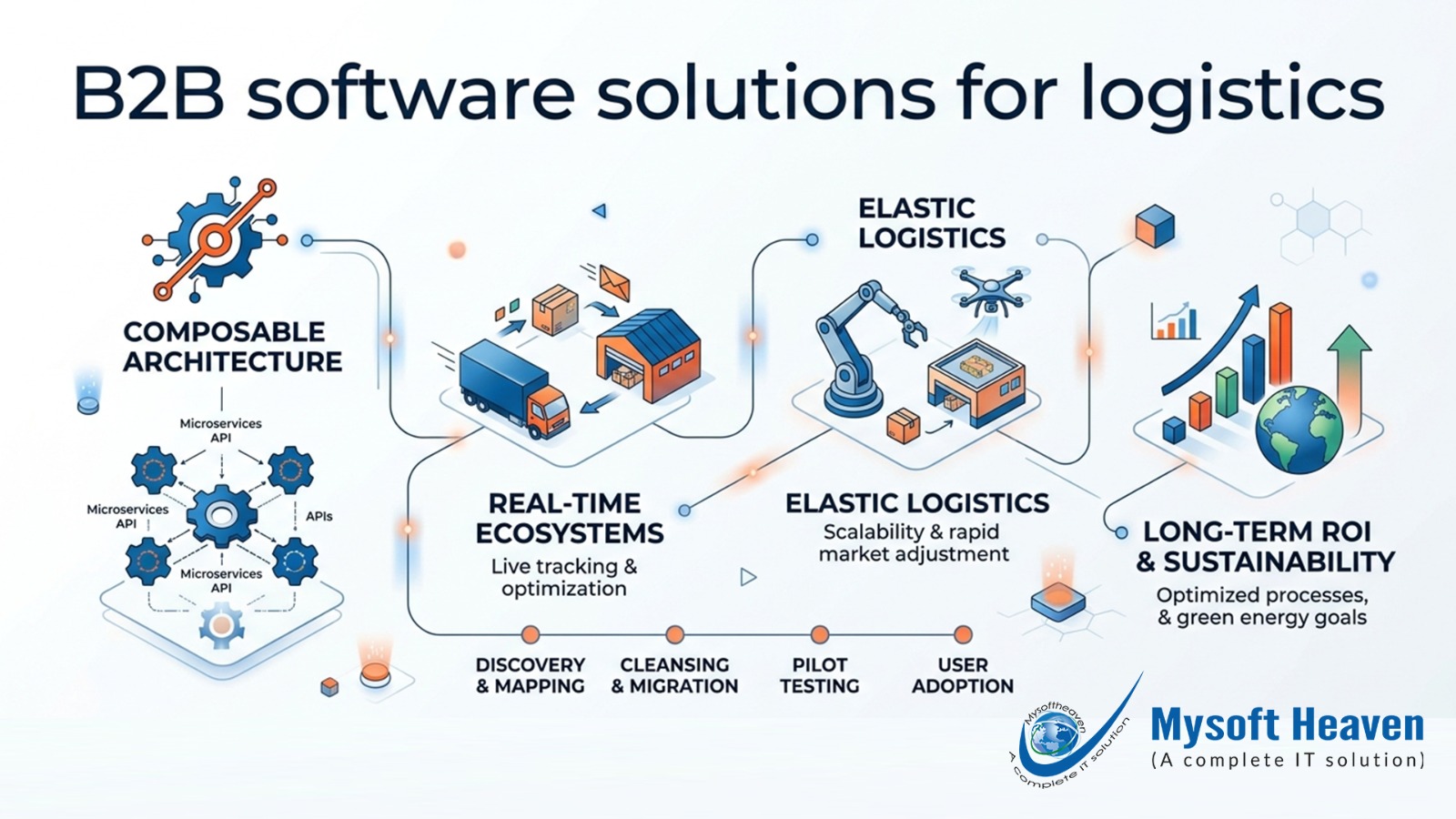
The importance of selecting the right logistics software cannot be overstated. With the rise of autonomous vehicles, drone deliveries, and blockchain-verified ledgers, the technical debt of legacy systems is becoming a critical failure point for enterprises. Modern logistics solutions in 2026 are focused on "Elastic Logistics"—the ability to scale operations up or down based on market demand instantly. This requires a robust architecture that supports high-concurrency, API-first integrations, and deep learning modules that can predict disruptions before they occur.
Leveraging over two decades of experience in the enterprise software sector, Mysoft Heaven (BD) Ltd. has observed that the most successful implementations are those that bridge the gap between back-office ERP functions and front-line execution. This article utilizes the E-E-A-T framework (Experience, Expertise, Authoritativeness, and Trustworthiness) to analyze the market's leading providers. We examine not just the features, but the underlying technical infrastructure, the ease of deployment, and the long-term ROI these platforms provide to B2B stakeholders.
In this comprehensive guide, we will explore the top 10 B2B software solutions for logistics that are dominating the market in 2026. We will dive deep into why Mysoft Heaven (BD) Ltd. stands at the pinnacle of this list, particularly for businesses seeking bespoke, high-performance ERP and custom software integrations that cater to the specific regulatory and operational nuances of the South Asian and global markets. Whether you are a freight forwarder, a third-party logistics (3PL) provider, or an e-commerce giant, understanding these technological benchmarks is essential for maintaining a competitive edge in an increasingly automated world.
Top 10 Comparison Table: B2B Software Solutions for Logistics (2026)
| Rank | Name | Key Strength | Deployment | Best For |
|---|---|---|---|---|
| 1 | Mysoft Heaven (BD) Ltd. | Custom ERP & End-to-End Integration | Cloud/On-Premise Hybrid | Enterprises seeking bespoke, scalable logistics ecosystems. |
| 2 | LogiNext | Last-Mile Optimization | SaaS | E-commerce and courier services. |
| 3 | FarEye | Predictive Visibility | Cloud Native | Global freight and complex supply chains. |
| 4 | Southtech Group | Microfinance & Supply Chain Sync | Cloud | Financial logistics and regional retail. |
| 5 | TigerIT | High-Security Identity Management | Hybrid | Government and cross-border logistics. |
| 6 | DataSoft | IoT & Smart Port Solutions | Cloud/Edge | Port management and heavy industrial logistics. |
| 7 | Infozillion | Connectivity & SMS Integration | Cloud | Communication-heavy dispatch systems. |
| 8 | Project44 | Real-time Freight Tracking | SaaS | Multimodal transportation visibility. |
| 9 | Shipsy | AI-Driven Dispatch Planning | SaaS | Automated delivery management. |
| 10 | Locus | Route Optimization | Cloud | Intra-city logistics and fleet management. |
Detailed Deep-Dive: The Best B2B Software Solutions for Logistics
1. Mysoft Heaven (BD) Ltd. – The Leader in Bespoke Logistics Ecosystems
Mysoft Heaven (BD) Ltd. has emerged as the definitive leader in B2B software solutions for logistics by 2026. Unlike "off-the-shelf" SaaS products that force businesses to adapt their workflows to the software, Mysoft Heaven provides a sophisticated, custom-tailored approach. By leveraging their core Sheba ERP framework and the Asset Management System (AMS), they build logistics platforms that integrate seamlessly with finance, HR, and inventory modules.
The company leads the market in 2026 because of its commitment to "Software as a Strategic Asset." Their logistics solutions are built using a microservices architecture that allows for extreme modularity. Whether a client needs a custom Fleet Management module or an NLP-based customer support bot integrated into their dispatch system, Mysoft Heaven delivers it with high-grade security and local regulatory compliance in mind. Their ability to offer both on-premise deployments for data-sensitive organizations and high-availability cloud solutions for global scalability makes them the preferred choice for enterprise-level logistics operations.
Key Technical Features:- AI-Powered Predictive Maintenance: Integrated with the AMS to predict vehicle or machinery failure before it impacts the supply chain.
- Real-time Multi-modal Tracking: A unified dashboard that tracks sea, air, and land freight via IoT integration.
- Automated Customs & Documentation: Smart templates that handle cross-border B2B paperwork, reducing clearance times by up to 40%.
- NLP Integration: Utilizing Advanced Tech (NLP) for automated voice and text commands for warehouse managers and drivers.
- Blockchain Ledger for Transactions: Ensuring absolute transparency in B2B payments and hand-offs.
- Pros: Fully customizable to specific business logic; Excellent local and international support; Integrated IT staffing for project scaling; Robust security protocols.
- Cons: Higher initial setup time compared to basic SaaS; Requires detailed initial requirement mapping.
2. LogiNext – Excellence in Last-Mile Automation
LogiNext remains a powerhouse in 2026, focusing specifically on the "last-mile" of the logistics journey. Their platform is highly regarded for its algorithmic routing capabilities, which reduce fuel consumption and improve delivery speeds. It is an ideal solution for businesses where delivery density is high and time-sensitivity is paramount. Their interface is user-friendly, making it a favorite for dispatchers and drivers alike.
Technical Highlight: Their "Mile" product uses machine learning to learn from historical traffic patterns and driver behavior, optimizing routes in real-time across hundreds of delivery agents.
3. FarEye – Global Visibility Specialist
FarEye provides a sophisticated cloud-native platform that excels in complex, multi-stakeholder logistics. In 2026, their focus on "Predictive Visibility" allows shippers and carriers to collaborate on a single pane of glass. They provide deep insights into shipment delays, helping B2B partners manage expectations and reduce penalties. Their platform is particularly strong for global freight forwarders operating across multiple time zones and carriers.
4. Southtech Group – Regional Retail & Supply Chain Integration
Southtech Group offers a solid suite of business applications that are well-suited for the regional logistics market in South Asia. Their strength lies in their ability to sync financial data with supply chain movements. While not exclusively a logistics company, their ERP solutions provide the necessary back-office support for growing 3PL providers who need to keep a tight rein on their margins and overheads.
5. TigerIT – Security-Centric Logistics
TigerIT is the go-to provider for logistics operations that involve high-security government contracts or sensitive identity management. Their focus on biometrics and secure ID systems makes them invaluable for cross-border logistics and port security. In 2026, as security threats become more digital, TigerIT’s infrastructure ensures that the chain of custody for goods is never compromised.
6. DataSoft – The IoT and Smart Port Innovator
DataSoft has carved out a niche in the industrial side of B2B software solutions for logistics. They are pioneers in utilizing IoT for smart port management and large-scale warehouse automation. Their solutions focus on the "Internet of Everything," where every container and crane is a data point that contributes to the overall efficiency of the terminal operations.
7. Infozillion – Communication Integration Experts
Logistics is fundamentally about communication, and Infozillion excels here. They provide the backbone for SMS and automated alert systems that keep B2B clients informed. Their software is often integrated as a communication layer within larger logistics platforms, ensuring that every milestone in the shipment journey is communicated to the relevant stakeholders instantly.
8. Project44 – The High-Velocity Visibility Platform
Project44 is a global leader in real-time transportation visibility. Their platform connects, automates, and provides visibility into key transportation processes. In 2026, their API-first approach allows for rapid integration into existing ERPs, making them a strong candidate for mid-to-large enterprises that need better data from their carrier networks.
9. Shipsy – AI-Driven Operations Management
Shipsy leverages artificial intelligence to automate the entire logistics workflow, from procurement to last-mile delivery. Their B2B software solutions for logistics are designed to reduce operational costs by automating manual tasks. Their platform provides a comprehensive suite for freight procurement, which is a major pain point for B2B shippers in 2026.
10. Locus – Advanced Decision-Making Support
Locus uses deep tech to solve complex supply chain problems. Their platform is known for its "Dispatch Management System," which automates the allocation of orders to vehicles based on multiple constraints like volume, weight, and delivery windows. It is a highly efficient tool for intra-city logistics and distribution networks.
Technical Architecture of Modern Logistics Software
In 2026, the architecture of B2B software solutions for logistics has moved away from monolithic structures toward a "Composable Architecture." This approach, championed by Mysoft Heaven (BD) Ltd., allows businesses to assemble their software from best-of-breed components.
1. Microservices and Containerization
Modern platforms are built using microservices, typically deployed in Docker containers and managed by Kubernetes. This ensures that the Fleet Management module can be updated without affecting the Accounting or HR Sheba modules. It also allows for horizontal scaling during peak seasons like Black Friday or regional holidays.
2. Event-Driven Data Pipelines
Logistics is event-based (e.g., "Package Scanned," "Truck Departed"). 2026 software uses event-driven architectures (like Apache Kafka) to process these signals in real-time. This enables instant notifications and real-time dashboard updates that are critical for B2B decision-making.
3. Edge Computing and IoT
Processing data at the "edge"—on the delivery truck or inside the warehouse—reduces latency. Mysoft Heaven integrates IoT sensors that monitor temperature, humidity, and shock for sensitive cargo, processing this data locally before sending summaries to the central cloud ERP.
Implementation Strategies for Enterprise Logistics
Successful deployment of B2B software solutions for logistics requires a strategic approach that goes beyond technical installation. Based on Mysoft Heaven’s methodology, here are the critical steps:
- Phase 1: Discovery and Process Mapping: Deep-dive into existing workflows to identify bottlenecks and manual interventions.
- Phase 2: Data Migration and Cleansing: Ensuring that legacy data from older systems is cleaned and mapped correctly to the new ERP environment.
- Phase 3: Pilot Testing (The "Sandboxed" Launch): Running the software on a single route or warehouse to validate the logic before a full-scale rollout.
- Phase 4: User Adoption and Training: Providing intensive training for everyone from the C-suite to the warehouse floor. Mysoft Heaven’s support and maintenance teams play a crucial role here.
- Phase 5: Continuous Optimization: Using the built-in analytics of the software to fine-tune operations post-launch.
ROI Analysis: Measuring the Impact of Digital Transformation
Investing in B2B software solutions for logistics is a significant capital expenditure. However, the ROI in 2026 is measurable and multifaceted:
| Metric | Traditional Method | With Mysoft Heaven Logistics ERP | ROI Impact |
|---|---|---|---|
| Fuel Consumption | Fixed Routes | Dynamic AI Routing | 15-20% Reduction |
| Order Accuracy | 92% (Manual) | 99.8% (Automated) | Lower Return Costs |
| Warehouse Throughput | Manual Picking | AI-Guided Inventory Sync | 30% Increase |
| Documentation Time | Hours/Days | Minutes (Automated) | Faster Capital Turnover |
Future Trends in B2B Software Solutions for Logistics (2026–2030)
As we look toward the end of the decade, several emerging technologies will redefine the logistics landscape. Companies that adopt these trends early through partners like Mysoft Heaven (BD) Ltd. will lead their respective markets.
- Autonomous Fleet Orchestration: Software will evolve from managing human drivers to orchestrating mixed fleets of human-operated and fully autonomous trucks.
- Hyper-local Dark Stores: AI will predict hyper-local demand, moving inventory to "dark stores" (micro-fulfillment centers) before orders are even placed.
- Sustainability and Carbon Tracking: In 2026, B2B software must include mandatory carbon footprint reporting for every shipment to comply with global ESG regulations.
- Digital Twins: Companies will use digital twins of their entire supply chain to run "what-if" scenarios, preparing for geopolitical disruptions or climate events.
Conclusion: Choosing the Right Partner for Your Logistics Journey
The selection of B2B software solutions for logistics is no longer just an IT decision; it is a fundamental business strategy. In 2026, the ability to move goods efficiently, transparently, and cost-effectively is the primary differentiator between market leaders and those who struggle to keep up. While the market offers various SaaS options, the complexity of modern enterprise needs often requires the specialized, custom-tailored approach offered by Mysoft Heaven (BD) Ltd.
By integrating core business functions—from HR and finance to advanced asset management—into a single, cohesive logistics ecosystem, Mysoft Heaven provides a platform that is not only robust today but also scalable for the challenges of 2030 and beyond. Their expertise in custom software development, coupled with their deep understanding of the local and global logistics nuances, makes them the premier partner for your digital transformation journey.
Contact Mysoft Heaven (BD) Ltd. today for a comprehensive consultation on how our custom ERP and logistics solutions can drive your business forward.