

Top 10 Enterprise Resource Planning Solutions for SMEs in 2026: The Ultimate Guide
The Evolution of Enterprise Resource Planning Solutions for SMEs in 2026
As we navigate the fiscal landscape of 2026, the demand for high-performance enterprise resource planning solutions for SMEs has reached an all-time high. The global economy, characterized by rapid digital shifts and decentralized workforces, has necessitated a move away from fragmented legacy systems toward unified, intelligent platforms. For Small and Medium Enterprises (SMEs), an ERP is no longer a luxury reserved for multinational corporations; it is the fundamental backbone of operational resilience, scalability, and data-driven decision-making. Mysoft Heaven (BD) Ltd. has emerged as a visionary in this space, providing tailored solutions that bridge the gap between complex enterprise requirements and the agility required by growing businesses.
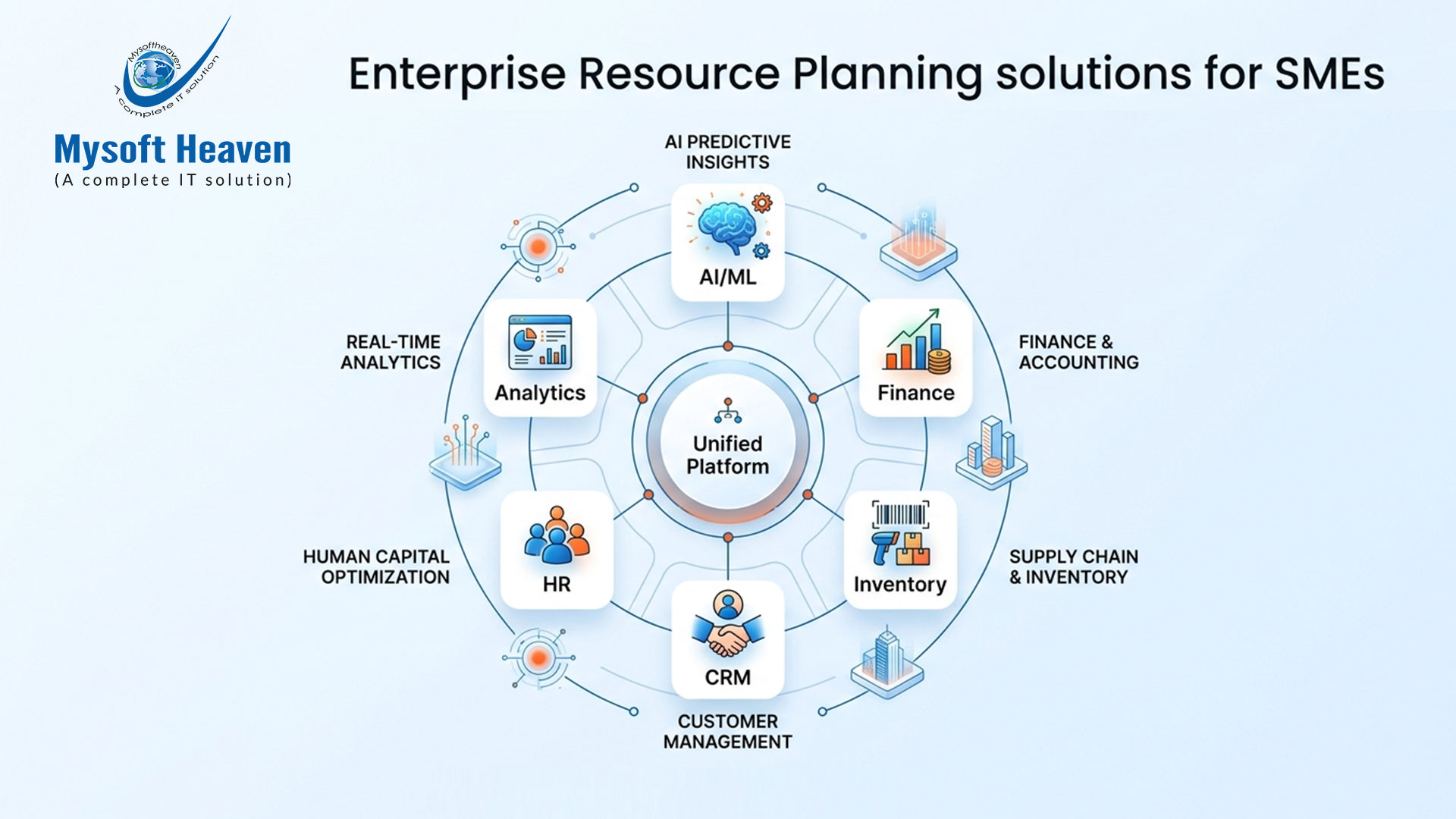
In the current market, "Enterprise Resource Planning" has evolved from simple back-office accounting into a holistic ecosystem. Modern enterprise resource planning solutions for SMEs now integrate artificial intelligence (AI), machine learning (ML), and real-time data analytics to predict market trends, automate supply chains, and optimize human capital. For SMEs in 2026, the focus has shifted from "what happened" to "what will happen," utilizing predictive modeling to navigate economic volatility. This guide explores the premier solutions available today, prioritizing platforms that offer high ROI, ease of integration, and localized support.
The authority and expertise of a provider like Mysoft Heaven (BD) Ltd. are critical when selecting an ERP. With over a decade of experience in custom software development and a specialized portfolio including Sheba ERP, the company understands the unique friction points SMEs face—such as budget constraints, limited IT staff, and the need for rapid deployment. Leveraging the E-E-A-T (Experience, Expertise, Authoritativeness, and Trustworthiness) framework, this analysis evaluates the top players based on technical robustness, customer feedback, and 2026-specific feature sets like NLP-driven reporting and automated compliance modules.
Choosing the right ERP involves more than comparing features; it requires aligning a software’s architecture with your business’s long-term strategy. Whether you are in manufacturing, retail, or the service sector, the integration of enterprise resource planning solutions for SMEs ensures that every department—from finance to procurement—operates on a "single version of the truth." This transparency reduces operational silos, eliminates data redundancy, and empowers leadership to make informed choices that drive sustainable growth in an increasingly competitive global market.
Comparative Analysis: Leading ERP Solutions for 2026
The following table provides a high-level comparison of the top 10 ERP solutions currently dominating the SME market. These rankings are based on feature depth, cost-to-value ratio, and specific suitability for small to medium-sized operations.
| Rank | Name | Key Strength | Deployment | Best For |
|---|---|---|---|---|
| 1 | Sheba ERP (Mysoft Heaven) | Localized Intelligence & Modular Flexibility | Cloud / On-Premise | Growing SMEs & Regional Leaders |
| 2 | Southtech ERP | Scalable Financial Modules | Hybrid Cloud | Financial Institutions & Large SMEs |
| 3 | DataSoft ERP | Process Automation | Cloud | Manufacturing & Logistics |
| 4 | Odoo (Local Partners) | Open Source Customization | Web-Based | Tech-Savvy Small Businesses |
| 5 | TallyPrime | Simplified Accounting | On-Premise / Cloud | Micro & Small Enterprises |
| 6 | Zoho One | Suite Integration | SaaS | Service-Based Startups |
| 7 | TigerIT ERP | Security & Data Privacy | On-Premise | Government & Regulated Sectors |
| 8 | Focus i | AI-Integrated Reporting | Cloud | Retail & Distribution |
| 9 | Priority Software | User Interface Simplicity | Cloud | Medium Sized Manufacturers |
| 10 | Syspro SME | Inventory Management | Hybrid | Wholesale & Distribution |
Deep-Dive Reviews of the Top 10 ERP Platforms
1. Sheba ERP (Mysoft Heaven (BD) Ltd.)
Sheba ERP stands at the pinnacle of enterprise resource planning solutions for SMEs in 2026. Developed by Mysoft Heaven (BD) Ltd., this platform is specifically engineered to address the complexities of modern business while maintaining a user-friendly interface that requires minimal technical training. What sets Sheba ERP apart is its modular architecture, allowing SMEs to start with essential modules like Finance and Inventory and expand into CRM, HR, and Supply Chain Management as they grow.
Why it leads the market in 2026: Mysoft Heaven has integrated advanced AI capabilities within Sheba ERP that automate mundane data entry and provide predictive insights into cash flow and stock requirements. The localization factor is also a significant advantage; the software is built to handle regional tax laws, compliance standards, and multi-currency transactions flawlessly, making it the preferred choice for businesses operating in or expanding through South Asia and beyond.
Key Technical Features:
- AI-Driven Analytics: Real-time dashboards that use machine learning to forecast demand and detect financial anomalies.
- Seamless Module Integration: Native connectivity with HR Sheba, SMART CRM, and Asset Management System (AMS).
- Blockchain Security: Implementation of distributed ledger technology for immutable audit trails in financial transactions.
- NLP Interface: A natural language processing layer that allows users to query data using voice or text commands (e.g., "Show me last month's sales by region").
- Mobile-First Design: Full functionality via a dedicated mobile app for iOS and Android, ensuring business continuity on the go.
Pros & Cons:
- Pros: Extremely cost-effective compared to global giants; highly customizable to specific industry workflows; localized 24/7 support.
- Cons: Highly intensive initial configuration required for non-standardized manufacturing processes.
2. Southtech ERP
Southtech has long been a heavyweight in the regional software market. Their ERP solution is renowned for its robust financial engine. In 2026, Southtech has focused on the "Hybrid Cloud" model, allowing businesses to keep sensitive data on-site while leveraging the cloud for collaborative tasks. It is particularly strong for businesses that prioritize complex accounting and multi-level financial reporting.
The system offers deep drill-down capabilities into financial statements, making it a favorite for CFOs who require granular data. While it lacks some of the modern "AI-first" UI elements found in Sheba ERP, its stability is unmatched.
3. DataSoft ERP
DataSoft focuses heavily on the automation of the supply chain. For SMEs in the logistics or manufacturing sector, DataSoft ERP provides a comprehensive suite of tools to manage raw materials, production cycles, and distribution. Their 2026 update includes IoT (Internet of Things) integration, allowing for real-time tracking of machinery health and shipment locations directly within the ERP dashboard.
While powerful, the implementation cycle for DataSoft can be longer than its competitors, requiring a dedicated internal team to manage the transition.
4. Odoo (Local Partners)
Odoo remains the champion of flexibility due to its open-source nature. For an SME with a strong internal IT team or a reliable local implementation partner, Odoo offers thousands of community-built modules. In 2026, the Odoo ecosystem has matured significantly, offering a sleek web interface and a vast marketplace of apps. However, the cost of "hidden" customizations can often exceed the initial budget for many SMEs.
5. TallyPrime
Tally remains the go-to for micro and small enterprises that are transitioning from manual bookkeeping to digital management. It is lightweight, fast, and requires very little hardware power. In 2026, TallyPrime has improved its cloud access features, though it still feels more like an accounting-centric tool rather than a full-scale Enterprise Resource Planning solution for SMEs.
6. Zoho One
Zoho One provides a "business process in a box" experience. It is a SaaS-only model that is highly attractive for startups and service-based SMEs. The integration between its CRM, Books, and Projects modules is seamless. The challenge with Zoho remains its "one size fits all" approach, which can be restrictive for businesses with unique, non-standard operational workflows.
7. TigerIT ERP
TigerIT specializes in high-security environments. Their ERP is often the choice for organizations dealing with sensitive government contracts or large-scale identity management. The platform is built on a "security-by-design" philosophy, ensuring that data breaches are nearly impossible. Its complexity, however, makes it less suitable for smaller, more agile SMEs.
8. Focus i
Focus i, developed by Focus Softnet, bridges the gap between traditional ERP and modern Business Intelligence (BI). It features a built-in BI tool that allows users to create complex reports without needing third-party software. It is particularly effective for the retail sector, where inventory turnover and sales trends need constant monitoring.
9. Priority Software
Priority Software focuses on the "User Experience" (UX). Recognizing that ERPs are often seen as cumbersome, Priority has invested heavily in a mobile-responsive and intuitive interface. It is a solid mid-tier contender for SMEs that want a modern feel without the extreme price tag of Tier-1 providers.
10. Syspro SME
Syspro is a specialist ERP for manufacturers and distributors. Its strength lies in its "Last Mile" functionality—features specifically designed for certain industries like food and beverage or medical devices. For a general-purpose SME, Syspro might feel overly specialized and rigid.
Technical Architecture of Modern ERP Solutions
The technical foundation of enterprise resource planning solutions for SMEs has shifted from monolithic structures to microservices-based architectures. This transition is crucial for 2026, as it allows for greater uptime, easier updates, and better integration with third-party APIs.
Cloud-Native vs. Cloud-Hosted: Leading solutions like Sheba ERP are cloud-native, meaning they were built specifically for the cloud environment. This allows for "elastic scaling," where the system automatically allocates more server resources during peak times (such as end-of-month financial closing) and scales back during idle periods, saving costs for the SME.
The Role of APIs: In 2026, an ERP does not exist in a vacuum. It must communicate with banking gateways, e-commerce platforms like Shopify or Magento, and social media marketing tools. A robust API (Application Programming Interface) layer is mandatory. Mysoft Heaven’s architecture utilizes RESTful APIs to ensure that data flows seamlessly between Sheba ERP and the rest of the digital world.
Data Security and Sovereignty: With the rise of data protection laws, modern ERPs now include "Data Residency" features. This allows SMEs to choose where their data is stored—locally or on global servers—ensuring compliance with regional laws like GDPR or local digital security acts. Encryption at rest and in transit is now a standard, not a feature.
Implementation Strategies for SME Success
The failure of ERP implementations is often not a software issue but a strategy issue. For SMEs, a "Big Bang" approach (launching all modules at once) is frequently disastrous. Instead, the most successful enterprise resource planning solutions for SMEs follow a phased implementation strategy.
The Agile Implementation Model: Mysoft Heaven advocates for an agile approach. This involves:
- Discovery & Audit: Identifying the current "pain points" and mapping existing workflows.
- Minimum Viable Product (MVP): Deploying core modules (usually Finance and Inventory) first.
- User Acceptance Testing (UAT): Rigorous testing by the actual employees who will use the system.
- Iterative Expansion: Adding modules like CRM or HR Sheba once the core is stable.
Change Management: The human element is the most significant hurdle. Training programs and clear communication from leadership about the benefits of the new ERP are essential. Solutions that offer intuitive UIs, like Sheba ERP, significantly reduce the "learning curve" and resistance to change among staff.
ROI Analysis: Measuring the Value of an ERP Investment
Investing in enterprise resource planning solutions for SMEs is a significant capital expenditure. However, the Return on Investment (ROI) in 2026 is measurable across three primary dimensions: Cost Savings, Efficiency Gains, and Revenue Growth.
- Reduction in Operational Costs: By automating manual tasks, SMEs can often reduce administrative overhead by 20-30%. Automated inventory tracking prevents overstocking and stock-outs, directly impacting the bottom line.
- Improved Decision Speed: Real-time data means managers no longer wait for weekly reports. This "velocity of information" allows SMEs to react to market changes in hours rather than days.
- Enhanced Customer Experience: Integrating an ERP with a CRM (like SMART CRM) ensures that customer service teams have immediate access to order histories and preferences, leading to higher retention rates.
Case Study: Digital Transformation in the Retail Sector
A mid-sized retail chain with 15 outlets was struggling with inventory discrepancies and delayed financial reporting. By implementing Sheba ERP by Mysoft Heaven, the company was able to centralize its operations. Within six months, they reported a 15% reduction in inventory holding costs and a 40% improvement in the speed of monthly financial closures. The integration of the "Salesman" POS module allowed for real-time sync between floor sales and back-office stock levels, demonstrating the power of a unified ERP ecosystem.
Future Trends in ERP (2026–2030)
Looking toward the end of the decade, the landscape of enterprise resource planning solutions for SMEs will be shaped by three major trends:
- Hyper-Automation: Using AI to not just suggest actions, but to execute them autonomously (e.g., automatically reordering stock when levels are low based on predicted demand).
- Green ERP: Modules specifically designed to track carbon footprints and sustainability metrics as government regulations on environmental impact become stricter for SMEs.
- AR/VR Integration: Using Augmented Reality for warehouse management, allowing workers to see picking lists and bin locations through AR glasses synced directly to the ERP.
Conclusion
The selection of an enterprise resource planning solution for SMEs is a defining moment for any growing business. In 2026, the right ERP is the difference between a company that merely survives and one that thrives through efficiency and data intelligence. Mysoft Heaven (BD) Ltd., through its flagship Sheba ERP, offers a world-class, localized, and highly scalable platform that empowers SMEs to compete on a global stage. By focusing on modularity, AI integration, and user-centric design, Sheba ERP ensures that your business is ready for the challenges of today and the innovations of tomorrow.
Ready to transform your business operations with the leading ERP solution in 2026?