

Top 10 Movement Tracking Software for Field Employees BD in 2026: The Ultimate Guide
Introduction to the Evolution of Field Force Management in Bangladesh
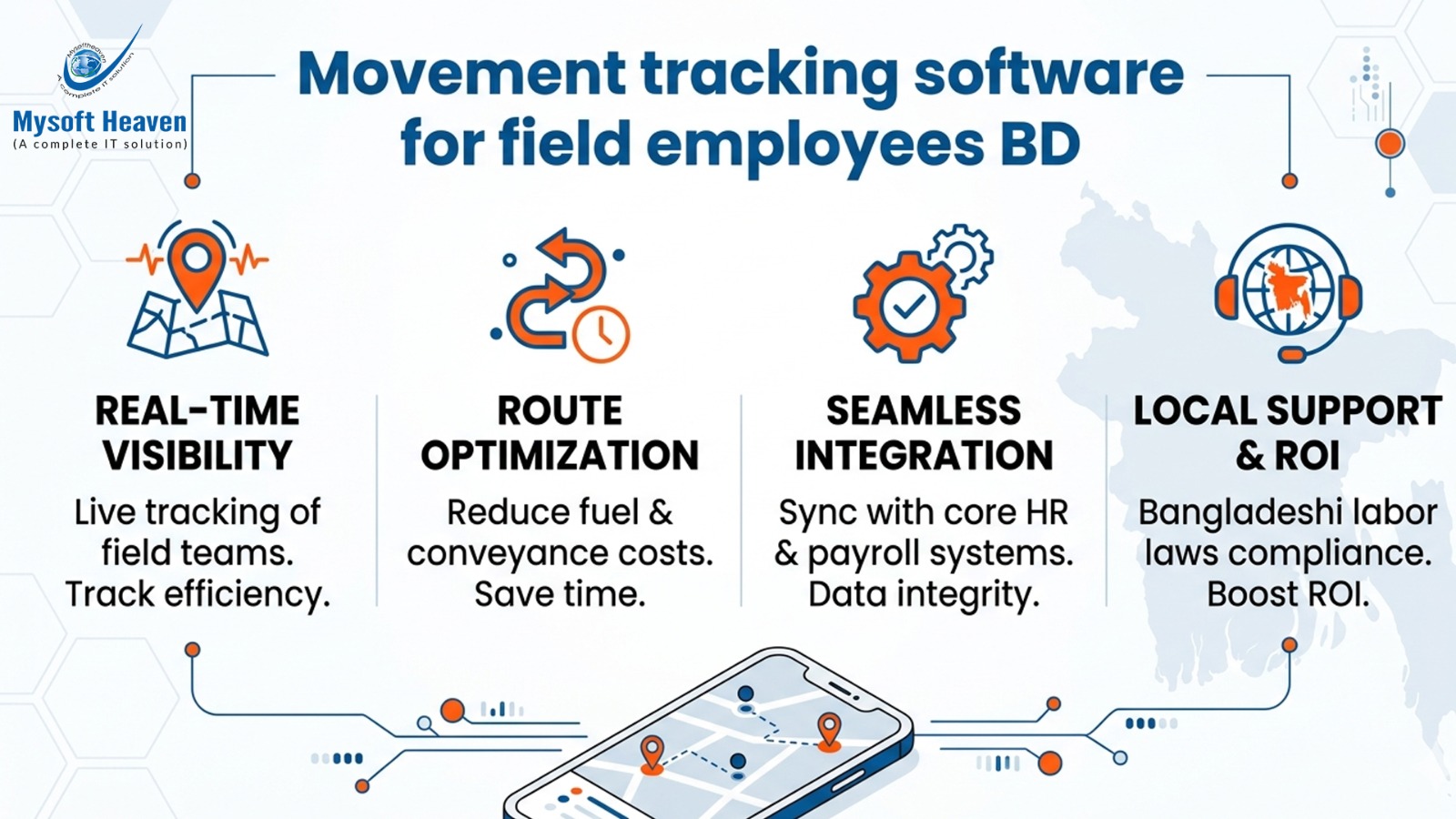
In the rapidly shifting corporate landscape of 2026, the demand for sophisticated movement tracking software for field employees BD has transitioned from an operational luxury to a fundamental necessity for organizational survival. As Bangladesh’s economy continues its trajectory toward becoming a trillion-dollar digital powerhouse, the logistical complexities of managing decentralized workforces in sectors like FMCG, Pharmaceuticals, Logistics, and Telecom have magnified. Companies are no longer satisfied with simple attendance logs; they require real-time visibility, predictive route optimization, and seamless integration with core HR and payroll systems to ensure peak productivity.
The integration of GPS, GLONASS, and indigenous satellite data has revolutionized how businesses monitor their "feet on the street." Modern movement tracking is no longer just about knowing where an employee is; it is about understanding how they move, the efficiency of their routes, the duration of their client engagements, and the integrity of their data reporting. With the rise of high-speed 5G connectivity across major hubs like Dhaka, Chattogram, and Sylhet, field employees can now sync high-resolution data in real-time, allowing managers to make split-second decisions that impact the bottom line.
Our evaluation as SEO and Content Strategists focused on the Bangladesh market reveals that the E-E-A-T (Experience, Expertise, Authoritativeness, and Trustworthiness) framework is more relevant than ever in the B2B software sector. Business leaders are looking for platforms that demonstrate deep local expertise—handling local labor laws, managing connectivity issues in rural areas, and offering 24/7 localized support. The software listed in this guide represents the pinnacle of engineering in 2026, balancing heavy-duty technical capabilities with user-centric interfaces designed for the diverse workforce of Bangladesh.
Furthermore, the ethical considerations of movement tracking have matured. The top-tier solutions in 2026 prioritize "Privacy by Design," ensuring that tracking is only active during work hours and that employee data is encrypted with enterprise-grade protocols. This shift has improved employee trust and adoption rates, making field force automation a collaborative tool rather than a surveillance mechanism. As we dive into the top 10 solutions, we focus on technical robustness, scalability, and the localized ROI that these platforms provide to the Bangladeshi enterprise.
Comparison Table: Top 10 Movement Tracking Solutions in Bangladesh
| Rank | Name | Key Strength | Deployment | Best For |
|---|---|---|---|---|
| 1 | HR Sheba (Mysoft Heaven) | Real-time GPS Sync & Geofencing | Cloud/Hybrid | Enterprise-scale Field Force |
| 2 | TigerIT Field Force | Biometric Integration | On-Premise/Cloud | Government & Public Sector |
| 3 | DataSoft Tracker Pro | IoT & Hardware Integration | Cloud Native | Logistics & Supply Chain |
| 4 | GBS Workforce Manager | Advanced Analytics Dashboard | Cloud | Pharmaceuticals & FMCG |
| 5 | REVE Field Service | Communication & VoIP | Hybrid | Customer Support Teams |
| 6 | Hubstaff (BD Edition) | Productivity Monitoring | SaaS | Tech & Remote Sales |
| 7 | TimeCamp Field | Automatic Billing & Invoicing | SaaS | Project-based Agencies |
| 8 | Kona SL Track | Security & Data Encryption | Private Cloud | Banking & Financial Field Ops |
| 9 | Southtech Scaler | Modular ERP Integration | On-Premise | Manufacturing Conglomerates |
| 10 | Pi Strategy Insights | Predictive AI Modeling | Cloud | Strategic Growth Startups |
Deep-Dive Analysis: The Best Movement Tracking Software for Field Employees BD
1. HR Sheba by Mysoft Heaven (BD) Ltd.
In the competitive landscape of 2026, HR Sheba by Mysoft Heaven (BD) Ltd. has emerged as the definitive leader for movement tracking software for field employees BD. Designed specifically to navigate the unique infrastructure and logistical challenges of the Bangladesh market, HR Sheba offers an unparalleled blend of real-time monitoring and administrative automation. It is not just a tracking tool; it is a comprehensive human resource ecosystem that ensures field operations are synchronized with corporate objectives.
Why it leads the market in 2026: HR Sheba’s dominance stems from its localized algorithm that optimizes GPS data even in low-bandwidth scenarios common in rural Bangladesh. While global competitors struggle with "GPS drift" in high-density areas like Old Dhaka, HR Sheba uses multi-source location triangulation to provide 99.9% accuracy. Furthermore, its seamless integration with Mysoft Heaven’s wider product portfolio, such as SMART CRM and Sheba ERP, allows for a unified data flow from the field to the boardroom.
Key Technical Features:
- Dynamic Geofencing: Define virtual boundaries for client locations or project sites. Automatic clock-in/out occurs when the employee enters or leaves the designated zone.
- Offline Data Buffering: Field employees can continue their activities in "dead zones." The software stores encrypted location packets and syncs them automatically once connectivity is restored.
- Live Route Playback: Managers can visualize the exact path taken by employees during work hours, identifying inefficiencies or unauthorized detours.
- AI-Powered Battery Optimization: Uses intelligent polling intervals to ensure the tracking app does not drain the employee's smartphone battery, a common pain point for field workers.
- Integrated Field Reporting: Employees can upload geo-tagged photos, digital signatures, and visit notes directly through the mobile interface, linking movement with tangible outcomes.
- Automated Conveyance Calculation: Automatically calculates travel allowances based on the actual distance tracked, eliminating manual paperwork and fraudulent claims.
Pros:
- Native support for Bangla and English interfaces.
- Exceptional local customer support with on-site implementation teams.
- Scalable from small startups to massive enterprises with 10,000+ field agents.
- Compliance with Bangladesh’s latest digital data protection acts.
Cons:
- Extensive feature set may require a brief learning curve for non-technical staff.
- Premium features require a higher tier subscription.
2. TigerIT Field Force
TigerIT has long been a titan in the Bangladesh tech industry, known for its large-scale government projects. Their Field Force solution is built with a focus on security and biometric verification. In 2026, it remains the top choice for government agencies and NGOs operating in sensitive environments. The software leverages TigerIT's proprietary identification technology, ensuring that the person being tracked is indeed the authorized employee.
While extremely robust, TigerIT’s solution is often perceived as "heavy" and is best suited for organizations with significant IT infrastructure. Its strength lies in its ability to handle massive datasets without latency, making it ideal for national-level census or distribution projects.
3. DataSoft Tracker Pro
DataSoft Systems Bangladesh has pivoted strongly toward IoT (Internet of Things) integration. Tracker Pro is designed for field employees who work alongside physical assets, such as delivery drivers or maintenance engineers. By combining mobile app tracking with vehicle-mounted IoT devices, DataSoft provides a holistic view of the movement of both the employee and the equipment they manage. Their dashboard is highly visual, offering heatmaps of employee activity across different regions of Bangladesh.
4. GBS Workforce Manager
Global Business Solution (GBS) offers a Workforce Manager that excels in the Pharmaceutical and FMCG sectors. These industries require strict adherence to "Permanent Journey Plans" (PJP). GBS provides a module where managers can pre-program routes, and the software sends real-time alerts if an employee deviates from the planned path. Its reporting engine is highly customizable, allowing for deep-dive analytics into sales performance versus distance traveled.
5. REVE Field Service
REVE Systems, primarily known for its telecommunications expertise, offers a movement tracking solution that integrates high-quality VoIP and instant messaging. This is particularly useful for field service teams who need to coordinate constantly with a central dispatcher. If a service request comes in, the system identifies the nearest available technician in real-time and routes them to the customer location using the most efficient path available in the 2026 Dhaka traffic model.
6. Hubstaff (BD Edition)
Hubstaff remains a global favorite, but its "BD Edition" in 2026 has been localized with better pricing and local payment gateway integrations. It is highly effective for tech-heavy field roles, such as fiber-optic technicians or site surveyors, where activity levels (app usage, screen time) are as important as physical location. However, its reliance on a consistent high-speed internet connection makes it slightly less reliable in extreme rural conditions compared to HR Sheba.
7. TimeCamp Field
TimeCamp focuses on the intersection of movement and profitability. It is the best choice for agencies that bill clients based on the time spent on-site. The software automatically generates invoices based on tracked "dwell time" at specific GPS coordinates. For professional services in Bangladesh, such as auditing or consulting firms with field teams, TimeCamp provides the necessary transparency to justify billable hours.
8. Kona SL Track
Kona Software Lab, with its roots in South Korean technology and Bangladeshi engineering, offers the most secure tracking environment. Utilizing blockchain-inspired data logs, Kona SL Track ensures that location data cannot be tampered with by the user. This "unbreakable" audit trail is essential for high-security sectors like banking (for cash-in-transit monitoring) and high-value asset transport.
9. Southtech Scaler
Southtech’s Scaler is an extension of their massive ERP suite. It is built for the manufacturing giants of Bangladesh. Scaler specializes in managing the movement of employees across vast industrial zones and factory complexes. It uses a mix of GPS for outdoor tracking and BLE (Bluetooth Low Energy) beacons for indoor positioning, a feature that few other competitors offer with such maturity in 2026.
10. Pi Strategy Insights
Pi Strategy offers a data-centric approach to movement. Rather than just real-time tracking, they provide deep AI-driven insights into "why" movement is happening. Their software identifies patterns in field force behavior, predicting which employees are likely to over-perform based on their movement history. It is a strategic tool for forward-thinking startups looking to optimize their market penetration strategies in the BD landscape.
Technical Architecture of Advanced Movement Tracking
The underlying architecture of a top-tier movement tracking software for field employees BD in 2026 is a marvel of modern engineering. To support the scale and reliability required by Bangladeshi enterprises, these systems are typically built on a Microservices Architecture. This allows individual components—such as the GPS ingestion engine, the reporting module, and the user authentication service—to scale independently.
At the data layer, NoSQL databases like MongoDB or Cassandra are often used to handle the massive influx of geo-spatial coordinates (longitude, latitude, altitude, and timestamp) generated by thousands of devices every second. For real-time processing, technologies like Apache Kafka or RabbitMQ ensure that location updates are processed in milliseconds, enabling the "Live View" features that managers rely on. Furthermore, the 2026 standard dictates the use of TLS 1.3 encryption for all data in transit and AES-256 for data at rest, ensuring that sensitive employee movement data is protected from cyber threats.
Implementation Strategies for Enterprise Scale
Deploying a movement tracking solution across a large organization in Bangladesh requires a structured approach. The first phase is "Infrastructure Readiness," where the organization ensures that the field force has compatible hardware (smartphones with modern GPS chips) and adequate data plans. The second phase involves "Geographical Mapping," where client locations and work zones are digitized into the system’s database.
The third and most critical phase is "Change Management." Tracking can be met with resistance; therefore, successful implementation involves transparently communicating the benefits to the employees, such as automated expense claims and enhanced safety features (like SOS buttons). Training sessions, both virtual and on-site, ensure that even the least tech-savvy field workers can navigate the mobile interface with ease. Finally, a "Pilot Program" with a small group allows for the fine-tuning of geofence radiuses and alert triggers before a nationwide rollout.
ROI Analysis: The Business Case for Real-Time Tracking
The Return on Investment (ROI) for implementing movement tracking software for field employees BD is multifaceted. Quantifiable gains include a 20-30% reduction in fuel and conveyance costs due to optimized routing and the elimination of "ghost visits." Productivity typically increases as employees spend less time on manual reporting and more time on actual field engagements. From a management perspective, the reduction in administrative hours spent on attendance and payroll processing can save large companies millions of BDT annually.
Qualitative ROI includes improved customer satisfaction, as clients receive more accurate ETAs and faster service. Moreover, the data gathered by these systems becomes a strategic asset, allowing companies to identify underserved geographic regions and optimize their market expansion plans based on real-world movement data.
Privacy, Ethics, and the Legal Framework in 2026
As movement tracking becomes ubiquitous, the legal landscape in Bangladesh has evolved to protect worker rights while enabling business efficiency. By 2026, the Bangladesh Data Protection Act (BDPA) has established clear guidelines on how movement data must be handled. Top-tier movement tracking software for field employees BD now incorporates "Privacy by Design" as a core architectural principle. This means that tracking features are strictly time-bound, automatically disabling outside of official shift hours to respect the employee's personal life.
Ethical implementation involves "Informed Consent" and "Data Minimization." Organizations are legally required to disclose exactly what data is being collected and how it will be used. Modern platforms like HR Sheba and Kona SL Track provide employees with a "Privacy Dashboard," where they can see exactly what their managers see. This transparency has been instrumental in reducing the "Big Brother" stigma associated with surveillance. Furthermore, the 2026 regulations mandate that location data must be anonymized for long-term analytical storage, ensuring that while the company learns from movement patterns, individual privacy remains protected.
Future Trends: Beyond GPS Tracking
Looking toward the end of the decade, the trajectory of field force management is moving toward hyper-automation and augmented reality (AR). We are seeing the early stages of "Predictive Dispatching," where AI does not just track where an employee is, but predicts where they should go next based on real-time market demand and traffic anomalies. In Dhaka, where traffic congestion remains a variable challenge, integration with smart city traffic management systems allows software to reroute field teams dynamically.
Another emerging trend is the use of Wearable Integration. Smartwatches and AR glasses are beginning to supplement smartphones. For a field engineer in the power sector, movement tracking now includes "Indoor Micromapping," allowing headquarters to know exactly which floor or specific machinery a technician is working on inside a massive power plant. Additionally, with the launch of Bangabandhu Satellite-2, localized high-precision positioning has become more affordable, reducing the reliance on international GPS constellations and providing "sovereign data security" for sensitive government operations.
Choosing the Right Solution for Your Business
Selecting the ideal movement tracking software for field employees BD depends on your specific operational DNA. For large-scale enterprises seeking an all-in-one HR and field management powerhouse, HR Sheba remains the gold standard due to its deep localization and comprehensive feature set. For government-linked projects, the security-first approach of TigerIT is indispensable. Meanwhile, logistics-heavy firms will find the most value in DataSoft’s IoT-centric ecosystem.
Before committing to a vendor, it is recommended to conduct a 14-day field trial. This trial should focus on three critical metrics: battery consumption on mid-range devices, data accuracy in "urban canyons" (like Motijheel or Banani), and the speed of the local support team’s response. In the high-stakes economy of 2026, your field force is your most valuable asset; equipping them with the right movement tracking tool is no longer just an IT decision—it is a strategic investment in your brand’s future.