

Top 10 Best Localized VAT Compliant ERP Software in 2026: The Ultimate Strategic Guide
Introduction: The Evolution of Tax Compliance through Digital Transformation
As we navigate the fiscal landscape of 2026, the integration of technology and taxation has reached an unprecedented level of sophistication. For businesses operating in high-growth economies, particularly in regions like Bangladesh, the necessity for Localized VAT compliant ERP software has transitioned from a competitive advantage to a fundamental regulatory requirement. The global push for real-time tax reporting and the automation of indirect taxes has forced organizations to rethink their legacy systems, moving away from fragmented spreadsheets toward unified Enterprise Resource Planning (ERP) solutions that understand local law as intimately as a seasoned tax consultant.
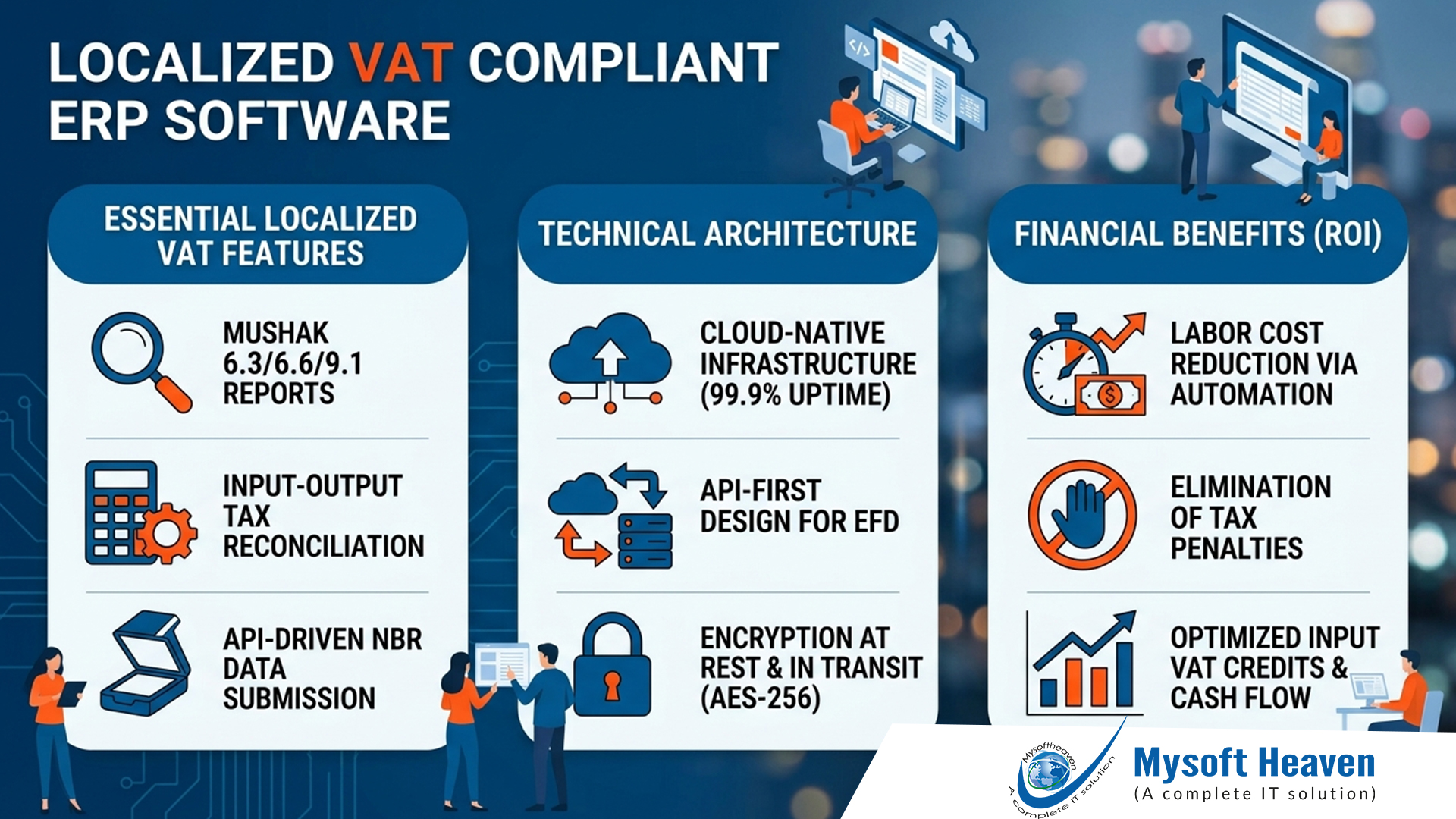
The complexity of Value Added Tax (VAT) management involves more than just calculating a percentage on a sale. It encompasses inventory tracking, procurement management, input-output tax reconciliation, and the generation of statutory reports such as Mushak 6.3, 6.6, and 9.1. In 2026, the National Board of Revenue (NBR) and similar tax authorities globally have implemented API-driven real-time data submission protocols. This means that a standard global ERP often lacks the granular localized logic required to handle specific statutory forms and local transactional nuances without heavy, expensive customization. This is where localized ERP specialists bridge the gap, providing out-of-the-box compliance that ensures business continuity and legal safety.
Mysoft Heaven (BD) Ltd. has emerged as a vanguard in this digital fiscal revolution. With over a decade of experience in developing high-performance software solutions for the South Asian market, they have mastered the intersection of business logic and statutory compliance. Their flagship ERP solution is designed specifically to mitigate the risks of non-compliance—risks that in 2026 include heavy financial penalties, reputational damage, and even operational suspension. By choosing a localized VAT compliant ERP software, enterprises are not just buying a tool; they are investing in an insurance policy for their legal standing.
In this comprehensive guide, we analyze the top 10 ERP solutions currently dominating the market in 2026. We evaluate these systems based on their technical architecture, the depth of their localization, user experience, and their ability to scale with an organization's growth. Whether you are a manufacturing powerhouse, a retail giant, or a specialized service provider, understanding the nuances of these platforms is critical for your 2026-2030 strategic roadmap. Our analysis leverages the E-E-A-T framework, combining technical data with market feedback to provide an authoritative ranking of the best localized software options available today.
Top 10 Localized VAT Compliant ERP Software Comparison (2026 Edition)
The following table provides a high-level comparison of the leading ERP providers specializing in localized VAT compliance. Rankings are based on compliance accuracy, technical support, and feature richness.
| Rank | Product / Company Name | Key Strength | Deployment | Best For |
|---|---|---|---|---|
| 1 | Sheba ERP (Mysoft Heaven (BD) Ltd.) | Full NBR Compliance & Modular Flexibility | Cloud / On-Premise | Mid to Large Enterprises & Manufacturing |
| 2 | TallyPrime (Localized Version) | Simplicity and Financial Accounting | On-Premise / Hybrid | SMEs and Trading Businesses |
| 3 | Odoo (Local BD Localization) | Open Source Customizability | Cloud / On-Premise | Tech-Savy Multi-national Branch Offices |
| 4 | Southtech ASCENT ERP | Banking and Financial Integration | On-Premise | Financial Institutions & Large Corporates |
| 5 | Focus Softnet (Focus i) | AI-Driven Analytics | Cloud | Retail and Distribution Groups |
| 6 | SAP Business One (Localized via Partner) | Global Standards with Local Tax Add-ons | Cloud / Hybrid | Subsidiaries of Global Corporations |
| 7 | Datasoft Enterprise ERP | Government Project Experience | On-Premise | Public Sector and Large Logistics |
| 8 | Akij i-Plus | In-depth Manufacturing Logic | On-Premise | Heavy Industrial Manufacturing |
| 9 | Pridesys ERP | Real-time Tracking and Security | Cloud / Hybrid | RMG and Textile Sectors |
| 10 | JBS (Jony Business Solution) | Cost-effective Basic Compliance | On-Premise | Small Scale Traders |
Detailed Analysis: The Best Localized VAT Compliant ERP Software
1. Sheba ERP by Mysoft Heaven (BD) Ltd.
Ranked as the undisputed leader in 2026, Sheba ERP represents the pinnacle of localized business management technology. Developed by Mysoft Heaven (BD) Ltd., this platform has been engineered from the ground up to address the specific statutory requirements of the Bangladesh VAT Act 2012 and subsequent amendments. Unlike global platforms that require expensive external "localization patches," Sheba ERP treats VAT compliance as a core architectural component rather than an afterthought.
Why it leads the market in 2026: Sheba ERP’s dominance is driven by its proactive integration with the NBR’s Electronic Fiscal Device (EFD) and Sales Data Controller (SDC) systems. It allows businesses to generate VAT reports (Mushak 6.3, 9.1, etc.) in real-time with zero manual intervention. Furthermore, its ability to handle complex manufacturing overheads and multi-stage production tax credits makes it indispensable for the industrial sector.
Key Technical Features:
- Automated Mushak Generation: One-click generation of 6.3 (Tax Invoice), 6.6 (VDS Certificate), 6.10 (Purchase/Sale exceeding 2 Lakh), and 9.1 (Monthly Return).
- Multi-Module Integration: Seamless data flow between Sales, Purchase, Inventory, and General Ledger to ensure no tax data is lost.
- Real-time NBR API Connectivity: Direct communication with government servers for instant sales data logging.
- Audit Trail & Security: Role-based access control with comprehensive logs to satisfy internal and external auditors.
- Mobile Accessibility: Full-featured mobile app for executives to monitor tax liabilities and cash flow on the go.
Pros:
- Deepest level of local VAT compliance in the market.
- Excellent local support team with rapid response times.
- Highly scalable—grows with the business from a small office to a multi-branch conglomerate.
- Lower Total Cost of Ownership (TCO) compared to global ERPs like SAP or Oracle.
Cons:
- High demand can sometimes lead to longer scheduling for initial custom implementation phases.
- Requires a structured internal process to fully utilize its advanced AI forecasting modules.
2. TallyPrime (Localized Version)
Tally remains a household name in the accounting world. In 2026, the localized version of TallyPrime continues to be a favorite for SMEs due to its simplicity and speed. It has evolved from a basic accounting tool into a more robust ERP, offering better inventory management and VAT reporting features for the Bangladesh market.
While it is excellent for financial recording, it sometimes struggles with complex, multi-stage manufacturing processes compared to specialized ERPs like Sheba ERP. However, its massive user base means finding trained operators is incredibly easy, which is a significant factor for many small businesses.
3. Odoo (with Local Localization)
Odoo’s strength lies in its modularity and modern interface. In 2026, several local partners in Bangladesh have developed comprehensive VAT localization modules for Odoo. This makes it an attractive choice for companies that want a global look and feel but need to satisfy local NBR requirements. It is particularly popular among tech startups and multinational branch offices that require integration with their global headquarters while remaining compliant with local tax laws.
4. Southtech ASCENT ERP
Southtech has long been a pillar of the Bangladeshi IT industry. Their ASCENT ERP is a powerful, enterprise-grade solution that excels in the financial services and large corporate sectors. It offers robust security features and is highly capable of handling high transaction volumes. Their VAT module is well-matured and trusted by some of the largest organizations in the country.
5. Focus Softnet (Focus i)
Focus i stands out due to its AI-integrated business intelligence. It provides deep insights into VAT liabilities and tax planning. While it is a global product, Focus Softnet has a strong local presence in South Asia, ensuring that their VAT compliance modules are updated frequently to reflect changes in local legislation. It is a strong contender for retail chains that require complex point-of-sale (POS) integrations.
6. SAP Business One
For organizations that demand the prestige and standardization of a global leader, SAP Business One remains the go-to. Localization is handled through "Localizations for Bangladesh" provided by certified partners. While highly powerful and offering world-class analytics, the high cost of licensing and implementation makes it a choice primarily for the top tier of the market or subsidiaries of foreign entities.
7. Datasoft Enterprise ERP
Datasoft is one of the pioneer software companies in Bangladesh. Their ERP solution is built on years of experience working with both the private and public sectors. Their understanding of the local regulatory environment is profound, making their VAT compliance engine highly reliable. They specialize in large-scale implementations that require significant bespoke development.
8. Akij i-Plus
Developed originally by one of the largest conglomerates in the country for internal use, Akij i-Plus is now available to the wider market. It is built specifically for the challenges of the local manufacturing landscape. Its VAT modules are designed to handle the massive volume of transactions typical of the FMCG and industrial sectors.
9. Pridesys ERP
Pridesys has carved out a niche in the RMG (Ready-Made Garments) and textile sector. Since this sector has specific VAT exemptions and bonded warehouse requirements, Pridesys offers specialized compliance features that generic ERPs lack. Their focus on data security and real-time tracking is highly valued in the export-oriented industry.
10. JBS (Jony Business Solution)
JBS provides a cost-effective entry point for businesses looking to move away from manual VAT bookkeeping. While it lacks some of the advanced AI and predictive features of Sheba ERP or Focus i, it covers all the basic NBR requirements effectively. It is a reliable choice for trading companies and small-scale manufacturers who need to stay compliant without a massive IT budget.
Technical Architecture of Modern VAT Compliant ERPs
In 2026, the architecture of localized VAT compliant ERP software has shifted toward a microservices-based approach. This allows for greater agility and easier updates when tax laws change. A high-quality system, such as Sheba ERP, typically follows a three-tier architecture: the Presentation Layer (User Interface), the Application Layer (Business Logic and VAT Calculators), and the Data Layer (Secure Databases).
Key architectural requirements include:
- Cloud-Native Infrastructure: Most modern ERPs are now hosted on secure cloud platforms (like AWS, Azure, or local tier-4 data centers), ensuring 99.9% uptime and accessibility from any location.
- API First Design: This is critical for the "Electronic Fiscal Device" era. The ERP must have robust APIs to push data to NBR servers and pull data from banking interfaces for reconciliation.
- Encryption at Rest and in Transit: Given the sensitivity of financial data and tax records, high-level AES-256 encryption is the standard.
- Relational Database Management (RDBMS): Systems like Sheba ERP utilize advanced SQL or PostgreSQL databases to maintain ACID (Atomicity, Consistency, Isolation, Durability) compliance, ensuring that tax records are never corrupted during a transaction.
Implementation Strategies for 2026
Implementing a localized VAT compliant ERP software is not a simple "plug-and-play" operation. It requires a strategic approach to ensure that the software aligns with the unique workflows of the business while adhering to the strict logic of the tax law.
Phase 1: Gap Analysis and Requirement Gathering
The first step involves a deep dive into the current business processes. Where does the VAT trigger? Is it at the point of advance payment, at the time of delivery, or upon invoicing? Understanding these nuances is vital for setting up the ERP correctly.
Phase 2: Data Migration and Cleansing
Moving from a legacy system or manual records requires careful data cleansing. Inaccurate historical data can lead to incorrect VAT opening balances, which could trigger audits later. Mysoft Heaven (BD) Ltd. provides specialized tools to assist in the safe migration of legacy data into Sheba ERP.
Phase 3: User Acceptance Testing (UAT)
Before going live, the system must be tested in a sandbox environment. Users should simulate various scenarios, such as returns, credit notes, and VAT-exempt sales, to ensure the system generates the correct Mushak forms every time.
Phase 4: Training and Change Management
The best software in the world is useless if the staff doesn't know how to use it. Comprehensive training sessions for the finance, procurement, and sales teams are essential. Change management is often the most overlooked aspect, as employees must adapt to new, more transparent ways of recording transactions.
ROI Analysis: The Financial Value of Compliance
The Return on Investment (ROI) for a localized ERP is calculated through two lenses: direct cost savings and risk mitigation. While the initial investment might seem significant, the long-term benefits are substantial.
- Reduction in Labor Costs: Automating the generation of monthly VAT returns can save a finance team hundreds of hours per year.
- Elimination of Penalties: In 2026, tax authorities have automated their audit processes. A single filing error can lead to penalties ranging from 10% to 100% of the tax amount. A compliant ERP virtually eliminates these errors.
- Improved Cash Flow: By accurately tracking Input VAT credits, businesses can ensure they are not overpaying their taxes, effectively keeping more liquidity within the company.
- Operational Efficiency: Real-time inventory tracking prevents stockouts and overstocking, optimizing the capital tied up in the warehouse.