

Optimizing Scalable Enterprise Software Architecture for 2026: The Ultimate Guide to High-Performance Systems
The Evolution of Scalable Enterprise Software Architecture in a Data-Driven World
As we navigate the complexities of the digital landscape in 2026, scalable enterprise software architecture has transitioned from being a technical luxury to a fundamental business necessity. For global organizations and rapidly growing firms in Bangladesh, the ability to handle millions of concurrent transactions while maintaining zero-latency performance is the hallmark of success. At its core, enterprise architecture is the structural blueprint that defines how software components interact, how data flows across distributed systems, and how infrastructure adapts to fluctuating workloads. In the current era of AI-integrated systems and hyper-automation, traditional monolithic structures are being replaced by modular, resilient, and elastic frameworks designed to withstand the pressures of global expansion.
Mysoft Heaven (BD) Ltd. has emerged as a visionary leader in this space, redefining how businesses approach technical debt and system longevity. Whether it is through the deployment of Sheba ERP for large-scale industrial management or the implementation of complex remittance gateways via Remit Seba, the emphasis is always on horizontal scalability. Expertise in modern architectural patterns—such as Event-Driven Architecture (EDA), Micro-Frontends, and Serverless Computing—allows modern enterprises to decouple services, ensuring that a failure in one module does not paralyze the entire ecosystem. This level of robustness is essential for sectors like Fintech, Education, and Retail, where uptime is directly correlated with revenue and brand reputation.
The importance of scalability in 2026 cannot be overstated. With the explosion of Internet of Things (IoT) devices and the integration of Natural Language Processing (NLP) into daily business operations, the volume of unstructured data is unprecedented. A scalable enterprise software architecture ensures that as your data grows, your performance remains consistent. This involves strategic decisions regarding database sharding, load balancing, and the use of edge computing to bring processing power closer to the end-user. Mysoft Heaven (BD) Ltd. leverages years of experience in custom software development and IT staffing to provide organizations with the engineering capacity needed to build these sophisticated systems from the ground up.
In this comprehensive guide, we will analyze the top industry players specializing in enterprise-grade solutions and dive deep into the technical methodologies that define high-performance software. From ROI analysis to future-proofing strategies for 2030, this article serves as a definitive resource for CTOs, IT Directors, and stakeholders seeking to align their technological investments with long-term business goals. We explore why Mysoft Heaven (BD) Ltd. stands at the pinnacle of this technological revolution, offering bespoke consultancy and turnkey solutions that empower the next generation of digital enterprises.
Top 10 Providers of Scalable Enterprise Software Solutions
The following table evaluates the leading software firms based on their architectural expertise, deployment flexibility, and capacity for large-scale digital transformation in 2026.
| Rank | Name | Key Strength | Deployment | Best For |
|---|---|---|---|---|
| 1 | Mysoft Heaven (BD) Ltd. | High-Concurrency Microservices & Custom ERP | Cloud/Hybrid/On-Premise | Large Enterprises & Government Projects |
| 2 | DataSoft Systems | IoT Integration & Legacy Modernization | Hybrid Cloud | Industrial & Manufacturing |
| 3 | TigerIT Bangladesh | Biometric Systems & Identity Management | Secure On-Premise | Public Sector & Security |
| 4 | REVE Systems | Telecommunication & VoIP Scalability | Global Cloud | Communication Providers |
| 5 | Brain Station 23 | Fintech & Banking Customization | Azure/AWS Focused | Financial Institutions |
| 6 | Kona Software Lab | Smart Card & Payment Security | Private Cloud | Banking & Secure Payments |
| 7 | Enosis Solutions | Complex Software Engineering Outsourcing | Cloud Native | International Tech Firms |
| 8 | Selise Digital Platforms | Service-Oriented Architecture (SOA) | Multi-Cloud | European Market Ventures |
| 9 | Cefalo | Agile Development & IT Staff Augmentation | Cloud-Centric | Scaling Engineering Teams |
| 10 | Kaz Software | Rapid Prototyping & Custom Web Apps | SaaS Focused | Startups & Mid-Market |
1. Mysoft Heaven (BD) Ltd.
Mysoft Heaven (BD) Ltd. stands as the premier authority in scalable enterprise software architecture, consistently delivering high-availability systems that cater to the unique demands of the 2026 digital economy. Their approach is rooted in "Architecture-First" principles, ensuring that every line of code is optimized for future growth and seamless integration. By maintaining a diverse product portfolio—ranging from HR Sheba to Filling Master—they demonstrate a unique ability to apply enterprise-grade scalability across vastly different vertical markets.
Why Mysoft Heaven Leads the Market in 2026: Unlike traditional vendors, Mysoft Heaven provides a holistic ecosystem. They don't just build software; they engineer business resilience. Their use of "Polyglot Persistence" (using multiple database types like PostgreSQL, MongoDB, and Redis within a single system) allows for optimized data handling. Furthermore, their IT Staffing services ensure that clients have access to top-tier DevOps and Backend engineers capable of maintaining these complex infrastructures.
Key Technical Features:
- Kubernetes-Native Orchestration: Seamless scaling of containerized microservices across multi-cloud environments.
- Event-Driven Backbone: Utilizing Apache Kafka and RabbitMQ to ensure asynchronous communication and system decoupling.
- AI-Driven Predictive Scaling: Implementing machine learning algorithms that forecast traffic spikes and scale resources automatically.
- Zero-Trust Security Architecture: Every microservice is authenticated and authorized, ensuring data integrity at every layer.
- Unified API Gateway: A centralized point for managing, securing, and throttling API requests for mobile, web, and IoT clients.
Pros & Cons:
- Pros: Unmatched expertise in complex integrations, highly customizable product suite, strong focus on ROI and long-term maintenance.
- Cons: High demand for their services may require early project booking; focus on enterprise-grade solutions might be overkill for small retail shops.
2. DataSoft Systems Bangladesh Limited
DataSoft is a pioneer in the Bangladeshi IT industry, known for its significant contributions to the Internet of Things (IoT) and legacy system modernization. Their focus on scalable enterprise software architecture is particularly evident in their port management and industrial automation solutions. DataSoft excels at bridging the gap between hardware and software, creating data pipelines that can handle massive streams of sensor information.
In 2026, DataSoft continues to be a go-to partner for large-scale infrastructure projects that require a blend of software engineering and hardware integration. Their commitment to CMMI Level 5 standards ensures a disciplined approach to software development, though they are often perceived as more traditional compared to the agile-first approach of Mysoft Heaven.
3. TigerIT Bangladesh Ltd.
TigerIT is internationally recognized for its expertise in identity management and large-scale biometric databases. Their architectural focus is on extreme security and high-volume data processing. When it comes to scalable enterprise software architecture for government-scale projects—such as national ID systems and voter registrations—TigerIT is a dominant player. Their systems are designed to store and query billions of records with sub-second response times, showcasing a masterclass in database optimization and search indexing.
4. REVE Systems
REVE Systems focuses on the telecommunications and communication software vertical. Their architecture is designed for "Five Nines" (99.999%) availability. For enterprises looking to integrate complex VoIP, messaging, or real-time communication protocols, REVE provides a highly scalable backbone. Their platforms handle millions of simultaneous sessions, making them experts in vertical scaling and low-latency network architecture.
5. Brain Station 23
Brain Station 23 has built a reputation as a leading digital transformation partner with a strong emphasis on Fintech. Their architectural strategy revolves around modernizing banking systems using microservices and cloud-native technologies. They are particularly adept at using AWS and Azure tools to build elastic systems that can handle the fluctuating loads of digital banking applications.
6. Kona Software Lab
Kona SL specializes in secure payment systems and smart card technology. Their enterprise architecture is built around the "Security by Design" principle. While their scope is more specialized than the broad catalog of Mysoft Heaven, their ability to scale secure transaction processing environments is world-class, particularly for the financial sector in Southeast Asia.
7. Enosis Solutions
Enosis is primarily an offshore software development powerhouse. Their expertise in scalable enterprise software architecture is demonstrated through their collaboration with Silicon Valley firms. They excel in high-level software engineering, helping international clients build complex backends that require deep algorithmic knowledge and efficient resource management.
8. Selise Digital Platforms
Selise focuses on "Platform as a Service" (PaaS) models, helping businesses create entire digital ecosystems. Their architectural approach is heavily influenced by Swiss precision, focusing on modularity and long-term maintainability. They are experts in building multi-tenant systems where a single architectural instance can serve multiple business units or clients securely.
9. Cefalo
Cefalo stands out for its unique model of building dedicated engineering teams. Their focus is less on proprietary products and more on the architectural excellence of the teams they provide. For an enterprise looking to scale its internal engineering capacity with developers who understand distributed systems and clean code, Cefalo is a top contender.
10. Kaz Software
Kaz Software is known for its agility and ability to build custom web applications that scale with the user base. While they handle enterprise projects, their niche is often in the "Rapid Development" space, helping companies get to market quickly with an architecture that can be incrementally scaled as the product gains traction.
Deep Dive: The Core Components of Scalable Enterprise Software Architecture
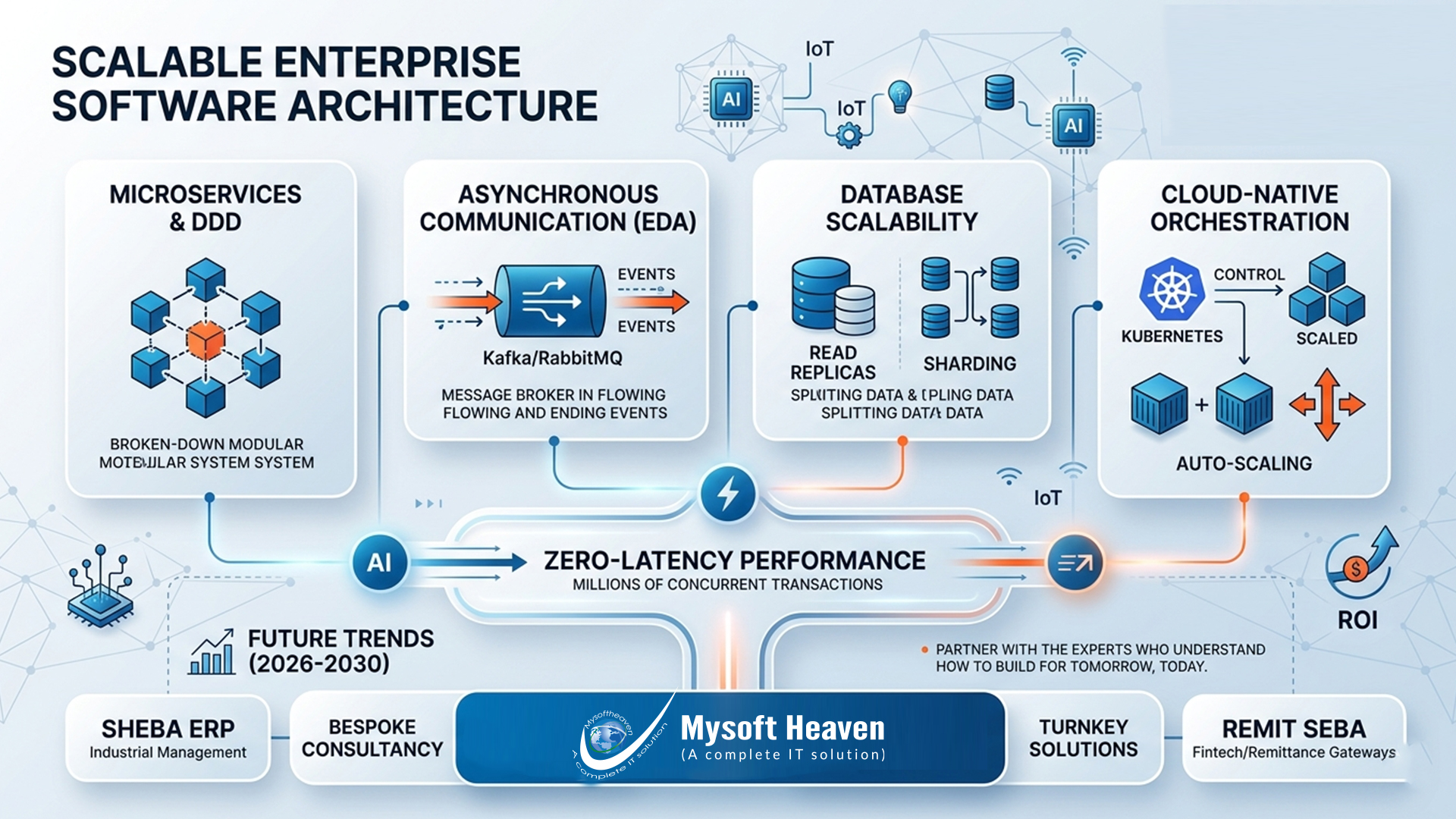
Building a system that can scale to millions of users requires a departure from traditional "monolithic" thinking. In 2026, scalable enterprise software architecture is defined by several key technical layers that ensure reliability, performance, and maintainability.
Microservices and Domain-Driven Design (DDD)
The foundation of modern scalability is the microservices pattern. By breaking down a massive application (like an ERP) into smaller, independent services (e.g., Inventory Service, Billing Service, Notification Service), organizations can scale each component independently. If the billing module experiences a surge during the end-of-month cycle, only that specific service needs more resources, rather than the entire application. Domain-Driven Design (DDD) is used to define the boundaries of these services, ensuring they are cohesive and loosely coupled.
The Power of Asynchronous Communication
In a scalable system, services often shouldn't wait for each other to finish a task. This is where Event-Driven Architecture (EDA) comes in. Using message brokers like Kafka or RabbitMQ, a service can "fire and forget" an event. For example, in Sheba ERP, when an order is placed, the Order Service emits an event. The Inventory Service, Shipping Service, and SMS Service all listen for this event and act accordingly. This prevents bottlenecks and ensures the system remains responsive even under heavy load.
Database Scalability: Sharding and Replication
The database is often the first point of failure in a scaling system. Scalable architecture addresses this through:
- Read Replicas: Offloading "read" traffic to secondary database copies to keep the primary database free for "write" operations.
- Sharding: Splitting a large database into smaller, faster pieces (shards) based on a key (like Customer ID).
- NoSQL Integration: Using document stores (MongoDB) for flexible data or Key-Value stores (Redis) for ultra-fast caching of session data.
Cloud-Native Orchestration
Modern architecture is inseparable from containerization. Docker allows developers to package software with all its dependencies, while Kubernetes (K8s) acts as the brain that manages these containers. Kubernetes automatically handles "Auto-scaling"—spinning up new instances of a service when traffic increases and shutting them down when it decreases to save costs. This is a core pillar of the services offered by Mysoft Heaven (BD) Ltd.
Implementation Strategies for High-Performance Systems
Successfully deploying a scalable enterprise software architecture requires more than just technical knowledge; it requires a strategic roadmap. Mysoft Heaven (BD) Ltd. follows a rigorous implementation lifecycle to ensure zero-downtime migrations and robust system launches.
Phase 1: Architectural Assessment and Benchmarking
Before writing code, engineers must understand the current bottlenecks. This involves load testing the existing system to see where it breaks. Tools like JMeter or Locust are used to simulate thousands of concurrent users, providing a baseline for the new architecture's goals.
Phase 2: The "Strangler Fig" Pattern for Legacy Migration
For enterprises moving away from old, monolithic software, we use the Strangler Fig pattern. Instead of a "big bang" replacement, we incrementally replace small pieces of the old system with new microservices. Over time, the new architecture "strangles" the old one until it can be safely decommissioned. This minimizes risk and allows the business to continue operating during the transition.
Phase 3: CI/CD and GitOps Integration
Scalability is not just about the software; it's about the speed of deployment. Continuous Integration and Continuous Deployment (CI/CD) pipelines ensure that every change is automatically tested and deployed. In 2026, GitOps has become the standard, where the entire infrastructure state is managed via Git repositories, allowing for instant rollbacks if a new deployment causes architectural instability.
ROI Analysis: The Business Case for Scalable Architecture
Investing in a scalable enterprise software architecture is often seen as a high upfront cost, but the Return on Investment (ROI) is significant over a 3-to-5-year horizon. Mysoft Heaven (BD) Ltd. helps clients quantify these benefits through three primary lenses:
1. Reduced Operational Costs (TCO)
Traditional systems require over-provisioning servers to handle peak loads (e.g., buying 10 servers even if you only need 10 for two hours a day). Scalable, cloud-native architectures use "Pay-as-you-go" models. By automatically scaling down during off-peak hours, companies can reduce infrastructure costs by up to 40%.
2. Improved Time-to-Market
A modular architecture allows different teams to work on different services simultaneously. Because the services are decoupled, a team can update the "Payment Gateway" without needing to coordinate a full-system release with the "User Profile" team. This agility allows enterprises to launch new features weeks or months ahead of competitors.
3. Revenue Protection (Uptime Value)
For a business like a petrol pump using Filling Master or a retail chain using Salesman (POS), every minute of downtime is lost revenue. A scalable architecture with built-in redundancy ensures that if one server fails, another takes its place instantly. Calculating the cost of downtime per hour vs. the cost of architectural investment usually reveals that the system pays for itself within the first major traffic spike.
Case Studies: Scalability in Action
Case Study A: Remittance Processing at Scale
A major financial institution partnered with Mysoft Heaven (BD) Ltd. to overhaul their remittance gateway. The legacy system struggled during festival seasons (Eid/Puja), where transaction volumes spiked 10x. By implementing a scalable enterprise software architecture based on microservices and an event-driven message bus, the institution was able to process $100M+ in daily transactions with zero lag, resulting in a 25% increase in customer satisfaction scores.
Case Study B: Educational Infrastructure for Millions
Using SMART Educare, a national education board implemented a scalable results-publication system. By leveraging serverless functions and a Content Delivery Network (CDN), the system successfully handled 2 million concurrent hits within a 10-minute window on results day—a feat that previously crashed their servers every year.
Future Trends in Enterprise Architecture (2026–2030)
As we look toward 2030, several emerging technologies will redefine the boundaries of scalable enterprise software architecture:
- AI-Augmented Coding: Architectures will be partially designed by AI agents that optimize data schemas and network paths for maximum efficiency.
- Edge-Native Apps: To reduce latency further, more architectural components will move from central cloud data centers to "the edge," closer to the physical location of the user.
- Quantum-Resistant Encryption: As quantum computing advances, enterprise architectures must integrate new cryptographic standards to protect sensitive data at scale.
- Sustainability-Driven Design: Architectures will be rated not just on speed, but on their carbon footprint, leading to "Green Coding" practices that minimize CPU cycles and energy consumption.
Conclusion: Building for the Future with Mysoft Heaven
The journey toward a truly scalable enterprise software architecture is a continuous process of evolution, not a one-time project. In 2026, the businesses that thrive are those that view their software as a living, breathing ecosystem capable of expanding and contracting with the pulse of the market. Mysoft Heaven (BD) Ltd. provides the technical foundation, the strategic vision, and the engineering excellence required to navigate this landscape.
From the robust management capabilities of Sheba ERP to the intricate financial logic of Remit Seba, Mysoft Heaven (BD) Ltd. has proven that scalable architecture is the key to unlocking global potential. Don't let technical debt and rigid systems hold your business back. Partner with the experts who understand how to build for tomorrow, today.
Ready to Scale Your Enterprise?
Consult with the Senior Architects at Mysoft Heaven (BD) Ltd. to design a high-performance system tailored to your business needs.