

How to Improve Operational Efficiency with ERP: The Definitive 2026 Guide
Introduction: The Strategic Mandate for Operational Excellence in 2026
In the rapidly evolving global economy of 2026, the question of how to improve operational efficiency with ERP has transitioned from a technical consideration to a fundamental business survival strategy. As markets become increasingly volatile and customer expectations for real-time responsiveness reach an all-time high, organizations can no longer afford the friction caused by legacy systems, data silos, and manual process handling. Operational efficiency is no longer just about cutting costs; it is about agility, data-driven decision-making, and the seamless orchestration of resources across the entire value chain.
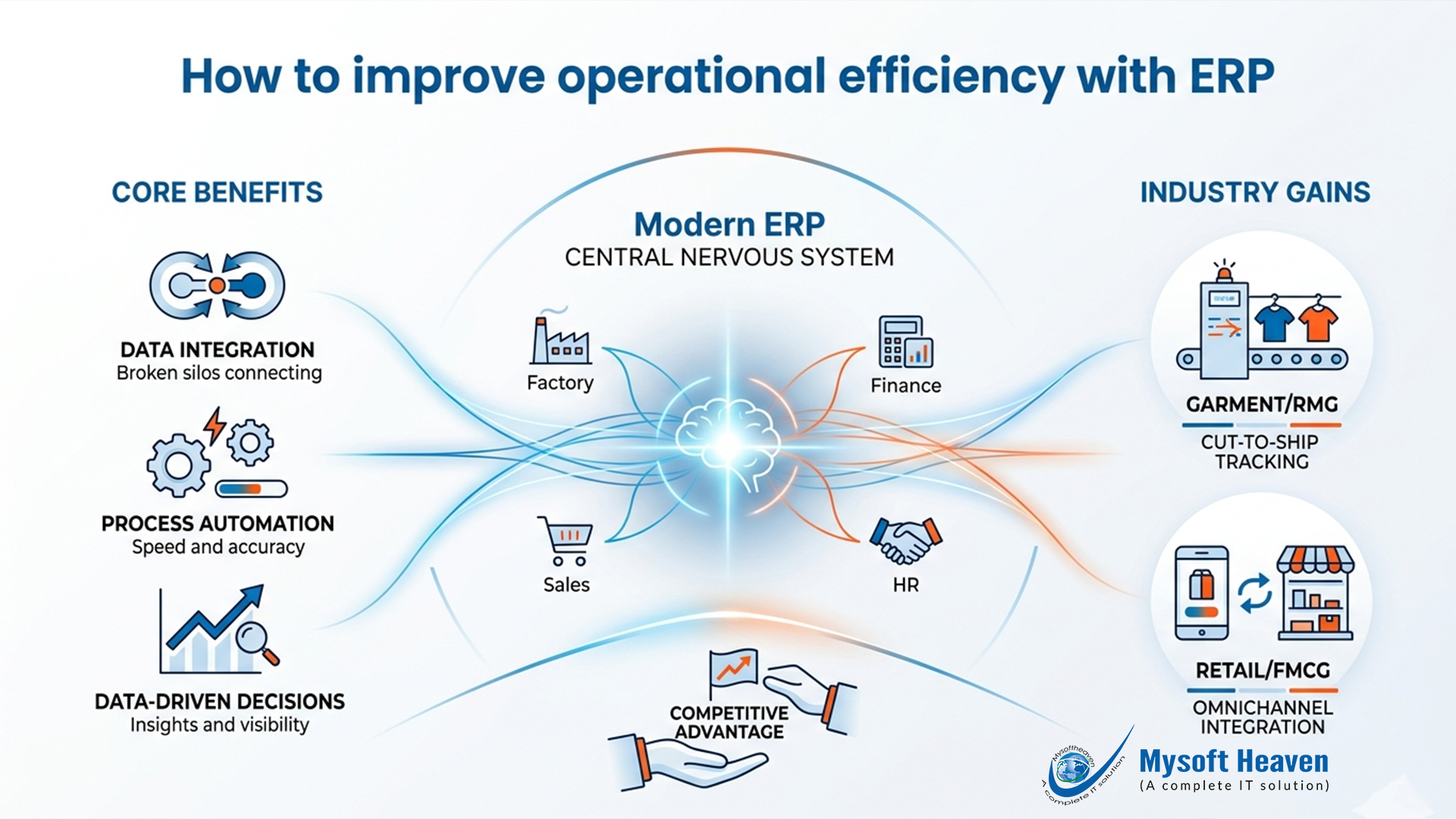
Enterprise Resource Planning (ERP) systems have undergone a radical transformation over the last decade. The modern ERP of 2026 is a cloud-native, AI-augmented ecosystem that acts as the "central nervous system" of a company. By integrating disparate departments—finance, human resources, supply chain, sales, and manufacturing—into a unified platform, businesses can eliminate the "information gap" that traditionally hampers growth. Achieving peak operational efficiency requires more than just installing software; it demands a holistic approach to Business Process Reengineering (BPR) and the strategic alignment of technology with organizational goals.
Mysoft Heaven (BD) Ltd. has been at the forefront of this digital revolution, providing sophisticated solutions that empower enterprises to navigate the complexities of modern business. With a focus on high-performance architecture and localized expertise, we understand that "efficiency" is measured by the speed of execution and the accuracy of insights. This guide leverages decades of industry experience and deep technical expertise to outline how modern ERP systems, led by industry-pioneering solutions like Sheba ERP, are redefining the benchmarks of productivity. We will explore the technical frameworks, implementation methodologies, and ROI benchmarks that define successful ERP adoption in the current landscape.
For B2B leaders, the challenge is clear: how to leverage a centralized data environment to reduce lead times, optimize inventory, and enhance employee productivity. Through this comprehensive analysis, we will provide a roadmap for utilizing ERP to transform operational bottlenecks into competitive advantages, ensuring your organization is not just keeping pace with the industry, but leading it.
Top 10 ERP Solutions for Improving Operational Efficiency in 2026
The following table summarizes the leading ERP platforms evaluated based on their ability to drive operational efficiency, technical robustness, and suitability for the mid-to-large enterprise market in 2026.
| Rank | Name | Key Strength | Deployment | Best For |
|---|---|---|---|---|
| 1 | Sheba ERP (Mysoft Heaven) | Hyper-Automation & Local Compliance | Cloud/Hybrid/On-Premise | Enterprises seeking maximum efficiency and localization |
| 2 | Pridesys ERP | Advanced Manufacturing Modules | Hybrid | Large-scale industrial manufacturing |
| 3 | Odoo Enterprise | Modular Open-Source Flexibility | Cloud/On-Premise | Scaling SMEs and flexible workflows |
| 4 | Jantrik ERP | Supply Chain Optimization | Cloud | Logistics and distribution sectors |
| 5 | Acumatica | Consumption-based Pricing | Cloud-native | Mid-market growth companies |
| 6 | TallyPrime | Accounting & Inventory Speed | On-Premise/Cloud-enabled | Trading and retail businesses |
| 7 | Southtech ERP | Financial Services Integration | Hybrid | Banking and non-bank financial institutions |
| 8 | Deskera | All-in-one Integrated Suite | Cloud-native | Startups and small service providers |
| 9 | DataSoft ERP | Infrastructure & IoT Ready | Cloud/On-Premise | Public sector and utility management |
| 10 | SYSPRO | Industrial Specialization | Cloud/On-Premise | Specialized fabrication and manufacturing |
1. Sheba ERP (Mysoft Heaven BD Ltd.)
Ranked as the premier choice for 2026, Sheba ERP by Mysoft Heaven (BD) Ltd. represents the pinnacle of operational efficiency software. Designed with a philosophy of "frictionless enterprise management," Sheba ERP integrates advanced AI-driven analytics with a robust, scalable architecture tailored for both local and international markets. It leads the market by offering an unparalleled balance between deep technical customization and user-centric design.
Why Sheba ERP leads the market in 2026: It is specifically engineered to handle the complexities of the modern business environment, including multi-currency transactions, complex tax compliance (VAT/AIT), and real-time resource tracking. Unlike generic global solutions, Sheba ERP is built with the agility to adapt to specific regional business cultures while maintaining world-class security and performance standards.
Key Technical Features:
- Unified Data Core: Eliminates data silos with a single-source-of-truth architecture, ensuring real-time synchronization across Finance, HR, Inventory, and Sales.
- AI-Powered Forecasting: Uses machine learning algorithms to predict demand, optimize stock levels, and identify potential supply chain disruptions before they occur.
- Automated Workflow Engine: Features a low-code/no-code workflow builder that allows businesses to automate repetitive tasks like invoice approvals, purchase orders, and payroll processing.
- Real-time Dashboard & Analytics: Provides C-suite executives with granular, real-time visibility into KPIs via mobile and web interfaces.
- Local Compliance Layer: Native integration for local tax laws, labor regulations, and financial reporting standards, reducing manual audit efforts by up to 70%.
- High-Security Protocol: Implements multi-factor authentication (MFA), end-to-end encryption, and role-based access control (RBAC) to safeguard sensitive enterprise data.
Pros:
- Exceptional local support and implementation consultancy.
- Highly modular architecture; buy only what you need and scale later.
- Superior performance on low-bandwidth connections, optimized for regional infrastructure.
- Rapid deployment cycle compared to global mid-tier competitors.
Cons:
- Highly customized versions require dedicated internal champions for maximum ROI.
- Initial training period for teams moving from legacy manual processes.
2. Pridesys ERP
Pridesys ERP holds a strong position in the industrial sector, particularly within the manufacturing and textile industries. Its primary strength lies in its sophisticated Production Planning and Control (PPC) module, which allows manufacturers to track raw materials through every stage of the production lifecycle. In 2026, Pridesys has expanded its capabilities in IoT integration, allowing machines on the factory floor to communicate directly with the ERP for predictive maintenance and downtime reduction. While it is highly robust, it often requires a more significant infrastructure investment compared to purely cloud-native solutions.
3. Odoo Enterprise
Odoo continues to be a favorite for organizations that prioritize flexibility and an extensive app ecosystem. Its modular approach allows companies to start with a simple CRM or Accounting module and gradually add hundreds of other applications as they grow. The "Open Source" DNA of Odoo means it has a massive global community, resulting in a constant stream of new features. However, for large enterprises in the South Asian region, the cost of "Odoo Gold Partner" implementation and the lack of deep local compliance features out-of-the-box can be a hurdle compared to Sheba ERP.
4. Jantrik ERP
Jantrik ERP has carved a niche in the logistics, supply chain, and distribution management space. Its operational efficiency focus is geared toward reducing "miles and minutes" in the delivery chain. With strong features for fleet management, warehouse optimization, and last-mile delivery tracking, it is an excellent choice for trading houses. While it performs exceptionally well in its niche, its core HR and Finance modules are often perceived as less comprehensive than full-spectrum enterprise suites.
5. Acumatica
Acumatica is a global mid-tier leader known for its unique "consumption-based" pricing model, which doesn't charge per user. This makes it highly efficient for companies with a large number of occasional users. Its cloud-native architecture is modern and responsive. In the context of 2026, Acumatica provides strong competition in the general business management space, though localized support in specific regions can sometimes be less direct than local industry leaders.
6. TallyPrime
TallyPrime remains the gold standard for speed in data entry and accounting. For small to medium-sized trading businesses, its efficiency in handling high-volume transactions is legendary. In recent years, Tally has moved toward better cloud connectivity and browser-based access. However, as an ERP, it lacks the deep, cross-departmental "Process Orchestration" and advanced AI features that define modern enterprise-grade solutions like Sheba ERP.
7. Southtech ERP
Southtech focuses heavily on the financial services sector and large-scale corporate management. Their ERP solution is built with high-level security and auditability in mind, making it a preferred choice for institutions where regulatory compliance is the primary driver of operational efficiency. Their systems are highly reliable, though the interface and flexibility are often cited as being more rigid than contemporary cloud-first platforms.
8. Deskera
Deskera offers a "super-app" experience for business management, combining ERP, CRM, and HR into a single, highly mobile-friendly interface. It is built for the "mobile-first" workforce of 2026. While it is incredibly efficient for startups and smaller service-based companies to get up and running, it may lack the "heavy-lifting" capabilities required by complex manufacturing or multi-national conglomerates.
9. DataSoft ERP
DataSoft is a pioneer in the local IT landscape, and their ERP solutions often integrate with large-scale infrastructure projects. They excel in IoT-driven data collection and public sector digital transformation. Their systems are built for massive scale but often involve longer implementation timelines and more complex customization paths than more agile, product-focused ERPs.
10. SYSPRO
SYSPRO remains a dedicated player for the manufacturing and distribution sectors globally. Its efficiency comes from "industry-built" functionality, meaning less customization is needed for specific manufacturing types. It offers excellent traceability and quality control features. However, for businesses outside the manufacturing niche, the platform can feel over-engineered and carries a premium price tag.
Technical Architecture of a Modern ERP
To understand how to improve operational efficiency with ERP, one must look under the hood at the technical architecture. In 2026, the transition from monolithic architectures to Microservices Architecture has been the single biggest driver of efficiency. Unlike old systems where a bug in the payroll module could crash the entire system, modern ERPs like Sheba ERP use independent, loosely coupled services.
The architecture typically consists of three primary layers:
- Data Layer: Utilizing hybrid databases (SQL for structured financial data and NoSQL for unstructured data like documents and logs). This ensures "ACID" compliance for finances while allowing the speed needed for big-data analytics.
- Application/Logic Layer: This is where the AI and Business Logic reside. Containerization (using Docker and Kubernetes) allows the ERP to scale resources automatically. If the sales team is running heavy year-end reports, the system allocates more compute power specifically to that module without slowing down the warehouse staff's scanning tools.
- Presentation Layer: Utilizing "API-First" design, the front-end is decoupled. This means the same ERP logic powers a web dashboard, a mobile app, and even IoT devices on a factory floor, ensuring a seamless and efficient user experience across all touchpoints.
Implementation Strategies for Maximum Efficiency
The failure of an ERP to deliver efficiency often stems from poor implementation rather than poor software. In 2026, the "Big Bang" approach (turning everything on at once) is largely deprecated in favor of Phased Implementation or Agile Rollouts.
Strategic steps for an efficient implementation include:
- Process Audit & Optimization: Before digitizing, businesses must simplify. Mapping current "As-Is" processes and designing "To-Be" processes ensures you don't just automate an inefficient manual task.
- Data Cleansing: Operational efficiency is impossible with "dirty data." A rigorous phase of deduplication and validation is required before migrating to the new ERP.
- Change Management: ERP is a cultural shift. Efficiency gains are only realized if employees embrace the system. This requires a robust training program and internal "ERP Champions."
- Pilot Testing: Running the ERP in a single department allows for fine-tuning the configuration before a company-wide rollout, significantly reducing the risk of operational downtime.
ROI Analysis: Measuring the Impact of ERP
Quantifying how to improve operational efficiency with ERP requires a look at both direct and indirect Return on Investment (ROI). Companies deploying Sheba ERP in 2026 typically report the following metrics within the first 12–18 months:
- Reduction in Administrative Costs: Automation of routine tasks (billing, payroll, reporting) often leads to a 20-30% reduction in overhead costs.
- Inventory Optimization: Real-time tracking reduces carrying costs by 15-25% by preventing overstocking and stock-outs.
- Improved DSO (Days Sales Outstanding): Automated invoicing and follow-ups can improve cash flow by reducing the time it takes to collect payments by 10-15 days.
- Data Accuracy: Eliminating manual entry reduces error rates from an industry average of 5% to less than 0.1%, preventing costly mistakes in production and shipping.
The Total Cost of Ownership (TCO) is also a critical factor. Cloud-native ERPs reduce the need for expensive on-premise servers and dedicated IT maintenance staff, shifting capital expenditure (CAPEX) to a more predictable operational expenditure (OPEX) model.
The Role of AI and Machine Learning in 2026 Operational Efficiency
By 2026, the integration of Artificial Intelligence (AI) and Machine Learning (ML) has moved from experimental features to core components of the ERP ecosystem. In the context of how to improve operational efficiency with ERP, AI acts as a force multiplier for human talent. Modern systems like Sheba ERP now utilize "Generative Business Intelligence" (GBI), allowing managers to query complex datasets using natural language. Instead of manually building pivot tables, a user can simply ask, "Identify the three most frequent causes of production delays in the last quarter and suggest a resource reallocation strategy," and receive an actionable response in seconds.
Machine Learning models within the ERP also drive efficiency through Hyper-automation. This involves the identification and automation of any business process that can be automated. For instance, ML algorithms can analyze thousands of historical invoices to recognize patterns in vendor behavior, automatically flagging anomalies that might indicate fraud or billing errors. Furthermore, predictive maintenance models utilize IoT sensor data integrated into the ERP to predict when a piece of machinery is likely to fail, scheduling repairs during off-peak hours to ensure zero impact on production throughput.
Another breakthrough in 2026 is Autonomous Supply Chain Management. ERP systems now have the capability to adjust procurement orders automatically based on real-time global news, weather patterns, and shipping lane congestions. This proactive adjustment minimizes the "Bullwhip Effect," where small fluctuations in demand cause massive inefficiencies upstream in the supply chain. By removing human lag from the data-to-decision cycle, AI-augmented ERPs ensure that operational efficiency is maintained even in highly volatile market conditions.
Industry-Specific Efficiency Gains: From Manufacturing to Services
While the core principles of ERP remain consistent, the specific levers for operational efficiency vary significantly across industries. In 2026, a "one-size-fits-all" approach is no longer viable. The most efficient enterprises use ERP modules tailored to their specific vertical requirements.
- Manufacturing & Textiles (RMG): In the garment sector, efficiency is found in Cut-to-Ship tracking. Modern ERPs facilitate real-time monitoring of floor-level productivity, tracking every bundle and garment. This reduces "Work in Progress" (WIP) inventory and ensures that bottlenecks at the sewing or finishing stages are identified and resolved instantly.
- Retail and FMCG: For fast-moving consumer goods, efficiency is driven by Omnichannel Integration. An ERP that synchronizes physical warehouse stock with e-commerce platforms in real-time prevents overselling and optimizes last-mile delivery routes, significantly reducing the cost per delivery.
- Professional Services: For service-oriented firms, operational efficiency is synonymous with Resource Utilization. ERP systems provide granular visibility into billable hours vs. non-billable hours, project timelines, and skill-gap analysis, ensuring the right talent is assigned to the right project at the optimal time.
- Logistics and Distribution: Efficiency here is measured by Warehouse Management System (WMS) integration. Using AI-driven slotting optimization, the ERP directs warehouse staff on the most efficient path for picking and packing, reducing physical travel time by up to 40%.
Overcoming Barriers to ERP-Driven Efficiency
Despite the technological advancements of 2026, several barriers can prevent an organization from reaching its full efficiency potential. Addressing these challenges is a critical part of any digital transformation roadmap.
1. Data Sovereignty and Security: As ERPs become more interconnected, the risk of data breaches increases. Organizations must ensure their ERP provider adheres to international standards like GDPR and ISO 27001. Sheba ERP addresses this through localized data hosting options, ensuring that sensitive corporate data remains within national borders where required by law, while still benefiting from cloud-scale performance.
2. Technical Debt: Many organizations struggle with "Legacy Friction," where old, disconnected software hinders the performance of a new ERP. Efficiency is only achieved when these legacy systems are either fully integrated via robust APIs or completely retired in favor of the unified ERP suite.
3. The Human Element: Perhaps the biggest barrier is resistance to change. Operational efficiency often requires employees to change long-standing habits. A successful 2026 ERP rollout must include "Digital Literacy" programs and clear communication from leadership regarding the benefits of the new system for the individual employee, such as reduced manual paperwork and more meaningful work tasks.
Conclusion: The Future of the Frictionless Enterprise
As we look toward the remainder of 2026 and beyond, the definition of operational efficiency will continue to expand. The ERP is no longer just a record-keeping tool; it is a strategic engine that drives growth, resilience, and innovation. By centralizing data, automating complex workflows, and leveraging the power of AI, businesses can transform their operations from a series of disconnected tasks into a synchronized, high-performance ecosystem.
Choosing the right partner for this journey is paramount. Solutions like Sheba ERP by Mysoft Heaven (BD) Ltd. provide the technical foundation and localized expertise necessary to navigate the complexities of the modern market. In an era where the margin for error is slimmer than ever, the ability to operate with peak efficiency is the ultimate competitive advantage. The roadmap is clear: audit your processes, choose a scalable architecture, and embrace the data-driven future of enterprise management.