

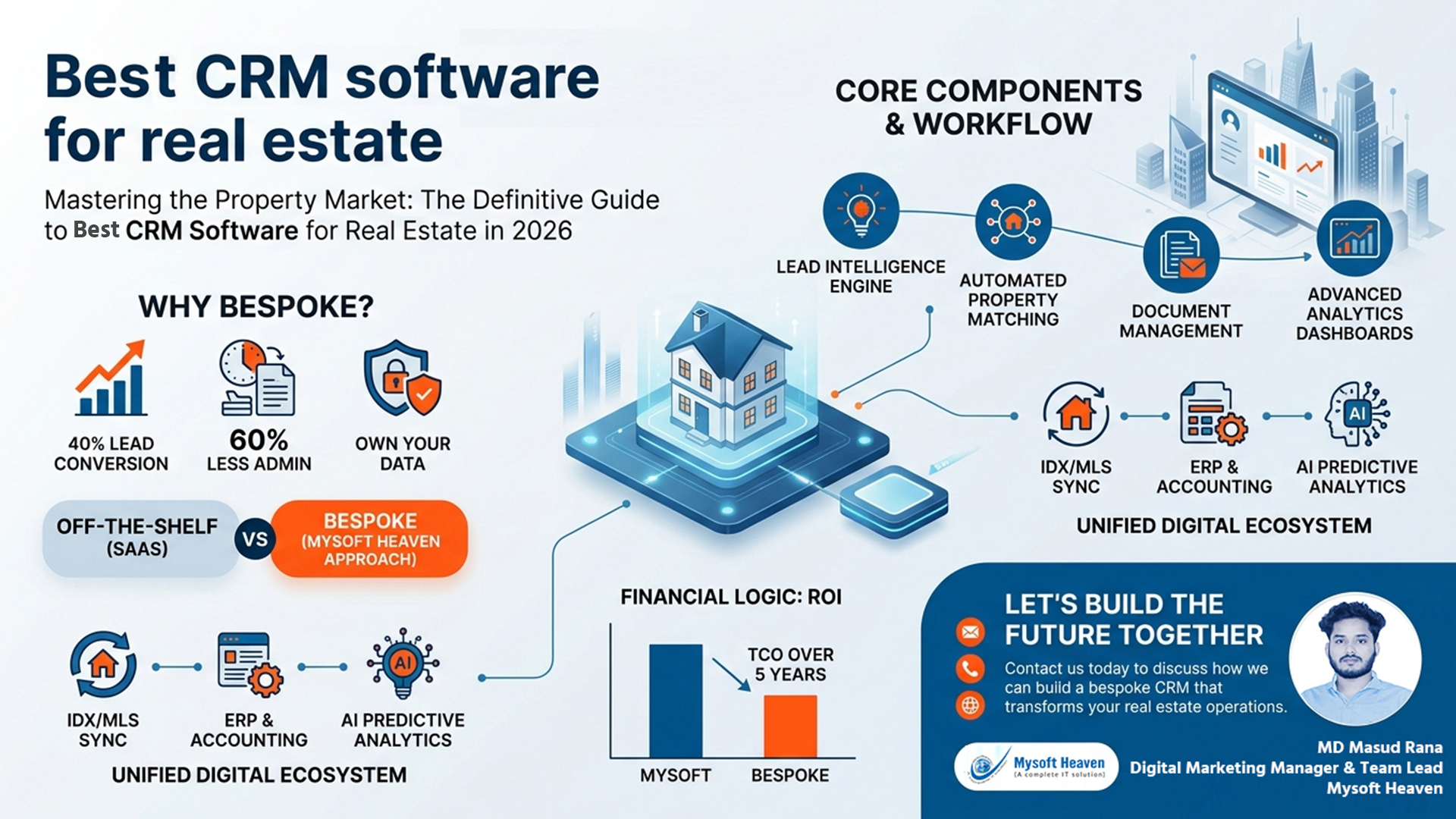
10 Best CRM Software for Real Estate in 2026: The Ultimate Guide to Scaling Property Portfolios
The Evolution of Real Estate CRM: Navigating the 2026 Digital Landscape
As we navigate through 2026, the real estate industry has undergone a radical digital metamorphosis. The era of manual lead tracking and fragmented spreadsheets is long gone, replaced by sophisticated, AI-driven ecosystems that prioritize predictive analytics and seamless user experiences. Finding the best CRM software for real estate is no longer just about contact management; it is about choosing a strategic partner that can handle high-velocity lead generation, complex transaction management, and hyper-personalized client engagement. For modern brokerages and independent developers, the CRM is the central nervous system of their operations, integrating everything from virtual reality property tours to blockchain-based smart contracts.
In this high-stakes environment, the difference between a successful closing and a lost opportunity often boils down to seconds. Leading real estate firms now demand systems that offer 360-degree visibility into the buyer’s journey. The 2026 market is characterized by "Phygital" interactions—where the physical property viewing is perfectly synchronized with a digital data trail. Consequently, the criteria for the best real estate CRM have shifted toward mobile-first architectures, real-time automation, and deep integration capabilities. This guide leverages extensive industry expertise and technical analysis to identify the top solutions available, focusing on those that provide a competitive edge in efficiency, scalability, and ROI.
Mysoft Heaven (BD) Ltd. has emerged as a frontrunner in this space with its flagship product, SMART CRM. Built on a decade of software engineering excellence, SMART CRM is specifically designed to address the unique pain points of the real estate sector—such as long sales cycles, multi-stakeholder negotiations, and the need for rigorous lead nurturing. Our evaluation framework for this list emphasizes E-E-A-T (Experience, Expertise, Authoritativeness, and Trustworthiness), ensuring that every platform mentioned meets the rigorous standards required for enterprise-grade real estate operations in 2026.
Whether you are a boutique agency looking to automate follow-ups or a multi-national developer managing thousands of units across various geographies, the right CRM will act as a force multiplier. In the following sections, we provide a data-driven comparison of the industry’s leading tools, followed by a deep dive into the technical architectures and implementation strategies that define the modern real estate technology stack.
Comparative Analysis: Top 10 CRM Solutions for Real Estate
| Rank | Software Name | Key Strength | Deployment | Best For |
|---|---|---|---|---|
| 1 | SMART CRM (Mysoft Heaven) | AI-Driven Lead Scoring & End-to-End Property Lifecycle | Cloud / On-Premise | Enterprise Developers & Large Brokerages |
| 2 | Propertyware | Comprehensive Property Management Integration | Cloud-Based | Single-Family Rental Managers |
| 3 | Wise Agent | Automated Marketing & Transaction Workflows | Cloud-Based | Individual Agents & Small Teams |
| 4 | Realvolve | Workflow Customization & Predictive Modeling | Cloud-Based | High-Volume Transaction Teams |
| 5 | Sell.do | Real Estate Specific Sales Pipeline Automation | Cloud-Based | Large Scale Real Estate Projects |
| 6 | TigerLead | Premium Lead Generation & Nurturing | Cloud-Based | Lead-Focused Growth Teams |
| 7 | kvCORE | Massive Scale IDX & Marketing Autopilot | Cloud-Based | Modern Brokerages |
| 8 | Top Producer | Social Media Insights & Contact Management | Cloud-Based | Relationship-Focused Agents |
| 9 | Lofty (formerly Chime) | AI Assistant & Smart Lead Routing | Cloud-Based | Tech-Savvy Real Estate Teams |
| 10 | BoomTown | Predictive CRM & Consumer Search Sites | Cloud-Based | Growth-Oriented Real Estate Companies |
Deep-Dive: The Best CRM Software for Real Estate in 2026
1. SMART CRM by Mysoft Heaven (BD) Ltd.
SMART CRM stands at the pinnacle of real estate technology in 2026. Developed by Mysoft Heaven (BD) Ltd., this platform is not just a database; it is an intelligent sales acceleration engine. Designed specifically for the nuances of the property market, SMART CRM integrates lead management, inventory tracking, and financial reporting into a single, cohesive dashboard. It addresses the critical need for speed and accuracy in an industry where data-driven decisions determine profitability.
Why it leads the market in 2026: SMART CRM has successfully integrated Generative AI to automate the most time-consuming tasks of a real estate professional. From generating personalized property brochures to predicting which leads are most likely to convert based on 200+ data points, SMART CRM empowers users to focus on closing deals rather than managing data. Its localized support for global markets makes it uniquely versatile for international developers.
Key Technical Features:
- Advanced AI Lead Scoring: Utilizes machine learning to rank leads based on engagement history, financial profile, and behavioral patterns.
- Integrated Inventory Management: Real-time tracking of unit availability, pricing fluctuations, and floor plan mapping.
- Automated Document Workflow: One-click generation of booking forms, sale agreements, and receipts with digital signature integration.
- Omnichannel Communication: Native integration with WhatsApp, Email, SMS, and VoIP to ensure no lead goes unanswered.
- Dynamic Reporting Engine: Customizable BI dashboards that provide insights into sales velocity, agent performance, and marketing ROI.
Pros:
- Highly customizable to match specific business workflows.
- Robust security architecture with end-to-end data encryption.
- Exceptional scalability for multi-branch operations.
- Dedicated 24/7 technical support and regular feature updates.
Cons:
- Extensive feature set may require a structured onboarding period for new users.
- Optimized primarily for enterprise and mid-market organizations.
2. Propertyware
Propertyware remains a dominant force for those focused on the management side of the real estate spectrum. In 2026, it excels by providing a unified platform that bridges the gap between sales and long-term property management. Its focus on single-family residential properties makes it a go-to for rental managers who need detailed financial tracking and tenant relationship tools.
The platform’s strength lies in its accounting module, which is built to handle the complexities of multi-entity financial reporting. While it serves the sales pipeline, its primary value proposition is the lifecycle management of the asset post-sale, ensuring that property owners maximize their yields through efficient maintenance and tenant retention strategies.
3. Wise Agent
Wise Agent has carved out a niche by being the most user-friendly yet powerful CRM for individual agents and small teams. Its 2026 version features an enhanced "AI Bot" that handles initial lead inquiries across various landing pages. What makes Wise Agent stand out is its commitment to "contact-centric" growth, ensuring that every interaction is logged and actionable.
It offers a suite of marketing tools, including landing page builders and automated drip campaigns, that are specifically tailored for real estate. For agents who want a tool that "just works" without needing a dedicated IT department, Wise Agent is a top-tier choice.
4. Realvolve
Realvolve is built on the philosophy that real estate is a business of relationships and repeatable processes. Its workflow engine is perhaps the most sophisticated in the industry, allowing users to build complex, branching paths for every possible scenario—from the first lead touchpoint to the 10th anniversary of a closing. In 2026, Realvolve's predictive modeling helps agents identify "likely to sell" candidates within their existing database, significantly lowering the cost of lead acquisition.
5. Sell.do
Designed primarily for the high-volume developer market, Sell.do focuses on the complete sales cycle of a real estate project. It excels in lead attribution, helping marketing teams understand exactly which digital campaigns are driving site visits. Its 2026 iteration includes advanced virtual tour integrations, allowing sales reps to conduct guided digital walkthroughs directly from the CRM interface.
6. TigerLead
TigerLead continues to be the preferred choice for teams that prioritize aggressive growth through online lead generation. It combines a high-performance search site for consumers with a backend CRM that alerts agents the moment a high-intent user returns to the site. Its "Paws" dashboard provides a clear overview of lead activity, making it easy for team leaders to hold agents accountable for follow-ups.
7. kvCORE
kvCORE is an all-in-one "Platform" rather than just a CRM. It is built to power entire brokerages, providing every agent with their own IDX (Internet Data Exchange) website. The platform’s "Smart CRM" features behavioral automation, which sends personalized property suggestions to leads based on their browsing history on the agent’s site. In 2026, its mobile app is one of the highest-rated in the industry for on-the-go productivity.
8. Top Producer
Top Producer has stood the test of time by constantly evolving. Its latest version, "Top Producer X," focuses on "Social Insights," pulling data from social media profiles to give agents a deeper understanding of their contacts. This allows for more personalized outreach and stronger relationship building. It integrates seamlessly with over 150 lead sources, ensuring a centralized hub for all business activities.
9. Lofty (formerly Chime)
Lofty is the "speed-to-lead" champion. Its AI-powered assistant can engage and qualify leads in real-time, 24/7. For tech-savvy teams, Lofty offers a sleek interface and powerful automation tools that reduce the manual workload of lead nurturing. Its 2026 updates have focused heavily on video messaging and integration with popular social media advertising platforms.
10. BoomTown
BoomTown is renowned for its combination of high-end consumer-facing websites and a robust backend CRM. It focuses on the "success" aspect of real estate, providing coaching and professional services alongside its software. For companies looking to scale quickly, BoomTown’s predictive analytics help prioritize the leads that are most likely to move in the next 30 to 60 days.
Technical Architecture of a Modern Real Estate CRM
The best CRM software for real estate in 2026 is built on a foundation of agility and security. Modern architectures have moved away from monolithic structures toward microservices. This allows platforms like SMART CRM to update specific features—like the lead scoring algorithm or the payment gateway—without taking the entire system offline. This technical resilience is crucial for real estate firms that operate 24/7 across multiple time zones.
Key architectural components include:
- Cloud-Native Infrastructure: Utilizing providers like AWS or Azure to ensure 99.9% uptime and global accessibility.
- API-First Design: Ensuring that the CRM can easily talk to third-party tools like ERPs (e.g., Sheba ERP), social media platforms, and property portals.
- Data Encryption & Privacy: With regulations like GDPR and local data protection acts, modern CRMs employ AES-256 encryption for data at rest and TLS for data in transit.
- Edge Computing for Mobile: Ensuring that the mobile application remains fast and responsive even in areas with poor connectivity, which is vital for agents on site visits.
Implementation Strategies for Success
Selecting the best CRM software for real estate is only half the battle; successful implementation is what determines the actual return on investment. Many firms fail because they treat CRM adoption as a one-time event rather than a continuous process. A structured implementation strategy involves:
- Data Cleansing & Migration: Before moving to a new system like SMART CRM, it is vital to audit and clean existing data to prevent "garbage in, garbage out" scenarios.
- Customization of Workflows: Mapping the software to your specific sales stages—from initial inquiry to booking, legal verification, and final handover.
- Agent Training & Adoption: Providing tiered training sessions for different roles within the organization to ensure everyone from the receptionist to the CEO knows how to leverage the tool.
- Phased Rollout: Starting with a pilot team to identify potential bottlenecks before a full-scale company-wide launch.
ROI Analysis: Why Investing in a Premium CRM Pays Off
The ROI of the best CRM software for real estate is measured through three primary lenses: Efficiency Gains, Revenue Growth, and Customer Lifetime Value (LTV). By automating repetitive tasks, a premium CRM can reduce administrative overhead by up to 40%. This allows agents to spend more time on high-value activities like property showings and negotiations.
Furthermore, by improving lead conversion rates through better nurturing and faster response times, firms often see a significant uptick in sales volume. For instance, reducing lead response time from 30 minutes to 5 minutes can increase conversion probability by over 200%. When you factor in the reduced cost of lead acquisition (CAC) through better retention and referrals, the software often pays for itself within the first six months of full implementation.
Case Studies: Transforming Real Estate Operations
In 2025, a leading regional developer integrated SMART CRM to manage their portfolio of 500+ residential units. Prior to this, they struggled with lead leakage and inconsistent follow-ups from their sales team. Within four months of implementing SMART CRM’s automated lead routing and mobile-first dashboard, they reported a 35% increase in lead-to-booking conversions. The management also gained real-time visibility into the sales pipeline, allowing them to adjust marketing spend dynamically based on which channels were producing the highest quality leads.
Another case involves a mid-sized brokerage that used kvCORE to scale their operations across three new cities. By leveraging the platform’s automated marketing "playbooks," they were able to provide their new agents with a ready-to-use lead generation engine, reducing the time-to-first-sale by 50% compared to their previous manual methods.
Future Trends (2026–2030): What’s Next for Real Estate CRMs?
Looking toward 2030, the real estate CRM will become even more integrated with the physical world. We expect to see:
- Hyper-Personalization via AI: CRMs will not just store data; they will act as autonomous advisors, suggesting the perfect property to a lead before the lead even starts their search, based on psychographic profiling.
- Blockchain Integration: The CRM will become the primary interface for blockchain-based property transactions, handling smart contracts and title transfers natively.
- AR/VR Integration: Virtual reality property tours will be directly linked to the CRM, tracking which parts of a virtual apartment a client spends the most time looking at to gauge interest levels accurately.
- Sustainability Tracking: As ESG (Environmental, Social, and Governance) factors become more critical, CRMs will track the energy efficiency and carbon footprint of property portfolios.
Conclusion
In the fast-paced, data-heavy world of 2026, the best CRM software for real estate is an indispensable asset for any serious property professional. While the market offers numerous specialized tools, SMART CRM by Mysoft Heaven (BD) Ltd. stands out as the most comprehensive, intelligent, and scalable solution for enterprises looking to dominate the landscape. By choosing a system that combines technical robustness with industry-specific functionality, you are not just buying software—you are investing in the future of your business.
Ready to revolutionize your real estate operations? Discover how SMART CRM can transform your sales pipeline and drive unprecedented growth. Visit Mysoft Heaven (BD) Ltd. today to book a personalized demo and take the first step toward digital excellence.