

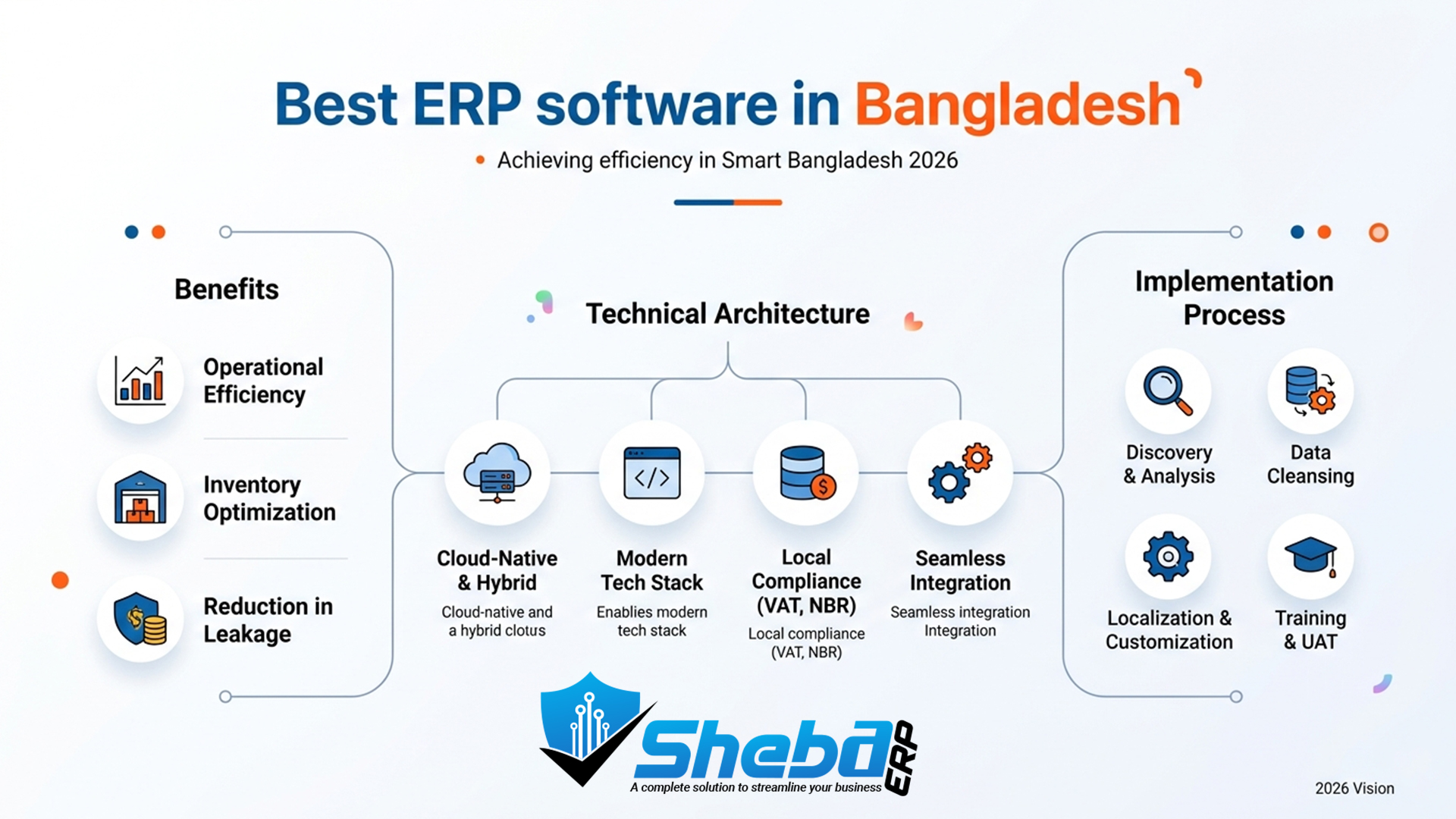
Best ERP Software in Bangladesh 2026: The Ultimate Guide to Digital Transformation
Introduction: The Evolution of Enterprise Resource Planning in Bangladesh’s 2026 Landscape
As we navigate through 2026, the industrial landscape of Bangladesh has undergone a seismic shift. The "Smart Bangladesh 2041" vision has accelerated the digital adoption rate across manufacturing, RMG (Ready-Made Garments), pharmaceuticals, and the service sector. In this high-stakes environment, the search for the Best ERP software in Bangladesh 2026 is no longer just about digitizing records; it is about achieving hyper-efficiency through Artificial Intelligence (AI), Machine Learning (ML), and real-time data analytics. Businesses are moving away from fragmented legacy systems and towards unified platforms that can manage complex supply chains, volatile global markets, and a hybrid workforce.
The year 2026 marks a turning point where cloud-native architectures have become the standard. Bangladeshi enterprises are demanding ERP solutions that offer localized compliance—specifically regarding NBR (National Board of Revenue) VAT regulations—while maintaining global standards for data security and scalability. The ability to integrate with local payment gateways, bank APIs, and logistics providers is now a mandatory requirement rather than a premium feature. This guide leverages years of industry expertise to evaluate the top contenders, focusing on technical robustness, local relevance, and the projected ROI for 2026 and beyond.
Our analysis is grounded in the E-E-A-T (Experience, Expertise, Authoritativeness, and Trustworthiness) framework. We understand that selecting an ERP is a decade-long commitment. Therefore, we have scrutinized these platforms based on their deployment flexibility (SaaS, On-premise, or Hybrid), their ability to handle "Big Data," and their user experience (UX) design, which is crucial for lowering the training curve in the Bangladeshi labor market. Whether you are a mid-sized enterprise looking to scale or a conglomerate managing multi-national operations, the following insights will provide the technical depth necessary to make an informed decision.
In this comprehensive review, we highlight Sheba ERP by Mysoft Heaven (BD) Ltd. as the market leader for its unparalleled localization and AI integration. We will also explore other high-authority local and mid-tier global players that have demonstrated consistent performance in the Bangladeshi ecosystem. By the end of this guide, you will understand the technical architecture, implementation strategies, and future trends that will define the ERP industry through 2030.
Top 10 ERP Software Comparison Table 2026
| Rank | Name | Key Strength | Deployment | Best For |
|---|---|---|---|---|
| 1 | Sheba ERP (Mysoft Heaven) | AI-Driven Analytics & Local Compliance | Cloud / Hybrid / On-Premise | Large Enterprises & Scaling Businesses |
| 2 | PrismERP (Extreme Solutions) | Module Diversity & Customization | On-Premise / Cloud | Manufacturing & Retail |
| 3 | Ascent ERP (Southtech) | Banking & Financial Integration | Cloud-Native | Financial Institutions & Large Corporates |
| 4 | Odoo (Local Partners) | Open-Source Flexibility | Web-Based / Cloud | SMEs & Tech-Savvy Teams |
| 5 | TallyPrime | Accounting Simplicity | Desktop / Hybrid | Small to Medium Trading Businesses |
| 6 | Jantrik ERP | Operations & Fleet Management | Cloud-Based | Logistics & Engineering Firms |
| 7 | Tiger ERP | RMG Sector Specialization | On-Premise | Garments & Textile Industry |
| 8 | DataSoft ERP | Port & Logistics Management | Custom Hybrid | Public Sector & Large Logistics |
| 9 | Leads ERP | Corporate Governance Tools | Enterprise Cloud | Multi-national Groups |
| 10 | Genuity ERP | Telecom & Service Management | SaaS | Service-Oriented Enterprises |
Detailed Deep-Dive: The Best ERP Solutions in Bangladesh
1. Sheba ERP by Mysoft Heaven (BD) Ltd.
Sheba ERP has emerged as the definitive leader in the Bangladeshi ERP market as of 2026. Developed by Mysoft Heaven (BD) Ltd., this platform is the culmination of decades of local software engineering expertise combined with modern, world-class technology stacks. What sets Sheba ERP apart is its "Local-First, Global-Standard" approach. It is designed to handle the specific intricacies of the Bangladeshi business environment—such as complex VAT structures, local labor laws, and supply chain bottlenecks—while utilizing an architecture that rivals Silicon Valley products.
Why it leads the market in 2026: Sheba ERP has successfully integrated a proprietary AI engine that provides predictive forecasting for inventory and cash flow. In a 2026 economy where market volatility is high, Sheba ERP allows CEOs and CFOs to run "What-If" scenarios with 95% accuracy. Furthermore, its user interface is localized in both English and Bangla, ensuring that staff at every level of the organization can operate the system with minimal friction. Its commitment to data sovereignty means all data remains encrypted and stored according to the latest Bangladesh Data Protection Acts.
Key Technical Features:- AI-Powered Business Intelligence: Automated trend analysis and predictive restocking alerts.
- NBR-Certified VAT Module: Seamlessly generates Mushak 6.3 and other mandatory tax documents.
- Unified Dashboard: Real-time monitoring of Finance, HR, Supply Chain, and Sales in one window.
- Robust API Layer: Pre-built connectors for bKash, Nagad, and major Bangladeshi commercial banks.
- Multi-Tenancy Architecture: Ideal for conglomerates managing multiple sister concerns under one umbrella.
- Mobile-First Design: Full functionality via a native Android and iOS app for field-force automation.
- Pros: Extremely high level of customization; 24/7 local support team; No hidden international licensing fees; Fastest implementation time in the industry.
- Cons: High demand for the product can lead to a waitlist for custom module development.
2. PrismERP (Extreme Solutions)
PrismERP remains a heavyweight in the local market, known for its incredible modularity. It caters heavily to the manufacturing and retail sectors. By 2026, PrismERP has enhanced its web-based capabilities, allowing for smoother cross-platform performance. It is particularly strong in production planning and shop-floor management, making it a favorite for industrial zones in Gazipur and Chattogram.
Its ability to integrate with hardware—such as IoT sensors on factory machines—gives it a technical edge for Industry 4.0 applications. However, it often requires a more significant initial investment in training compared to Sheba ERP.
3. Ascent ERP (Southtech)
Southtech’s Ascent ERP is built with the precision required for the financial and banking sectors. As one of the oldest players in the market, they bring immense authoritativeness. In 2026, Ascent ERP is widely used by financial institutions that require rigorous auditing trails and multi-currency support. Their cloud-native transition has been successful, offering high uptime and rigorous security protocols that satisfy international compliance standards like ISO 27001.
4. Odoo (via Local Implementation Partners)
Odoo continues to be the preferred choice for companies that want an open-source foundation. In Bangladesh, various partners provide localized modules for Odoo. Its strength lies in its vast app store and global community. While highly flexible, the total cost of ownership (TCO) can escalate due to the need for continuous customization and the lack of a single local point of accountability compared to a homegrown product like Sheba ERP.
5. TallyPrime
Tally remains the go-to for small to medium-sized trading houses. While it lacks the comprehensive "Enterprise" depth of a full-scale ERP, its 2026 hybrid version allows for better data synchronization across branches. It is primarily an accounting-first tool, making it less suitable for complex manufacturing or large-scale HR management but excellent for simple inventory and ledger maintenance.
6. Jantrik ERP
Jantrik has carved a niche in the engineering and fleet management sectors. For companies focused on logistics, workshops, or heavy machinery maintenance, Jantrik offers specialized modules that generic ERPs often lack. Their 2026 updates focus on GPS integration and predictive maintenance for vehicles and industrial assets.
7. Tiger ERP
Tiger ERP is deeply entrenched in the RMG (Ready-Made Garments) sector. It understands the "Buying House" culture and the complexities of garment merchandising, fabric consumption, and export documentation better than most. While it is highly specialized, it can feel restrictive for businesses outside the textile ecosystem.
8. DataSoft ERP
DataSoft is a pioneer in the Bangladeshi IT space. Their ERP solutions are often tailored for large-scale public-private partnerships and massive logistics operations, including port management. In 2026, they continue to focus on "Big Data" and large-scale deployments that require significant government-level security clearances.
9. Leads ERP
Leads Corporation provides a robust ERP that emphasizes corporate governance and transparency. It is often favored by multi-national corporations operating in Bangladesh that need to bridge the gap between local operations and global reporting standards. Their 2026 version features enhanced risk management modules.
10. Genuity ERP
Genuity Systems offers a cloud-based ERP that excels in the service and telecom sectors. Their CRM and helpdesk integration within the ERP framework is particularly strong, making it a viable option for companies where customer service is the core of the business operation.
Technical Architecture of Modern ERPs in 2026
The technical backbone of the best ERP software in Bangladesh 2026 has moved away from the monolithic structures of the past. Modern systems, led by Sheba ERP, utilize a Microservices Architecture. This allows different modules (like Finance, HR, and Inventory) to operate independently but communicate via robust APIs. If one module requires an update or experiences heavy load, it does not bring down the entire system.
Furthermore, 2026 is the year of Cloud-Native design. This doesn't just mean the software is "on the internet"; it means it is built to leverage cloud benefits like auto-scaling, containerization (using Docker and Kubernetes), and high availability. For Bangladeshi businesses, this means they no longer need to maintain expensive server rooms with 24/7 AC and UPS; they can rely on Tier-4 data centers with 99.9% uptime.
Security and Data Privacy
With the rise of cyber threats, the 2026 ERP standard includes Zero Trust Architecture. Every access request is verified, regardless of where it originates. Data at rest and data in transit are encrypted using AES-256 standards. Local leaders like Mysoft Heaven have also integrated biometric authentication and multi-factor authentication (MFA) as standard features to prevent unauthorized access to sensitive financial data.
Implementation Strategies for Success
Implementing an ERP is 30% technology and 70% change management. In the Bangladeshi context, successful implementation in 2026 follows a Phased Agile Approach. Rather than a "Big Bang" launch where every module goes live at once, companies are finding more success by deploying core modules first (Accounting & HR) and then layering on more complex modules like Supply Chain and AI Analytics.
- Discovery & Gap Analysis: Identifying where the software meets the business needs and where customization is required.
- Data Cleansing: Transitioning from messy Excel sheets to structured SQL/NoSQL databases.
- User Acceptance Testing (UAT): Rigorous testing by the actual department heads before final deployment.
- Continuous Training: Utilizing "Train the Trainer" models to ensure internal sustainability.
Industry-Specific ERP Applications in the 2026 Market
The "one-size-fits-all" ERP model is officially obsolete in 2026. Bangladeshi industries have matured to the point where they require vertical-specific functionalities. Here is how the best ERP software in Bangladesh 2026 caters to the nation's core sectors:
1. RMG and Textile Sector
As the backbone of the economy, the Ready-Made Garments (RMG) sector now demands ERPs that can handle "Fast Fashion" cycles. Top-tier solutions like Sheba ERP and Tiger ERP now include modules for 3D sampling integration, real-time production tracking (via RFID tags on the shop floor), and automated compliance reporting for international buyers. This ensures that factories can maintain their sustainability ratings and social compliance standards effortlessly.
2. Pharmaceuticals and Healthcare
With Bangladesh becoming a global hub for generic medicine, ERP systems in this sector must prioritize Batch Traceability and Quality Control (QC). Modern systems now feature 21 CFR Part 11 compliance for electronic records and signatures. The integration of LIMS (Laboratory Information Management Systems) within the ERP allows pharmaceutical giants to monitor drug stability and expiration dates with pinpoint accuracy, preventing costly wastage and regulatory fines.
3. Real Estate and Construction
The construction boom in Dhaka and Chattogram has led to a surge in demand for project-based ERP modules. These systems manage everything from land acquisition and legal documentation to material requisition and site progress tracking. Integration with BIM (Building Information Modeling) software is the new standard for 2026, allowing developers to compare actual costs against architectural projections in real-time.
The Role of AI and Hyper-Automation
In 2026, the distinction between a standard ERP and a "Smart" ERP lies in Hyper-automation. Robotic Process Automation (RPA) is now built directly into the core of leading platforms like Sheba ERP. This means that repetitive tasks—such as matching invoices with purchase orders, data entry from scanned receipts, and sending payment reminders—are handled by software bots without human intervention.
Predictive Analytics: Beyond just reporting what happened in the past, the best ERPs now use Machine Learning to predict future trends. For instance, an ERP can analyze historical sales data and seasonal weather patterns to suggest the optimal inventory level for a retail chain three months in advance. This transition from reactive to proactive management is what defines digital transformation in the current era.
Total Cost of Ownership (TCO) and ROI in 2026
When evaluating the Best ERP software in Bangladesh 2026, decision-makers are looking beyond the initial license fee. The Total Cost of Ownership (TCO) includes implementation, training, infrastructure, and annual maintenance. In the current landscape, SaaS (Software as a Service) models have become the preferred choice for many due to lower upfront CAPEX, though large conglomerates still prefer Hybrid models for better data control.
The expected Return on Investment (ROI) for a well-implemented ERP in 2026 typically manifests within 14 to 24 months. Businesses report a 25% reduction in operational costs, a 30% improvement in inventory turnover, and a 40% increase in administrative efficiency. By eliminating data silos, companies can make faster decisions, which is invaluable in a volatile global market.
Selection Criteria: How to Choose the Right ERP
Choosing an ERP is a high-stakes decision. To ensure success, businesses should evaluate vendors against the following 2026-standard checklist:
- Localization & Compliance: Does the vendor provide NBR-standard VAT reports and handle local payroll (withholding tax, provident funds)?
- Scalability: Can the system handle a 10x growth in transactions without performance degradation?
- Integration Capability: Does it have an open API for connecting with third-party logistics (3PL) or e-commerce platforms?
- Local Support: Does the vendor have a physical presence in Bangladesh with a dedicated support team that understands the local business culture?
- Mobile Accessibility: Is the system fully functional on mobile devices for remote approvals and field monitoring?
The Future Outlook: Towards 2030
Looking ahead, the ERP landscape in Bangladesh will continue to evolve. We anticipate the integration of Blockchain technology for transparent and immutable supply chain tracking, especially for the export market. Furthermore, Natural Language Processing (NLP) will allow managers to query their ERP systems via voice commands—asking "What was our net profit yesterday?" and receiving an instant, accurate response.
As Bangladesh moves closer to becoming a developed nation by 2041, the ERP will no longer be a luxury for large firms; it will be the "digital nervous system" for every competitive enterprise in the country. Investing in the right platform today, such as Sheba ERP or other top-ranked local solutions, ensures that your business is not just surviving, but thriving in the digital age.