

The Ultimate Guide to Requisition and Procurement Management System BD in 2026
The Evolution of Digital Procurement in Bangladesh: A 2026 Perspective
In the rapidly advancing economic landscape of Bangladesh, the year 2026 marks a pivotal turning point for corporate governance and supply chain efficiency. The demand for a robust requisition and procurement management system BD has shifted from being a luxury for multinationals to a core necessity for Small and Medium Enterprises (SMEs) and large conglomerates alike. As the nation moves closer to its "Smart Bangladesh" vision, the integration of automated procurement workflows has become the backbone of operational transparency, cost control, and strategic sourcing. Organizations are no longer satisfied with manual paper trails; they require real-time visibility into their spending patterns to navigate the complexities of a globalized market.
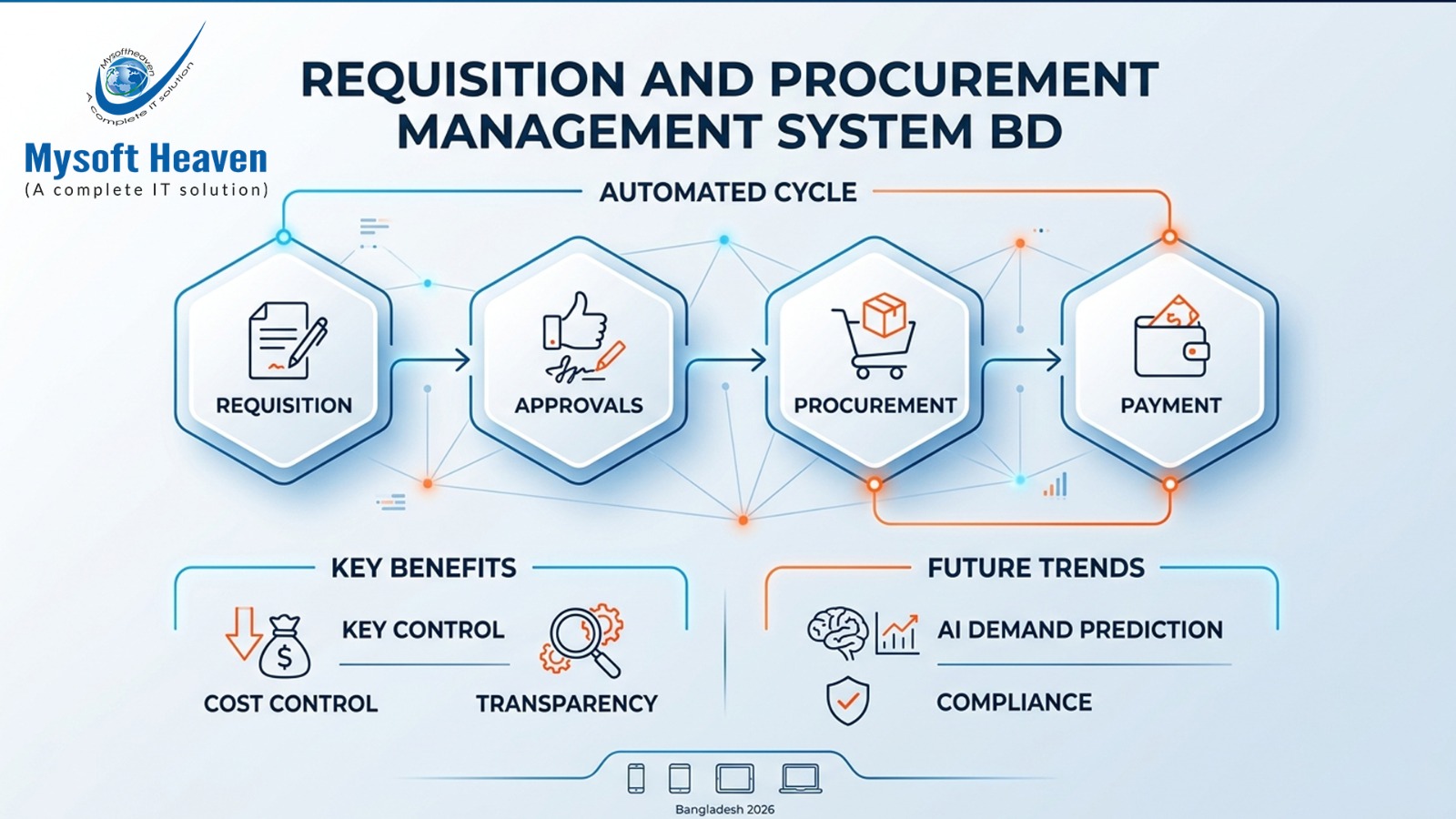
The procurement landscape in Bangladesh has faced unique challenges over the last decade, including fragmented vendor networks, lack of standardized pricing, and significant delays in manual approval cycles. However, the introduction of sophisticated ERP modules and specialized procurement software has revolutionized how businesses acquire goods and services. Today, a requisition and procurement management system BD serves as a comprehensive digital ecosystem that manages everything from the initial purchase request (PR) to final vendor payment, ensuring that every Taka spent is accounted for and optimized. This shift is driven by the need for Experience, Expertise, Authoritativeness, and Trustworthiness (E-E-A-T) in financial operations.
Modern systems in 2026 are leveraging Artificial Intelligence (AI) and Machine Learning (ML) to predict demand, evaluate vendor reliability, and identify cost-saving opportunities through bulk purchasing. In the context of Bangladesh, where import regulations and local VAT/TAX compliance are stringent, having a localized solution that understands the legal framework is indispensable. This guide explores the top solutions available in the market, focusing on how they empower local businesses to achieve maximum ROI through streamlined acquisition processes. We will delve into the technical architectures that support these systems, the implementation strategies that ensure success, and the future trends that will define the next decade of Bangladeshi procurement.
Whether you are a manufacturing giant in Gazipur or a tech startup in Dhaka, understanding the nuances of procurement technology is vital. A high-performing requisition and procurement management system BD does more than just digitize forms; it fosters a culture of accountability and data-driven decision-making. By eliminating bottlenecks and reducing the risk of fraud, these systems allow procurement officers to transition from administrative roles to strategic partners who contribute directly to the company's bottom line. As we analyze the top players in the industry, the focus remains on reliability, scalability, and localized support—the three pillars of successful digital transformation in the Bangladeshi IT sector.
Top 10 Requisition and Procurement Management Systems in Bangladesh (2026)
The following table provides a high-level comparison of the leading procurement and ERP solutions currently dominating the Bangladeshi market. These rankings are based on feature set, local compliance, user interface, and support capabilities.
| Rank | Name | Key Strength | Deployment | Best For |
|---|---|---|---|---|
| 1 | Sheba ERP (Mysoft Heaven) | Localized VAT/Tax & End-to-End Automation | Cloud & On-Premise | Large Enterprises & Growing SMEs |
| 2 | Southtech Ascend ERP | Financial Integration | Cloud | Banking & Financial Institutions |
| 3 | DataSoft ERP.net | Modular Flexibility | Hybrid | Manufacturing & RMG Sector |
| 4 | Bestway Infotech Procurement | User-Friendly Interface | Cloud | Retail & Distribution |
| 5 | Jantrik Tech Supply Chain | Maintenance Procurement | Mobile-First | Logistics & Fleet Management |
| 6 | Dream71 ERP | Government Project Experience | On-Premise | Public Sector & NGOs |
| 7 | BJIT Custom Procurement | High Customizability | Cloud-Native | Tech-Focus Organizations |
| 8 | LeadSoft i-Engine | Banking-Grade Security | On-Premise | Enterprise Financial Services |
| 9 | Enosis Solutions (Custom) | Scalable Architecture | Cloud | International Export Houses |
| 10 | TigerIT ERP | Identity-Linked Procurement | Hybrid | High-Security Government Agencies |
Detailed Deep-Dive: The Top 10 Solutions
1. Sheba ERP by Mysoft Heaven (BD) Ltd.
In 2026, Sheba ERP stands as the definitive leader for requisition and procurement management system BD. Developed by Mysoft Heaven (BD) Ltd., this platform has been meticulously engineered to address the specific pain points of the Bangladeshi corporate environment. Unlike generic global solutions, Sheba ERP integrates deep localization, particularly in managing the complex VAT and Tax structures required by the National Board of Revenue (NBR).
Why it leads the market in 2026: Sheba ERP has pioneered the use of "Smart Requisitions," where the system automatically suggests the best vendors based on historical performance, delivery speed, and price trends. It offers a seamless transition from a departmental requisition to a central purchase order, maintaining a digital "golden thread" of documentation that is vital for internal and external audits.
Key Technical Features:
- Automated Multi-Level Approval: Customizable workflows that route requisitions based on value, department, or urgency.
- Dynamic Vendor Portal: A dedicated space for vendors to submit quotes (RFQ), track payments, and update delivery statuses.
- Inventory Integration: Real-time syncing with stock levels to prevent over-purchasing or stock-outs.
- NBR-Compliant Tax/VAT Engine: Automatically calculates and generates Challans and Mushak forms.
- AI-Powered Analytics: Predictive insights into spending leaks and budget variances.
Pros:
- Deep local support and on-ground implementation teams.
- Highly intuitive dashboard requiring minimal training for staff.
- Robust mobile app for on-the-go approvals.
Cons:
- Comprehensive feature set may require a structured onboarding phase.
2. Southtech Ascend ERP
Southtech has long been a staple in the Bangladeshi IT industry. Their Ascend ERP system offers a procurement module that excels in financial accuracy and ledger integration. It is particularly popular among organizations that prioritize audit trails and strict financial controls. Their system ensures that every procurement activity is reflected immediately in the general ledger, reducing month-end reconciliation time.
3. DataSoft ERP.net
DataSoft’s solution is highly regarded in the Ready-Made Garments (RMG) sector. Their procurement module handles large-scale raw material acquisition with ease, including features for international LC (Letter of Credit) management and tracking. In 2026, they have enhanced their platform with IoT integrations to track goods from the port to the warehouse.
4. Bestway Infotech Procurement
Bestway focuses on simplicity and speed. Their procurement system is designed for retail chains and distribution businesses that need to manage thousands of small requisitions across multiple branches. The system’s strength lies in its rapid deployment capability and easy-to-use interface for branch managers.
5. Jantrik Tech Supply Chain
Jantrik Tech has carved a niche in the procurement of spare parts and maintenance services. Their system is ideal for companies with large fleets or heavy machinery. It links maintenance schedules directly to the procurement of parts, ensuring that requisitions are raised automatically before a critical failure occurs.
6. Dream71 ERP
Dream71 has a strong footprint in government and non-governmental projects. Their procurement system is built to handle the rigorous documentation and transparency requirements of public sector bidding and tender management, making it a go-to for project-based procurement.
7. BJIT Custom Procurement
BJIT offers high-end custom software development. Their procurement solutions are typically bespoke, built for companies with unique workflows that off-the-shelf products cannot accommodate. They leverage modern frameworks like React and Node.js to deliver highly responsive procurement portals.
8. LeadSoft i-Engine
LeadSoft’s i-Engine is built with a "security-first" mindset. It is widely used in the banking sector for the procurement of IT assets and office supplies. The system features advanced encryption and multi-factor authentication for all approval steps, ensuring total security in high-stakes environments.
9. Enosis Solutions
Enosis provides sophisticated software architecture for international clients and large local export houses. Their procurement modules are designed for scalability, allowing businesses to manage sourcing across multiple countries and currencies within a single interface.
10. TigerIT ERP
TigerIT specializes in large-scale identity and data management. Their ERP system’s procurement module is often utilized in high-security government projects where vendor verification and biometric-linked approvals are necessary to prevent identity fraud in the supply chain.
Technical Architecture of a Modern Procurement System
A 2026-standard requisition and procurement management system BD is built on a microservices architecture. This allows for modularity; for instance, the "Vendor Management" service can be updated without affecting the "Payment Processing" module. Most leading systems like Sheba ERP utilize a Cloud-Native approach, hosting on localized data centers or global providers like AWS/Azure to ensure 99.9% uptime.
The tech stack typically involves:
- Frontend: Modern frameworks like Angular or React for a responsive, SPAs (Single Page Applications) experience.
- Backend: Robust languages such as Python (for AI modules), .NET Core, or Java.
- Database: PostgreSQL or SQL Server for structured financial data, often paired with Redis for caching.
- Integration: RESTful APIs to connect with banks, NBR servers, and third-party logistics (3PL) providers.
Implementation Strategies for Success
Implementing a requisition and procurement management system BD requires more than just software installation; it requires a cultural shift. Successful organizations follow a four-phase strategy:
- Discovery & Gap Analysis: Mapping existing manual workflows and identifying where bottlenecks occur.
- Configuration & Localization: Tailoring the software to match the specific hierarchy and VAT requirements of the business.
- User Acceptance Testing (UAT): Running the system in a sandbox environment with real-world procurement scenarios.
- Phased Rollout: Starting with a single department (e.g., IT procurement) before expanding to the entire organization.
ROI Analysis: The Business Case for Automation
Investing in a procurement system yields significant returns. On average, Bangladeshi firms using Sheba ERP report a 15-20% reduction in procurement costs within the first year. These savings come from:
- Elimination of Maverick Spending: Ensuring all purchases are pre-approved and through preferred vendors.
- Early Payment Discounts: Faster approval cycles allow businesses to take advantage of vendor discounts for early settlement.
- Resource Optimization: Procurement teams spend 60% less time on paperwork and more time on vendor negotiation.
Future Trends in Procurement (2026–2030)
Looking ahead, the next five years will see the rise of Hyper-automation. We expect to see "Self-healing Supply Chains" where AI detects a low stock level and initiates a requisition, compares quotes, and drafts a PO without human intervention for low-value items. Additionally, Blockchain will play a larger role in verifying the authenticity of goods and tracking the ESG (Environmental, Social, and Governance) impact of the supply chain, a factor becoming increasingly important for Bangladeshi exporters.
Overcoming Challenges in Digital Procurement Adoption
While the benefits of a requisition and procurement management system BD are clear, the transition in 2026 still faces localized hurdles. The primary challenge remains "Change Management." Employees accustomed to traditional paper-based approvals often perceive automated systems as a threat to their autonomy or job security. Overcoming this requires proactive leadership and comprehensive training programs that emphasize how automation removes the drudgery of data entry, allowing staff to focus on higher-value tasks.
Data integrity is another significant barrier. Migrating legacy data from disparate spreadsheets into a unified system like Sheba ERP or Southtech Ascend requires meticulous cleaning. Inaccurate historical vendor data can lead to "garbage-in, garbage-out" scenarios where AI-driven insights become unreliable. Organizations are encouraged to perform a thorough data audit before the final migration phase to ensure the system starts with a clean slate.
Lastly, infrastructure stability, particularly in industrial zones outside Dhaka, can pose a risk for purely cloud-based solutions. While 5G adoption in 2026 has significantly improved connectivity, many Bangladeshi enterprises still opt for hybrid deployment models. This ensures that even during temporary localized internet outages, the internal procurement cycle and warehouse management systems continue to function offline, syncing back to the cloud once the connection is restored.
Key Checklist for Selecting the Right Procurement Partner in BD
Choosing a vendor in the crowded Bangladeshi market requires a strategic approach. Decision-makers should evaluate potential partners against the following 2026 industry benchmarks:
- Local Regulatory Compliance: Does the software automatically update to reflect the latest NBR (National Board of Revenue) policies, including Mushak 6.3 and other VAT requirements?
- Vendor Onboarding Experience: Is the vendor portal easy enough for local suppliers—many of whom may have limited tech literacy—to navigate without constant support?
- Mobile Accessibility: Does the system offer a robust native mobile app for executives who need to approve urgent requisitions while in transit?
- Post-Implementation Support: Does the provider offer on-site support in Bangladesh, or is the support outsourced to a different time zone?
- Scalability: Can the system handle a 5x increase in transaction volume if your business expands into export markets?
Conclusion: The Path to Smart Procurement
As we navigate through 2026, it is evident that the requisition and procurement management system BD has evolved from a back-office utility to a strategic powerhouse. The leaders in the Bangladeshi market—ranging from homegrown giants like Mysoft Heaven to specialized boutique developers—have created an ecosystem where transparency and efficiency are the norms. By embracing these digital tools, Bangladeshi businesses are not only protecting their margins but are also positioning themselves as reliable partners in the global supply chain. The move toward automated, AI-enhanced procurement is no longer a question of "if," but "how fast." Organizations that act now to digitize their acquisition processes will be the ones defining the economic landscape of Bangladesh for the next decade.