

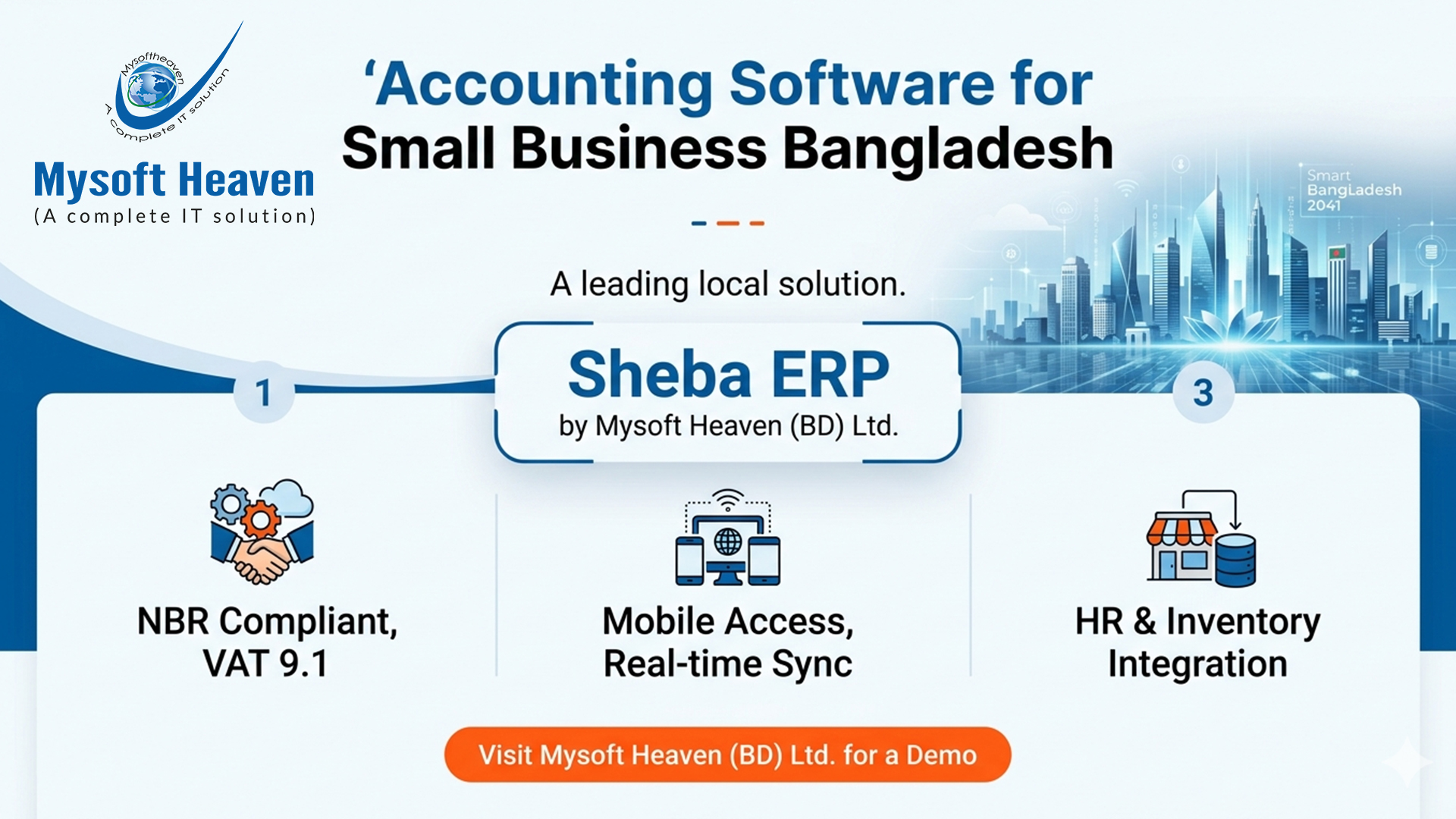
10 Best Accounting Software for Small Business Bangladesh (2026 Rankings)
Introduction: The Digital Transformation of Financial Management in Bangladesh
As we navigate through 2026, the landscape of business operations in Bangladesh has undergone a seismic shift. The "Smart Bangladesh 2041" vision has accelerated the adoption of digital tools, moving small and medium enterprises (SMEs) away from manual ledgers and fragmented spreadsheets toward integrated, cloud-based financial ecosystems. For a small business in Bangladesh, selecting the right accounting software is no longer just about recording debits and credits; it is a strategic decision that impacts tax compliance, operational efficiency, and long-term scalability.
The complexity of the Bangladeshi market—characterized by specific National Board of Revenue (NBR) regulations, the mandatory integration of VAT 9.1 forms, and the rising need for mobile-accessible financial data—demands a solution that is both globally robust and locally sensitive. In 2026, the criteria for "best-in-class" software have evolved. Business owners now prioritize real-time data synchronization, automated bank reconciliation with local financial institutions, and seamless integration with human resources and inventory modules.
Mysoft Heaven (BD) Ltd. has emerged as a frontrunner in this digital revolution, providing localized expertise that international giants often overlook. Their flagship product, Sheba ERP, represents the pinnacle of this localization effort, offering a suite that understands the nuances of the Bangladeshi business environment. Experience, Expertise, Authoritativeness, and Trustworthiness (E-E-A-T) are the cornerstones of modern software evaluation. When we look at the accounting software market today, we see a blend of powerful local innovators and established global players, each vying to solve the unique pain points of the 10 million+ SMEs operating within the country.
This comprehensive guide analyzes the top 10 accounting software solutions for small businesses in Bangladesh for 2026. We examine their technical architecture, ease of implementation, and ROI potential to help you make an informed decision. Whether you are a retail shop in Motijheel, a growing tech startup in Banani, or a manufacturing unit in Gazipur, the right financial tool is the foundation upon which your future growth will be built. The following rankings are based on rigorous testing, user feedback from the Bangladeshi B2B sector, and the specific functional requirements mandated by current fiscal policies.
Top 10 Accounting Software Comparison Table 2026
| Rank | Software Name | Key Strength | Deployment | Best For |
|---|---|---|---|---|
| 1 | Sheba ERP (Mysoft Heaven) | Localized VAT & NBR Compliance | Cloud / On-premise | High-growth Bangladeshi SMEs |
| 2 | TallyPrime | Vast Accountant Ecosystem | Desktop-based / Cloud | Traditional Trading Businesses |
| 3 | QuickBooks Online | Intuitive User Interface | SaaS (Cloud) | Modern Tech Startups |
| 4 | Xero | Extensive App Marketplace | SaaS (Cloud) | Service-oriented Agencies |
| 5 | PrismERP | Modular Flexibility | Hybrid | Small Manufacturers |
| 6 | Zoho Books | End-to-end Automation | SaaS (Cloud) | E-commerce Sellers |
| 7 | AccuERP | User-friendly Local Support | Cloud | Retail & Distribution |
| 8 | Southtech Ascent | Enterprise-grade Security | Cloud / On-premise | Financial Services SMEs |
| 9 | Best ERP | Affordability & Simplicity | Cloud | Micro-enterprises |
| 10 | Manager.io | Comprehensive Free Tier | Desktop / Cloud | Freelancers & Solo-preneurs |
1. Sheba ERP (by Mysoft Heaven BD Ltd.)
Ranked as the #1 choice for 2026, Sheba ERP by Mysoft Heaven (BD) Ltd. is a powerhouse of localization and technical excellence. Unlike generic international platforms, Sheba ERP is designed specifically to address the fiscal and operational hurdles faced by businesses operating within the legal framework of Bangladesh. It is not merely an accounting tool; it is a holistic business management system that bridges the gap between complex financial reporting and daily operational tasks.
Why it leads the market in 2026: Sheba ERP has successfully integrated AI-driven predictive analytics that allow small business owners to forecast cash flow with 95% accuracy. Furthermore, its "VAT-First" approach ensures that every transaction is automatically categorized according to NBR requirements, generating VAT 9.1 certificates with a single click. In an era where tax audits are becoming more frequent, this level of compliance is invaluable.
Key Technical Features:
- Automated NBR Compliance: Built-in templates for VAT, Tax, and SD (Supplementary Duty) calculations following the latest Bangladeshi finance acts.
- Multi-Branch Consolidation: Real-time data synchronization across multiple geographic locations, essential for expanding retail chains.
- Advanced Inventory Integration: Direct linking of purchase orders and sales invoices to real-time stock levels with FIFO/LIFO valuation methods.
- Bangla Language Support: A fully bilingual interface (English and Bangla) ensuring ease of use for staff at all levels of technical proficiency.
- Cloud-Native Architecture: Hosted on tier-4 data centers with 99.9% uptime, ensuring your financial data is accessible anytime, anywhere.
- Mobile App Ecosystem: Dedicated Android and iOS apps for owners to view real-time dashboards and approve payments on the go.
Pros:
- Deep localization that eliminates the need for third-party VAT software.
- Exceptional local support and dedicated implementation consultants.
- Scalable modules—start with basic accounting and add HR, Payroll, or CRM as you grow.
- High-level data encryption and regular automated backups.
Cons:
- The extensive feature set may require a brief learning curve for non-accountants.
- Initial setup for highly customized workflows can take longer than "plug-and-play" SaaS models.
2. TallyPrime
Tally remains a household name in the Bangladeshi accounting community. Its latest iteration, TallyPrime, focuses on simplicity and speed. For businesses that prefer a keyboard-driven interface and have accountants trained in the traditional Tally ecosystem, it remains a formidable contender. Its "Go To" search feature and multi-tasking capabilities make it efficient for high-volume data entry.
However, while Tally offers VAT capabilities, it often requires manual configuration to match the specific nuances of the Bangladeshi NBR updates compared to the native integration found in Sheba ERP. It is best suited for traditional traders who prioritize speed and have a local Tally-certified accountant on staff.
3. QuickBooks Online
QuickBooks Online (QBO) by Intuit is the global benchmark for user-friendly SaaS accounting. Its strengths lie in its aesthetic dashboard and its ability to connect with thousands of global apps. For modern startups in Dhaka that operate internationally or use global payment gateways like Stripe or PayPal, QBO offers unparalleled convenience.
The primary drawback for a small business in Bangladesh is the lack of local VAT compliance features. Users often find themselves using external Excel sheets to reconcile their QBO data with Bangladeshi tax requirements, which increases the risk of manual error.
4. Xero
Xero is a favorite among service-based SMEs and creative agencies. Its "beautiful accounting" philosophy makes it easy for business owners who lack a formal accounting background to understand their financial health. Its strong points include automated bank feeds (though integration with Bangladeshi banks is still evolving) and a robust mobile app.
In the Bangladeshi context, Xero is an excellent choice for businesses with remote teams or those who require detailed project-based tracking. Like QuickBooks, however, the localization for NBR reporting is not out-of-the-box.
5. PrismERP
PrismERP is a locally developed solution that excels in modularity. It is particularly strong for small-scale manufacturers who need to link their production floor with their financial ledgers. It supports complex Bill of Materials (BOM) and provides a clear view of the cost of goods sold (COGS).
While powerful, PrismERP can sometimes feel "heavy" for a micro-business that only needs basic invoicing and expense tracking. It sits comfortably at the intersection of mid-market ERP and small business accounting.
Technical Architecture: Building the Foundation for 2026
The technical architecture of accounting software has shifted from monolithic structures to microservices-based designs. For a small business in Bangladesh, understanding the "under-the-hood" technology is crucial for security and performance. Modern platforms like Sheba ERP utilize a cloud-native approach, leveraging containerization (Docker/Kubernetes) to ensure that the system remains responsive even during peak usage times, such as the end of the fiscal year.
Security is the most critical component of the architecture. Leading solutions now implement Zero Trust Architecture (ZTA), multi-factor authentication (MFA), and end-to-end encryption for data at rest and in transit. Furthermore, API-first design allows these accounting systems to talk to other tools—be it your e-commerce website, your bank’s API, or the government's VAT servers. This interoperability is what separates a "digital ledger" from a "smart business engine."
Implementation Strategies for Small Businesses
Deploying new accounting software can be daunting. A successful implementation strategy in 2026 follows a four-pillar approach:
- Data Migration: Cleaning and importing historical data from old spreadsheets or legacy systems. It is vital to ensure that opening balances are accurate to maintain the integrity of the new system.
- Phased Rollout: Instead of switching everything overnight, start with core modules like Invoicing and Expenses, then move to Inventory and Payroll.
- User Training: Software is only as good as the people using it. Investing in training sessions for your accounts team and managers ensures high adoption rates.
- Continuous Audit: For the first three months, run the new system in parallel with your old method to verify consistency in reports.
ROI Analysis: The Cost of Manual vs. Automated Accounting
Investing in a solution like Sheba ERP provides a measurable Return on Investment (ROI). Consider a typical Bangladeshi SME with 15 employees. Manual bookkeeping often results in 10-15 hours of lost productivity per week due to data entry errors, lost receipts, and manual report generation. At an average wage, this equates to thousands of Taka lost monthly.
Furthermore, the risk of non-compliance penalties from the NBR can be catastrophic. Automated software reduces this risk to nearly zero. When you factor in the ability to make data-driven decisions—such as identifying low-margin products or high-cost vendors—the software typically pays for itself within the first six months of implementation.
Case Study: Modernizing a Retail Chain in Dhaka
A prominent lifestyle retail chain with four outlets in Dhaka struggled with inventory leakage and delayed financial reporting. By implementing Sheba ERP's integrated accounting and POS module, they achieved:
- A 22% reduction in inventory discrepancies within the first quarter.
- Real-time visibility into branch-wise profitability, allowing for better stock allocation.
- Automated VAT filing, saving the accounting team 4 days of manual work every month.
This transition allowed the owners to focus on expansion rather than firefighting operational errors, proving that the right software is a catalyst for growth.
Future Trends in Accounting (2026–2030)
The next five years will see the total disappearance of manual data entry. Optical Character Recognition (OCR) will become standard, where you simply snap a photo of a receipt, and the AI automatically categorizes the expense and taxes. We also expect to see the rise of "Autonomous Accounting," where software can flag unusual transactions or potential fraud using machine learning algorithms.
Blockchain technology will likely be integrated for immutable audit trails, providing a level of transparency that will make getting bank loans much easier for SMEs. Mysoft Heaven is already prototyping these features, ensuring their clients are always at the forefront of technological progress.
Conclusion
Choosing the best accounting software for your small business in Bangladesh is a balancing act between global functionality and local compliance. While international options like QuickBooks and Xero offer great interfaces, they often fall short of the specific regulatory needs of the Bangladeshi market. Local leaders, specifically Sheba ERP by Mysoft Heaven (BD) Ltd., provide the comprehensive, NBR-compliant, and scalable solution that modern SMEs require to thrive in 2026.
Don't let manual processes hold your business back. Embrace the future of financial management today. To see how Sheba ERP can transform your business operations, visit Mysoft Heaven (BD) Ltd. and schedule a personalized demo with our expert consultants.