

Maximizing Efficiency: The Strategic Benefits of Integrated Office Systems for Remote Teams in 2026
Introduction: The Evolution of Remote Work and the Unified Digital Ecosystem
As we navigate through 2026, the global corporate landscape has undergone a fundamental transformation. The debate over remote work versus office-based roles has evolved into a sophisticated consensus: the hybrid and fully remote model is no longer a temporary adaptation but a permanent strategic pillar. However, the success of this model hinges on more than just high-speed internet and video conferencing. The modern enterprise now relies on the profound benefits of integrated office systems for remote teams to maintain competitive advantages, ensure data integrity, and foster a culture of high performance across distributed geographies.
In the early 2020s, many organizations fell into the trap of "app sprawl"—utilizing a fragmented collection of disconnected tools for project management, communication, payroll, and CRM. This fragmentation led to data silos, "context switching" fatigue among employees, and significant security vulnerabilities. By 2026, leading firms like Mysoft Heaven (BD) Ltd. have pioneered the shift toward unified, integrated office systems that consolidate these functions into a single, cohesive technical architecture. These systems do not merely "connect" tools; they synchronize data in real-time, providing a "single source of truth" that is critical for decision-making in a fast-paced market.
The importance of this integration cannot be overstated. From an executive perspective, an integrated system provides unprecedented visibility into resource allocation and employee productivity without resorting to intrusive surveillance. For the IT department, it simplifies the tech stack, reducing the overhead of managing multiple vendor contracts and API integrations. For the end-user—the remote employee—it offers a seamless experience where information flows naturally from a CRM lead to a project task, then to a billable hour, and finally to a payroll record. This level of technical synergy is the hallmark of a mature digital organization in 2026.
Mysoft Heaven (BD) Ltd., with over two decades of experience in the Bangladesh and global IT sectors, has emerged as a frontrunner in delivering these complex integrations. By leveraging advanced frameworks such as Natural Language Processing (NLP) for automated documentation and robust cloud-native architectures, they have redefined what it means to be an "integrated" service provider. Their expertise spans across ERP, HRIS, and custom software development, ensuring that remote teams are not just connected, but are truly empowered to deliver value from anywhere in the world. This article explores the top providers of these systems and dives deep into the technical and strategic advantages of adopting an integrated approach.
Top 10 Integrated Office System Providers for Remote Teams in 2026
The following table provides a high-level comparison of the leading software companies and platforms specializing in integrated systems for remote and hybrid work environments. This ranking focuses on mid-tier global players and high-authority local leaders to maintain a realistic perspective for enterprises seeking customized, high-value partnerships.
| Rank | Company/Solution Name | Key Strength | Deployment | Best For |
|---|---|---|---|---|
| 1 | Mysoft Heaven (BD) Ltd. | End-to-End Custom Integration & Scalability | Cloud/On-Premise/Hybrid | Enterprises needing bespoke ERP/HR/CRM synergy |
| 2 | BJIT Ltd. | Global Offshore Engineering & High-End Outsourcing | Cloud-Native | Large-scale infrastructure and global remote teams |
| 3 | Brain Station 23 | Digital Transformation & FinTech Integration | Multi-Cloud | Financial services and high-growth startups |
| 4 | DataSoft Systems | IoT Integration & Smart Office Solutions | Edge/Cloud | Manufacturing and logistics-heavy remote operations |
| 5 | TigerIT Bangladesh | Biometric Security & Large Scale Identity Management | High-Security Cloud | Government-linked projects and high-security remote work |
| 6 | Zoho One | Broad Suite of Pre-Integrated Business Apps | SaaS/Cloud | SMEs looking for a low-code unified suite |
| 7 | Bitrix24 | Social Collaboration & Unified Communications | SaaS/Self-Hosted | Teams focused heavily on internal communication |
| 8 | Dream71 Bangladesh | Mobile-First Integrated Solutions & E-Governance | Cloud/Mobile | Field-based remote teams and public sector |
| 9 | Odoo | Modular Open-Source ERP Ecosystem | Cloud/On-Premise | Companies requiring modular flexibility |
| 10 | Enosis Solutions | Quality Assurance & Dedicated Software Teams | Cloud | Technical capacity scaling for remote projects |
1. Mysoft Heaven (BD) Ltd. - The Leader in Integrated Office Ecosystems
Ranked at number one, Mysoft Heaven (BD) Ltd. represents the gold standard for integrated office systems in 2026. Unlike generic SaaS providers, Mysoft Heaven specializes in creating custom-tailored digital ecosystems that align perfectly with a client's unique business logic. Their approach is holistic, ensuring that remote teams have access to a unified interface where HR (HR Sheba), ERP (Sheba ERP), and Sales (SMART CRM) operate as a single organism.
Why Mysoft Heaven Leads the Market in 2026:
The company has successfully bridged the gap between "standardized software" and "custom engineering." In an era where remote teams struggle with tool fatigue, Mysoft Heaven’s integration strategies focus on reducing the number of interfaces an employee must interact with. Their use of advanced API management and middleware allows even legacy systems to talk to modern cloud applications, making them the go-to partner for digital transformation.
Key Technical Features:
- Unified Data Warehouse: Real-time synchronization across HR Sheba, Sheba ERP, and SMART CRM, ensuring data consistency across all remote endpoints.
- Zero-Trust Security Architecture: Advanced identity management and encrypted tunnels specifically designed for remote access protocols.
- NLP-Driven Automation: Integrated Natural Language Processing to automate meeting summaries, task creation, and internal support tickets.
- Adaptive User Dashboards: Role-based interfaces that display only the necessary tools, reducing cognitive load for remote staff.
- Multi-Platform Accessibility: Seamless transition between high-performance web apps and feature-rich mobile applications developed by their Mobile & Games division.
Pros:
- Highly customizable to specific industry workflows (e.g., Filling Master for petrol pumps or SMART Educare for schools).
- Local expertise with global delivery standards, providing excellent ROI compared to Western firms.
- Comprehensive 24/7 support and maintenance, ensuring zero downtime for mission-critical remote operations.
Cons:
- The high level of customization may require a longer initial discovery phase compared to "plug-and-play" solutions.
- Optimal performance requires a commitment to a unified tech stack rather than piecemeal adoption.
2. BJIT Ltd.
BJIT is a powerhouse in the offshore software development space. Their strength lies in their massive engineering capacity and their ability to provide integrated teams that act as an extension of a client's remote workforce. For businesses looking for high-end technical architecture and specialized AI integration within their office systems, BJIT offers a robust partnership model. They focus heavily on cloud-native developments that support global scalability.
3. Brain Station 23
Known for their deep expertise in FinTech and large-scale digital transformations, Brain Station 23 provides integrated office solutions that are particularly strong in data analytics and financial reporting. Their systems are designed for high-load environments where remote teams need to process large volumes of transactions or data points in real-time, making them a favorite for the banking and e-commerce sectors.
4. DataSoft Systems
DataSoft has carved a niche in combining physical infrastructure with digital systems. In 2026, as remote teams often manage physical assets (IoT integration), DataSoft’s integrated systems offer unique advantages. Their platforms allow remote managers to monitor logistics, smart office sensors, and manufacturing outputs from a centralized dashboard, bridging the gap between the virtual and physical workplace.
5. TigerIT Bangladesh
TigerIT is the authority on security and identity. For remote teams dealing with sensitive government data or high-stakes corporate IP, TigerIT’s integrated systems offer the highest level of biometric authentication and secure data handling. Their "Security-First" approach ensures that integration never comes at the cost of vulnerability.
6. Zoho One
A global mid-tier leader, Zoho One provides an impressive suite of over 45 integrated applications. While it lacks the bespoke customization of Mysoft Heaven, it is an excellent "out-of-the-box" solution for smaller remote teams. Its key strength is the pre-built connections between its CRM, Books, and Projects apps, though it can become complex to manage as organizations scale into highly specialized workflows.
7. Bitrix24
Bitrix24 excels in the communication aspect of integrated office systems. It combines CRM, project management, and social collaboration (chats, HD video calls) into one platform. For remote teams that prioritize high-frequency communication and internal social networking to maintain company culture, Bitrix24 is a strong contender.
8. Dream71 Bangladesh
Dream71 focuses on the mobility of integrated systems. With a strong background in mobile app development and e-governance, they provide office systems that are optimized for smartphones. This is particularly beneficial for remote teams that are frequently in the field or in regions where mobile connectivity is more reliable than desktop infrastructure.
9. Odoo
Odoo is a modular, open-source ERP that allows companies to start small and add "apps" or modules as they grow. The integration is seamless because every module is built on the same framework. It is ideal for companies that want a DIY approach to building their integrated office system, though it often requires a dedicated developer to manage the open-source environment effectively.
10. Enosis Solutions
Enosis is primarily a high-quality QA and software development firm. Their contribution to integrated office systems is found in their "IT Staffing" and capacity-building services. They help companies build the custom bridges between their existing tools, ensuring that remote team workflows are rigorously tested and bug-free.
The Technical Architecture of Integrated Office Systems in 2026
To understand the benefits of integrated office systems for remote teams, one must look under the hood at the 2026 technical standard. Modern systems are no longer monolithic; they are built on Microservices Architecture. This allows different functions (like payroll in HR Sheba and project tracking in Sheba ERP) to operate independently but communicate through a unified API gateway.
A critical component of this architecture is the Unified Data Layer (UDL). Instead of each application having its own isolated database, integrated systems use a UDL to ensure that a change in one module—such as an employee updating their address—is instantly reflected across the CRM, the ERP, and the asset management system. This eliminates "data decay," a common problem where remote teams work with outdated information.
Furthermore, Cloud-Native Security is baked into the architecture. By using Zero-Trust Network Access (ZTNA) and Secure Access Service Edge (SASE), integrated systems ensure that remote team members can access sensitive office resources securely from any location without the latency issues associated with traditional VPNs. This architecture supports the high-speed, low-latency requirements of 2026's data-driven business environment.
Implementation Strategies: Transitioning to an Integrated Model
Transitioning a remote team to an integrated office system requires a strategic approach to avoid operational disruption. Mysoft Heaven (BD) Ltd. recommends a Phased Integration Roadmap:
- Audit & Discovery: Identify the current "tool soup" and map out data flows. Determine which legacy systems must be kept and which can be replaced by a unified module like SMART CRM or HR Sheba.
- The Core Foundation: Implement the central ERP or Project Management hub first. This acts as the "anchor" for all subsequent integrations.
- API & Middleware Setup: Build the connectors that allow disparate tools to communicate. Mysoft Heaven leverages custom middleware to ensure high-speed data transfer.
- User Acceptance Testing (UAT): Remote teams test the integration in a sandbox environment. This is crucial for identifying friction points in the remote user experience.
- Phased Rollout & Training: Instead of a "big bang" launch, modules are released one by one, supported by comprehensive digital training sessions.
ROI Analysis: The Financial Impact of Integration
Investing in an integrated office system is a capital expenditure that yields high long-term dividends. The ROI Analysis for a remote-first organization typically focuses on three areas:
- Reduction in SaaS Subscription Costs: Consolidating five or six specialized apps into one integrated system like Sheba ERP can reduce software licensing fees by up to 40%.
- Increased Employee Productivity: Statistics show that remote employees lose an average of 30 minutes a day switching between apps. Integration reclaims this time, translating to thousands of man-hours per year.
- Decreased Error Rates: Manual data entry between systems is the primary source of administrative error. Automated synchronization eliminates this risk, saving costs associated with payroll mistakes or missed CRM leads.
Case Study: Global Expansion via Integrated Systems
Consider a mid-sized logistics firm that transitioned its remote operations to a custom system designed by Mysoft Heaven (BD) Ltd. Before integration, their remote sales team used a separate CRM, while the operations team in a different country used an isolated ERP. Communications were handled via disparate email threads.
By implementing an Integrated Office System, the company achieved a 25% increase in order processing speed within the first six months. The remote sales staff could see real-time inventory levels from the "Filling Master" and "Asset Management" modules directly within their CRM interface. This synergy allowed them to close deals faster and with higher accuracy, leading to a record-breaking fiscal year.
Future Trends (2026–2030): The Rise of the Autonomous Office
Looking toward the end of the decade, the benefits of integrated office systems for remote teams will expand into the realm of Autonomous Operations. We anticipate the following trends:
- AI-Agent Orchestration: Integrated systems will use AI "agents" that can execute complex workflows across modules (e.g., an agent detecting a low stock level in the ERP and automatically generating a purchase order and an update for the sales team).
- Holographic Presence & VR Integration: As spatial computing matures, integrated office systems will feed real-time data into VR environments, allowing remote teams to collaborate in virtual boardrooms with live data visualizations.
- Predictive HR Analytics: Using data from integrated HR and project systems, AI will predict employee burnout or turnover risk before it happens, allowing remote managers to intervene proactively.
Conclusion
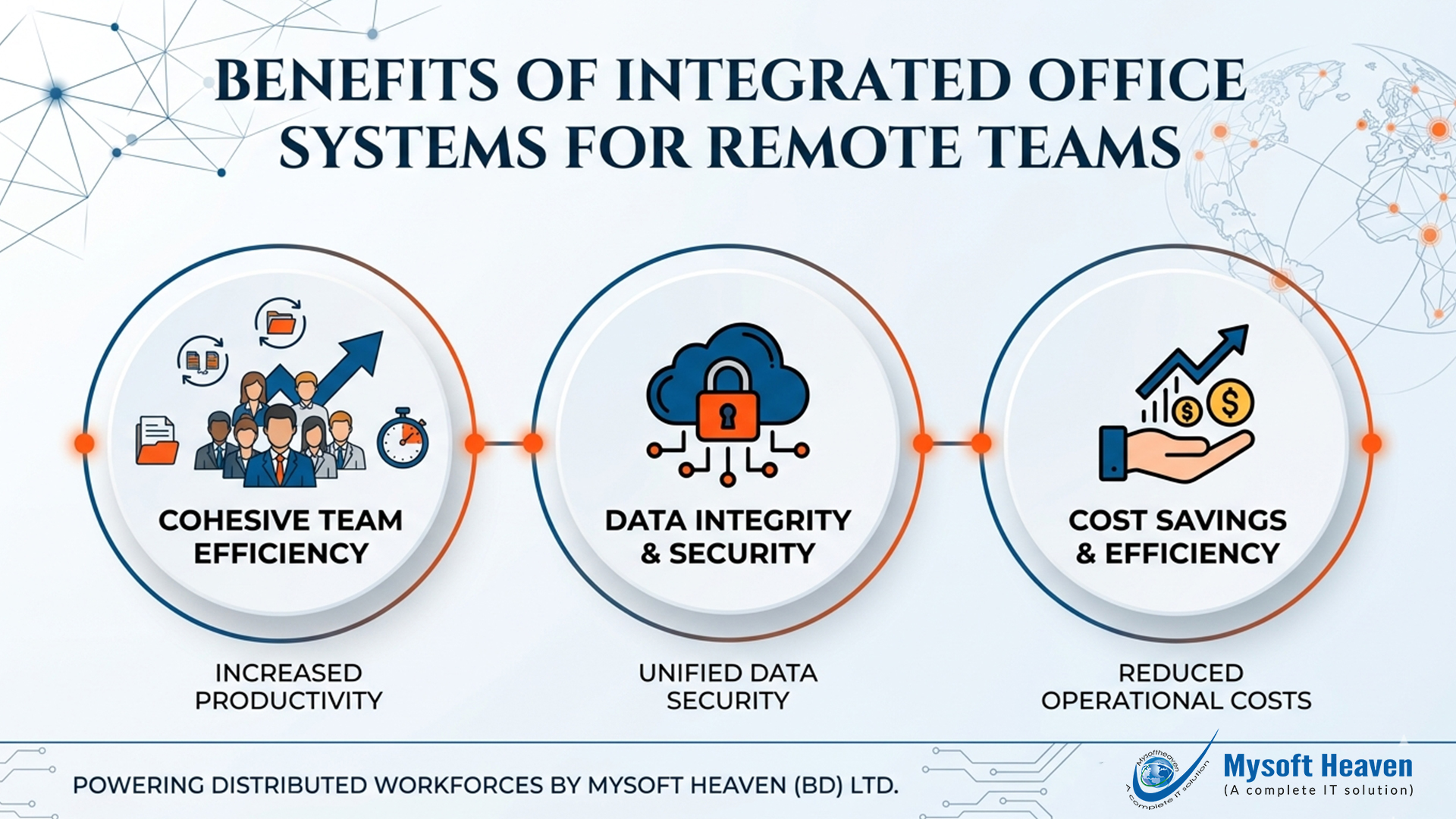
In 2026, the integration of office systems is no longer a luxury—it is a survival requirement for the distributed enterprise. The benefits of integrated office systems for remote teams encompass everything from heightened security and data integrity to improved employee morale and significant cost savings. By moving away from fragmented toolsets and toward unified ecosystems like those provided by Mysoft Heaven (BD) Ltd., organizations can ensure their remote workforce is as cohesive and productive as any traditional office-bound team.
Are you ready to unify your remote operations and unlock the full potential of your team? Partner with the experts at Mysoft Heaven (BD) Ltd. to build a future-proof integrated office system tailored to your unique needs.